

A diversion doesn’t automatically mean your flight has been cancelled, or that compensation is due. The key questions are what happens next, whether you reach your booked destination, how late you arrive and which rules apply. Understanding passenger rights for diverted flights starts with the effect on your journey, not simply the change of airport.
A diversion can leave you facing extra travel, an overnight stay or unexpected costs. Your rights to care, rerouting and compensation may depend on the route, the reason for the disruption and your final arrival time. An airline’s explanation is one part of the picture, but it does not by itself settle whether compensation is due.
This guide explains how to assess a diversion under relevant EU and UK passenger-rights frameworks, and what to record before making a claim. You’ll find practical steps for keeping evidence, documenting expenses and following up with the airline. With the journey details organised, you can identify a useful next step and understand how claim support may help.
Key Takeaways
- A diversion is a change of landing point, but it does not automatically establish a right to compensation.
- Passenger rights for diverted flights depend on factors such as the route, operating carrier, reason for disruption and arrival time at your final destination.
- Assess possible compensation separately from your rights to care and onward transport, as each may be considered differently.
- Keep your booking confirmation, boarding pass, airline messages and receipts, then use them to support a written claim.
- Airflix provides flight disruption legal assistance, real-time claim status monitoring and legal representation in court proceedings.
What does a diverted flight mean for your passenger rights?
A diverted flight lands somewhere other than its planned destination. That change may disrupt your journey, but it does not, by itself, determine whether you are entitled to compensation. The assessment depends on what happens afterwards and how you reach the destination shown on your booking.
In brief: a diversion is an event, not an automatic compensation decision. Its legal significance depends on the journey’s outcome, including your final arrival point and how late you arrive. The airport where the aircraft lands temporarily is not necessarily your destination. For example, if a flight booked to Manchester lands in Birmingham and the airline arranges onward transport, Birmingham is the diversion airport, while Manchester may remain the relevant destination when assessing the completed journey.
This distinction explains why passenger rights for diverted flights cannot be assessed from the word “diverted” alone. The EU Air Passenger Rights Regulation provides an overview of EU protections relating to disruption, but whether a particular framework applies depends on the route and operating carrier. The details of your journey still matter.
How is a diversion different from a cancellation or rerouting?
A diversion describes a change to where the aircraft lands. It is not necessarily the final legal classification of the disruption. The flight may land at another airport and continue to its booked destination, or the airline may arrange a replacement flight or other onward transport. The arrangements and the journey you actually complete are relevant to the assessment.
Landing elsewhere does not automatically mean the original flight was cancelled or that you were rerouted in a legal sense. The airline’s instructions and the transport it provides are useful evidence, but the applicable rules and circumstances determine how the event is assessed. Keep the airline’s messages and details of any alternative arrangements together with your booking documents.
Which details of the journey should passengers establish first?
Start by building a timeline. Record the destination on your booking, the airport where the aircraft landed and where you eventually arrived. Note the scheduled and actual arrival times at the relevant final destination, rather than relying only on the time the aircraft touched down at the diversion airport.
Identify the operating airline, which may differ from the company that sold your ticket, and record the departure and arrival airports shown on the booking. For a connecting itinerary, keep the full route and note whether the flights were on the same booking. These details help establish which passenger-rights framework may apply and provide a consistent account of the disruption.
- Booked journey: save the itinerary showing the original route and scheduled arrival.
- Actual journey: note the diversion airport, onward arrangements and final arrival time.
- Operating carrier: record the airline that operated the disrupted flight and any replacement transport.
With these facts established, you can distinguish the diversion itself from its consequences and assess whether you may have rights to assistance, rerouting or compensation.
Which passenger-rights rules apply after a flight diversion?
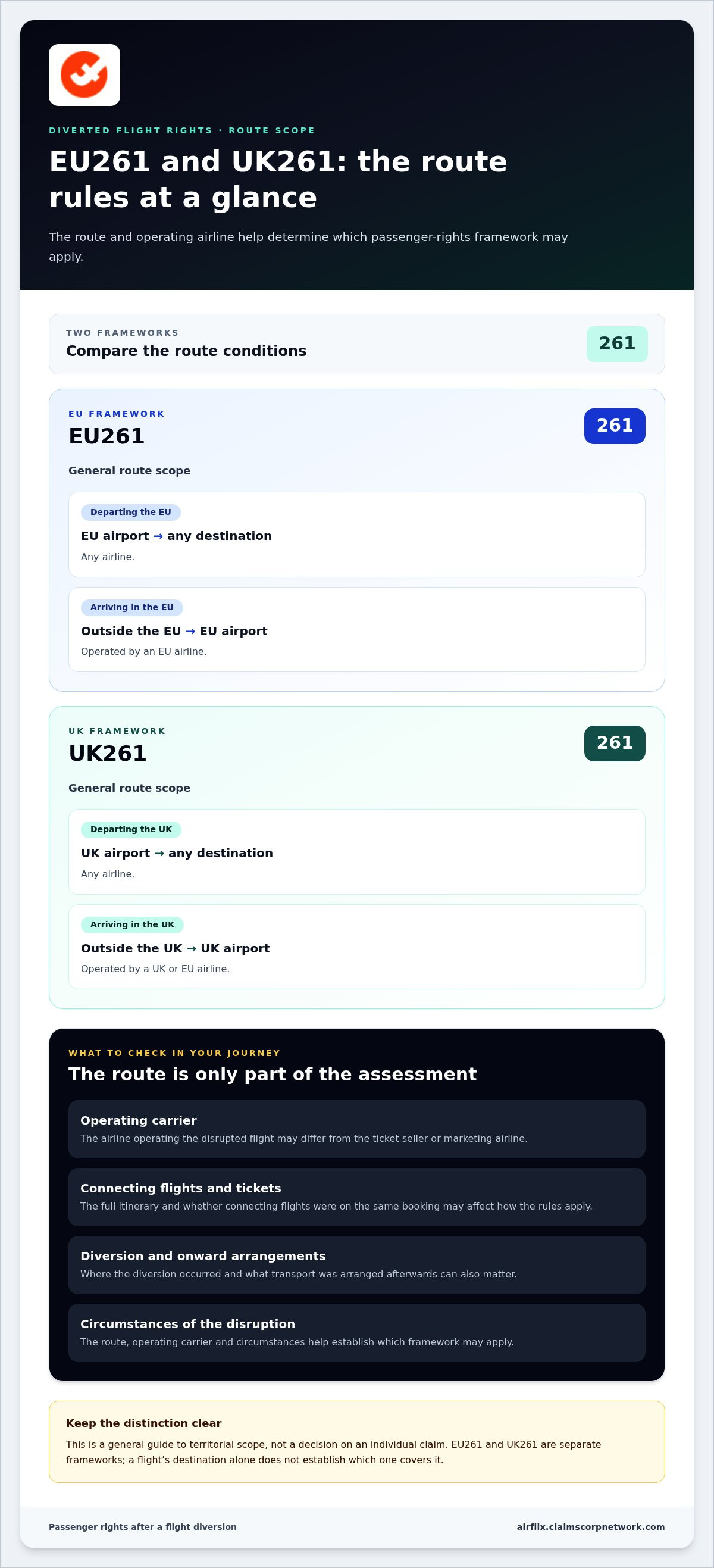
A diversion can involve more than one airport or carrier, so first identify the framework that governs the affected flight. Regulation (EC) No 261/2004, commonly called EU261, and the UK’s equivalent framework, UK261, may apply to eligible disruptions. Their scope depends on where the flight departs or arrives and which airline operates it. The ticket seller or marketing airline may not be the operating carrier.
The route, operating carrier and circumstances of the journey determine which passenger-rights framework may apply. This matters particularly on international itineraries. A flight’s destination alone does not establish that EU261 or UK261 covers it, and the two frameworks should not be treated as interchangeable.
This is a general guide to territorial scope, not a decision on an individual claim. Connecting flights, separate tickets, where the diversion occurred and the transport arranged afterwards may all affect how the rules apply. Check the itinerary and operating carrier for the disrupted flight, rather than relying only on the airline named on the booking confirmation.
When might EU air passenger rights apply?
EU261 sets common rights for passengers on flights within its scope when qualifying disruption occurs. A flight departing from an EU airport is generally covered regardless of the airline’s base. For a flight arriving in the EU from elsewhere, the operating carrier’s status is relevant. A diversion does not change these route facts, but it may make the arrival point and the outcome of the journey more complicated to assess.
How should passengers consider UK261 and other rules?
UK261 is a separate framework for eligible journeys involving the UK. A flight from the UK may fall within its scope regardless of carrier, while the operating airline can matter for an inbound journey. Other international itineraries may be governed by different local rules, so don’t assume EU261 or UK261 covers every flight.
Statutory rights are distinct from an airline’s customer-service policy and from travel insurance. An airline may provide assistance under its policy, but that does not itself settle whether a statutory claim is due. Insurance is a separate contractual route, with cover determined by the policy terms. To assess passenger rights for diverted flights, establish the route and operating carrier first, then consider the disruption under the framework that applies.
Where the route and carrier details point to a potential claim, flight disruption legal assistance can help you progress the assessment.
Can a diverted flight qualify for compensation, care or rerouting?
Possibly, but a diversion alone doesn’t guarantee compensation. Under EU261 and UK261, compensation may be due if a covered passenger reaches their final destination at least three hours late and the delay wasn’t caused by extraordinary circumstances. The assessment depends on the applicable framework, the cause of the disruption and the facts of the journey. Legal thresholds and exceptions, including how they apply to a particular diversion, should be considered against current rules and relevant case law.
Assess these rights separately. Compensation is a fixed payment that may be available when the legal criteria are met. Care and assistance address immediate needs during disruption, while rerouting or onward transport concerns how you can continue your journey. You may have a right to care even if the reason for the disruption prevents compensation.
How can arrival delay and the final destination affect compensation?
The diversion announcement is only one part of the timeline. If an aircraft lands at an alternate airport, that landing doesn’t necessarily mean you have reached the destination on your booking. Record when you arrive at the booked destination, including after any onward transport arranged by the airline. Under EU and UK rules, a delay of three hours or more at the final destination may meet the timing threshold for compensation, but other eligibility criteria still apply.
The cause matters too. Extraordinary circumstances can exclude compensation, but the label alone doesn’t settle whether an event qualifies. Keep the airline’s explanation and messages about the disruption. How a diversion, alternate airport or onward journey is treated can depend on the circumstances and legal interpretation, so assess your specific itinerary rather than relying on a general rule.
What assistance or onward arrangements may be relevant?
For passengers covered by EU261 or UK261, the right to care applies regardless of the reason for the delay. Depending on the circumstances, this can include meals and refreshments, access to communication and hotel accommodation if the delay requires an overnight stay. The airline may also need to address how passengers can continue to their destination. Available arrangements depend on the applicable rules and the disruption.
If you pay for reasonable essentials because assistance isn’t provided, retain itemised receipts and note why you incurred each expense. Submit these separately from any compensation request: reimbursement of expenses and fixed compensation are different claims, with different criteria. Keeping them distinct makes it easier to explain what you’re seeking and why.
- Compensation: assess the final arrival delay, the reason for disruption and the framework that applies.
- Care: record what assistance was offered or missing during the delay.
- Expenses: preserve receipts and explain how each cost relates to the disruption.
Separating these three issues helps prevent the airline’s response to one part of a claim from being mistaken for a decision on all the others.
What should you do after your flight is diverted?
A clear record helps you explain how the diversion affected your journey and what you’re claiming. Organise the facts first, then submit a concise written account supported by documents. These steps turn a disrupted trip into an evidence-based assessment of passenger rights for diverted flights.
- Record the diversion. Note the date, flight number, original destination and airport where the aircraft landed. Save any airline announcement or message explaining the change.
- Track your onward journey. Record what transport the airline arranged, when it departed and where you eventually arrived. Write down the scheduled and actual arrival times at your booked final destination.
- Organise your documents and expenses. Keep your booking confirmation, itinerary, boarding pass, airline correspondence and receipts. For each expense, note what it was for and how it resulted from the disruption.
- Check the applicable rules and deadline. Confirm which passenger-rights framework covers your journey and the current deadline for submitting a claim. Deadlines vary, so don’t assume one time limit applies to every route or claim.
- Submit a written claim and keep a copy. Set out the journey facts, what happened, the remedy you’re requesting and the evidence attached. Save the submission, reference number and any response.
What evidence can help document a diverted flight?
Keep original digital messages where possible and store copies of key travel documents together. Your itinerary and boarding pass establish the booked flight; airline communications can show what arrangements or explanations were provided. If a travel document doesn’t show your final arrival time, make a dated note and retain any available records that support your timeline. Keep receipts itemised, with a short explanation of each disruption-related cost.
How can passengers submit and follow up a claim?
Address the claim to the airline responsible for the disrupted flight. Use a factual sequence: identify the booking and route, describe the diversion and onward arrangements, state the remedy sought, then attach relevant evidence. Separate a compensation request from a request to reimburse expenses, as each has different grounds. Dates, times and documents make your account more precise than broad statements.
If the airline rejects the claim or doesn’t resolve it, retain its response and identify the appropriate escalation route for the jurisdiction and circumstances. The route can differ between claims, so establish the relevant process before taking the next step. A complete file also makes it easier to review the airline’s reasoning and address any missing information.
Flight disruption legal assistance can support you with progressing a claim. Airflix provides real-time claim status monitoring, so you can follow its progress as it develops.
How can Airflix assist with a diverted-flight claim?
Once you have assembled the journey facts and supporting documents, professional claim assistance can help organise the process. Airflix provides legal assistance for flight disruption claims, including claims involving diverted flights. The assessment depends on your evidence, the applicable rules and the circumstances of the disruption. Assistance doesn’t guarantee compensation or any particular outcome.
What can legal claim assistance help passengers manage?
A claim needs a coherent account of the journey: the booked route, what happened during the diversion, how you continued and when you reached your final destination. Airflix flight disruption claim assistance can help you manage the legal claim process and supporting information. An organised file presents the relevant facts clearly, though it doesn’t determine whether the airline is liable.
Airflix also provides real-time claim status monitoring. This gives you visibility into claim progress; it is not a promise of a particular decision or timeframe. Keep copies of key records, including airline correspondence and receipts, so the information remains available as the claim progresses.
- Journey record: retain the itinerary and details of the diversion and onward travel.
- Supporting documents: keep airline messages, tickets and receipts relevant to the claim.
- Claim progress: use status monitoring to follow updates as they become available.
When might passengers consider further legal representation?
An airline may dispute whether you are eligible, how the disruption should be classified or whether an exception applies. The appropriate next step depends on the evidence, the governing law and the circumstances of the claim. If a dispute proceeds to court, Airflix provides legal representation in court proceedings. Whether that step is suitable depends on the individual case.
Understanding passenger rights for diverted flights is the starting point; the next task is to present the journey and claim clearly. Airflix’s assistance can support that process, while the outcome depends on the facts and applicable law.
Airflix flight disruption claim assistance can help you manage a diverted-flight claim.
Take the next step with a clear claim plan
A diverted journey can leave questions that aren’t resolved by the airline’s first explanation. Treat your claim as a process: keep the record intact, identify the decision you need from the airline and assess any response against the facts and applicable rules. This puts you in a better position to decide what to do next without assuming that a diversion automatically entitles you to compensation.
Where passenger rights for diverted flights indicate that a claim may be appropriate, professional support can help manage its progress. Airflix provides real-time claim status monitoring and legal representation in court proceedings where applicable. Neither assistance nor representation guarantees compensation or a particular result, but both can form part of a structured approach to progressing a claim.
To get support with a diverted-flight claim, request flight disruption legal assistance from Airflix.
Frequently Asked Questions
Can I claim compensation if my diverted flight arrives at another airport?
Possibly, but arrival at a different airport doesn’t automatically establish a right to compensation. For a flight covered by EU261 or UK261, the assessment may turn on how late you reach the destination on your booking, why the disruption occurred and how the onward journey was arranged. Keep evidence of your final arrival, including transport records, and note if you had to make your own way onwards.
Is a diverted flight automatically treated as cancelled?
No. A diversion describes where the aircraft lands, not necessarily whether the booked flight was cancelled. The airline might continue the service or arrange alternative transport, and the practical outcome can affect how the disruption is assessed. If the airline’s app or message labels the flight “cancelled” but you’re offered onward travel, save that notice alongside the new itinerary. The status label alone may not explain what happened to your journey.
What happens if the airline takes me to a different airport?
Ask the airline for clear instructions about onward transport and the destination it intends to get you to. Keep any revised itinerary, transfer details and communications, and record when you reach your booked destination. If you arrange transport yourself because no workable option is provided, retain the receipt and note why you paid for it. Whether the cost can be recovered depends on the applicable rules and the specific circumstances.
Can I claim hotel or meal expenses after a diverted flight?
For a flight covered by EU261 or UK261, care may include meals and refreshments during a qualifying wait and hotel accommodation if an overnight stay is required. Keep itemised receipts if you pay for essentials yourself, and record whether the airline offered assistance. Reimbursement isn’t automatic: the expense should relate to the disruption, and its assessment is separate from any fixed compensation claim.
Does the reason for a flight diversion affect compensation?
Yes. Under EU261 and UK261, the reason can affect compensation because extraordinary circumstances may exempt an airline from paying it, even where the arrival-delay threshold is met. An airline’s description of an event doesn’t settle the legal question by itself. Save its explanation and relevant updates, such as messages describing weather or an operational issue, because the circumstances and their legal interpretation matter.
How do I find out which passenger-rights rules apply to my diverted flight?
Start with the route and the airline that operated the disrupted flight, rather than only the company that sold your ticket. EU261 generally covers departures from EU airports and certain arrivals operated by EU airlines; UK261 has its own route and carrier scope. For passenger rights for diverted flights, also consider whether connections were on one booking or separate tickets, as that can affect the assessment.
What evidence should I keep after a diverted flight?
Keep the booking confirmation, full itinerary, boarding pass and every airline message about the diversion or revised travel arrangements. Add a brief dated note of announcements or conversations, including who you spoke to and what they said. Preserve receipts for costs linked to the disruption, and make a separate note explaining each one. These records can help resolve gaps if the airline’s account differs from your recollection.


