

What legal protection for air passengers applies when a journey crosses borders? A delayed or cancelled flight doesn’t automatically give every passenger the same rights. The rules can depend on where the flight departs or arrives and which airline operates it, so identifying the relevant framework is the first step towards a clear claim.
It’s easy to confuse a ticket refund with compensation or practical assistance during a disruption. These are separate remedies, and eligibility depends on the circumstances and applicable rules. This guide explains how to distinguish them, what evidence to keep and what to do if an airline rejects a claim or takes time to respond.
You’ll learn how to identify the relevant passenger-rights framework, preserve useful evidence and organise a claim before escalating it. It also explains how legal assistance can help manage a claim, monitor its progress and provide representation in court proceedings where relevant. No process can guarantee a particular outcome, but a documented approach makes the next steps clearer.
Key Takeaways
- Legal protection for air passengers depends on the journey and the rules that apply, so establish the relevant framework before deciding what to claim.
- Distinguish a ticket refund from compensation, reimbursement and practical assistance. Each addresses a different issue.
- Build a clear record of the disruption with booking and boarding documents, relevant receipts and airline correspondence.
- Submit a concise complaint to the airline and retain its replies, so you have an organised record if further escalation is needed.
- Structured legal assistance can help manage a claim, monitor its status in real time and provide legal representation in court proceedings where relevant.
What legal protection for air passengers means when a flight goes wrong
Legal protection for air passengers is the combination of rights, complaint routes and remedies available under the rules that govern a particular journey. It can set out when a passenger may seek a refund, claim compensation, request reimbursement for eligible expenses or receive practical assistance. These outcomes are not interchangeable. The remedy depends on the type of problem and the conditions set by the applicable framework.
A refund generally concerns money paid for travel that was not taken, whilst compensation is a separate remedy that may apply in defined circumstances. Practical assistance addresses immediate needs during a disruption, while reimbursement concerns eligible costs already incurred. A passenger might receive one form of support without qualifying for another. The distinction matters when describing the problem to an airline and assessing its response.
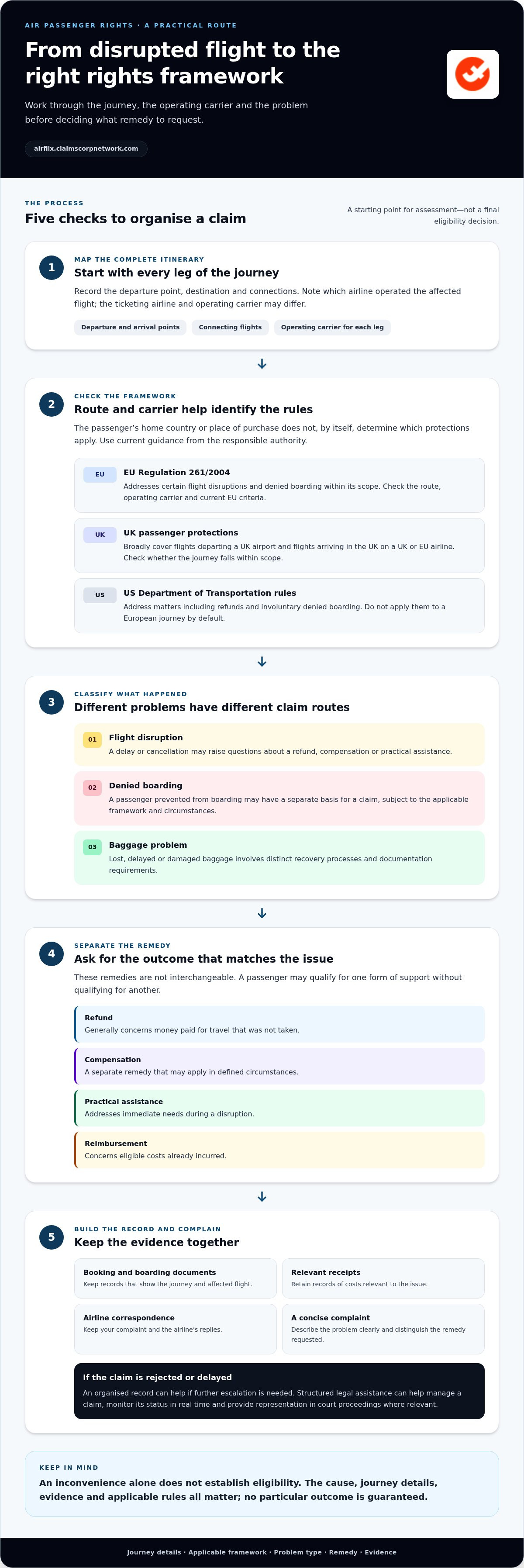
The relevant framework is not necessarily determined by the passenger’s home country. The route, the disruption and other journey details can affect which rules apply. The EU Air Passenger Rights Regulation, for instance, is one framework covering issues such as delays, cancellations and denied boarding. Other journeys may be governed by UK passenger protections, US Department of Transportation rules or different legal arrangements. The same event can therefore lead to different rights or complaint routes depending on the facts.
Which passenger problems can legal protections address?
Start by classifying the problem. A flight disruption, denied boarding and a baggage issue are distinct claim categories, each with different rules, evidence and routes for seeking a remedy. A cancellation claim should not be treated as a baggage claim simply because both affected the same trip. Identifying the issue precisely helps direct the assessment to the relevant protections.
- Disruption: Delays or cancellations may raise questions about refunds, compensation or assistance under the applicable rules.
- Denied boarding: A passenger prevented from boarding may have a separate basis for a claim, subject to the relevant framework and circumstances.
- Baggage: Lost, delayed or damaged baggage can involve distinct recovery processes and documentation requirements.
Each category has its own practical considerations. Airflix supports passengers with flight disruption claims and baggage claim regress, helping organise the relevant claim details and supporting documents.
What legal protection does not automatically guarantee
An inconvenience alone does not establish eligibility for compensation. The cause of the event, the journey details and the conditions in force all matter. An airline may also offer a goodwill gesture or act under its commercial policy. That response is separate from a remedy required by law, and receiving it does not, by itself, explain what other rights may apply.
Avoid assuming a particular outcome before the route and circumstances have been assessed. Record what happened, distinguish the remedy being requested and refer to the rules relevant to the journey. Eligibility and results depend on the evidence and current requirements. Where a claim is complex or disputed, structured assistance can help organise its handling without guaranteeing acceptance or compensation.
How the applicable air passenger rights framework is identified
There is no single set of rules for every flight. To assess legal protection for air passengers, start with the complete itinerary, not just the airport where the disruption occurred. Departure point, destination, connections and the airline operating each flight can all be relevant. The ticketing airline and operating carrier may differ, so keep the booking confirmation and check which carrier operated the affected leg.
How route and itinerary affect the rules
Consider a journey with a connection. A disruption on one leg may raise different questions from a disruption on another, particularly if the flights are operated by different airlines or cross jurisdictional boundaries. The points of departure and arrival can also matter. These are indicators, not universal tests. Apply the territorial and carrier-scope criteria of the relevant law to the facts, using current guidance from the responsible authority rather than assuming that the passenger’s nationality or place of purchase determines the result.
EU, UK and US protections are not interchangeable
The table offers a starting point, not a final eligibility decision. Each framework has its own scope and remedies. For example, the UK rules broadly cover flights departing a UK airport and flights arriving in the UK on a UK or EU airline. EU rules have their own scope criteria, explained in the European Commission’s passenger-rights guidance. US Department of Transportation rules address matters including refunds and involuntary denied boarding, but those rules should not be applied to a European journey by default.
| Framework | High-level role | Check first |
|---|---|---|
| EU Regulation 261/2004 | Addresses certain flight disruptions and denied boarding within its scope. | Route, operating carrier and the current EU criteria. |
| UK passenger protections | Cover qualifying disruptions on journeys within the UK rules’ scope. | Whether the flight departs the UK or arrives on a qualifying UK or EU airline. |
| US DOT rules | Set US consumer protections, including rules on refunds and some denied-boarding situations. | Whether the journey and issue fall under US requirements. |
| Montreal Convention | May be relevant to questions about international carriage, including baggage claims. | Whether the carriage is international within the Convention’s scope and which claim concerns are involved. |
For current jurisdiction-specific guidance, consult the European Commission’s air passenger rights information, the UK Civil Aviation Authority and the US Department of Transportation’s Aviation Consumer Protection pages. The Montreal Convention is a separate international framework, not a substitute for EU, UK or US disruption rules. Its relevance depends on the carriage and the claim.
Once you have identified the likely framework, compare its current conditions with the itinerary and specific event before drawing conclusions. If organising a disruption claim across these details feels complex, structured flight disruption legal assistance can help manage the claim process. The applicable rules and evidence still determine eligibility and outcome.
How to assess a passenger protection claim without confusing remedies
Start by deciding what outcome you are seeking. A passenger who chooses not to travel after a cancellation may be seeking a refund, whilst someone who completes the journey after a qualifying disruption may be asking whether separate compensation rules apply. Neither request automatically establishes entitlement. The route, event, evidence and applicable legal criteria must be considered together.
| Issue | Possible remedy | Relevant framework | Evidence to retain |
|---|---|---|---|
| Cancelled flight and passenger does not travel | Refund for the unused ticket, where the applicable rules provide for it | For example, EU261, UK261 or US DOT refund rules, depending on scope | Booking, cancellation notice, refund offer and choice made |
| Delay or cancellation, but passenger travels | Possible statutory compensation or practical assistance, assessed separately | The relevant disruption rules, such as EU261 or UK261 where applicable | Itinerary, arrival details, airline explanation and messages about assistance |
| Extra costs after disruption | Possible reimbursement of eligible expenses, subject to the governing rules | Applicable passenger-rights rules or other relevant terms | Itemised receipts, proof of payment and explanation of why costs arose |
| Delayed, lost or damaged baggage | Possible recovery for a baggage loss or related expense | Relevant carriage rules, which may include the Montreal Convention for international carriage | Baggage report, travel documents, photographs and receipts |
| Involuntary denied boarding | Possible compensation or other remedy, depending on the jurisdiction and circumstances | Applicable EU, UK or US rules | Boarding documents, written explanation, itinerary and any alternative travel offer |
Refunds, compensation and reimbursement are different
A refund returns the price of a ticket or unused part of it when the relevant conditions are met. Compensation is a separate payment that may be available under a statutory scheme for a defined disruption. Reimbursement concerns eligible costs a passenger has already paid, whilst assistance addresses support during the disruption. Each remedy has its own test. A refund does not automatically include compensation or expenses.
For example, a passenger whose flight is cancelled might accept an alternative journey and later ask whether the disruption qualifies for compensation. The cost of meals paid for during the wait would be a separate reimbursement question. Alternative travel arrangements and out-of-pocket costs can be governed by different provisions, so record each request separately and keep the related evidence.
When an airline’s explanation needs closer review
An airline’s stated reason is relevant, but it is not the whole assessment. For disruption claims, eligibility can turn on the facts and the current legal test, including any applicable rules on extraordinary circumstances. An operational problem is not automatically qualifying, nor automatically exempt. Compare the explanation with available records, such as delay notices and correspondence, then assess it against the rules governing that journey. Legal protection for air passengers depends on the evidence, not on a label alone.
What passengers should document before escalating an airline claim
A well-organised record makes it easier to explain what happened, identify the remedy you are seeking and assess the airline’s response. Keep documents together by journey and claim, and distinguish confirmed facts from assumptions. This record supports a clearer complaint and can help if the matter needs further review under the relevant rules.
Build a clear record of the journey and disruption
Record the scheduled and actual journey details, including each affected flight and any relevant connections. Note when you received disruption updates and what the airline told you, using dates, times and claim reference numbers where available. Keep the wording factual: record the airline’s stated reason, but don’t present it as independently established unless you have evidence to support it.
Gather documents that relate directly to the issue. Depending on the claim, these may include:
- Booking confirmation, ticket details and itinerary, including connecting flights.
- Boarding passes or other travel documents for the affected journey.
- Airline messages, complaint submissions, replies and claim reference numbers.
- Itemised receipts and proof of payment for costs linked to the disruption.
- For a baggage issue, relevant reports and records describing the loss or damage.
Keep the original files where possible and organise copies in a simple timeline. This connects each receipt or message to the event it relates to, rather than leaving evidence scattered across inboxes and devices.
Escalate methodically and preserve the response trail
Use a clear written complaint to set out the flight details, what occurred, the remedy you are requesting and the evidence attached. Avoid combining unrelated issues, such as a disruption and a separate baggage matter, into one unclear account. Save a copy of the complaint and note the date and method of submission. Retain the airline’s full response, including any explanation or request for further information.
- Record the event: Write a concise chronology of the scheduled journey, disruption and communications.
- Gather supporting documents: Match booking records, boarding documents, correspondence and relevant receipts to the issue.
- Submit a focused complaint: State what happened and what remedy you are requesting, then include the relevant evidence.
- Preserve the reply trail: Record the submission date, reference number and each response, or note when a response has not arrived.
If the airline’s response does not resolve the issue, the next route may involve a regulator, an approved dispute-resolution process or court proceedings, depending on the jurisdiction, claim type and current rules. Procedures and response times vary, so don’t assume one deadline or escalation path applies to every journey. Check the relevant authority’s current guidance and note any applicable time limits.
Organised documentation can also support structured flight legal assistance by keeping claim details and progress together. It doesn’t guarantee that a claim will be accepted, but a clear evidence trail makes the issues easier to assess.
How legal assistance can support an air passenger claim
Once you have gathered the key records, structured assistance can help turn them into a claim that is easier to manage. The process may involve organising journey details, identifying the issue being raised and keeping supporting information connected to the case. This can be useful when airline correspondence is ongoing or the claim involves several stages.
What claim assistance can contribute
Assistance can help manage a disruption claim and provide a clearer view of its progress. Airflix includes real-time claim-status monitoring, so passengers can follow a claim as it moves through the process. Monitoring improves visibility, but it doesn’t determine whether a claim is legally eligible or ensure that an airline will accept it.
The practical value lies in structure. A passenger may have booking records, airline messages and receipts, but still be uncertain how they relate to the issue or what stage the claim has reached. Organised handling can keep those details together and distinguish the passenger’s request from the airline’s response. The applicable rules and evidence remain central to any assessment.
When a passenger may consider professional support
Professional support may be worth considering if the circumstances are complex, airline correspondence has not resolved the issue, or the matter is moving towards formal proceedings. Legal input can help with further handling at the appropriate stage. Airflix also provides legal representation in court proceedings against airlines, although not every claim requires or proceeds to court.
Before seeking help, keep the claim record accessible and note any response or reference details already received. This gives the process a practical starting point and avoids relying on memory alone. Airflix provides flight disruption legal assistance to support structured claim handling. The availability of a remedy depends on the journey, circumstances and governing rules. No assistance can guarantee eligibility, acceptance or a particular result.
For support managing a flight disruption claim and following its status, explore Airflix legal assistance for flight disruptions.
Take the next step with a clear claim plan
Once you’ve gathered the relevant records, decide whether you’re comfortable managing the next steps yourself or would benefit from structured support. Legal protection for air passengers is most useful when the process stays connected to the facts of the journey and the rules that apply, rather than assumptions about the outcome.
Airflix supports claim handling with real-time claim-status monitoring and can provide legal representation in court proceedings against airlines where a case reaches that stage. Its service is developed within Claims Corporation Network and offers a structured route for managing a flight disruption claim. Eligibility and results still depend on the circumstances and applicable rules.
If you’re ready to consider support for your disruption claim, explore Airflix legal assistance for flight disruptions. A well-organised next step can help you move forward with greater clarity.
Frequently Asked Questions
What legal rights do air passengers have when a flight is disrupted?
Rights depend on the route, circumstances and applicable law. A cancellation might give a passenger a choice of refund or rerouting under one framework, whilst a separate compensation test may apply only if its conditions are met. Assistance during a wait is another question. EU, UK and US rules are distinct systems, not universal standards. Check current official guidance against every flight in the itinerary, especially if carriers or jurisdictions change mid-journey.
Can an airline refuse an air passenger compensation claim?
Yes. An airline may reject a claim if it considers the eligibility criteria unmet or believes an exception applies. The refusal alone doesn’t establish that its assessment is correct. Keep the decision, including any explanation of the event, and compare it with the applicable rules and your records. If the response leaves material questions unanswered, consider the relevant complaint or review route, or seek assistance to assess the next step.
How do I know which country's passenger-rights rules apply?
Assess the full itinerary, including departure and destination airports, connecting flights and the operating carrier for each leg. For example, a journey booked with one airline may include a flight operated by another, making the carrier detail important to the assessment. No single rule automatically governs every international trip. Compare the route with current official, jurisdiction-specific guidance. EU, UK and US protections aren’t interchangeable.
What happens if an airline does not reply to a passenger complaint?
Keep a copy of the complaint, the date and method of submission, and any reference number or delivery confirmation. If there’s no reply, check the official complaint process relevant to the journey and type of claim, since response expectations and escalation routes vary. Silence doesn’t mean the airline has accepted the claim. A clear record can support a follow-up or help organise the matter for structured claim assistance.
Is a ticket refund the same as flight compensation?
No. A refund concerns the ticket price or unused travel, whilst compensation is a separate remedy that may be available under specific rules. Reimbursement for an eligible expense and practical assistance during disruption are separate issues too. For instance, receiving a refund doesn’t automatically establish a right to compensation for the same event. Check each requested remedy against the circumstances and framework that govern the journey.
Can I seek legal assistance if the airline has already rejected my claim?
Yes, a rejection doesn’t necessarily end the matter, but any further step depends on the airline’s reasons, the available evidence, applicable rules and relevant time limits. Keep the decision and the documents relating to the affected flight, then assess whether the explanation addresses the claim. Legal assistance can help manage a claim or consider formal escalation options. It can’t guarantee eligibility, acceptance or a particular outcome.
Does legal protection for air passengers apply to every international flight?
No. International travel doesn’t create one universal set of passenger rights. The route and issue determine which frameworks may be relevant. Disruption and baggage claims, for example, can raise different legal questions. Some rules address international carriage, but that doesn’t mean they apply to every aspect of a journey. Identify the affected flight and claim type, then use current authoritative guidance to assess the relevant scope.


