

Flight overbooking compensation depends not only on whether a flight was oversold, but on how you lost your seat. If you’re asked at the gate to give up your place, accepting an offer is different from being refused boarding against your will. That distinction can affect what you may claim and which options are available to you.
It’s understandable to feel under pressure when the airline asks you to volunteer or offers a voucher, especially when you’re also trying to work out how to reach your destination. The rules that apply depend on your itinerary. Compensation is only one part of the picture: rerouting, refunds and care may also be relevant. This guide explains the difference between volunteering and involuntary denied boarding, which passenger-rights rules may apply, and what to consider before accepting an offer. It also covers the records to keep and how to submit a clear claim, so you can assess your position and follow up with the airline in an organised way.
Key Takeaways
- Overbooking means more seats are sold or confirmed than a flight can accommodate, but how boarding is refused shapes your next steps.
- Identify which passenger-rights framework may apply by considering your route, carrier and the relevant rules.
- Understand how volunteering differs from involuntary denied boarding, and why agreed benefits may not be the same as statutory compensation.
- Keep your booking confirmation, boarding pass, airline notices and written communications to support a clear flight overbooking compensation claim.
- Airflix offers legal assistance, claim-status monitoring and court representation to support the claims process.
Flight overbooking compensation: what being bumped actually means
Being told at the gate that there’s no seat for you can disrupt your plans and leave you unsure what the airline’s decision means. The key question is whether you agreed to give up your seat or the airline refused to carry you. Overbooking means an airline has sold or confirmed more seats than the aircraft has available. That fact alone doesn’t establish a right to flight overbooking compensation. The key event is usually involuntary denied boarding, assessed under the passenger-rights rules that apply to your journey.
Involuntary denied boarding means the airline refuses to carry a passenger who has a confirmed reservation and has met the applicable check-in and boarding requirements, against that passenger’s will. Under EU and UK rules, reasonable grounds such as health, safety, security or inadequate travel documents can affect whether a refusal counts. The circumstances matter, so keep the airline’s explanation and any written record of the gate decision.
When does an overbooked flight become denied boarding?
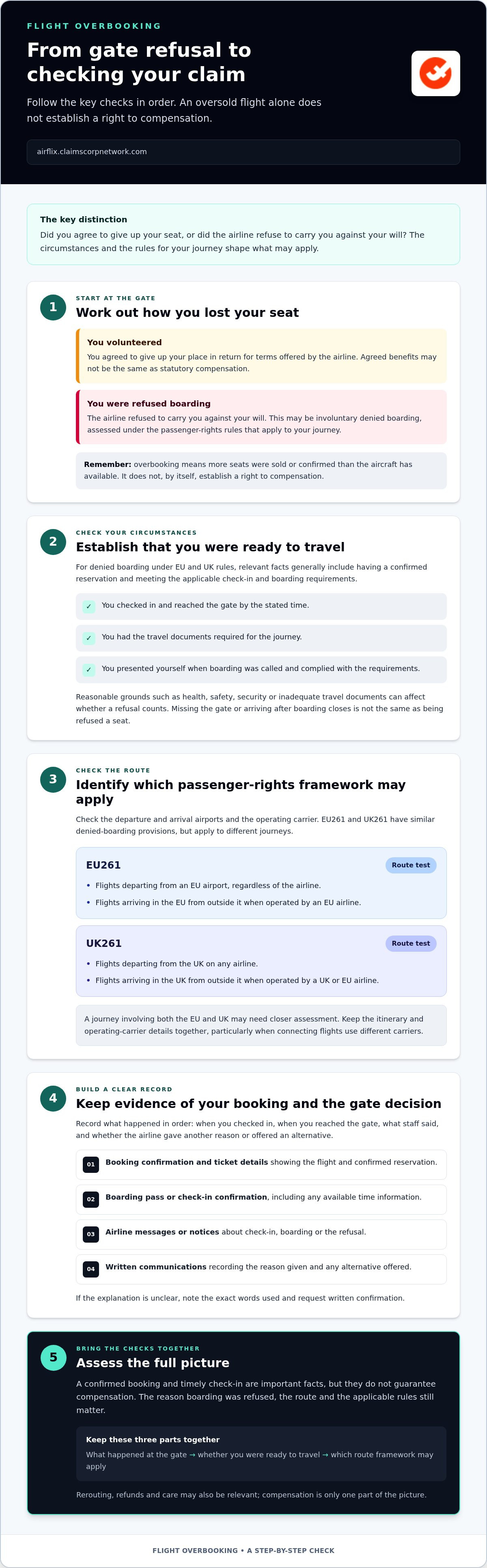
The distinction is more than terminology. A confirmed booking, timely check-in and compliance with document and boarding requirements help show that you were ready to travel. If staff refuse you a seat because there aren’t enough places, that may count as denied boarding. By contrast, a flight that leaves late is a delay, and a service that doesn’t operate is a cancellation. Missing the gate or arriving after boarding closes is not the same as being refused a seat, even if the flight was overbooked.
Reconstruct what happened in order. Did you check in, reach the gate by the stated time and present yourself when boarding was called? Did the airline say the flight was full, or give another reason for refusing to carry you? These details help distinguish a capacity-related refusal from a decision based on travel documents, safety or another stated ground. If the explanation is unclear, record the exact words used and request written confirmation.
Why do airlines overbook flights?
Airlines may confirm more bookings than there are seats because some ticketed passengers don’t travel. This is a commercial and operational practice intended to account for no-shows and make use of available capacity. It doesn’t mean every oversold flight will result in someone being refused boarding: the final number of passengers may still fit within the aircraft’s seat capacity.
The immediate problem arises when more passengers arrive and are ready to travel than there are usable seats. The airline then has to resolve the mismatch, often by asking for volunteers willing to travel later. If not enough people volunteer, some passengers may be refused boarding against their will. These situations are different: a volunteer agrees to terms with the airline, while an involuntary refusal may engage statutory passenger rights, depending on the route and applicable rules. The next section explains how to identify which framework may apply.
Who may qualify for flight overbooking compensation under EU or UK rules?
A refusal to board doesn’t automatically mean compensation is due. The applicable passenger-rights framework depends on the route and, for some journeys, the airline operating the flight. EU Regulation 261/2004 and the UK’s retained equivalent, known as UK261, have similar provisions for denied boarding but apply to different journeys. Start by checking the route; the specific circumstances determine whether a claim qualifies.
Which flights may fall under EU261 or UK261?
EU261 generally applies to flights departing from an EU airport, regardless of the airline, and flights arriving in the EU from outside it when operated by an EU airline. UK261 generally applies to flights departing from the UK on any airline, and flights arriving in the UK from outside it when operated by a UK or EU airline. Other territories and route details can affect the assessment.
For example, a flight from an EU airport to a non-EU destination may fall within EU261 even if a non-EU airline operates it. A flight from outside the UK to a UK airport may fall within UK261 when operated by a qualifying UK or EU carrier. Don’t assume a rule applies simply because you bought your ticket in Europe or the airline has a familiar nationality. Check the departure and arrival airports and the operating carrier.
These route tests are not interchangeable. A journey involving both the EU and UK may require a closer look at which framework governs the particular flight. Keep the itinerary and airline details together, especially if your booking includes connecting flights operated by different carriers.
How do booking and check-in affect eligibility?
Passenger-rights rules generally require a confirmed reservation and presentation for check-in and boarding within the airline’s stated time limits. You must also have the travel documents required for the journey. These are important facts to establish, but they don’t guarantee compensation: the reason boarding was refused and the applicable legal framework still matter.
Keep records that show both your booking and what happened at the airport. Useful evidence includes:
- The booking confirmation and ticket details, showing the flight and confirmed reservation.
- Your boarding pass or check-in confirmation, with any available time information.
- Airline messages or notices about check-in, boarding or the refusal.
- Written communications recording the reason given and any alternative offered.
Use the route, carrier and travel records to assess your position rather than assuming flight overbooking compensation is automatic. An organised record also makes it easier to explain what happened and follow up with the airline.
Volunteering versus being bumped: compare your flight options
At the gate, a request to give up your seat can sound similar to a refusal to carry you, but the legal and practical consequences differ. A volunteer agrees to surrender their seat on terms negotiated with the airline; involuntary denied boarding occurs when the airline refuses to carry a passenger against their will. That distinction can affect whether statutory compensation applies.
Compare the situations before deciding what to do:
| Situation | What it means | What to consider |
|---|---|---|
| Volunteering | You agree to give up your seat in exchange for benefits offered by the airline. | The agreed package sets out what you receive. It may include replacement travel or other benefits, but volunteering doesn’t automatically qualify you for statutory denied-boarding compensation. |
| Involuntary refusal | The airline refuses to carry you, although you’re willing and prepared to travel. | Depending on the applicable rules and circumstances, you may have rights to compensation, a choice of refund or rerouting, and care whilst waiting. |
| Boarding after rerouting | You accept alternative travel after being refused a place on your original flight. | Rerouting addresses how you continue your journey. It doesn’t necessarily remove any compensation entitlement, although arrival time on the replacement journey can affect the amount under EU or UK rules. |
What should you clarify before volunteering your seat?
Before agreeing, establish which replacement flight you’ll take, when it is expected to arrive and exactly what benefits the airline is offering. Clarify whether the offer is cash, a voucher or another arrangement, and whether it covers each passenger in your booking. Ask for the terms in writing, including any conditions. A clear record can prevent misunderstandings, but don’t treat the negotiated offer as a promise of separate statutory compensation.
What choices may follow an involuntary refusal?
Under the applicable EU or UK framework, a passenger involuntarily refused boarding may generally choose between reimbursement and rerouting, subject to the rules for that journey. Care, such as meals or accommodation where required, is separate from both compensation and reimbursement. Keep records of the option you chose, expenses and any assistance from the airline. The details and applicable conditions depend on the route and circumstances.
Compensation is also separate from the practical choice of how to travel. Under the EU and UK rules described here, denied-boarding compensation is set by flight distance, with listed bands of €250/£220, €400/£430 or €600/£520. If rerouting gets you to your destination within specified time limits, compensation may be reduced by 50%. For example, the threshold is two hours for flights of 1,500 km or less, and four hours for flights over 3,500 km. The relevant framework determines the currency, band and conditions, so don’t assume an airline’s rerouting offer settles every part of a flight overbooking compensation claim.
How to document and submit a flight overbooking compensation claim
A clear claim links the airline’s decision at the gate to the passenger-rights rules that apply to your journey. Record events promptly, keep the original documents and make your request in writing. This creates a timeline that helps explain whether boarding was refused involuntarily, what the airline offered and how you responded.
What evidence should you keep at the airport?
Save evidence that establishes both your booking and what happened on the day. Keep digital copies as well as originals where possible, and note details whilst they’re fresh. The airline’s stated reason and any replacement travel offer can be especially useful if later correspondence describes the event differently.
- Booking confirmation, ticket details and check-in confirmation to show your reservation and check-in.
- Boarding pass or other boarding documents, plus any airline notice or written explanation of the refusal.
- The time you reported to the gate, the reason staff gave and details of alternative travel offered.
- Written messages with airline staff and receipts for additional expenses connected with the disruption.
Keep receipts, but don’t assume every expense is recoverable. Whether costs can be claimed depends on the applicable rules and circumstances.
Use your records to submit the claim in a clear sequence:
- Write down the gate decision, including when it happened and the reason given.
- Confirm whether you volunteered or were refused boarding against your will, and record any terms you accepted.
- Gather your booking, check-in and boarding records, airline notices, correspondence and relevant receipts.
- Set out your journey, what happened, the resolution you’re seeking and the basis for your request. Keep the account factual.
- Submit the claim to the airline through its stated process and retain a copy of your submission and any reference number.
- Note when you submitted it and follow up in writing if needed, keeping replies with the rest of your evidence.
How should you respond if an airline rejects the claim?
Read the rejection carefully and compare its reasoning with your timeline, booking and airline communications. If it says you weren’t checked in on time, for example, use your check-in confirmation and boarding records to clarify the sequence. Review the applicable passenger-rights rules too. Complaint procedures and further legal routes depend on the jurisdiction and circumstances, so establish the relevant process and claim deadline rather than assuming one deadline applies everywhere.
Airflix provides legal assistance for flight disruption claims, helping with correspondence and follow-up. Real-time claim-status monitoring gives you visibility into the claim process, and Airflix provides legal representation in court proceedings. Keep copies of the documents you provide and correspondence you receive, so your claim record remains complete.
How Airflix can support an overbooking compensation claim
After you’ve reviewed the relevant passenger-rights rules, considered your options and organised your evidence, managing the claim can still involve correspondence and follow-up with the airline. Airflix provides legal assistance for flight disruption claims, including claims related to overbooking. The airline’s response and any further steps depend on the facts and applicable rules.
What happens when Airflix manages a claim?
Airflix provides legal assistance with claim correspondence and follow-up, helping organise information about the disruption as the matter progresses. Real-time claim-status monitoring gives you visibility into the claim’s progress, so you can follow its status. If court proceedings arise, Airflix provides legal representation. This support helps manage the process, but doesn’t guarantee compensation.
A well-organised record remains useful throughout. For example, if the airline’s reply refers to an offer made at the gate, your account of what you accepted, along with any written terms, can help clarify whether you volunteered or were refused boarding. If you were rerouted, include the alternative itinerary and arrival details. Airflix’s legal assistance supports correspondence and follow-up using the information available, while status monitoring lets you track the claim as it progresses.
What information should you have ready?
Before starting, gather the core details needed to describe your journey and the boarding decision. Provide an accurate account, including whether you accepted an offer, what it involved and whether the airline arranged rerouting. Distinguish what you know from what you’re unsure about, and share relevant records so the claim can be assessed in light of the circumstances.
- Passenger and booking details, including the booking reference and flight information.
- Records of the refusal, such as airline notices, written explanations or messages from staff.
- Details of any offer accepted, including its terms and any replacement travel arranged.
- Related correspondence and receipts that help explain events or additional costs.
Keep your account consistent with your documents. Clear information supports the handling of correspondence and follow-up, while Airflix’s real-time claim-status monitoring gives you visibility into progress. If court proceedings arise, legal representation is part of the support Airflix provides. For assistance with your overbooking claim, Start your flight claim with Airflix.
Take the next step with a clear claim record
The gate decision may be over, but the way you handle the claim can still shape what happens next. Organise your records and make sure your account of events matches the documents you’ve kept. Structured support can help you manage correspondence and follow-up. Whether flight overbooking compensation is due depends on the applicable rules and the facts of your journey.
Airflix provides legal assistance for flight disruption claims, real-time claim-status monitoring and legal representation if court proceedings arise. This support helps you follow the claim process and manage its next stages with visibility into progress.
Start your flight claim with Airflix to take a considered next step towards resolving your claim.
Frequently Asked Questions
Can I claim compensation if I volunteered to give up my seat?
Usually, volunteering doesn’t qualify for statutory denied-boarding compensation because you agreed to give up your seat. The airline should provide the benefits set out in your agreement, so keep its written terms and any payment or voucher record. If you felt pressured or the airline doesn’t honour what it offered, document what was said and preserve any messages. These details can help establish whether you genuinely volunteered and whether flight overbooking compensation could apply.
Is an airline allowed to overbook a flight?
Generally, yes. Overbooking is a commercial practice, but it doesn’t remove passenger rights if the airline refuses to carry someone involuntarily. The important questions are what happened at the gate and which rules govern the journey. If the airline asks for volunteers, take time to understand the offer before agreeing. Being asked to volunteer isn’t the same as being told you can’t board.
Can I choose a refund instead of another flight after being denied boarding?
Under applicable EU or UK passenger-rights rules, a passenger who qualifies after involuntary denied boarding will generally be offered a choice between reimbursement and rerouting. If you no longer wish to travel, tell the airline clearly that you’re choosing reimbursement rather than an alternative flight, and keep a record of your choice. The precise options depend on the rules governing your journey and the circumstances of the refusal.
What if the airline says I was denied boarding for an operational reason?
Ask the airline to explain the operational reason in writing, rather than relying on a broad label. The reason may affect whether the event qualifies as involuntary denied boarding under the applicable rules, but the wording alone doesn’t settle the issue. Preserve any message, gate notice or staff explanation, and compare it with your booking and check-in records. If the explanation remains unclear, address that point in your written claim.
Can other passengers on my booking claim compensation too?
Potentially, yes. Each traveller’s position is assessed individually, including whether they had a confirmed reservation, met the relevant check-in requirements and were refused boarding involuntarily. For example, if one person in a family booking volunteers but another is refused boarding, their situations may be treated differently. Keep each passenger’s boarding documents and record who accepted any offer, so the airline can assess each traveller’s circumstances.
Does accepting a replacement flight mean I give up compensation?
Not necessarily. Accepting rerouting is a choice about continuing your journey and doesn’t, by itself, mean you’ve waived any compensation that may be due. Under EU or UK rules, the arrival time on the replacement journey may affect the amount. Read any document the airline asks you to sign, particularly if it refers to a settlement or waiver, and keep a copy of the rerouting details.


