

The flight may be over, but resolving a claim can involve gathering records, explaining what happened and following up with the airline. Airline claim legal assistance can bring structure to that process, but it doesn’t guarantee compensation or replace the need for clear evidence.
You may be unsure whether a disruption supports a claim, what to do after the airline responds, or whether seeking help will take more time and effort than handling it yourself. The right level of support depends on the circumstances, the documents available and the steps already taken.
This guide explains how airline claim legal assistance works in 2026, when it may be useful and what to organise before seeking support. It also covers how claim monitoring helps you follow progress and how legal representation fits in if court proceedings arise. The aim is to help you prepare an evidence-led claim, understand the stages ahead and choose a practical route with realistic expectations.
Key Takeaways
- Airline claim legal assistance can support the assessment and handling of a passenger claim, but it is distinct from travel insurance and doesn’t guarantee compensation.
- The steps involved depend on the disruption, the evidence available and the legal rules that apply to the journey.
- Handling a claim yourself may suit you if you’re comfortable organising records and managing airline correspondence. Assistance offers structured support and process oversight.
- Gather booking and flight details, disruption records and airline communications. Keep original documents and a dated record of contact.
- Airflix provides real-time claim-status monitoring and legal representation if court proceedings arise.
What does airline claim legal assistance cover?
Flight disruption can leave passengers unsure whether to make a claim, what evidence to provide and how to respond if the airline disputes it. Airline claim legal assistance supports the assessment, management and pursuit of a passenger’s claim through the relevant stages. This can include reviewing the circumstances and available records, handling claim correspondence and monitoring progress. The appropriate route depends on the facts: a cancelled flight, a long delay and denied boarding can raise different questions. A disruption alone does not establish eligibility or entitlement.
This support is distinct from travel insurance, which concerns cover under an insurance policy, and from airline customer service, which handles the airline’s own passenger enquiries. Legal assistance focuses on the claim process and applicable passenger-rights rules. It cannot guarantee that a claim will succeed or that compensation will be awarded. Whether a passenger has a valid claim depends on the journey, the cause and circumstances of the disruption, the evidence and the legal framework that applies.
For international journeys, applicable rules may depend on the route and the parties involved. For example, the EU Air Passenger Rights Regulation gives an overview of a framework relevant to certain flight disruptions. It is a starting point, not a substitute for assessing how the rules apply to a particular journey. Baggage issues are a separate matter. Airflix also provides a baggage-claim regress service, while this section focuses on disruption claims.
What support can form part of an airline claim?
Claim handling can involve organising the passenger’s account and documents, assessing the claim, following up with the airline and considering appropriate next steps. The order and scope depend on the facts and applicable rules, so cases do not all follow the same path. Case-status monitoring helps passengers follow progress. If court procedures arise, Airflix provides legal representation. This does not promise a particular decision.
When might a passenger consider legal assistance?
Assistance can be useful when an airline disputes a claim, its response leaves the next procedural step unclear, or repeated correspondence is difficult to manage alongside other commitments. If you’re comfortable organising records, setting out what happened and communicating with the airline, you may be able to manage a straightforward claim independently. The level of support you choose is separate from whether the claim qualifies.
Before choosing a route, separate three questions: what happened, what records support your account, and which rules may apply to the journey. An itinerary, booking confirmation, airline notices and copies of correspondence can help establish the facts. Keep original documents and note when communications were sent or received. These records make it easier to assess the matter and identify what remains unresolved, whether you manage the claim yourself or receive assistance.
How airline claim legal assistance moves a case forward
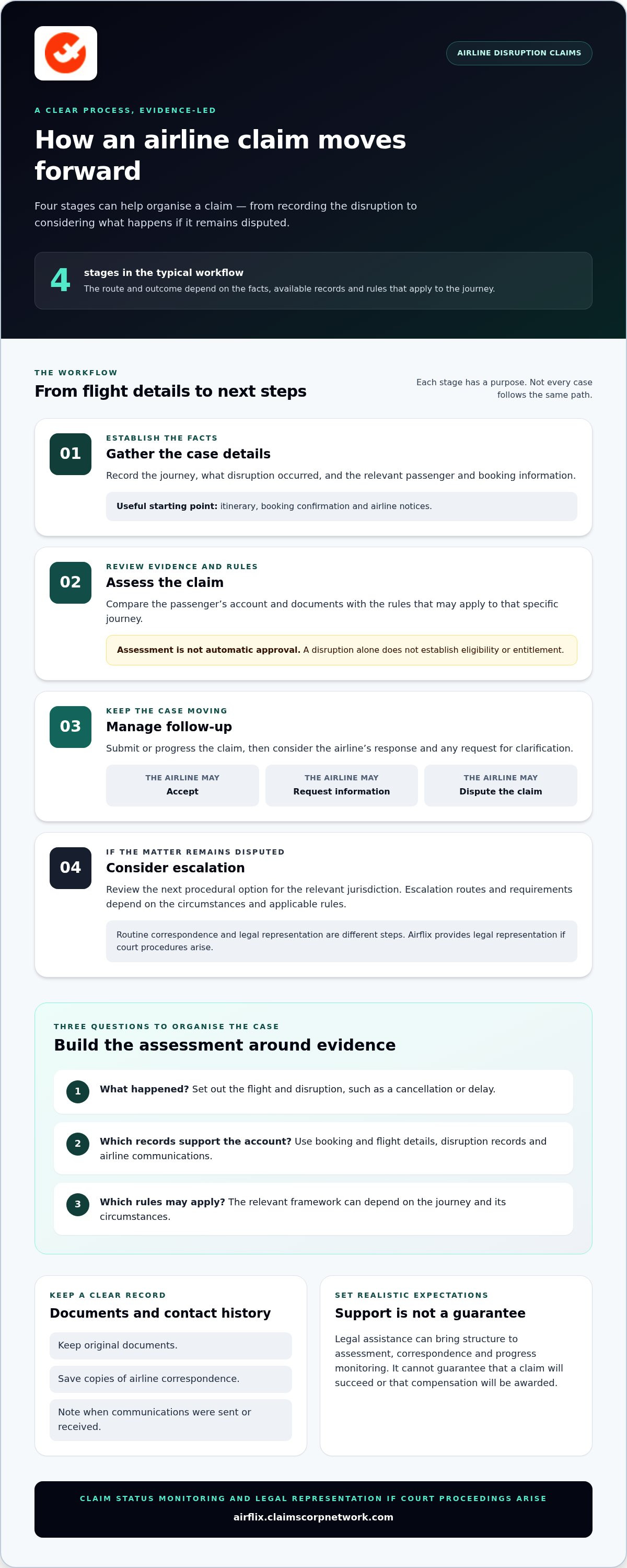
A claim is easier to manage when each stage has a clear purpose: establish what happened, assess the available evidence, follow up with the airline and decide whether another step is appropriate. Airline claim legal assistance can bring structure to this workflow, but cases do not all follow the same route or reach the same outcome. The facts, supporting records and rules that apply to the journey shape what happens next.
A typical process may include these stages:
- Gather the case details. Record the journey, the disruption and the relevant passenger and booking information.
- Assess the claim. Review the account and documents against the rules that may apply. Assessment is not automatic approval.
- Manage follow-up. Submit or progress the claim and consider the airline’s response, including any request for clarification.
- Consider escalation. If a claim remains disputed, review the next procedural option for the relevant jurisdiction.
From flight details to claim assessment
The itinerary establishes where the journey began and was due to end, while disruption information helps explain what changed. Passenger records and airline communications can add context, such as whether the flight was cancelled, delayed or otherwise affected. Together, these details support a review of the facts and relevant rules. They do not mean compensation is automatically due. Missing or inconsistent information may need clarification before the assessment can proceed.
An evidence-led claim assessment compares a passenger’s documented account of the disruption with the rules that may apply to that specific journey.
Airline response, follow-up and possible escalation
An airline may accept a claim, request more information or dispute the account or its implications. If it disputes a claim, review the records and the reason given before assuming the matter must go to court. Routine claim administration, such as managing correspondence, is distinct from legal representation, which is relevant if court procedures arise.
Escalation routes and procedural requirements depend on the jurisdiction and circumstances. A process relevant to a US journey, for example, may differ from one under another legal framework. The US DOT Office of Aviation Consumer Protection provides information on US air-travel consumer matters, including complaints. It is not a guide to every international claim.
Progress updates help passengers see whether a case is being assessed, followed up or awaiting a next step. They make the process easier to track, but don’t predict when a decision will arrive or what it will be. Airflix provides real-time claim-status monitoring so you can follow a case as it progresses. Explore Airflix claim monitoring to see how this supports visibility through the process.
Legal assistance or handling an airline claim yourself?
There isn’t one right route for every passenger. Your choice depends on how comfortable you are managing records and airline correspondence, and whether the case involves uncertainty or more involved procedures. Airline claim legal assistance offers structured handling and progress visibility. Managing the claim yourself can be practical if you understand the process and can keep the case organised.
| Consideration | Managing the claim yourself | Using legal assistance |
|---|---|---|
| Passenger effort | You organise the records, prepare correspondence and follow up with the airline. | Claim handling can support you with managing the case and its follow-up. |
| Process oversight | You keep track of what has been sent, what response is due and what step may follow. | Structured case handling helps maintain oversight as the claim progresses. |
| Case visibility | You maintain your own record of the claim’s status and communications. | Airflix provides real-time claim-status monitoring, making case progress easier to follow. |
| Escalation support | You research and manage any further steps relevant to the journey. | Assistance supports the claim process, and legal representation is provided if court procedures arise. |
The table compares general features, not guaranteed results. Assistance doesn’t establish eligibility, ensure payment or secure a favourable decision. The facts and rules applicable to the journey still matter. Passengers considering a journey covered by EU rules can consult the European Commission Air Passenger Rights page for an official overview. The appropriate process can differ across jurisdictions.
When might self-management be sufficient?
Self-management may suit you if you understand the relevant claim process, have a clear account of the disruption and can organise the supporting documents. It can also work when the airline’s correspondence is straightforward and you’re confident responding to it. You remain responsible for reviewing any decision, retaining records and meeting applicable procedural requirements. Managing a claim independently doesn’t remove those responsibilities.
When can structured support add practical value?
Support can be useful if the airline disputes the claim, correspondence becomes repetitive or it’s difficult to understand what procedural step may follow. A monitored process makes it easier to see where a case stands, though updates don’t predict when it will be resolved. Claim administration and court representation are distinct: managing correspondence isn’t the same as representing a passenger if court procedures arise.
To decide, consider the work involved, not just the disruption itself. If you can keep a clear record, interpret the airline’s response and manage the next step, self-management may be proportionate. If you want structured oversight or the process becomes difficult to follow, assistance can help organise the case. Neither route guarantees a successful claim, and assisted claims aren’t necessarily faster or more likely to succeed.
How to prepare information for airline claim legal assistance
A well-organised case file makes the facts easier to review, reduces the chance of overlooking relevant details and gives a clearer basis for follow-up. Before seeking airline claim legal assistance, gather what you already have rather than waiting to create a perfect file. The documents that matter depend on the disruption and the rules that may apply. Use this checklist as a practical starting point, not a guarantee that every item will be required.
Which flight and booking records should be organised?
Start with records that identify the journey and show how the disruption unfolded. Keep original files where possible, and make copies for reference. Useful records may include:
- Booking confirmation and itinerary, including the affected flight details.
- Boarding pass or other available travel documentation.
- Airline notifications about a delay, cancellation, rerouting or other change.
- Records that help establish the sequence of events, such as updated itinerary information.
Write a short timeline while the details are fresh. Note the affected flight, what changed and when you became aware of it. Separate what you observed from information provided by the airline. If you’re unsure of a precise time or reason, say so rather than filling the gap from memory. Don’t alter original documents. If a detail needs explanation, add a separate note and keep the source material intact.
How should airline correspondence be recorded?
Keep the complete exchange with the airline, not only its latest reply. Save copies of messages, submitted forms and responses, along with dates and any reference numbers. A simple log helps: record when you sent a message, its subject, how it was submitted and whether a response followed. If you speak to the airline, note the date and substance of the conversation as accurately as you can.
Organise records in date order and use clear file names where practical. For example, label a saved message with its date and whether it was a submission or a reply. Keep attachments with the message they relate to. This makes it easier to connect an airline response to the point it addresses and identify unanswered questions without searching through a long inbox.
Keep facts and interpretations distinct. “The airline notified me of a cancellation” describes a recorded event; “the airline was responsible for the cancellation” may require further evidence or assessment. This distinction helps you present a consistent account without overstating what the documents establish. Organised records also make it easier to explain what happened and identify gaps in the timeline.
Once you’ve gathered your records, you can submit your flight claim for assistance.
How Airflix provides airline claim legal assistance
Airflix is a digital aviation claims solution developed within Claims Corporation Network. Its flight-disruption service combines claim handling with status visibility, helping passengers follow a case as it progresses. This makes the stages easier to track, while recognising that claims can take different routes and decisions depend on the individual case.
Passenger support and case-status visibility
After a passenger submits details of a disruption, Airflix assesses and manages the claim through the relevant stages, including follow-up with the airline where appropriate. Real-time claim-status monitoring lets passengers see where the case stands, rather than relying only on their own notes. Status information shows progress; it doesn’t predict a resolution date or guarantee compensation.
Airflix provides legal representation if court procedures arise. This is distinct from routine claim administration: representation applies if a case reaches that stage, but doesn’t ensure a favourable outcome. The facts, supporting evidence and applicable rules remain central to the assessment. Case updates show process movement while helping passengers keep realistic expectations about the decision itself.
Baggage matters are a separate service context. Airflix provides a baggage-claim regress service, distinct from the flight-disruption claim process described above. Keeping the two issues separate helps passengers identify the type of matter they’re raising and organise the relevant records.
For passengers seeking airline claim legal assistance, Airflix combines claim handling with ongoing visibility. This is useful when the challenge is not only submitting a claim, but also following its progress through airline correspondence and any later procedural steps. Monitoring supports oversight; it isn’t a decision on eligibility or entitlement.
A separate portal option for travel partners
Airflix also offers a white-label passenger portal for travel agents and operators. This partner-facing option lets organisations provide branded passenger claim management and real-time case tracking. It’s separate from the individual passenger service: the portal supports a travel partner’s passenger-facing claims activity, rather than adding a step every passenger must take.
For travel partners, a branded portal brings passenger claim management and case visibility into their customer journey. It provides a channel for managing claims and tracking cases, without implying that every claim is eligible or that a particular outcome will follow. This partner option is distinct from support for an individual dealing with a disrupted flight.
Passengers seeking a structured route for a flight-disruption claim can explore Airflix flight-disruption legal assistance and consider how claim support and status monitoring fit their circumstances.
Choose a practical next step for your claim
Before taking action, consider what would make the process easier to manage: a clearer view of progress, support with follow-up or help if formal proceedings arise. This can help you decide whether to continue handling the claim yourself or seek airline claim legal assistance, based on the circumstances and your confidence in managing the next steps.
Airflix provides claim-status monitoring and legal representation if court procedures arise. These are forms of support, not a promise of compensation or a favourable decision. Travel agents and operators can also explore the separate white-label passenger portal for branded claim management and case tracking.
If structured assistance fits your situation, explore Airflix airline claim legal assistance and take the next step. A well-considered route can make the process clearer, whatever the eventual outcome.
Frequently Asked Questions
Is airline claim legal assistance the same as travel insurance?
No. Airline claim legal assistance supports the assessment and pursuit of a claim against an airline; travel insurance is a separate product governed by its policy. Airflix provides flight-disruption legal assistance, not travel insurance. For example, assistance with an airline claim doesn’t add medical or cancellation cover to an insurance policy. It doesn’t replace separate insurance or change the airline’s underlying responsibilities, so treat these as distinct arrangements.
Can I get airline claim legal assistance after the airline has rejected my claim?
Yes. A rejection can still be reviewed, but it doesn’t establish that the claim should proceed. The airline’s stated reason, the documents available and the rules for the journey all matter. Keep the rejection message and any evidence relevant to the reason given, such as a booking record or disruption notice. Assistance can help assess possible next steps, including escalation where appropriate, but cannot guarantee the airline will change its decision.
How much does airline claim legal assistance cost?
Costs and payment arrangements depend on the service and its terms. Airflix offers monthly or yearly subscription options and per-flight arrangements. Before proceeding, review the relevant offer to understand what the arrangement covers and how the claim will be managed. This gives you a sound basis for comparing the service and its terms, without relying on an assumed saving or promised recovery.
Does legal assistance guarantee airline compensation?
No. Assistance supports the work of assessing and pursuing a claim, but it can’t guarantee that you’re eligible, that the airline will accept the claim or that compensation will be awarded. A disruption notice, for example, can confirm that a flight changed, but may not establish why it changed or which rules apply. The outcome depends on the specific evidence and applicable legal process, including any further procedures needed.
Can I handle a flight claim myself instead of using legal assistance?
Yes. You can manage a claim independently, particularly if you’re comfortable organising evidence, corresponding with the airline and following the relevant procedure. If you can track replies and respond to requests, you may prefer to handle a straightforward exchange yourself. Keep copies of what you submit and review any decision carefully. Choosing self-management doesn’t remove applicable procedural requirements or the need to provide accurate information.
Does airline claim legal assistance apply to every disrupted flight?
No. A disruption alone doesn’t establish a right to make a successful claim. The route, flight circumstances, available evidence and relevant legal framework can all affect whether a claim is available. A cancellation notice, for example, may show what happened without resolving every question about the case. Treat general guidance as a starting point and assess the specific journey against current requirements before drawing conclusions about entitlement.
Can a legal representative make an airline accept a claim?
No. A representative can communicate and pursue a case through relevant procedures, but can’t compel an airline to accept it or guarantee payment. If the airline contests the claim, its position and the available evidence inform what may happen next. Court representation may be relevant if proceedings arise; any decision then rests with the appropriate legal process. Representation supports the case, but doesn’t determine its outcome.


