

Could a disrupted flight entitle you to compensation, a refund, assistance, or more than one? Working out how to get flight compensation involves more than counting hours. The relevant rules depend on factors such as your route, the operating airline and the cause of the disruption. A ticket refund and assistance during travel are separate considerations.
It can be difficult to know where to start, especially when the airline’s explanation leaves your rights unclear or you’re unsure what evidence to keep. Begin by identifying the passenger-rights rules that may apply and recording what happened. Keep your booking details, airline messages, arrival times and receipts together.
This guide explains the main factors that affect eligibility, what information to gather and how to submit a well-supported claim. It also covers how to track progress and what to consider if the airline disputes your claim. Airflix provides flight disruption legal assistance, real-time claim-status monitoring and legal representation in court proceedings for passengers who want help managing the process.
Key Takeaways
- To understand how to get flight compensation, first identify which passenger-rights rules apply to your route and operating airline.
- A delay, cancellation or denied boarding needs its own eligibility assessment. Disruption alone doesn’t establish a right to compensation.
- Keep booking details, airline communications and journey records to support your claim. Store receipts for expenses separately.
- Compare submitting a clear claim directly with using legal assistance to manage the process, then keep track of its status.
- Airflix provides flight disruption legal assistance, real-time claim-status monitoring and legal representation in court proceedings.
How to get flight compensation: start by identifying the rules for your journey
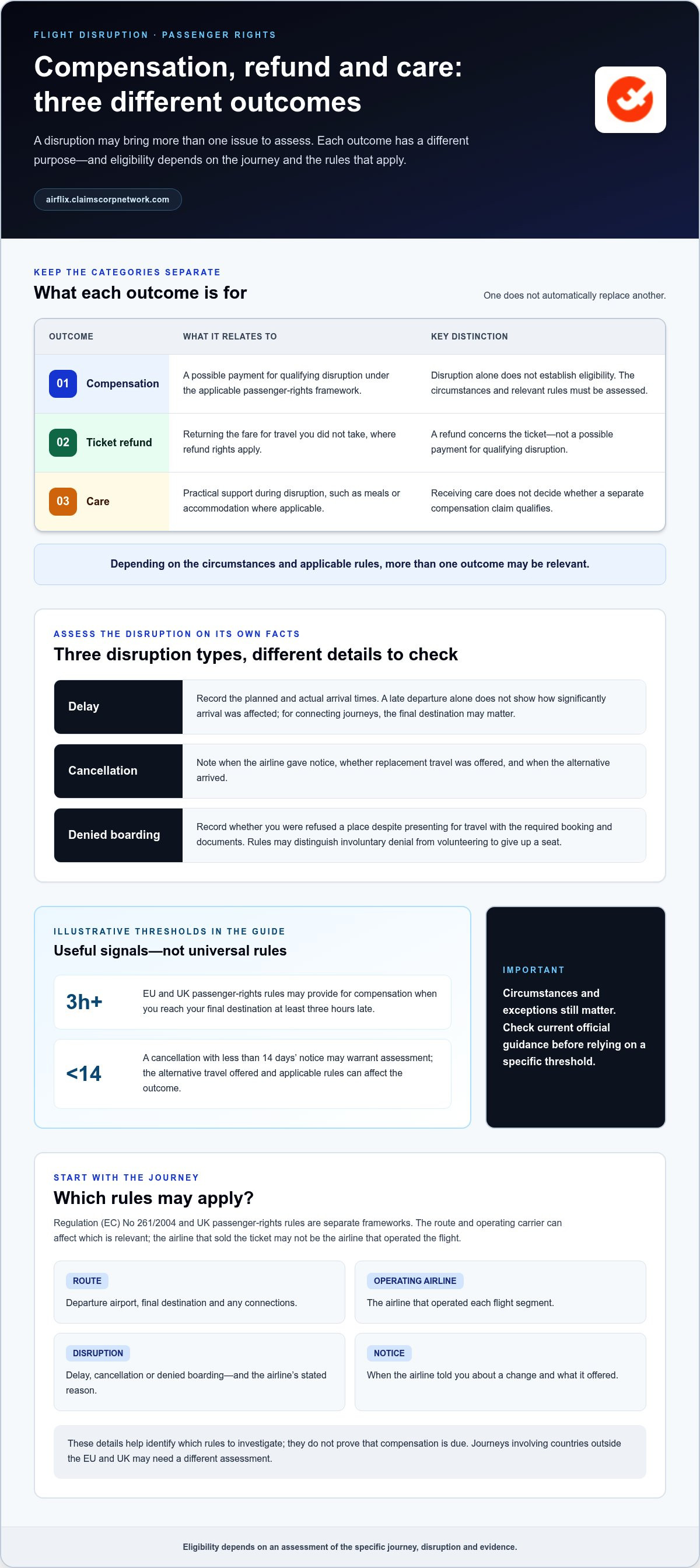
Before deciding how to get flight compensation, establish which passenger-rights rules may apply to your journey. Compensation is a possible statutory payment for qualifying disruption. It is different from a refund for an unused ticket and from care, such as meals or accommodation, provided during a disruption where applicable. Each has a different purpose, and one does not automatically replace another.
Delays, cancellations and denied boarding are common reasons to look into a claim, but the event alone doesn’t establish eligibility. The relevant rules and the circumstances of the disruption must be assessed. Start with the full journey: where each flight departed, the final destination, which airline operated each flight and whether the flights were part of a connecting itinerary. The airline that sold the ticket may differ from the airline that operated the flight.
Which passenger-rights rules may apply to a flight?
Regulation (EC) No 261/2004 and UK passenger-rights rules are separate frameworks. The route and operating carrier can affect which framework is relevant, so don’t assume the rules based on where you bought the ticket or the airline’s brand. The EU Regulation 261/2004 provides background on the EU framework. For a route-specific assessment, check current official guidance, including information from the relevant regulator.
For an initial assessment, record:
- The departure airport and final destination, including any connections.
- The operating airline for each flight segment.
- Whether the disruption involved a delay, cancellation or denied boarding.
- The airline’s stated reason and when it notified you of a change.
These details help you identify which rules to investigate, but they don’t prove that compensation is due. Passenger-rights rules can also differ outside the EU and UK, so a journey involving another country may need a different assessment.
What counts as compensation, a refund or assistance?
Keep the categories separate when reviewing the airline’s response. Compensation may be payable for qualifying disruption under the applicable rules. A ticket refund concerns the cost of travel you didn’t take, where refund rights apply and you choose not to continue with an alternative journey. Care addresses immediate needs during disruption, where the rules require it.
| Outcome | What it relates to |
|---|---|
| Compensation | A possible payment for qualifying disruption under the applicable framework. |
| Ticket refund | Returning the fare for travel not taken, where refund rights apply. |
| Care | Practical support during disruption, such as meals or accommodation where applicable. |
A refund isn’t the same as compensation, and receiving care doesn’t decide whether a separate compensation claim qualifies. Depending on the circumstances and the rules that apply, more than one outcome may be relevant. This guide covers general principles rather than deciding an individual claim. Eligibility depends on an assessment of the specific journey and evidence.
When can a delayed, cancelled or disrupted flight qualify for compensation?
A disruption is a reason to assess your rights, not proof that compensation is due. Eligibility depends on the passenger-rights framework that applies and the details of what happened, including the length of any arrival delay, how much notice you received of a cancellation and the cause of the disruption. Each situation has its own test, so don’t treat one threshold as a universal rule.
For example, EU and UK passenger-rights rules may provide for compensation when a passenger reaches their final destination at least three hours late, but the circumstances and applicable exceptions still matter. A cancellation with less than 14 days’ notice may also warrant assessment. The outcome can depend on the alternative travel offered and the rules governing the journey. Check current official guidance, such as the European Union air passenger rights information, before relying on a specific threshold.
How do delay, cancellation and denied boarding differ?
A delay means the flight operates later than scheduled. Record both the planned and actual arrival times: a late departure alone doesn’t show how significantly your arrival was affected. For a connecting itinerary, your arrival time at the final destination may also matter under the applicable rules.
A cancellation means the scheduled flight doesn’t operate as planned. Note when the airline notified you, whether it offered replacement travel and when that alternative arrived. Accepting a rerouting option doesn’t automatically settle whether compensation applies, but the timing and effect on your journey may form part of the assessment.
Denied boarding is different. It generally means you were refused a place on a flight despite presenting for travel with the required booking and documents, rather than choosing not to board. The rules may distinguish involuntary denied boarding from situations where a passenger volunteers to give up their seat. Keep any written explanation and details of what the airline offered.
How can the cause of disruption affect a claim?
The airline’s explanation matters because some rules make compensation dependent on the cause of the disruption. Extraordinary circumstances, such as severe weather or air traffic control strikes, may affect entitlement under some frameworks. However, describing a disruption as “operational” doesn’t automatically exempt the airline, and the same exception doesn’t apply in every jurisdiction.
Save the airline’s messages, announcements and any later explanation. If the reason is unclear, make a note of what you were told and when. Then compare that explanation with the current rules for your journey instead of assuming a broad label settles the claim. The airline’s stated cause is useful evidence, but the applicable legal test determines how it should be assessed.
These distinctions are central to understanding how to get flight compensation, but they don’t replace an assessment of your individual case. Airflix provides flight disruption legal assistance, including claim-status monitoring and legal representation if court proceedings arise. Neither a disruption nor a claim guarantees compensation.
Claiming yourself or using legal assistance: compare the practical routes
You don’t have to hire a representative to submit a flight compensation claim. If the relevant rules are clear and your evidence is organised, contacting the airline directly may be a practical option. You control the wording, documents and follow-up, and can keep the claim focused on the facts of your journey.
Another option is supported claim handling. This may suit passengers who would prefer help managing correspondence, or whose claim is harder to assess because the airline disputes the facts, gives an unclear response or asks for more documentation. Assistance can reduce the administration you handle, but it can’t guarantee that the airline will accept the claim, make a payment or respond within a particular timeframe.
What does handling a claim directly involve?
Making a direct claim usually involves identifying the applicable process, preparing a concise account of what happened, attaching relevant evidence and submitting it through the airline’s stated channel. Keep a copy of your submission and any acknowledgement. You remain responsible for monitoring replies, providing requested information and deciding what to do if the airline rejects or doesn’t resolve the claim.
Possible escalation routes depend on the jurisdiction and the rules governing the journey. You may need to follow a specific complaint or dispute-resolution process before considering further action. Check current guidance for the relevant country rather than assuming the same route applies everywhere.
When might legal assistance be useful?
Consider what the case requires from you. A straightforward claim with consistent booking records, clear disruption details and a direct response from the airline may be manageable without representation. More involved correspondence can take additional time, particularly if the airline challenges the claim or the applicable rules are difficult to interpret. You may choose legal assistance to help manage that process.
Airflix provides flight disruption legal assistance and real-time claim-status monitoring, so passengers can follow the progress of a case. If court proceedings arise, Airflix also provides legal representation. These services support claim management, but they don’t determine the airline’s decision or assure a particular outcome.
Before choosing a route, consider how much time you can allocate, how complete your records are and whether you’re comfortable handling a disputed response. Keep copies of every message and note any deadlines that apply. If you’d prefer support with the administration, Airflix flight disruption claim assistance is available.
In practical terms, how to get flight compensation depends first on the rules and evidence, then on how you choose to pursue the claim. Direct submission can suit a clear case; assistance is an option, not a prerequisite. Either way, retain a record of the claim and assess each airline response against the applicable process.
How to submit a flight compensation claim: an evidence-led process
An organised claim makes it easier to explain what happened and assess the airline’s response. Before submitting, separate evidence about the disruption and journey from receipts for additional expenses. These records may relate to different rights: receipts can support a request for reimbursement where applicable, but they don’t establish entitlement to compensation on their own.
What information and evidence should you prepare?
Gather your booking confirmation, flight number, travel date and the names of the passengers included in the claim. Add the scheduled and actual departure and arrival times, any cancellation or rerouting notice, and the airline’s explanation of the disruption. Keep relevant emails, messages and written responses together. If you’re seeking reimbursement for expenses, retain itemised receipts separately and note what each cost covered.
Set out the timeline clearly. For example, note when the airline notified you of a cancellation, what alternative journey it offered and when you arrived. Keep copies rather than sending original documents, unless the official process specifically requires otherwise.
How to submit and follow up
Use this workflow to prepare, submit and track your claim:
- Check the applicable rules. Identify the relevant passenger-rights framework, the airline responsible for the flight and the route or complaint process that applies.
- Organise the evidence. Match each document to a fact, such as the booking, disruption notice or arrival time. Keep expense receipts separate.
- Write a concise account. State the flight details, describe what happened in chronological order and explain what outcome you’re requesting. Leave out unrelated issues that could make the claim harder to review.
- Submit through the official channel. Send the claim to the airline or other responsible body using the applicable official form or contact route. Follow its instructions for passenger details and supporting documents.
- Keep a complete record. Save the submitted claim, attachments, submission date, confirmation and any reference number. Add later correspondence to the same file.
After submitting, compare each response with the applicable rules and the evidence you provided. If the airline asks for more information, keep a copy of your reply and note when you sent it. If it rejects the claim, identify the reason given and whether it addresses the facts and rules relevant to your journey.
Escalation options vary by jurisdiction. Check current official guidance before taking the next step, including any process or deadline that applies. Don’t assume a route available under one country’s rules also applies under another framework.
Airflix provides flight disruption legal assistance and real-time claim-status monitoring for passengers who want support managing a claim. Get support with your flight disruption claim and track its progress. Assistance doesn’t guarantee acceptance, payment or a particular timeframe.
How Airflix supports passengers pursuing flight compensation
Airflix provides legal assistance for passengers managing flight disruption claims, with real-time monitoring to make claim progress visible. This can help if you’d prefer not to manage every part of the correspondence yourself or if the case needs further attention.
What happens when you use Airflix for a flight claim?
Airflix assists with pursuing flight disruption claims and provides real-time claim-status monitoring. Tracking lets passengers follow a case and view updates as they become available. It doesn’t determine the outcome or mean that a claim has been accepted.
As with any claim route, an assessment depends on the journey, the applicable passenger-rights rules and the information available. Keep your booking details, disruption records and correspondence organised so the relevant facts are clear as the claim progresses. Airflix also provides legal representation if court proceedings arise. This doesn’t mean every claim goes to court: court action is one possible stage in some cases, not a standard requirement for all passengers.
What to consider before choosing your next step
Before deciding how to proceed, prepare a clear record of your itinerary and the disruption. Keep your booking confirmation, flight number, travel date, airline notices, timing information and relevant correspondence together. If the airline has responded, include its explanation and any reference number. An organised record helps keep your account consistent, whether you submit a claim yourself or use assistance.
Then consider what you need from the process. You may feel comfortable managing a clear claim directly, while a disputed response or complex correspondence may make support useful. The right route depends on your circumstances and the applicable rules, which can affect both eligibility and complaint or escalation procedures. Check current official guidance for the relevant jurisdiction before taking formal steps.
Understanding the process is only part of pursuing a claim. Keeping your records together and tracking what happens next can help you manage the work involved. Airflix’s flight disruption legal assistance includes claim-status monitoring and, where court proceedings arise, legal representation. These services can help manage a claim, but don’t guarantee compensation or a particular outcome.
Choose the next step that fits your claim
Understanding how to get flight compensation is useful when it helps you decide what to do next. Consider whether you’re ready to manage the claim yourself or would prefer support with the process. Keep your journey records accessible and note what still needs attention, such as reviewing an airline response or checking the procedure that applies to your route.
You don’t need to treat this decision as a prediction of the outcome. A claim’s progress and result depend on its circumstances and the relevant rules. Focus on choosing a considered next step rather than assuming disruption automatically leads to payment or that assistance guarantees it.
Airflix provides flight disruption legal assistance, real-time claim-status monitoring and legal representation in court proceedings. If you’d like support managing your claim, explore Airflix flight claim assistance.
Frequently Asked Questions
Can I claim flight compensation if I booked through a travel agent?
Yes. Booking through a travel agent doesn’t by itself determine whether you can claim. The airline operating the flight and the rules that apply to your journey matter to the assessment. Check your itinerary for the operating carrier, then use the relevant official claim route. Keep the agent’s confirmation as well as any airline-issued booking or disruption messages, particularly if the flight number changed.
How long does it take to receive flight compensation?
There’s no single timeframe for receiving compensation. A claim may take longer if the airline asks for more evidence or disputes eligibility. Keep the submission confirmation, case reference and a dated record of messages so you can follow up with a clear history. If you’re tracking a case through a claim service, status updates can show progress, but they can’t predict when it will finish or guarantee a particular outcome.
Can I claim flight compensation for an old flight?
Possibly, but the deadline depends on the applicable rules and jurisdiction, so the flight date alone isn’t enough to decide. Find the travel date, relevant airline correspondence and any existing claim records, then check current official guidance for the route and claim type. If you’re asking how to get flight compensation for an older journey, assess the deadline promptly rather than relying on a general time limit found online.
What if the airline says extraordinary circumstances caused the disruption?
The airline’s explanation doesn’t automatically settle whether compensation is payable. Ask for its reasoning in writing, including the stated cause and how it relates to your flight, then compare that explanation with the rules that apply to your journey. Keep messages, notices and other records that may help establish the timeline. If the response is unclear or you disagree with its assessment, consider the official complaint or escalation process for the relevant jurisdiction.
Can I claim compensation for a connecting flight?
Yes, a disruption affecting a connection may be relevant to a compensation assessment, but the itinerary and circumstances matter. Keep the booking showing all flight legs, along with boarding passes or travel records for each segment and evidence of when you reached your final destination. For example, if a delay on the first leg caused you to miss the next flight, record the replacement arrangements and your actual arrival details. Don’t assume each leg is assessed independently.
Is flight compensation separate from travel insurance?
Yes. A passenger-rights claim against an airline and a claim under a travel insurance policy are separate processes, with different terms and evidence requirements. Depending on what happened, you may need to review each separately rather than treating an insurer’s reimbursement as an airline compensation decision. Airflix provides legal assistance for flight disruption claims. For an insurance claim, refer to the policy wording and the insurer’s claims process.


