

You lift your suitcase from the carousel and find a cracked shell or broken wheel. Before leaving the airport, take photographs and report the damage to the airline. Knowing how to get compensation for damaged luggage starts with acting promptly: reporting deadlines can depend on your itinerary and the rules that apply, and a clear record helps document the bag’s condition.
It’s understandable to be unsure which process applies, what evidence to keep or whether an airline’s first response reflects the full value of your loss. A claim isn’t automatically successful, but a clear account of the damage, your report and the bag’s value can help support it.
This guide explains what to do at the airport, which documents to retain and how to identify the rules that may apply to your journey. It also covers how to respond if the airline refuses your claim or offers less than you believe the evidence supports. Airflix provides baggage claim regress support and real-time claim status monitoring for passengers managing this process.
Key Takeaways
- To understand how to get compensation for damaged luggage, report the damage promptly through the airline’s designated process and keep the reference number.
- The rules can depend on your route. The Montreal Convention is relevant to many international journeys.
- Photographs, receipts and other records can help show the damage, its cause and the value of your loss.
- Physical damage, missing contents and ordinary wear may be assessed differently. Describe each issue separately.
- If the airline disputes your claim or offers less than expected, review its reasons and respond with relevant evidence. Baggage claim regress support can help with claim handling and status monitoring.
Damaged luggage after a flight: what counts, and what should you do first?
A damaged-baggage claim asks an airline to address physical harm to a bag, or a related loss, that occurred while the bag was in its care. A cracked shell, broken handle or wheel that no longer turns properly may be relevant. The airline assesses the circumstances, including what was damaged, whether it appears to have happened during the journey and what evidence supports your account.
Check the bag before arranging repairs or discarding any packaging. Photograph the damage from several angles, with close-ups of affected parts and a wider view showing the whole suitcase. If available, keep photographs of the bag before travel too. Report the damage promptly, as deadlines can be strict and vary with the route and applicable rules. Follow the airline’s reporting instructions and record when and how you notified it.
A damaged bag is not the same as luggage that arrives late or does not arrive. Physical damage concerns the bag’s condition or potentially its contents. Delay and non-arrival concern the bag’s whereabouts and require different information. Describe the issue accurately so the airline can assess the right type of baggage claim.
What counts as damaged luggage after air travel?
Damage can include a cracked or crushed case, a detached handle, torn fabric or a wheel broken during transit. Record each affected part and any contents that appear damaged. Don’t assume every reported loss will be covered. Visible marks alone may not show when or how the damage occurred, so explain what you found and when you first noticed it.
Distinguish new damage from existing scratches, dents or signs of regular use. A bag may have ordinary wear as well as a new break, so describe both accurately. In the United States, the Department of Transportation has clarified that damage to wheels, handles, straps and zips is not automatically normal wear and tear. The rules that apply to your claim still depend on the journey and other relevant circumstances.
Why the itinerary matters to a baggage claim
Your route helps determine which legal framework applies. Domestic travel and international journeys may be subject to different rules. An itinerary with connecting flights can make the relevant framework less obvious than the final destination suggests. The airline, the journey’s structure and the circumstances of the damage can all affect how the claim is assessed.
The Montreal Convention is an international treaty relevant to baggage liability on many international journeys. It does not apply automatically to every flight described as international. Its applicability depends on the itinerary and other facts. Before relying on a particular deadline or compensation limit, establish which rules govern your route and claim. Identifying the right process is an important first step in understanding how to get compensation for damaged luggage, because strong evidence cannot replace the need to use the applicable process.
Which rules apply to a damaged-luggage compensation claim?
The rules for a damaged-baggage claim depend on the journey and the applicable law. A passenger’s rights on a domestic flight may differ from those on an international itinerary. The carrier’s baggage conditions can also affect how it handles a report. Start by establishing which framework applies rather than assuming one country’s rules cover every part of the trip.
Keep the full itinerary, booking details and baggage report together. If the journey involved connections or more than one airline, note which carrier operated each leg and where you discovered the damage. These details can help identify the route and carrier, but do not determine liability on their own. The airline may consider the circumstances, the evidence and the applicable legal conditions.
When the Montreal Convention may apply
The Montreal Convention is relevant to many international journeys, but it does not automatically apply to every flight described as international. Whether it governs a claim can depend on the itinerary and details of carriage. Where it applies, baggage liability is subject to conditions and limits. It does not provide automatic payment for every reported break or loss.
Before relying on a specific deadline or compensation limit, confirm the current rule for your route and claim. Avoid using a figure or time period from a different journey, airline or earlier guidance. This matters especially when an itinerary includes several legs, as the applicable framework may not be clear from the final destination alone.
Airline claims, insurance, and applicable limits
An airline claim and a travel insurance claim are separate processes. Reporting damage to the airline does not necessarily meet an insurance policy’s requirements, and an insurance claim does not replace the airline’s reporting process. Read the relevant policy terms and airline instructions, and keep copies of communications so you can manage each claim on its own basis.
Depending on the claim, useful evidence may include photographs, a baggage report, receipts or repair assessments. These records can help explain the bag’s condition and support the value claimed, but they do not make every cost recoverable. The airline or insurer may consider the cause, the nature of the damage, the applicable conditions and the evidence provided. Compensation is not automatic, and the assessment may differ from the amount requested.
Airflix provides baggage claim regress support and real-time claim status monitoring for passengers progressing a baggage claim. This gives you a structured way to manage the claim after identifying the applicable rules and gathering supporting records.
What damage and losses may a baggage claim cover?
A baggage claim may concern physical damage to a suitcase, items reported missing from it, or both. Describe these as separate issues. The airline may assess what happened, the bag’s condition before travel and the evidence supporting each claimed loss. A repair estimate or replacement price can help explain the impact, but neither automatically establishes what the airline is liable to pay.
Use the comparison below to organise the details before submitting your claim. The airline’s process and the rules for your itinerary will determine what it considers.
| Issue | What to describe | Evidence that may help |
|---|---|---|
| Physical damage | The affected part and how the bag’s use or function has changed. | Photographs, repair assessment and proof of purchase, if available. |
| Missing contents | Each item believed to be missing, listed separately. | Receipts, photographs or other records that support ownership and value. |
| Ordinary wear or previous damage | Existing marks or deterioration, distinguished from any new break. | Earlier photographs or other records showing the bag’s prior condition. |
Damage to the suitcase versus missing contents
Describe damage to the suitcase and missing contents as separate parts of the claim, even if you noticed them at the same time. For example, state that a zip is broken, then list any contents you believe are missing, with a clear description of each item. This helps distinguish missing property from damage to the case itself.
Keep the list factual. Note when you last saw each item and what supports your account, such as a receipt or photograph. Don’t assume that every item or related expense will be accepted. Follow the airline’s reporting instructions and organise the information in the format it requests.
Wear and tear, previous damage, and valuation
A scuff or faded surface may reflect ordinary use, while a new crack or broken component may indicate a change during the journey. If the bag already had marks, distinguish them from the damage you’re reporting. Earlier photographs can help show the difference, but the airline will assess the circumstances and available evidence.
Proof of purchase may support the bag’s original cost, while a repair estimate can indicate the cost of addressing the present damage. If repair is not practical, evidence of a comparable replacement may help explain the amount claimed. These documents serve different purposes, and the original purchase price does not necessarily equal the assessed loss. Don’t assume that related expenses, such as buying another bag, are automatically recoverable.
Evidence can make a claim clearer, but it doesn’t guarantee acceptance or a particular amount. An organised account helps the airline assess the damage and the value claimed. To understand how to get compensation for damaged luggage, separate each type of loss and match it to relevant evidence.
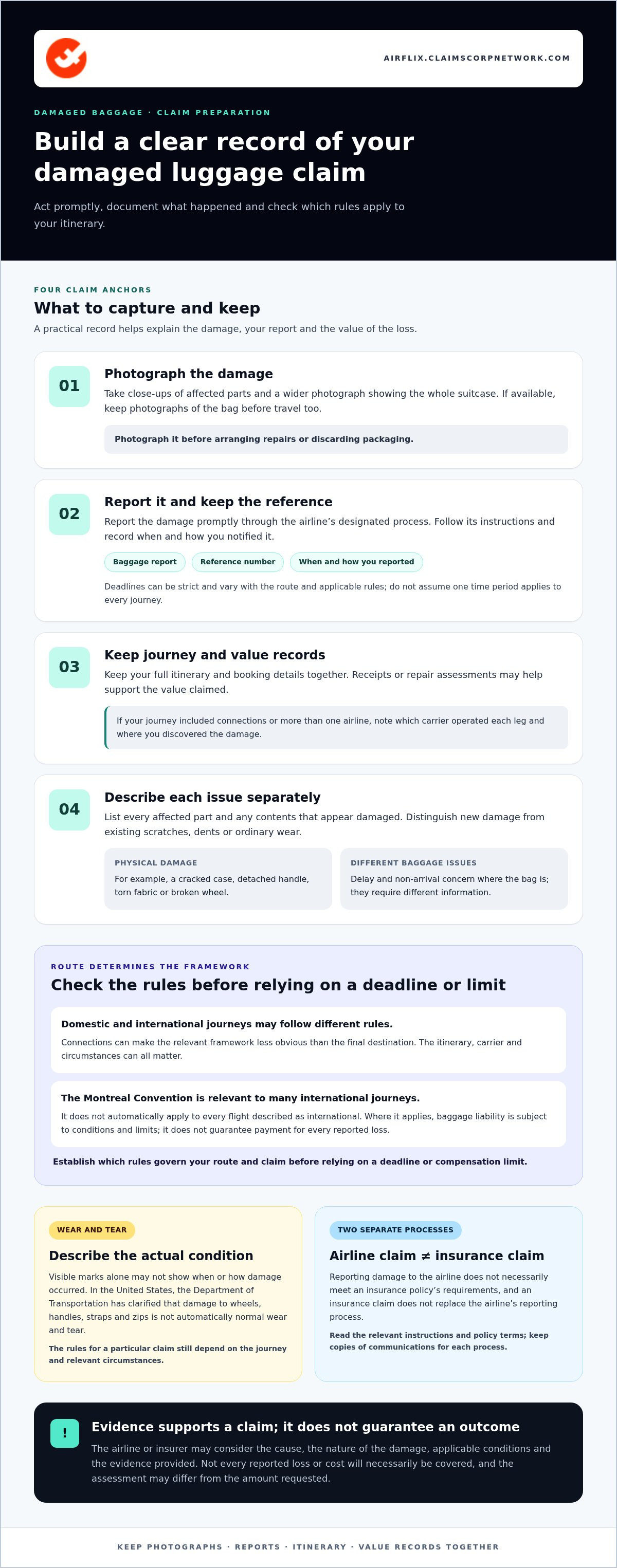
How to report damaged luggage and prepare your claim
A clear, consistent record makes it easier for the airline to assess what happened and what loss you’re claiming. Reporting deadlines vary by itinerary and applicable rules, so don’t assume the same time limit applies to every flight. Follow the airline’s designated process promptly and retain copies of every submission and response.
Document the damage before making a claim
Record the suitcase’s condition before repairing or disposing of it. Take clear photographs from several angles, including close-ups of broken parts and wider shots showing the whole bag. Note when and where you discovered the damage, and keep your bag tag and travel documents. Retain the damaged luggage and relevant receipts until the claim has been assessed, unless the airline gives different instructions.
Then follow this sequence:
- Document the damage. Photograph each affected area and write a concise note describing what you found and when.
- Report it to the airline. Use the baggage service desk or the airline’s designated online process. Follow its instructions and submit the report promptly, since deadlines can differ by route and carrier.
- Keep the reference. Record the report number, submission date and any contact details or confirmation provided. Save screenshots or copies of online forms.
- Submit supporting evidence. Provide the requested documents, keep a copy of each item sent and note when you submitted it.
Submit the report and retain a clear record
Use the airline’s requested forms and reporting channel rather than relying on an informal conversation alone. If you report the damage at a desk, ask for a written record or reference. If you use an online form, save the confirmation page or email. Keep your account factual: include the flight details, when you discovered the damage, what is affected and what outcome you’re requesting.
Useful records may include photographs, your bag tag, itinerary or booking confirmation, proof of purchase, and repair or replacement information. If contents are also missing, list them separately and provide relevant evidence for each item. Send copies unless the airline specifically requests an original, and keep a record of what you supplied.
These steps give the airline a clear basis to review the report, but they don’t guarantee that a claim will be accepted or paid in full. For help managing a baggage claim and monitoring its progress, use Airflix baggage claim assistance.
What to do if an Airline Disputes Your Luggage Claim
A refusal, a reduced settlement and an unanswered claim call for different next steps. First identify which situation applies. If the airline has made a decision, compare its reasons with the evidence you submitted. If you’ve received no substantive response, check the status of the claim and use the airline’s stated follow-up channel. Keep your messages factual and retain a copy of each one.
How to respond to a rejection or disputed assessment
Compare the airline’s explanation with your original report. It may dispute when the damage occurred, the bag’s condition, the cause of the damage or the value claimed. Note each point separately and identify any document that addresses it. If the response does not explain how the assessment was reached, ask for written clarification rather than guessing at the reason.
Organise your reply so the reviewer can follow the sequence: journey and discovery, initial report and reference, evidence submitted, airline response, then the specific point you’re disputing. Attach relevant photographs, receipts, repair estimates or correspondence again if needed, and explain briefly what each item shows. Avoid adding unrelated costs or unsupported claims, which can distract from the issue under review.
If the airline hasn’t answered, refer to the date and method of your original submission, include the reference number and request an update. An unanswered claim is not the same as a reasoned rejection, so make the distinction clear. Keep copies of your follow-up and any confirmation of receipt.
Escalation options depend on the applicable rules, the airline’s complaint procedure and the itinerary. Review the relevant process and any applicable time limits before taking the next step. A further review may be possible, but an appeal or escalation does not guarantee that the airline will change its position or offer a particular amount. A clear written record helps you understand what has been considered and what remains in dispute.
How Airflix supports baggage claim handling
Once you’ve organised the report, response and supporting documents, Airflix’s baggage claim regress service can support the handling of a disputed baggage claim. You can monitor claim status in real time to follow the case’s progress. If court procedures arise, Airflix provides legal representation. This support does not guarantee compensation: the outcome depends on the claim’s facts and applicable rules.
If you need help with the next stage, get support with a baggage claim. Keeping each step documented can help you respond clearly when the airline challenges the evidence or its assessment.
Take the next step with a clear claim plan
Decide what remains unresolved and keep the claim moving through the appropriate process. A concise case file can make this easier: note the current position, the point still in dispute and the action you intend to take next. This gives you a practical reference when following up or explaining the claim to someone assisting with it.
Knowing how to get compensation for damaged luggage is not about guaranteeing a particular result. It means approaching the claim methodically and making informed decisions as the airline reviews it. Airflix can support the handling of your baggage claim and provide real-time status monitoring.
Keep your records organised and focus on the next step. Get support with your baggage claim through Airflix.
Frequently Asked Questions
Can I claim for damage to items inside my suitcase?
You can report damaged or missing contents, but whether a loss is covered depends on the applicable rules, the circumstances and the evidence. Describe what happened to each item separately from damage to the suitcase. For example, if a toiletry bottle has leaked and stained clothing, record the affected items and their condition when you found them. Airline conditions may also set limits or exclusions for particular belongings.
What if I only notice the luggage damage after leaving the airport?
Report the damage to the airline as soon as you notice it, even if you’ve already left the airport. Use its designated baggage-claim channel and explain where and when you found the damage. Leaving the baggage hall does not by itself determine whether you can report it, but don’t delay: deadlines can depend on the journey and applicable rules. Keep the bag and original photographs, and avoid repairs that could obscure how the damage occurred.
Can I claim for a damaged cabin bag?
Possibly. The relevant question is what happened to the cabin bag and whether the airline had responsibility for it at the time. A bag carried and stored by its owner may raise different factual questions from one accepted by the airline for transport, such as a cabin bag placed in the hold. Describe how it was being handled, when the damage appeared and which airline operated that part of the journey.
Does travel insurance cover damaged luggage?
It may, depending on the policy wording and circumstances. Read the sections on baggage and personal belongings, including exclusions, excesses, valuation rules and notification requirements. A policy may treat a damaged suitcase differently from damage to an item inside it. An insurance claim is separate from an airline claim, so follow each process independently and provide accurate details about any related claim or payment.
What happens if the airline says the damage was already there?
Ask the airline to explain the basis for that assessment, then compare it with any evidence of the bag’s condition before the journey. A dated photograph taken before departure, for example, may show that a wheel or handle was intact. Respond to the specific point in dispute and explain what the evidence shows. The airline will assess the full circumstances, so no single document guarantees that it will change its decision.
Can I claim if my luggage has only cosmetic scratches?
You can report scratches, but marks consistent with ordinary use may be assessed differently from damage that affects the bag’s structure or function. Consider whether the mark is new and whether it has reduced the bag’s usability, rather than assuming every scuff supports compensation. A close-up and a wider photograph can show the mark in context. The airline’s assessment will depend on the evidence and applicable claim rules.


