

A delayed flight doesn’t automatically mean you have a valid compensation claim. Legal support for flight delays can help establish which passenger-rights rules apply, assess the airline’s explanation and identify the evidence needed before a claim proceeds.
It’s understandable to be unsure where to start. The relevant rules can depend on the journey, the length of the delay and its cause, so an airline’s response may not make your position clear. This guide explains when legal support may help, what information to gather and how to prepare for a clearer assessment.
You’ll also see how a claim can progress from a review of your flight details and supporting documents to correspondence with the airline. If a matter proceeds to court, legal representation may form part of the process. Airflix provides flight-disruption legal assistance and real-time claim-status monitoring, so you can follow progress without assuming compensation is guaranteed.
Key Takeaways
- Identify which passenger-rights framework applies to your journey before assessing whether a delay may support a claim.
- Legal support for flight delays can help organise an assessment, review the airline’s stated reason and identify appropriate next steps.
- Compare a passenger-led claim with supported handling to decide how you want to manage documents, airline follow-up and possible escalation.
- Gather your booking confirmation, boarding pass, flight number, travel date, and scheduled and actual arrival times to make an assessment clearer.
- Airflix provides claim-status monitoring and legal representation if court proceedings arise.
Legal support for flight delays: first establish which rules apply
Legal support for flight delays can help assess whether a claim may have a basis, organise the evidence and manage the process, including correspondence with the airline. If court proceedings arise, legal representation may also be relevant. This support does not guarantee compensation: a delay by itself does not establish entitlement. The applicable rules and the facts of the disruption must be considered together.
Start with the journey, not just the airline’s general explanation. The departure point, destination, operating carrier and route can determine which passenger-rights framework may apply. A connecting itinerary can make this less obvious, particularly if different airlines operate separate legs. Keep the details of each flight, including its operating carrier, so the journey can be assessed accurately.
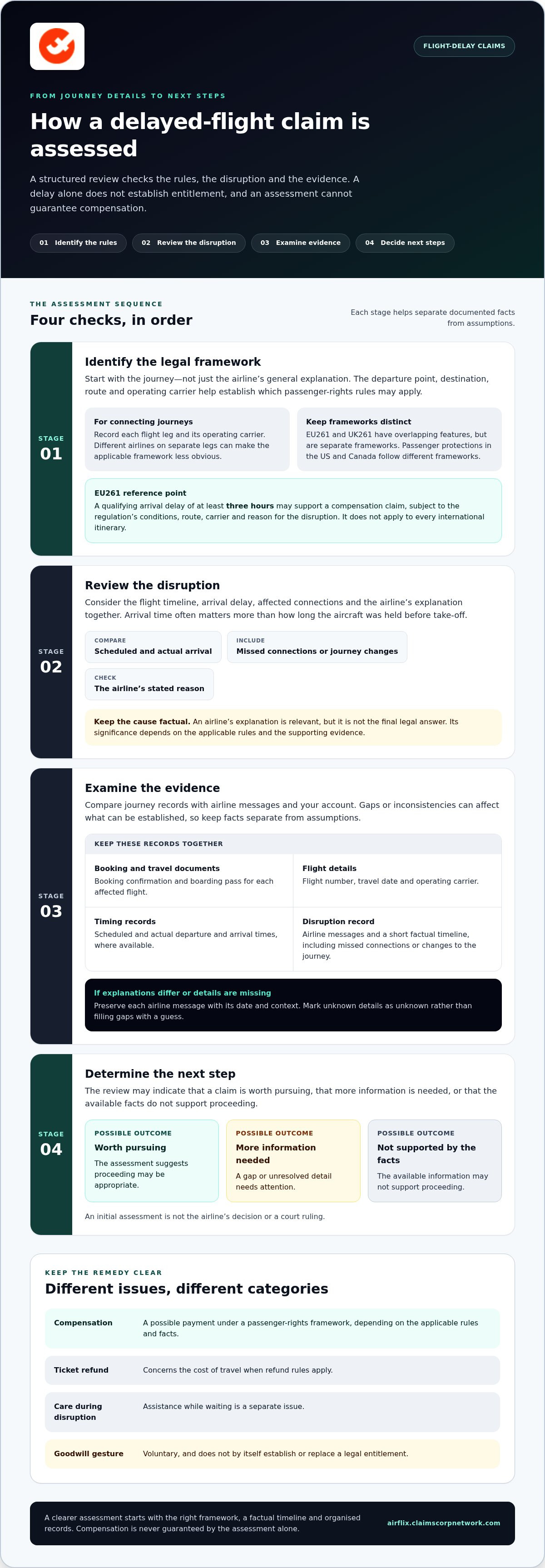
EU Regulation (EC) No 261/2004 and the UK’s separate UK261 framework have overlapping features, but neither should be assumed to cover every international itinerary. Under EU261, a qualifying arrival delay of at least three hours may support a compensation claim, subject to the regulation’s conditions and the reason for the disruption. The route and carrier also matter. The Air Passenger Rights Regulation overview provides background on EU rules, but an individual assessment still needs to consider the relevant route and circumstances. Passenger protections in the US and Canada follow different frameworks, so don’t assume that rights in one jurisdiction apply to another.
Which passenger-rights framework may cover a delayed flight?
EU261 and UK261 are distinct legal frameworks, even where their provisions are similar. The departure airport, arrival airport and operating carrier help determine whether either applies. For an itinerary with connections, record the details of each leg rather than relying only on the final destination or the airline that sold the ticket. This helps identify which rules to assess before considering eligibility.
What information helps establish whether a claim is worth assessing?
Arrival time often matters more than how long the aircraft was held before take-off, so note both the scheduled and actual arrival times at your destination. Keep key records together and describe events plainly. A concise account should set out what happened, what the airline told you and how the disruption affected your journey, without guessing at the legal significance of the cause.
Keep these details in one organised file:
- Booking confirmation and boarding pass for each affected flight.
- Flight number, travel date and operating carrier.
- Scheduled and actual departure and arrival times, where available.
- Airline messages or other communications explaining the disruption.
- A short factual timeline, including any missed connection or change to the journey.
Finally, distinguish the type of remedy you’re considering. Compensation is a possible payment under a passenger-rights framework; a ticket refund concerns the cost of travel when refund rules apply. Care during disruption, such as assistance while waiting, is a separate issue. An airline goodwill gesture is voluntary and does not, by itself, establish or replace a legal entitlement. Identifying the right category makes the assessment clearer.
How legal support assesses a delayed-flight claim
A claim assessment is a structured review, not a prediction of what an airline or court will decide. It compares the facts of the disruption with the rules that apply; it cannot promise compensation. Legal support for flight delays can help move the review from an initial eligibility question to an organised claim and, if necessary, possible legal escalation.
The process usually follows a sequence:
- Identify the legal framework. The journey details establish which passenger-rights rules may be relevant. The assessment should apply that framework’s test rather than rely on a general assumption about delay claims.
- Review the disruption. The flight timeline, arrival delay, affected connections and airline’s explanation are considered together. A short departure delay, for example, may have a different significance from a later arrival.
- Examine the evidence. Booking and journey records are compared with airline messages and the passenger’s account. Gaps or inconsistencies can affect what can be established, so the review should separate documented facts from assumptions.
- Determine next steps. The assessment may indicate that a claim is worth pursuing, that further information is needed, or that the available facts do not support proceeding. An initial view is not the airline’s decision or a court ruling.
How the delay reason and supporting evidence are reviewed
An airline’s stated cause is relevant, but it is not the final legal answer. A reviewer can compare the explanation with the passenger’s timeline, flight records and other available correspondence, then consider its significance under the applicable rules. The same description of an event may be assessed differently depending on the framework and evidence. The US Department of Transportation Flight Delay Rules provide a US reference, but should not be substituted for the rules governing another route.
A clear record helps keep the review grounded. If the airline gives different explanations at different points, preserve each message with its date and context. If details are missing, identify what is unknown rather than filling the gap with a guess. This makes it easier to distinguish a supported fact from an unresolved question.
What happens when an airline rejects or does not resolve a claim?
An airline response is one stage of the process, not necessarily the end. Depending on the applicable rules and the circumstances, further correspondence or legal escalation may be considered. Each step should address the airline’s stated reason and any evidence or reasoning in its response. Court proceedings are a possible later stage, not an automatic consequence of a rejected claim.
Airflix provides legal assistance for delayed-flight claims and legal representation in court proceedings. Representation supports the handling of proceedings, but cannot guarantee a particular decision or payment. Real-time claim-status monitoring helps passengers follow progress. For a structured review of a disruption claim, explore Airflix flight-delay claim support.
DIY claim or legal support: compare the work, oversight and escalation
Choosing between managing a claim yourself and seeking legal support for flight delays largely comes down to time, confidence and how much follow-up the case may require. A passenger-led claim can be appropriate when the facts are clear and you’re comfortable interpreting the relevant rules. Assistance can add structure when the case is more involved, the airline’s response leaves questions unresolved or legal proceedings may become relevant. Neither approach, on its own, determines whether a claim is valid.
Passenger time: A self-managed claim requires you to prepare the submission, track replies and decide what to do next. With assistance, the claims process is handled with support, although you may still need to provide information or respond to requests.
Document organisation: Managing a claim yourself means keeping records together and making sure the evidence supports your account. Structured assistance can help organise the material for assessment and follow-up.
Airline follow-up: With a passenger-led claim, you monitor correspondence and decide how to answer the airline. With legal support, claim communications can be handled as part of the process.
Escalation: You can decide independently whether to take further steps, but will need to assess what those steps involve. Legal assistance can help manage escalation and includes representation if court proceedings arise.
When managing a claim yourself may be practical
A straightforward case, with a clear journey record and a relevant explanation from the airline, may be manageable without assistance if you’re comfortable applying the rules and corresponding directly. Keep copies of everything you submit and receive, and maintain a dated log of calls, messages and decisions. A self-managed claim is not inherently weaker; its assessment depends on the applicable rules and evidence, not on who prepared it.
What legal support can add to the process
Support can provide a structured review of the facts against the relevant framework, help organise claim communications and identify possible next steps if the airline does not resolve the matter. Airflix provides legal assistance for flight-disruption claims, including delayed flights, and can represent passengers in court proceedings. Representation is a possible stage, not a promise of a particular decision or payment.
Before choosing, consider the complexity of the itinerary, whether the airline’s explanation is disputed and how much time you can give to correspondence. For EU journeys, the European Union Air Passenger Rights resource can help explain the applicable passenger-rights framework; it does not replace an assessment of individual facts.
Service terms and fee arrangements vary. Review the terms that apply to the assistance you’re considering, including how the claim is handled and what happens if it proceeds further. Compare the responsibilities and oversight involved rather than assuming either route guarantees a faster response or a successful outcome.
Prepare a delayed-flight claim with a clear evidence checklist
Good evidence helps show what was booked, what happened and what the airline communicated. It’s useful whether you plan to submit a claim yourself or seek legal support for flight delays. Keep original records where possible, and organise copies so each document can be matched to the relevant passenger and flight.
A dated timeline and original travel records make a claim easier to assess. Put the core journey documents first, then add communications and any records of extra spending. This keeps the evidence relevant and makes it easier to distinguish a possible compensation claim from a separate request relating to expenses.
Documents and details to gather before submitting a claim
Use the flight details shown on your booking and travel documents. For a journey with connections, record every affected leg separately, including its flight number and operating airline. Save messages in their original form rather than relying only on a summary or recollection. Receipts can support a separate expense request, but don’t by themselves establish entitlement to flight-delay compensation.
- Booking confirmation: Keep the itinerary and passenger names as booked.
- Boarding passes: Save a copy for each affected flight, if available.
- Flight details: Record each flight number, travel date and operating carrier.
- Timing: Note scheduled and actual departure and arrival times, particularly the arrival time at your destination.
- Airline communications: Retain emails, app notifications and written explanations, including later updates that differ from an earlier reason.
- Expense records: Store receipts separately and label each with its date, amount and purpose, such as a meal or replacement transport.
- Other relevant records: Keep information about a missed connection or change to the journey if it helps explain the disruption.
How to keep the claim accurate and easy to follow
Arrange the records in chronological order and create a short timeline of confirmed events. For example, note when the delay was announced, when the airline provided an explanation and when you arrived. If a time is approximate, label it as an estimate; don’t present it as a confirmed record. Use the same passenger names, booking reference and flight details throughout your notes and correspondence.
Keep your account factual. State what you observed and what the airline told you, separating those points from anything you cannot verify. Avoid overstating the length or impact of the disruption, and don’t include costs without a receipt or clear explanation. If documents appear to conflict, note the difference rather than altering a record to make the timeline seem consistent.
A concise, organised file is useful during an assessment and if further information is requested. To start a supported review of your delayed-flight claim, submit your flight details for claim support.
How Airflix supports a flight-delay claim through to the next stage
Airflix provides legal assistance for flight-disruption claims, including delayed flights. Its role is to support the claim process, from assessing the passenger’s situation to handling appropriate next steps. The claim still depends on the applicable passenger-rights rules and the facts of the disruption. Support can make the process more structured, but it does not guarantee compensation or a particular outcome.
A passenger’s claim can involve several stages: information is reviewed, the claim is progressed and the airline’s response is considered. If the matter requires further action, the appropriate next step depends on the case and the relevant procedures. Airflix’s real-time claim-status monitoring lets passengers follow the progress of a claim and see more clearly where it stands as it is handled.
What passengers can expect from claim monitoring
Status monitoring is a visibility tool. It helps passengers keep track of a claim’s progress without treating every update as a decision on eligibility. A status view cannot determine how the airline will respond, confirm that compensation is due or predict the final legal outcome. Those depend on the assessment, evidence and decisions made as the matter proceeds.
This distinction matters. A claim may be progressing while the substantive question remains unresolved. Monitoring helps make the process easier to follow, but it does not replace the underlying review of the route, disruption details and applicable rules. Nor should it be read as a promise that a claim will reach a particular stage or be completed within a specific period.
Airflix’s support connects the practical administration of a claim with the possibility of further action, if the circumstances call for it. The process is not the same for every passenger: the route, evidence and airline response can shape what happens next. Keeping a clear record of the claim and its status can help passengers understand where matters stand and what information may be relevant if further steps arise.
When legal representation may become relevant
If a claim proceeds to court, legal representation may form part of the later-stage process. Airflix provides legal representation in court proceedings. Whether that step is appropriate depends on the facts and procedures that apply; it is not an automatic result of an airline rejecting a claim. Representation supports the handling of proceedings, but cannot promise a particular decision or payment.
For passengers considering legal support for flight delays, Airflix combines claim assistance with real-time status monitoring, making progress easier to follow without confusing an update with an outcome. If you’re ready to explore support for your delayed-flight claim, view Airflix flight-delay legal support and consider the next step that fits your circumstances.
Take the next step with a clearer view of your claim
A delay can leave unanswered questions, but your next move needn’t be complicated. Start by deciding whether you’re comfortable managing the claim yourself or would value structured assistance with its assessment and progress. Legal support for flight delays can help turn the information you’ve gathered into a process you can follow, without treating compensation as a certainty.
Airflix is a specialist aviation brand developed within Claims Corporation Network. Its legal assistance includes real-time claim-status monitoring, and Airflix provides legal representation if proceedings arise. These are parts of the support process, not guarantees of a particular result.
If you’re ready to consider support for your circumstances, explore Airflix legal support for flight delays. A clear next step can help you move forward with confidence.
Frequently Asked Questions
Can I get legal support for a flight delay if the airline has rejected my claim?
Yes. An airline’s rejection doesn’t by itself determine whether your claim is valid. Keep the response, including the reason given, and compare it with your booking details and travel records. Legal support for flight delays can help review whether the explanation addresses the relevant rules and evidence. Depending on the case, possible next steps may include further correspondence or legal representation if proceedings become relevant.
Is legal support for flight delays only useful if I take the airline to court?
No. Assistance may be useful before court proceedings, for example if you’re unsure how the rules apply or need help organising a response to the airline. While specialist dispute resolution firms like WYN Legal handle formal litigation in complex civil disputes, most flight delay claims are resolved through negotiation well before court action is considered. The support that may be appropriate depends on the journey, the evidence available and the airline’s response. You can consider assistance without assuming that a case will go to court.
How long do I have to claim for a delayed flight?
There isn’t one deadline that applies to every delayed-flight claim. Time limits can vary with the passenger-rights framework and the legal process involved, so a period that applies to one journey may not apply to another. Note the travel date and keep any claim correspondence. Establish the current limit for the relevant route and rules promptly, and avoid delaying while you work out which deadline applies.
What happens if the airline says the delay was caused by extraordinary circumstances?
The airline’s explanation should be considered alongside the available evidence and the rules that apply to the journey. The phrase “extraordinary circumstances” doesn’t, on its own, resolve whether compensation is due. Keep the airline’s written explanation and any later updates, especially if the stated cause changes. An assessment can consider how the explanation relates to the circumstances, but it can’t promise that a claim will succeed.
Can I claim compensation for a delayed connecting flight?
Possibly, but the full itinerary may matter. For example, a passenger might reach the final destination later than planned even though the first flight departed close to schedule. Keep the booking and records for each flight, including any rebooking and the arrival time at the journey’s final destination. The relevant rules and how the flights were arranged affect the assessment, so don’t judge a connection solely by the delay on one leg.
Does legal support guarantee compensation for a delayed flight?
No. Legal assistance can help assess the claim and manage its progress, but it can’t guarantee that the airline will pay or that a court will rule in the passenger’s favour. The outcome depends on the applicable framework, the evidence and the circumstances of the disruption. Treat an initial assessment as a review of whether and how a claim may proceed, not as a promise of compensation.
What information should I provide for a delayed-flight claim assessment?
Provide the booking confirmation, boarding pass, flight number, travel date, and scheduled and actual arrival times. Include the airline’s explanation and any later messages so the sequence is clear. If you’re claiming separate expenses, keep those receipts distinct from the core travel records and note what each relates to. A brief timeline can also help clarify which details are confirmed and which are estimates or recollections.


