

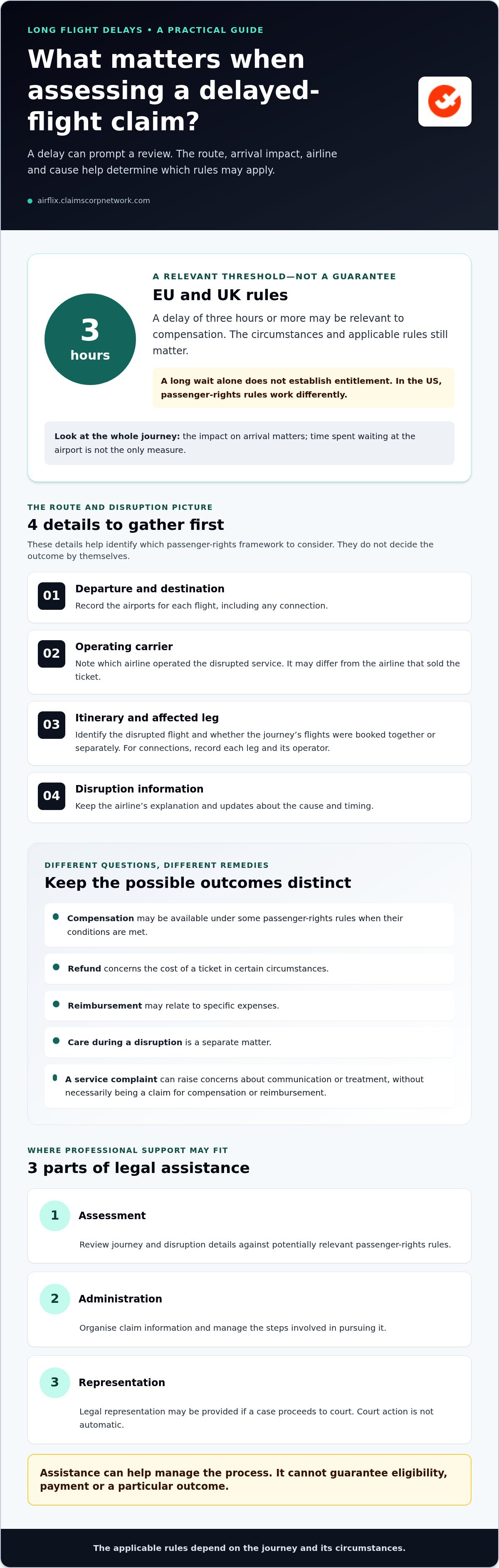
Legal assistance for long flight delays can help you understand whether a disruption may support a claim and what information is needed to assess it. The answer depends on which passenger-rights rules apply, how late you reached your destination and what caused the delay. Under EU and UK rules, a delay of three hours or more may be relevant to compensation, but the circumstances still matter. In the US, the rules work differently.
It’s understandable to be unsure where to begin, especially if the airline’s explanation is brief or you receive no clear response to a claim. Legal assistance can help assess the relevant rules and evidence, then manage the claim process. It can’t guarantee eligibility or a particular outcome.
This guide explains what to check first, which records can support an assessment and how professional assistance can help manage claim progress. It also covers real-time status monitoring and how legal representation may form part of the process if a case proceeds to court.
Key Takeaways
- A long delay alone doesn’t establish a right to compensation. The applicable rules and circumstances determine whether a claim may be available.
- Check the journey details, including departure and destination, to identify which passenger-rights framework may apply.
- Organise booking records, delay information, airline communications and relevant receipts to support an assessment.
- Consider whether legal assistance for long flight delays could help manage a complex or time-consuming claim.
- Real-time claim-status monitoring can make progress easier to follow, while court representation may be relevant if proceedings are required.
What legal assistance for long flight delays can, and cannot, do
Legal assistance helps assess, organise and, where appropriate, pursue a claim arising from a flight disruption. It does not promise that the claim will be accepted or paid. Support can clarify which rules may apply, organise relevant information and manage claim administration. A long wait at the airport may prompt a review, but the length of the delay alone doesn’t establish entitlement.
Different remedies address different issues. Compensation may be available under some passenger-rights rules when their conditions are met. A refund concerns the cost of a ticket in certain circumstances, while reimbursement may relate to specific expenses. Care during a disruption is a separate matter. A service complaint can raise concerns about communication or treatment without necessarily being a claim for compensation or reimbursement.
What makes a flight delay legally relevant?
An assessment considers the whole journey, not just the time spent waiting. The impact on arrival, route, operating carrier and stated cause of the disruption can all affect which rules apply and how they treat the circumstances. The relevant framework may depend on the departure point, destination and itinerary, so a rule that applies to one journey may not govern another.
A passenger-rights claim seeks a remedy available under applicable rules. A service complaint asks the airline to address a concern, while a request for assistance seeks practical support. These processes can overlap, but one does not automatically establish the other. For a broad overview of causes and regional approaches, see Flight delay. A specific eligibility assessment should use current rules for the relevant jurisdiction.
What can legal assistance cover?
Legal assistance for long flight delays can start with a review of the journey and disruption details. This means organising the itinerary, arrival information and airline explanations so they can be considered against potentially applicable rules. It helps separate relevant facts from assumptions, such as treating the scheduled departure delay as the only measure that matters.
Depending on the claim, professional support may include administering the claim and representing the passenger in court proceedings. Court action is not automatic; whether it is appropriate depends on the circumstances and process. Assistance can organise and manage the work, but it cannot guarantee eligibility, payment or a particular result.
- Assessment: Review journey and disruption details against potentially relevant passenger-rights rules.
- Administration: Organise claim information and manage the steps involved in pursuing it.
- Representation: Provide legal representation in court proceedings where the case proceeds to that stage.
For passengers, this support can reduce the administrative burden of deciding what to submit and following the process. Seeking assistance is separate from the underlying question of whether the facts and applicable rules support a claim.
Which passenger-rights rules apply to a long flight delay?
The applicable passenger-rights framework depends on the flight and its circumstances, not simply on how long the delay lasted. In 2026, an assessment may involve checking where the journey began and ended, which airline operated each flight and how the itinerary was arranged. EU and UK passenger-rights frameworks have defined scopes and conditions. Neither should be assumed to cover every international journey.
Start by gathering these details:
- Departure and destination: Record the airports for each flight, including any connection.
- Operating carrier: Identify the airline that operated the disrupted service. It may differ from the airline that sold the ticket.
- Itinerary: Note whether flights were booked together or separately, and identify the affected leg.
- Disruption information: Keep the airline’s explanation and updates about the cause and timing.
This checklist helps identify which rules to consider before assessing eligibility, but it doesn’t determine the outcome. Check the current rules for the relevant jurisdiction, as scope, conditions and legal interpretations can differ.
How route and operating carrier affect the assessment
A ticket can show one airline’s name even when another carrier operates the aircraft. This commonly happens with codeshares or connecting itineraries. The operating carrier can therefore be important when identifying which framework applies and which airline is relevant to the disrupted flight. For a connection, record the route and operator for each leg rather than relying only on the lead carrier shown on the booking confirmation.
For example, a connecting journey may involve two operating airlines and different departure points. That doesn’t mean one set of protections automatically governs the entire itinerary. Consider the route, ticket arrangements and rules in force before drawing a conclusion.
How the cause of delay may affect a claim
The airline’s explanation is relevant, but it may not be the complete legal analysis. Operational issues and events outside an airline’s control may be treated differently under some frameworks. The legal concept of extraordinary circumstances can be relevant to certain claims, but its application depends on the applicable law, the precise cause and the evidence.
Weather, a technical issue or staffing disruption shouldn’t be treated as an automatic answer either way. Look for the specific event said to have caused the delay, whether it affected the flight in question and what the airline has documented. A general label may not resolve those questions. The facts and applicable legal interpretation need to be assessed together.
Airline customer-service commitments and voluntary policies are another distinct layer. They may describe practical support offered during particular disruptions, but they aren’t automatically the same as statutory passenger rights or proof that compensation is due. If the route, carrier or relevant rules make the assessment difficult, organised legal assistance can help review the flight details and applicable framework. It can’t guarantee eligibility or a particular result.
Legal assistance or a direct airline claim: how to weigh the options
Passengers can usually start by contacting the airline themselves, but the right approach depends on the claim and the effort involved. A direct enquiry may be enough to request an explanation or address a service problem. A formal passenger-rights claim is different: it asks for a remedy under the rules that apply to the journey. The airline’s complaint process and a legal claim may overlap, but they aren’t automatically the same procedure.
Legal assistance for long flight delays can provide structure when the rules, evidence or airline response make a case harder to manage. It doesn’t change the eligibility criteria or guarantee that a claim will succeed. Use the comparison below to consider which approach better fits your circumstances.
| Consideration | Managing it directly | Using legal assistance |
|---|---|---|
| Time and administration | You prepare and submit the claim, keep records and follow up with the airline. | Claim administration can be handled with professional support, reducing the work you manage yourself. |
| Rules and complexity | May suit a case where you understand the relevant framework and the facts are straightforward. | Can help organise a review when the applicable rules or circumstances are less clear. |
| Airline response | You assess replies and decide what to do next. | Structured handling can help manage responses and potential escalation. |
| Oversight | You track progress using your own records and follow-ups. | Claim-status monitoring can make progress easier to follow. |
When might a passenger manage the claim directly?
Managing a claim yourself may be practical if you’ve identified the relevant rules, have a clear account of the disruption and feel comfortable making the claim and responding to the airline. Direct contact is also useful for asking what caused the delay, requesting documents or raising a service concern. It isn’t automatically quicker or more effective: response times and case complexity can vary.
When can legal assistance be useful?
Professional support may be useful if the airline’s explanation is disputed, the itinerary involves several carriers, the evidence is difficult to organise or you’re unsure how to respond to a rejection. Assistance can provide structured claim handling and, where appropriate, escalation or representation in court proceedings. Not every case reaches court, and support can’t guarantee eligibility or payment.
Before deciding, read the service terms carefully so you understand what the assistance covers, what you’re authorising and how the process is managed. Airflix provides flight-disruption legal assistance, with real-time claim-status monitoring to help you follow progress.
What records can help a long-delay claim receive a proper assessment?
A clear set of records helps establish what was booked, what happened and how the airline communicated during the disruption. It also makes it easier to distinguish confirmed details from recollection. No single document proves a claim by itself. The relevant evidence depends on the journey, the issue being assessed and the passenger-rights framework that applies.
Gather the information in sequence:
- Start with the booking: Save the confirmation, e-ticket and itinerary, including each flight number, route and operating carrier. Keep any updated booking if the airline changed your plans.
- Record the planned and actual journey: Retain boarding documents and note scheduled and actual departure and arrival times for each affected flight. Include connecting flights and any missed connection or rebooking.
- Keep disruption communications: Save airline emails, text messages, app notices and written explanations. Record when you received them, especially if the stated reason for the delay changed.
- Collect relevant expense records: Keep itemised receipts and proof of payment for costs connected with the disruption. These can help explain what you spent, though reimbursement depends on the applicable rules and circumstances.
Build a clear timeline of the disruption
Put events in chronological order, from the original schedule through your final arrival. Note when the delay was announced, what the airline said, when a replacement flight was offered and whether the connection or arrival time changed. Use travel documents and messages to support the timeline. If you add personal notes, distinguish what you observed from what you inferred about the cause or responsibility.
Keep documents organised for claim review
Group records by flight and date, then separate itinerary documents, timing evidence, airline communications and receipts. Use clear file names so a reviewer can find a notice or receipt without searching through unrelated material. Keep original messages and documents where possible, alongside copies. The precise records needed vary with the claim and applicable legal framework.
A concise chronology helps a reviewer compare the scheduled journey with what happened and identify gaps that may need clarification. For instance, a booking confirmation establishes the planned itinerary, while a rebooking notice may show how the airline changed it. Together, the records support a factual assessment. They don’t decide whether the law provides a remedy or guarantee a particular conclusion.
If organising evidence or managing the next steps feels burdensome, use Airflix flight-disruption claim assistance. Legal assistance for long flight delays can help manage claim administration, while the records you gather provide a clearer basis for review.
How Airflix manages legal assistance for long flight delays
After reviewing the relevant rules and gathering available records, passengers may prefer support managing a claim. Airflix provides flight-disruption legal assistance, including claim administration and real-time claim-status monitoring. Monitoring makes progress easier to follow, but it doesn’t predict whether a claim will be accepted or what its outcome will be.
Airflix is a specialised aviation claims solution within Claims Corporation Network. Each claim depends on its facts and the legal rules that apply. Professional assistance can help manage the process, but it can’t guarantee eligibility, payment or a particular result.
From claim information to monitored case progress
Organised journey and disruption details provide a clearer basis for assessment and subsequent case administration. The relevant information depends on the claim. Real-time status monitoring gives passengers a way to follow progress and track the administrative process, without suggesting when a decision will be made or what it will be.
What to expect when considering Airflix assistance
Airflix provides flight-disruption legal assistance and legal representation in court proceedings if a matter reaches that stage. Court representation is part of the service, but not every claim proceeds to court. The assessment remains dependent on the specific circumstances and applicable passenger-rights rules.
Passengers considering managed support can review how it may fit their circumstances and claim. Explore legal assistance for flight disruptions to learn more about Airflix’s approach to claim administration and status monitoring.
Choose a clear next step for your flight disruption
Uncertainty can make it tempting to leave a potential claim untouched. A practical next step is to decide whether you’re comfortable managing it yourself or would value structured support. The choice doesn’t alter the rules that apply, but it can shape how you handle administration and follow progress.
For passengers considering legal assistance for long flight delays, Airflix provides a specialised aviation claims solution within Claims Corporation Network. Its service includes real-time claim-status monitoring and legal representation in court proceedings if a matter reaches that stage. Neither changes the need to assess each case on its facts, and neither guarantees a particular result.
Explore the available support and decide whether managed assistance fits your circumstances. Explore legal assistance for flight disruptions and take an informed next step with greater clarity.
Frequently Asked Questions
Can I get legal assistance for any long flight delay?
Yes, you can seek an assessment, but a lengthy delay doesn’t automatically establish a right to compensation. The applicable rules may depend on the route, operating carrier, arrival impact and cause of the disruption. A review should also distinguish compensation from a ticket refund, care during the disruption or reimbursement of expenses. Airflix provides legal assistance to assess flight disruptions, but eligibility and outcomes depend on the facts and relevant law.
Is a delay of more than three hours always eligible for compensation?
No. A delay threshold used in one passenger-rights framework isn’t a universal guarantee. For example, the relevant measure may concern arrival rather than departure, and other conditions may apply to the route, carrier or cause. If a connection was involved, note the planned and actual arrival at your final destination. Check current official guidance for the specific journey before relying on a threshold or making a claim.
What happens if the airline says the delay was caused by extraordinary circumstances?
The airline’s explanation is relevant, but the phrase alone doesn’t settle whether compensation is due. Consider the applicable rules alongside the evidence about the specific event. Keep the original message, including its date, and save later explanations if they differ. For instance, a general notification may not identify the particular event affecting your flight. An assessment can consider the explanation without assuming it decides the claim.
Can I claim compensation and a refund for the same delayed flight?
Possibly, but compensation and a refund address different situations, so one shouldn’t be assumed to include the other. The answer depends on the disruption, whether you travelled and the rules governing your itinerary. Care or reimbursement for documented expenses may be separate questions. Before submitting requests, state clearly whether you’re seeking payment for the disruption, a ticket refund or repayment of a particular expense.
How long do I have to bring a long-delay flight claim?
There isn’t one deadline that safely applies to every flight claim. The relevant limitation period may depend on the jurisdiction and legal basis, so a timeframe found online for another country may not apply to your journey. Identify the route and airline involved, then check current official guidance promptly. Keep a dated copy of any claim or correspondence you submit to help establish the steps already taken.
Do I need a lawyer to make a flight-delay claim?
No. Passengers can contact an airline directly, particularly if the issue is straightforward and they understand the relevant process. Legal assistance for long flight delays may be useful if the airline disputes the facts, the itinerary is complex or you’re unsure how to proceed after a response. Compare the support and administration involved before deciding. Professional assistance can manage a claim, but it doesn’t change the eligibility rules or guarantee an outcome.
What evidence should I keep after a long flight delay?
Keep records that help verify the booking, the disruption and any resulting expense. Alongside your travel documents and airline messages, save rebooking details and receipts in their original digital format where possible. If a message disappears from an app, retain a dated screenshot or another copy. Note any differences between the airline’s explanation and what you observed, but separate direct observations from assumptions about the cause.


