

A delayed flight doesn’t automatically point to one remedy. The right legal assistance for flight issues depends on what happened, your itinerary and the rules that apply. A cancellation, long delay, denied boarding or baggage problem may each need a different claims route, so start by identifying the issue.
When an airline’s explanation is unclear or your evidence is spread across booking emails, notices and receipts, it can be difficult to know what to do next. This guide explains what legal assistance can do, what information to gather and how to approach a claim, without assuming that every disruption qualifies for compensation. Airflix supports flight disruption and baggage-related claims, with real-time claim status tracking and legal representation if court proceedings arise. The sections ahead explain how to classify a problem, organise useful evidence and follow claim progress.
Key Takeaways
- Identify the type of disruption, your route, the operating carrier and the circumstances when assessing which passenger-rights framework may apply.
- Legal assistance for flight issues can help assess, prepare and manage a claim, but it doesn’t establish eligibility or guarantee an outcome.
- Use your records to decide whether a direct airline complaint may be suitable or more structured support could help.
- Organise relevant travel documents and correspondence so the facts and claim history are easy to follow.
- Airflix supports claim handling and status monitoring, with legal representation if court proceedings arise. Travel-sector partners can use a white-label passenger portal.
Flight issues and legal assistance: understand what support can address
Legal assistance for flight issues means help assessing, preparing and managing a passenger claim. It can bring the relevant facts and documents together, clarify procedural steps and manage communications as a claim progresses. The support needed depends on the issue: a disrupted flight and a baggage problem may involve different records, procedures and rules.
It is useful to distinguish three broad categories:
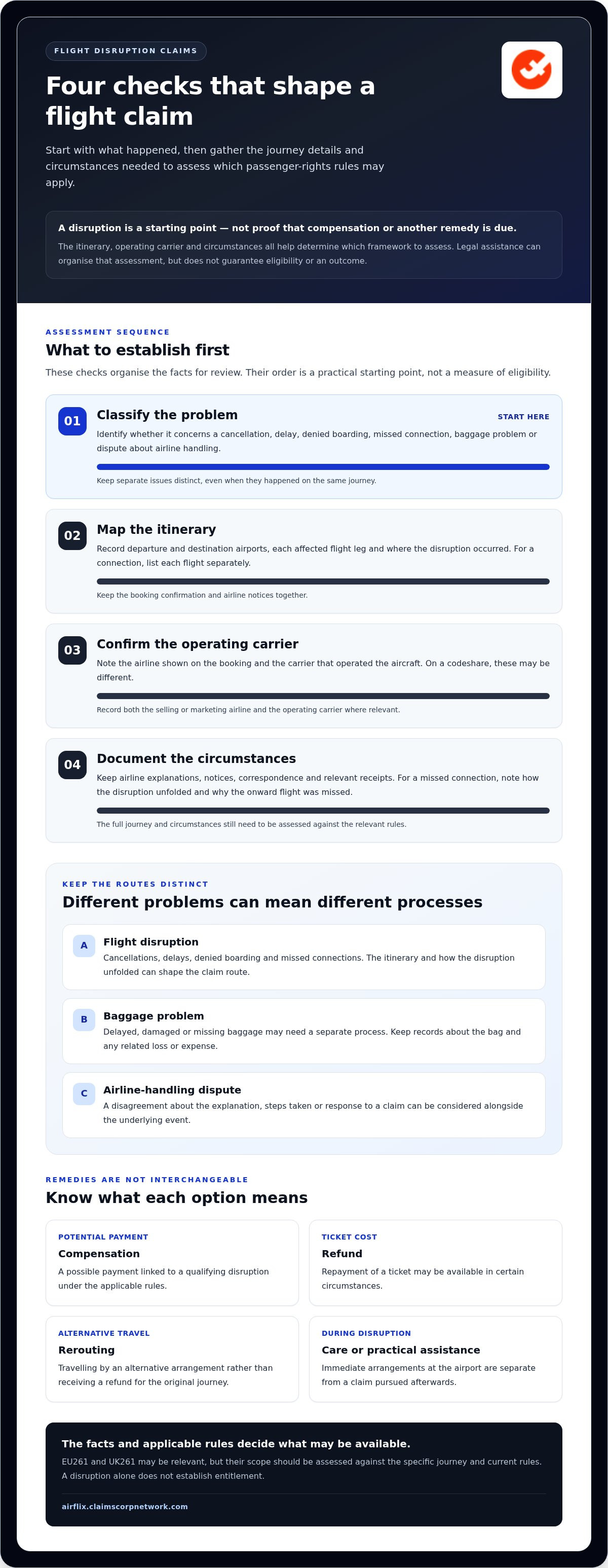
- Flight disruption: cancellations, delays, denied boarding and missed connections. The itinerary and how the disruption unfolded can shape the claim route.
- Baggage problems: delayed, damaged or missing baggage may require a separate process from a disruption claim, with records about the bag and any related loss or expense.
- Airline-handling disputes: a disagreement about the explanation given, the steps taken or the response to a claim may need to be considered alongside the underlying event.
These categories can overlap. A missed connection might follow a delayed first flight, while a baggage issue could arise during the same journey. The itinerary, operating carrier and circumstances help determine which rules are relevant. Classifying each problem separately makes it easier to explain what happened and avoid treating every issue as the same type of claim.
Which flight problems may call for legal support?
A cancellation removes a planned service; a delay changes its timing; denied boarding means a passenger is not permitted to board as expected. A missed connection concerns the onward part of an itinerary, and the reason it was missed may matter when assessing the circumstances. These descriptions help identify the issue, but don’t settle whether a particular remedy is available.
Baggage claims follow a different track from disruption claims. Keep the events distinct, even if they occurred on one trip, and note which carrier operated each flight. This gives you a clearer starting point for identifying the relevant process.
What legal assistance can and cannot establish
Assistance can help organise information, prepare and pursue a claim, and clarify procedural next steps. It can also help keep communications and supporting records together, reducing the administrative burden of managing the matter. Airflix provides legal representation if a claim proceeds to court.
Legal guidance can clarify a claim’s route, but the facts and applicable rules determine whether compensation or another remedy is due. Assistance is not insurance, automatic compensation or a promise that an airline will pay. It supports the process, but doesn’t itself establish eligibility or guarantee an outcome.
How passenger-rights rules apply to flight disruption claims
A delay or cancellation is the starting point for assessing a claim, not the answer to which rules apply. The relevant passenger-rights framework can depend on the itinerary, the operating carrier and the circumstances of the disruption. EU261 and UK261 may be relevant, but their scope and application should be assessed against the specific journey and current rules. The ticket seller’s location alone may not settle the question.
A disruption alone does not establish entitlement to compensation or another remedy; the applicable rules and the facts of the journey determine what may be available. A passenger might have a potential claim for one form of remedy but not another. Legal assistance for flight issues can help organise the assessment, but the route and relevant framework still need to be identified.
Why route and operating carrier matter
Start with your travel records, not an assumption about which country’s rules apply. Note the departure and destination airports, each affected flight, the airline shown on the booking and the carrier that operated the aircraft. On a codeshare, the airline that sold or marketed the flight may differ from the operating carrier, so record both. For connecting itineraries, list each flight leg separately and document where the disruption occurred.
These details help clarify which framework to assess, but don’t establish by themselves that it applies. The full itinerary and circumstances still matter. Keep your booking confirmation and airline notices together so the route can be reviewed accurately.
Compensation, refund and assistance are different remedies
Compensation is a potential payment linked to a qualifying disruption under the applicable rules. A refund concerns the cost of a ticket in circumstances where repayment may be available. Rerouting means travelling by an alternative arrangement rather than receiving a refund for the original journey. These are distinct options, and one shouldn’t be treated as an automatic substitute for another.
Care or practical assistance during a disruption is separate from a claim pursued afterwards. Depending on the situation and applicable rules, you may need to address immediate arrangements at the airport and later assess whether a further remedy is available. Keep receipts and written communications relating to expenses or assistance. Deadlines and procedures can vary, so don’t rely on a general time limit without checking the rules relevant to your journey.
Use current passenger-rights information alongside your travel documents to assess which framework may apply. A clear record of the route, carrier and event gives any later assessment a more reliable starting point.
How to assess flight legal assistance against your specific issue
The useful level of support depends on the issue and the work needed to progress it. A clear complaint about one cancelled flight, supported by a booking confirmation and airline notice, may be manageable through direct correspondence. A disputed explanation, a complicated connection or a claim that needs further legal steps may call for more structured handling. Either way, the evidence and applicable rules determine whether a remedy is available.
Use the table to identify a practical starting point. It highlights records to organise, not a guarantee that a claim will succeed.
| Issue | Useful records | Likely procedural focus |
|---|---|---|
| Cancellation or delay | Booking and itinerary, boarding pass, airline notices and messages | Establishing the journey, disruption and airline response |
| Denied boarding | Travel documents, airline communications and details of alternatives offered | Recording what happened at the airport and what options were presented |
| Missed connection | Full itinerary, records for each flight and notices about the affected leg | Setting out the sequence and how the itinerary was affected |
| Baggage problem | Baggage report, receipts, photographs where relevant and correspondence | Handling a separate baggage-related claim and supporting records |
Baggage-related regress should be treated separately from a flight-disruption claim. A delayed or damaged bag involves evidence about the baggage and any related loss or expense, while a disruption file centres on the flight and the airline’s handling of it. If both happen on one trip, keep distinct records for each so one issue doesn’t obscure the other.
Match the support to the disruption
For a cancellation or delay, organise the itinerary alongside the airline’s explanation and updates. For denied boarding or a missed connection, write down the sequence of events and retain details of any alternatives offered. Keep baggage reports, receipts and related correspondence in a separate file. This issue-led approach shows what has been documented and where information may still be missing.
Questions that clarify the assistance process
Assess whether the process explains its stages, the evidence needed and how progress is communicated. Claim administration and legal representation are different forms of support: preparing and managing a claim doesn’t necessarily mean representing it in court. Airflix provides real-time claim status tracking and legal representation in court proceedings. These services support the claims process, but don’t guarantee eligibility or an outcome. Look for clear explanations rather than promises of speed, certainty or recovery.
Legal assistance for flight issues is most useful when its role is clear and proportionate to the claim. A straightforward matter may need organised correspondence; a contested or more involved claim may require structured handling. Assistance supports the process, while the facts and applicable law determine the result.
Prepare a flight-issue claim with organised evidence and clear steps
A clear record makes it easier to explain what happened and keep a claim organised. Start with a concise timeline, then collect documents that support each stage of the journey and disruption. Keep original files where possible and save copies of messages, forms and notices. This preparation can help you spot missing information before submitting a claim.
- Document the event. Note the affected flight, scheduled and actual timings, what happened and when, and any explanation provided by the airline. For a missed connection, record the sequence across each flight and the effect on the rest of the itinerary.
- Gather relevant records. Keep booking confirmations, boarding passes, airline notices and correspondence together. Add receipts relating to expenses, and retain any forms or supporting evidence connected with the issue.
- Submit a clear account. Arrange the documents to support your timeline, then provide the information requested through the relevant claim process. A concise description is easier to follow than a collection of unlabelled files.
- Retain correspondence and track progress. Save the submitted material, submission date, reference number, replies and any requests for further information. Review each communication before responding or deciding on a next step.
A short chronology can clarify cause and sequence without requiring a lengthy narrative. For example, note when a delay was announced, what the airline communicated and how the planned connection or arrival was affected. Stick to information you can support with records, and distinguish confirmed details from your own recollection.
Build a clear record of what happened
Use one file or folder for each claim, with a simple, consistent naming system for documents. Keep flight-disruption records separate from baggage records: a baggage report, related receipts and correspondence concern a different issue from notices about a cancelled or delayed flight. If both arose on the same trip, separate files help prevent evidence or procedures from becoming mixed.
Organised records can support the review and handling of the information provided. Your documents should make it possible to follow the itinerary, event and subsequent communications without relying on memory alone.
Follow the claim without losing track of next steps
Maintain a simple log of submission dates, reference numbers, responses and outstanding requests. Response periods and escalation routes depend on the applicable rules and circumstances, so don’t assume one timetable applies to every claim. Read each reply carefully, note what it addresses and provide requested information clearly and in an organised way.
Legal assistance for flight issues can help structure claim information and monitor its progress, but it doesn’t establish eligibility or guarantee a remedy. Airflix provides real-time claim status tracking as part of its claims support. Explore Airflix claim assistance to see how structured handling can support your next steps.
How Airflix supports flight legal assistance and claim progression
General passenger-rights information can explain which rules may be relevant, but a claim also needs its records and progress managed. Airflix supports passengers with flight disruption claim handling, real-time claim status tracking and legal representation if court proceedings arise. These are distinct forms of support: handling and monitoring help you follow a claim, while representation may become relevant if the matter proceeds to court.
Status visibility helps passengers see how a claim is progressing; it isn’t a prediction of the result. Eligibility and any remedy depend on the facts, evidence and applicable law. Airflix’s support doesn’t guarantee compensation, recovery or a successful legal outcome. Keep the claim’s scope clear by recording the disruption, relevant documents and communications, and distinguish process updates from a decision on entitlement.
What passengers can expect during claim handling
For flight disruption, Airflix provides support with managing the claim and tracking its status in real time. If court proceedings arise, legal representation is available. Baggage-related regress is a separate area of support, with its own claim records and procedural focus. Keeping baggage documentation distinct from disruption evidence helps ensure each matter is handled on its relevant facts, rather than treated as a single claim.
This structure can reduce the administrative burden of keeping claim information and progress together. It also distinguishes general information from case-specific support: a framework may help explain what to consider, while claim handling concerns the individual matter and its supporting evidence. Neither status updates nor representation establish that a passenger qualifies for a particular remedy.
When travel-sector partners need a passenger-support workflow
Travel agencies and operators can use Airflix’s white-label passenger portal to support customer claims through a partner-branded workflow. The portal is designed for travel-sector partners, rather than being the passenger claim service itself. Partners can access real-time case tracking to follow claim progress without treating a status update as a decision or assuming an outcome.
For passengers, the relevant support includes flight disruption claims, baggage-related regress, claim monitoring and, where proceedings occur, legal representation. For partners, the portal provides a way to manage customer claims within a white-label setting. In both contexts, clear records and an understanding of the process help keep expectations grounded in the case facts.
If structured handling and claim visibility would help with your situation, review flight legal assistance as a possible next step. The appropriate route still depends on the issue, its evidence and the rules that apply.
Choose a clear next step for your claim
A flight problem can leave several decisions competing for attention: whether to challenge an airline response, which records matter and whether further support is proportionate. Your next step needn’t commit you to a particular outcome. It can simply be a structured review of the issue, the available documents and the process that may apply. Taking time to organise the facts can prevent a rushed response from obscuring what needs to be established.
Legal assistance for flight issues is most valuable when it helps you understand both the procedure and its limits. Start with practical steps: preserve relevant records, note any deadlines identified in authoritative guidance, and don’t treat an initial assessment as confirmation that compensation is due. A brief, factual account of what you want resolved can also focus the next stage, whether you manage the matter directly or seek support.
Ready to consider structured support for your case? Explore Airflix flight legal assistance and take a clear next step with your claim.
Frequently Asked Questions
Can I get legal assistance for any flight issue?
Not every travel problem follows the same claims process, but legal assistance for flight issues can help assess flight disruptions and baggage-related problems. Start by identifying what happened and which party was involved. For example, a damaged bag needs different supporting details from a cancelled flight. Support can help organise and manage a claim, but the issue, available evidence and applicable rules determine whether a remedy may be pursued.
Does legal assistance guarantee flight compensation?
No. Assistance can help prepare and progress a claim, but it can’t guarantee compensation or a successful outcome. An assessment may find that the evidence doesn’t support the claim or that the relevant rules don’t provide the remedy sought. A claim submission or status update isn’t the same as an airline accepting liability. The final position depends on the circumstances, supporting evidence and applicable law.
What documents should I keep after a flight disruption?
Keep your booking confirmation, boarding pass, airline messages and any written explanation of the disruption. Save receipts for relevant extra expenses and note the date, time and reference number of any complaint. If information appeared in an app or online account, retain a copy if possible, as details may later change or become harder to locate. Keep original files and organise copies by flight or claim.
Are a flight refund and compensation the same thing?
No. A refund generally concerns repayment for a ticket, while compensation is a separate remedy that may be available under applicable passenger-rights rules. One doesn’t automatically replace or establish entitlement to the other. For example, choosing not to travel after a cancellation may raise a refund question, while a separate compensation assessment would depend on the circumstances and relevant framework. Check what the airline’s response addresses before treating the matter as resolved.
Can EU261 or UK261 apply to my flight issue?
They may be relevant, depending on the route, operating carrier and circumstances of the disruption. Don’t assume that the airline’s country of registration or the place where you bought the ticket settles the question. Note each flight leg, including connections, and identify the carrier that operated each one. Then assess the itinerary against the current scope of the relevant framework before relying on a particular right or deadline.
What happens if an airline rejects my flight claim?
Read the rejection carefully and identify the reason given, any evidence the airline refers to and whether it asks for further information. Compare that explanation with your travel records and timeline, then keep the reply with your original submission. The next step may depend on the rules and circumstances of the case. Structured claim support can help organise a response or clarify procedural options, but rejection alone doesn’t determine whether further action is available.
Can a travel agent arrange assistance for a passenger claim?
Yes. Travel-sector partners can use Airflix’s white-label passenger portal to manage customer claims under their own brand, with access to real-time case tracking. This gives an agency or operator a way to follow claim progress for passengers, while the underlying assessment remains specific to each case. A travel agent should keep passenger records and claim communications clearly associated with the relevant booking so the information can be reviewed accurately.


