

Can an airline’s failure to provide meals or accommodation entitle you to cash compensation? The distinction matters: compensation for lack of flight assistance may mean reimbursement for necessary expenses, while fixed flight compensation is a separate claim with its own eligibility rules.
If a disruption leaves you waiting and the airline does not provide required care, you may be able to seek reimbursement for reasonable expenses you paid yourself. However, a failure to assist does not automatically entitle you to fixed compensation.
This guide explains when care may be due under EU261 or UK261, how to document missing assistance and request reimbursement, and when the disruption might also support a separate compensation claim. The applicable rules depend on your journey and circumstances. Airflix provides legal assistance with flight disruption claims and real-time claim status monitoring.
Key Takeaways
- Distinguish practical care and reimbursement for necessary expenses from fixed flight compensation. Each has different conditions.
- Check whether EU261 or UK261 applies to your journey, then assess the disruption under the relevant rules.
- For a potential compensation for lack of flight assistance claim, keep flight records, airline messages, photographs, receipts and notes of what happened.
- Describe what assistance was missing and list the expenses you incurred, supporting each item with your records.
- Airflix can provide legal assistance with the claim process and monitor its status in real time.
Compensation for Lack of Flight Assistance: What Does the Term Mean?
“Compensation for lack of flight assistance” can refer to different remedies. If an airline fails to provide required meals, accommodation or other care during a disruption, you may be able to seek reimbursement for necessary expenses you paid yourself. That is separate from a fixed cash award for an eligible flight disruption.
Where passenger-rights rules apply, assistance means practical care required during a qualifying disruption; fixed compensation is a separate remedy with its own eligibility rules. The relevant rights depend on the journey, what happened and which rules govern it, including Regulation (EC) No 261/2004 or UK261 where applicable.
It helps to separate three questions. First, what care was the airline required to provide while you waited? Second, can you recover reasonable costs you paid because that care was not provided? Third, does the disruption qualify for fixed flight compensation? A problem with one does not automatically establish a right to the others.
What counts as flight assistance during a disruption?
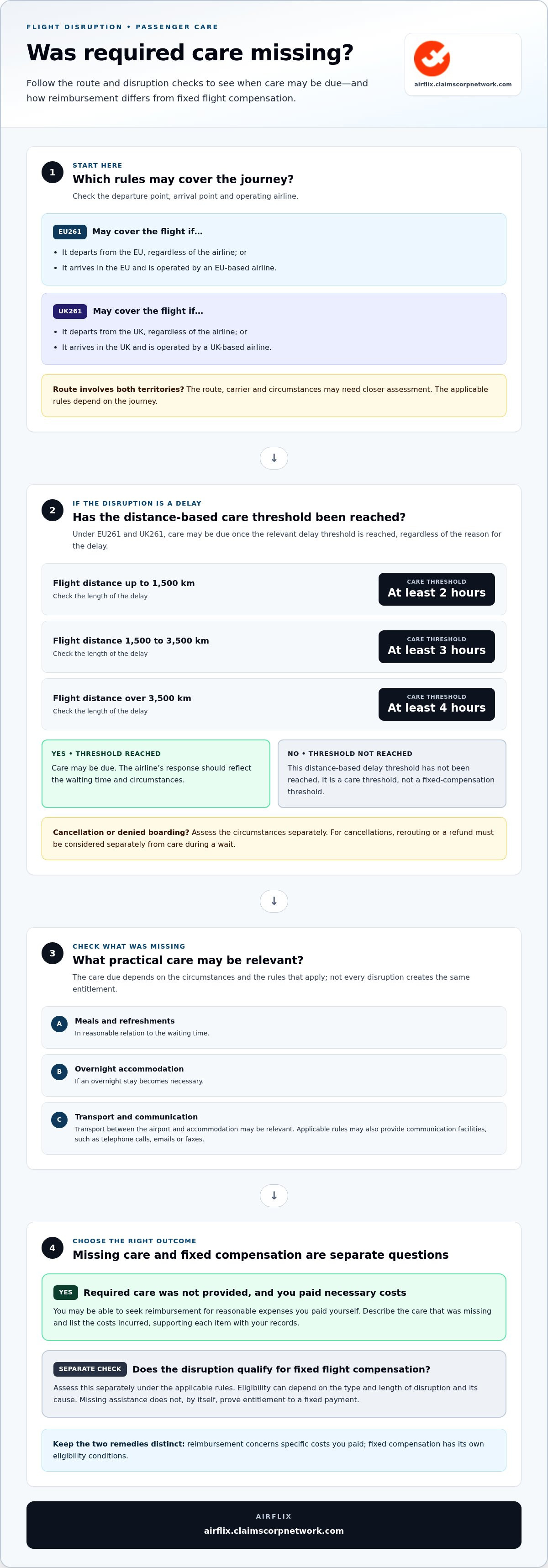
Assistance can include meals and refreshments in reasonable relation to the waiting time. If an overnight stay becomes necessary, hotel accommodation and transport between the airport and accommodation may also be relevant. Applicable rules may provide communication facilities, such as telephone calls, emails or faxes. The care due depends on the circumstances and the rules that apply, so not every disruption creates an identical entitlement.
For example, a long wait may call for meal assistance, while a disruption that requires an overnight stay raises the question of accommodation and transport. These are practical forms of care, not a promise that every cost or preference will be covered. The timing and nature of the expense matter.
Is missing assistance the same as missing compensation?
No. An airline’s duty to provide care and a passenger’s eligibility for fixed compensation are separate questions. Care may be due during a qualifying delay regardless of its cause under the relevant rules. Fixed compensation has separate conditions, which can include the type and length of disruption and its cause. A failure to provide assistance does not, by itself, prove that those conditions are met.
Keep the issues distinct when explaining what happened. If you bought food after receiving no meal assistance, describe the missing care and the expense incurred. Separately assess whether the disruption supports a fixed compensation claim. Which rules and remedies apply depends on the route and circumstances, so first identify the governing regime and relevant care requirements.
When Do EU and UK Rules Require an Airline to Provide Care?
Start by checking which passenger-rights framework covers your journey. Regulation (EC) No 261/2004 (EU261) generally covers flights departing from the EU, regardless of the airline, and flights arriving in the EU when operated by an EU-based airline. UK261 generally covers flights departing from the UK, regardless of airline, and flights arriving in the UK when operated by a UK-based airline. A journey involving both territories may require closer assessment of the route, carrier and circumstances.
These rules concern airline care during disruption. Separate rights may apply to passengers with disabilities or reduced mobility. The UK CAA guidance on disabled passenger rights explains assistance in that context.
How long delays affect care
Under EU261 and UK261, the care threshold for a delay depends on flight distance. Once the relevant threshold is reached, care may be due regardless of the reason for the delay. These are care thresholds, not fixed-compensation thresholds.
| Flight distance | Delay threshold for care |
|---|---|
| Up to 1,500 km | At least 2 hours |
| 1,500 to 3,500 km | At least 3 hours |
| Over 3,500 km | At least 4 hours |
For example, the care threshold for a flight of 1,200 km is 2 hours, while a flight of 2,000 km reaches its threshold at 3 hours. Once care is due, the airline’s response should reflect the waiting time and circumstances.
Cancellations and denied boarding need separate assessment
A cancellation is not simply a long delay. Options such as rerouting or a refund must be considered separately from care during any wait. If you are denied boarding, assess what happened at the airport and what arrangements the airline made. In each case, eligibility for care and fixed compensation are distinct legal questions, and the conditions may differ.
Care may remain relevant even when an airline disputes a passenger’s eligibility for fixed compensation. When making an enquiry about compensation for lack of flight assistance, identify the route, disruption type and timeline. Missing care does not, by itself, prove entitlement to a separate compensation payment. The precise application of EU261 or UK261 depends on those facts.
Once the journey and disruption are clear, flight disruption claim assistance can help manage the claim process and track its status in real time.
What Can You Claim If the Airline Did Not Provide Assistance?
If required care was not provided, assess each possible claim separately. You may have incurred necessary costs while making your own arrangements, and the disruption may also meet the conditions for fixed flight compensation. Neither outcome is automatic: the applicable rules, evidence and circumstances determine what you can claim.
Expense reimbursement and fixed flight compensation require separate assessments. Reimbursement relates to specific costs you paid, while fixed compensation concerns eligibility under passenger-rights rules.
| Issue | What it concerns | What to assess |
|---|---|---|
| Practical care | Meals, accommodation or other assistance the airline may have been required to provide | Whether care was due under the rules applying to the journey |
| Out-of-pocket expenses | Necessary costs paid because care was not provided | Receipts, the reason for each expense and whether the cost was reasonable |
| Fixed flight compensation | A separate payment for an eligible disruption | Disruption type, arrival impact, airline responsibility and any applicable exception |
Can you recover reasonable costs you paid yourself?
Reimbursement depends on the applicable rules, supporting evidence, the reasonableness of the expense and the facts of the case. Jurisdiction-specific requirements or limits may also apply, so a receipt alone does not prove that the full amount is recoverable.
When might fixed flight compensation be a separate issue?
Assess compensation independently. Under EU261 or UK261, a delay may qualify where arrival is at least three hours late. Cancellation with less than 14 days’ notice or involuntary denied boarding may also be relevant. Eligibility depends on the applicable framework and conditions, including the cause of the disruption. Airline responsibility matters, and extraordinary circumstances outside the airline’s control can affect entitlement.
A missing meal or hotel does not establish these criteria by itself. Likewise, a dispute about fixed compensation does not settle whether reasonable expenses can be recovered. Compare the actual arrival time with the scheduled arrival, retain cancellation or boarding communications, and record the airline’s explanation. These details help distinguish an expense request from a compensation claim.
Travel insurance is another route, not a substitute for an airline claim. Whether a policy covers disruption-related costs depends on its terms, conditions and exclusions. An insurance claim does not determine the airline’s obligations. For a formal assessment of a potential airline claim, Airflix can help manage the process.
How to Document and Report a Lack of Flight Assistance
A clear record helps show what care was missing, when you needed it and what you did in response. If possible, collect evidence during the disruption, then organise it before submitting a complaint. Keep the assistance issue distinct from any request for fixed flight compensation, even if both relate to the same flight.
What evidence should you keep?
Build a simple timeline and retain the documents that support it. Record your flight number, scheduled and actual departure or arrival times, and when and how the airline notified you of the disruption. Save messages, emails, app alerts and photographs of relevant notices or airport screens. Note when you asked for help, what you requested, whom you spoke to and what response you received.
For expenses, keep itemised receipts and add a brief note explaining why each cost arose because assistance was not provided. A meal receipt, for example, is more useful alongside the time you were waiting and any request you made for meal assistance. Keep copies of original documents and organise files by date or type so the sequence is easy to follow. Evidence supports a request but does not guarantee reimbursement.
How should you make a complaint to the airline?
Write a concise account in chronological order. Identify the flight and disruption, explain what care you needed, when you requested it and how the airline responded. State what you had to arrange yourself. Precise dates, times and records are more useful than assumptions about why the airline acted as it did.
- Set out the disruption. Include the flight details, scheduled and actual timings, and the airline’s notification.
- Describe the care issue. Specify what assistance you requested, when you requested it and what was or was not provided.
- List expenses separately. For each cost, give the date, purpose and amount, then attach a copy of the receipt.
- Separate any compensation request. If you are also making a fixed-compensation claim, identify it as a separate issue and explain its basis.
- Ask for a reasoned response. Request that the airline address the care failure and each expense, and keep a copy of your complaint and any reply.
Use the airline’s designated complaints channel and retain confirmation that your submission was received. If it does not reply, record the dates and any follow-up. Silence alone should not be treated as acceptance of your request. Check the applicable process and time limits for your journey before deciding what to do next.
Good documentation makes it easier to assess whether a compensation for lack of flight assistance claim concerns missing care, expenses, fixed compensation or more than one issue. If you have assembled your records, get help with your flight disruption claim.
How Airflix Can Help Manage a Flight Assistance Claim
Once you have recorded what happened and separated missing care or expenses from any fixed-compensation request, legal assistance can help manage the next stage. Airflix provides assistance with flight disruption claims, monitors claim status in real time and offers legal representation in court proceedings where relevant. This support helps organise the process, but does not guarantee that a claim will succeed.
What happens when a claim is managed by Airflix?
The process starts with the disruption and the records you have kept. The claim can then be considered against the applicable rules and the facts of the case. If it proceeds, its status is monitored in real time, so you can follow its progress. Eligibility and any outcome depend on the governing rules and evidence, including the journey, the disruption and the airline’s response.
Organise the relevant details, including:
- Flight number, route and scheduled and actual timings.
- Notifications or correspondence from the airline.
- A concise account of what assistance you requested and received.
- Receipts and notes explaining expenses you paid because assistance was absent.
- Details of any separate compensation request or response from the airline.
These records help establish what happened, but they do not determine the legal assessment on their own. A claim may concern care, expenses, fixed compensation or more than one of these issues. Each must be considered on its own basis.
When is legal assistance a practical next step?
Legal assistance may be useful if correspondence with the airline has not resolved the issue, or if you are unsure how to frame a claim under the rules that apply to your journey. Airflix can manage the flight disruption claim process and provide real-time status monitoring. If court proceedings become relevant, legal representation is available as part of the service.
For a potential compensation for lack of flight assistance claim, keep the distinction clear: a request about missing care or necessary expenses is not automatically the same as a fixed-compensation claim. The assessment depends on the applicable rules and facts. Airflix can help manage the claim without promising a particular decision or result.
If you have documented the disruption and are ready to proceed, submit a flight disruption claim for assessment.
Take the Next Step With a Clear Claim
Before proceeding, decide what you want the airline to address: missing care, expenses you paid, fixed compensation or more than one issue. A concise, well-supported request gives the claim a clear focus and makes it easier to assess against the rules that apply to your journey. Keep your records together and retain copies of further correspondence.
If you are considering compensation for lack of flight assistance, Airflix can help manage a flight disruption claim based on the information you provide. The service is developed by FlightClaimEU within Claims Corporation Network. The assessment depends on the relevant rules and case facts, so no particular outcome can be promised.
To take the next step, submit your disruption details for assessment: submit a flight disruption claim for assessment.
Frequently Asked Questions
Is an airline required to provide meals and accommodation during a flight disruption?
Under EU261 or UK261, an airline may have to provide meals and refreshments after a qualifying delay, and accommodation and transport where an overnight stay is necessary. The delay threshold depends on flight distance: 2 hours for flights up to 1,500 km, 3 hours for flights between 1,500 and 3,500 km, and 4 hours for longer flights. Check that the relevant rules cover your journey, as route and carrier affect their application.
Can I claim compensation if the airline did not help me?
Possibly, but the airline’s failure to provide care does not by itself establish eligibility for fixed compensation. Under EU261 or UK261, compensation may apply to qualifying long delays, certain cancellations or involuntary denied boarding, subject to the rules and circumstances. The cause of the disruption can matter, including whether an extraordinary circumstance applies. Treat compensation for lack of flight assistance as separate from a request to recover necessary expenses you paid.
What happens if I paid for a hotel because the airline offered no assistance?
You can ask the airline to reimburse a necessary, reasonable hotel expense where the applicable rules support recovery, but payment is not automatic. Keep the itemised invoice, booking confirmation and proof of payment. Record why an overnight stay was needed, what assistance you sought and what the airline said or did. If you also make an insurance claim, review the policy terms separately, as insurer decisions and airline obligations are distinct.
Can I accept an airline voucher instead of assistance or compensation?
You can consider a voucher, but first establish what it is intended to cover: an immediate meal or hotel arrangement, reimbursement of an expense, or a proposed alternative to fixed compensation. Read its conditions, including expiry, restrictions and any wording about settling claims. For fixed compensation under EU or UK rules, do not assume a voucher replaces a cash payment without your agreement. Keep the offer and ask the airline to clarify its purpose in writing.
How do I complain if an airline ignores my request for assistance?
Send a written complaint through the airline’s stated complaints channel and keep a copy with proof of submission. Include your flight details, a short timeline, the assistance you requested, the response or lack of one, and receipts for costs incurred. If there is no reply, send a dated follow-up and retain it. Further escalation routes and deadlines depend on the country and rules governing your journey, so check the relevant process.
Does an extraordinary circumstance remove the airline’s duty to provide care?
No. Under EU261 and UK261, an extraordinary circumstance may affect entitlement to fixed compensation, but it does not by itself remove the duty to provide care once the relevant delay threshold is reached. For example, severe weather could be relevant to a compensation decision, while meal or accommodation assistance may still be due during a qualifying wait. The route, delay and applicable framework must still be assessed.


