

What if one set of rules could entitle you to compensation for a disrupted flight, while another provides only a refund? The answer can depend on your route, airline and what happened, so it’s understandable to be unsure where to begin. Knowing how to request flight compensation starts with identifying the rights framework that applies to your journey.
A clear request should reach the right airline, explain the disruption and include evidence that supports your account. Missing details or an unclear explanation can make it harder to follow the claim and understand the airline’s response.
This guide explains how to check which rules may apply, prepare and submit an evidence-supported claim, and keep a record as it progresses. It also covers what to do if the airline doesn’t resolve the request. Airflix provides flight disruption legal assistance, real-time claim status tracking and legal representation in court proceedings for passengers who want help managing a claim.
Key Takeaways
- Start by identifying the rules that apply to your route and the airline operating the flight.
- Check whether the disruption may qualify, and distinguish compensation from a refund or expense reimbursement.
- To understand how to request flight compensation, follow a clear process: gather relevant records, explain your claim and save the acknowledgement.
- Choose a claim route that suits your needs, from contacting the airline directly to seeking legal assistance.
- Keep a record of updates and responses so you can decide what to do if your claim is refused or remains unresolved.
How to request flight compensation starts with identifying your rights
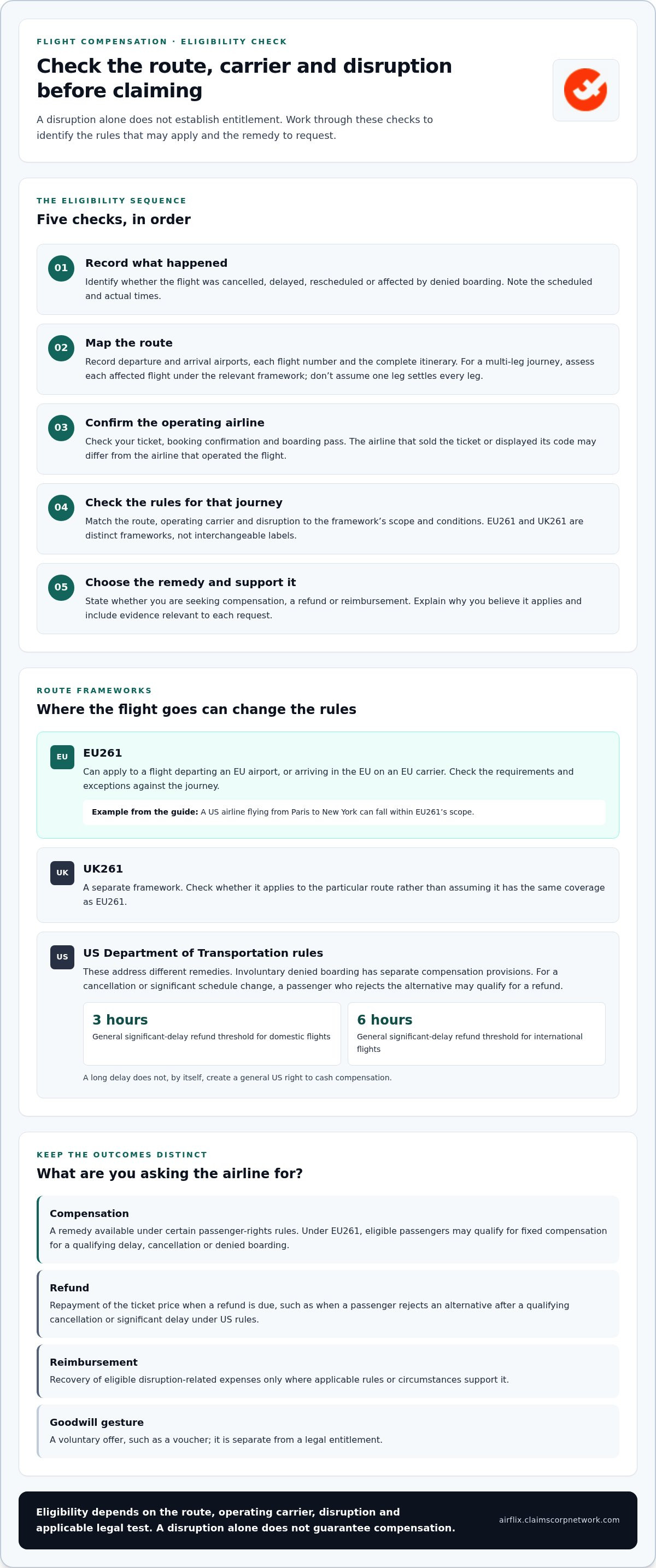
Before submitting a request, establish four things: which passenger-rights rules may apply, what remedy they provide, which airline is responsible for handling the claim and what evidence supports it. This jurisdiction-first check matters because the applicable rules can depend on the route, operating carrier and type of disruption. The airline whose code appears on your booking may differ from the airline that operated the flight.
A flight compensation request is a formal claim asking an airline to provide compensation available under the rules governing a particular journey. It doesn’t guarantee payment. You need to identify a potentially applicable entitlement and explain how the disruption meets its conditions. Cancellation, delay and denied boarding can have different tests, so one disruption type shouldn’t be treated as proof that another remedy applies.
Keep the possible outcomes distinct. Compensation is a remedy available under certain passenger-rights rules. A refund is repayment for qualifying unused or disrupted travel, while reimbursement concerns eligible expenses where relevant rules or circumstances permit it. An airline may also offer a voluntary goodwill gesture, such as a voucher, but that is separate from any legal entitlement. State which outcome you’re requesting to make your claim more precise.
Which flight compensation rules may apply?
EU261 and UK261 are distinct frameworks, so don’t assume that a journey covered by one is automatically covered by the other. EU261 can apply to flights departing from an EU airport, or arriving in the EU on an EU carrier. Check the requirements and exceptions against your journey. The Air Passenger Rights Regulation (EC 261/2004) provides an overview of the EU framework.
US Department of Transportation rules address different remedies. For example, a passenger who rejects an alternative after a cancellation or significant schedule change may be entitled to a refund. Involuntary denied boarding has separate compensation provisions. These rules don’t provide a general promise of cash compensation for every delay. Assess the full itinerary and operating carrier before relying on a particular framework.
Compensation, refunds and reimbursement are different outcomes
Under EU261, eligible passengers may qualify for fixed compensation for a qualifying delay, cancellation or denied boarding. A ticket refund addresses the ticket price when a refund is due, such as when a passenger rejects an alternative after a qualifying cancellation or significant delay under US rules. Reimbursement is narrower: it concerns expenses, such as costs incurred during a disruption, only where applicable rules or circumstances support recovery.
When deciding how to request flight compensation, state the remedy you’re seeking and why you believe it applies. If you’re requesting more than one outcome, label each separately and include evidence relevant to each request. This helps distinguish a compensation claim from a refund request or expense claim, making the basis of your submission easier to assess.
Check whether your disrupted flight may qualify before claiming
Before making a request, work through the facts in order: identify what happened, map the route, confirm which airline operated the affected flight, check the rules that may apply, then decide which remedy to seek. This helps avoid a common mistake: treating every cancellation or delay as an automatic right to compensation. A disruption alone does not establish entitlement; the route, operating carrier and applicable legal test all matter.
Use the same process for each affected flight on a multi-leg itinerary. A missed connection, for example, may form part of a wider journey assessment, but the result depends on the relevant framework and circumstances. Don’t assume that a rule applying to one leg automatically settles the position for every leg.
Establish the route and operating airline
Compare your ticket, booking confirmation and boarding pass to record the departure and arrival airports, each flight number and the airline that operated the affected service. The airline selling the ticket or displaying its code may be the marketing carrier, while another airline operates the aircraft. That distinction can matter when identifying the airline responsible for a claim. For connecting journeys, record the complete itinerary and assess it under the rules relevant to those flights.
Then check the territorial scope of the possible framework. EU261 can cover a flight departing an EU airport regardless of carrier, or arriving in the EU when operated by an EU-based carrier. For example, a US airline flying from Paris to New York can fall within EU261’s scope. UK261 is a separate framework, so establish whether it applies to the particular route rather than assuming EU and UK coverage are interchangeable.
Check the disruption and the remedy you can request
Record whether the flight was cancelled, delayed, rescheduled or affected by denied boarding, and note the scheduled and actual times. Different disruption types have different tests. Under US Department of Transportation rules, involuntary denied boarding may qualify for compensation. For a cancellation or significant schedule change, a passenger who rejects the alternative may instead qualify for a refund. A long delay does not, by itself, create a general US right to cash compensation.
In the US, the significant-delay threshold for a refund is generally three hours for domestic flights and six hours for international flights. The cause may also matter where a rule makes it relevant, such as when assessing airline obligations for meals or accommodation. Under European rules, the cause can affect whether compensation is payable. Assess it against the specific framework rather than treating it as a blanket reason to accept or reject a claim.
Finally, label the outcome you’re seeking: compensation, a ticket refund or repayment of eligible expenses. Keep the evidence for each separate, including disruption notices and receipts. As you work through how to request flight compensation, verify current jurisdiction-specific eligibility tests, exceptions and deadlines before submitting. Airflix provides flight disruption legal assistance to help assess and manage a claim.
Compare airline, regulator and legal-assistance routes for a claim
Once you’ve identified a possible entitlement, choose a route that fits the stage of your case. A direct airline claim puts your request to the carrier. A regulator may handle complaints or oversee compliance, depending on its remit, but it may not assess or award compensation in every jurisdiction. Legal assistance can help organise and manage a claim, and may include representation if court proceedings become necessary.
These routes aren’t always alternatives. Some procedures require you to approach the airline before escalating a complaint. Check the relevant authority’s process and the rules for your journey before deciding what to do next. Whatever route you use, keep a dated record of each submission, acknowledgement and reply.
| Route | Who handles it | What you provide | Following progress |
|---|---|---|---|
| Direct airline claim | The airline receiving your request | Flight details, explanation and supporting records | Save the reference, acknowledgement and correspondence |
| Regulator or complaint body | The authority responsible for the relevant jurisdiction or process | Your claim history and documents requested under its procedure | Use its case reference and follow its stated process |
| Legal assistance | A legal-assistance provider managing or supporting the claim | Relevant journey information and evidence | Use the provider’s claim updates and retain your own records |
Submitting a request directly to the airline
A direct submission lets you set out your position to the carrier and attach the records supporting it. Use the airline’s designated claims channel where available, and make the request specific: identify the flight, describe the disruption, state the remedy sought and include relevant evidence. Retain a copy of the completed form or email, attachments, submission date and any acknowledgement. If the airline responds, save the full reply, including its explanation for accepting or refusing the request. Don’t assume a particular response time or outcome; procedures vary.
When legal assistance may help manage a claim
Managing a claim can involve organising documents, reviewing airline correspondence and keeping track of developments. Specialist support can help coordinate these tasks and monitor claim status, but it doesn’t guarantee a particular result. Airflix provides legal assistance for flight disruptions, real-time claim status monitoring and legal representation in court proceedings.
Regulatory escalation depends on the jurisdiction. The relevant authority may accept a complaint, review compliance or provide a route for resolving a dispute, but its powers differ and not every regulator awards compensation directly. Check what it can consider, whether an airline response is needed first and which documents it asks for. This helps ensure your next submission reaches the body that can handle that stage of the case.
Knowing how to request flight compensation includes choosing who should handle each step, not simply sending the same message to every organisation. Start with the route required by the applicable procedure, preserve a clear record, then escalate or seek legal assistance if the case remains unresolved.
Prepare and submit a clear flight compensation request
A well-organised claim helps the airline understand what happened, what you’re asking it to provide and which records support your account. Keep your explanation factual and concise. Set out the journey and disruption, then state the remedy you believe applies.
Gather the information that supports your request
Start by assembling the records for the affected journey. Useful information may include passenger names, booking reference, flight number, travel date and operating airline. Keep your booking confirmation and boarding pass, if available, alongside any airline message about a delay, cancellation, schedule change or denied boarding. These records help connect your account to the correct booking and flight.
Save contemporaneous notes or other records that clarify the sequence of events, such as when you received a notification or what alternative travel was offered. If you’re also requesting reimbursement for expenses, retain the relevant receipts and explain what each cost relates to. Receipts aren’t a substitute for evidence of the disruption, and they’re relevant to an expense request only where recovery is permitted.
Include the passenger and flight details, a factual description of the disruption, the remedy requested and records that support your account. Treat this as a practical checklist, not a claim that every item is mandatory in every jurisdiction. Requirements and procedures can differ, so follow the airline’s instructions and the rules that apply to your journey.
Write, submit and keep a record
Use this workflow to prepare a complete submission and preserve a reliable record of it:
- Organise the documents. Put booking and flight details together with disruption notices. Separate expense receipts if you’re seeking reimbursement.
- Set out the timeline. Briefly describe what happened, using dates and times shown in your records where possible. Distinguish confirmed facts from anything you’re unsure about.
- Name the remedy. State whether you’re requesting compensation, a refund or reimbursement, and explain the basis for the request without presenting an unverified legal conclusion as fact.
- Submit through the appropriate channel. Use the airline’s designated claim form or contact method where one is provided. Check that the passenger and flight details match your booking before sending.
- Save the complete submission. Keep a copy of the form or message, every attachment, the date sent, the acknowledgement and any case reference together.
For example, write, “My flight was cancelled on [date]. I travelled on the alternative offered and am requesting [remedy]. I’ve attached my booking confirmation and the cancellation notice.” Replace the placeholders with accurate details and attach only relevant records. A clear account gives the recipient a useful starting point without overstating what the evidence proves.
Airflix can help manage a disruption claim and follow its progress. Get flight disruption legal assistance.
Track your flight compensation claim and choose the next step
Submitting a claim is not the final step. Keep a clear record of its progress so you can see what the airline has received, what it has said and whether you need to act. An organised file also makes it easier to explain the history if you follow up, use an escalation route or seek legal assistance.
Monitor responses and keep the claim record organised
Create a simple log with the date of each submission, acknowledgement, airline response and follow-up. Note any case reference, documents requested and the date you supplied them. Store related emails, letters and attachments together, using clear file names so you can retrieve each item quickly. If you speak to the airline, record the date, channel and a brief summary of the discussion.
Compare each response with your original request. Check whether it addresses the remedy you sought, explains the airline’s decision and refers to relevant facts or evidence. If the airline asks for additional information, note exactly what it needs and keep a copy of your reply. If its decision appears inconsistent with your records or the applicable rules, identify the specific point and ask for clarification rather than resending the entire claim without explanation.
There is no single response deadline for every claim and jurisdiction. Check the applicable procedure for any stated time limits, including when you can follow up or escalate. Silence does not, by itself, establish that a claim has been accepted or refused. If the stated period passes without an update, follow the relevant process and keep a copy of your enquiry.
Consider support if the claim needs further handling
If the airline refuses the request or the matter remains unresolved, review the reasons before deciding what to do next. You may be able to provide further evidence, ask the airline to reconsider, complain to a competent authority or use another dispute-resolution route. Available options, their order and any deadlines depend on the applicable jurisdiction. Check the authority’s remit too: some bodies handle complaints or compliance matters but don’t award compensation directly.
Keep any escalation focused. Refer to the airline’s case reference, summarise the steps already taken and attach relevant correspondence and supporting records. If you’re uncertain about the procedure or the claim involves a contested decision, legal assistance may help manage the case. It doesn’t guarantee a particular outcome, and any next step should be considered against the rules and deadlines that apply.
Airflix provides real-time claim status monitoring and legal assistance for flight disruptions, including legal representation in court proceedings. Explore Airflix flight-claim assistance to get support tracking and managing a claim.
Choose the right support for your next step
A disruption claim may not follow a straight path from submission to resolution. If the airline’s position leaves a material question unanswered, pause before sending another request. Review the correspondence, identify what remains in dispute and consider which route is appropriate under the rules for your journey. A deliberate next step can help prevent missed stages and make further communication more focused.
For passengers who want help managing a flight disruption claim, Airflix, part of Claims Corporation Network, offers legal assistance, real-time claim-status monitoring and legal representation in court proceedings. These services support the claims process but don’t guarantee a particular decision. Decide whether you’re comfortable managing the outstanding work yourself or would value support with the claim.
If you’d like support, explore Airflix flight-claim legal assistance. With a clear record and a considered next step, you can approach how to request flight compensation with greater confidence, even while the outcome is being determined.
Frequently Asked Questions
How long do I have to request flight compensation?
There isn’t one deadline for every flight compensation claim. The time limit depends on the rules governing the journey and may vary by jurisdiction and claim type. Check the relevant national rules promptly, using your departure and arrival locations and operating airline to identify the likely framework. Don’t assume that an airline’s reply period is also your legal deadline for bringing a claim.
Can I request compensation if the airline offered me a voucher?
Possibly. An offer of a voucher doesn’t automatically establish that you’re ineligible for compensation or a refund. Under applicable EU and US rules, passengers aren’t generally required to accept a voucher instead of cash where cash compensation or a refund is due. Read the offer’s terms before accepting it, and check which remedy applies to your disruption. If you’ve already accepted a voucher, review the terms and relevant rules before making another request.
Do I need to use the airline’s own claim form?
Not necessarily, unless the applicable procedure requires that method. If the airline provides a dedicated form, using it can help ensure your request reaches the right team and includes the details it needs. If you submit through another permitted channel, identify the passenger, booking and affected flight, explain your request clearly, and keep proof of delivery. Check whether the airline or relevant authority specifies a format or supporting information.
Can a travel agent submit a flight compensation request for me?
A travel agent may be able to help prepare or submit a request, but whether it can act on your behalf depends on the airline’s process and applicable rules. The airline may ask for your written authorisation or other evidence that the agent can represent you. Agree who will receive correspondence and keep copies of anything submitted. A booking made through an agent doesn’t necessarily make the agent responsible for deciding the airline claim.
Does travel insurance replace a flight compensation claim?
No. A travel insurance claim and a request to an airline are separate routes, with different terms and eligibility tests. Insurance may cover specified losses under the policy, whilst airline compensation or a refund depends on passenger-rights rules. You may be able to pursue both where their terms allow, but disclose relevant payments and claims accurately. Check your policy wording and don’t assume that an insurance payment settles an airline claim.
Can I request compensation for another passenger in my booking?
You may be able to submit information for other passengers, but a shared booking reference doesn’t automatically give one traveller authority to act for everyone. Check the airline’s requirements: it may ask each adult passenger to submit a separate request or provide written consent for a representative. Keep each passenger’s details accurate and follow the process for children or passengers who need someone else to act on their behalf.
What should I do if the airline rejects my flight compensation request?
Read the refusal carefully and identify the reason given. Compare it with your original request, itinerary and supporting records, then ask the airline to clarify or reconsider any specific factual point you believe is incorrect. If it maintains its decision, check whether a regulator, complaint body or other dispute route can handle the case. Available routes and deadlines depend on the applicable jurisdiction. For help with how to request flight compensation after a refusal, Airflix provides legal assistance with flight disruption claims.


