

What happens when an airline rejects a flight claim or challenges the facts behind it? A refusal can leave passengers unsure whether the decision is sound, which evidence matters next and whether they’ll have to deal with formal proceedings alone. Flight claim legal representation can bring structure to a disputed case, helping move it through relevant steps while keeping the limits of the process clear.
Legal support isn’t a promise of compensation or a guarantee that a representative will make every decision for you. Its role is to manage the case as it progresses and, where court proceedings arise, provide representation. Accurate information, organised evidence and clear updates can help you understand what is happening and what may be required.
This guide explains what legal representation can and can’t do, why an airline might dispute or reject a claim, and what may happen if the matter proceeds to court. It also outlines how Airflix supports flight disruption claims through real-time status monitoring and legal representation in court proceedings against airlines.
Key Takeaways
- Understand how formal representation differs from submitting a claim or receiving general guidance.
- See why the route, operating carrier and disruption circumstances can affect how a claim is assessed.
- Compare managing airline correspondence yourself with professional support, and consider how complexity may shape that choice.
- Learn how an airline’s response and the available evidence can influence whether a claim progresses towards court.
- Find out how flight claim legal representation through Airflix connects court support with real-time claim status monitoring.
Flight claim legal representation: what it means for passengers
Flight claim legal representation is professional support in presenting and, where necessary, pursuing a passenger’s claim against an airline, including representation in court proceedings. Submitting a claim starts a request for compensation or another remedy. Representation can go further by reviewing the case, setting out its legal position and managing proceedings where applicable. General information may explain possible rights, but it doesn’t assess and act on a passenger’s specific case.
This distinction matters when an airline disputes a claim or rejects it. Representation can help organise the case and handle formal steps, but it doesn’t make an otherwise ineligible claim valid. Eligibility and outcomes depend on the circumstances, the evidence available and the law that applies. No representative can guarantee compensation or a particular court decision.
What does a representative do in a flight claim?
A representative may review the disruption details, the airline’s response and documents relating to the journey, then communicate the claim’s legal position. If the matter proceeds to court, the role may include handling relevant proceedings. The support involved depends on the claim’s stage and circumstances, so early claim administration and later court representation are not necessarily the same task.
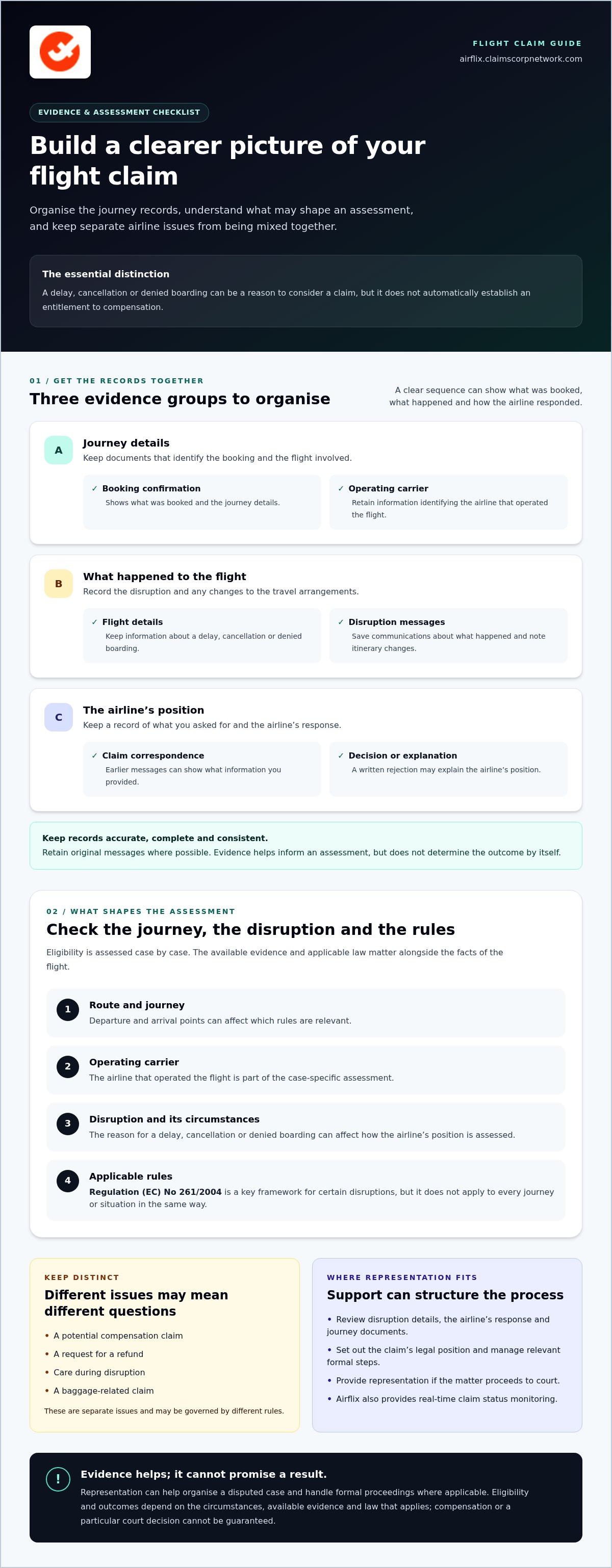
Keep useful records together, including airline correspondence and information about what happened to the flight. These can establish a timeline, show what you claimed and record how the airline responded. For example, a written rejection may explain the airline’s position, while earlier messages can show what information you provided. Evidence informs an assessment, but doesn’t determine the outcome by itself.
Which flight disruptions may lead to a claim?
Delays, cancellations and denied boarding can each be reasons to consider a claim, but they don’t automatically establish an entitlement to compensation. The relevant rules and facts need to be assessed, including details such as the journey, the operating carrier and the reason for the disruption. The airline’s response may also affect what happens next.
When considering a claim, keep the journey details, disruption and airline response in view. A case-specific assessment considers the available evidence and applicable law. These factors help clarify what representation can contribute and why it cannot promise a particular result.
How the legal framework shapes a flight claim
Regulation (EC) No 261/2004 is a key framework for certain flight disruptions, including some delays, cancellations and cases of denied boarding. It doesn’t apply to every journey or situation in the same way. The route, operating carrier and circumstances of the disruption can affect which rules are relevant and how a claim should be assessed.
Eligibility is assessed case by case because the route, carrier, disruption and applicable rules all matter. A flight’s departure and arrival points can be relevant, as can the airline that operated it. The reason for a disruption may also affect how the airline’s position is assessed. A delay or cancellation alone isn’t enough to establish that compensation is due.
When does Regulation (EC) No 261/2004 matter?
The Regulation may be relevant where a disruption falls within its scope, but its application depends on the specific journey and facts. Distinguish a potential compensation claim from other issues, such as a request for a refund, care during disruption or a claim relating to baggage. These are separate questions and may be governed by different rules. Flight claim legal representation can help assess the basis for a claim, but it can’t predetermine the result.
For example, a passenger whose flight is cancelled may need to consider both the effect on their travel arrangements and whether the circumstances support a compensation claim. A baggage problem is a separate matter from a disruption claim, even if it happened on the same trip. Keeping the issues distinct helps ensure that correspondence addresses the right question rather than treating every airline complaint as the same type of claim.
What evidence can support the legal assessment?
Start by organising records that show what was booked, what happened and how the airline responded. Depending on the circumstances, useful material may include:
- Booking confirmation and information identifying the journey and operating carrier.
- Flight details and communications about a delay, cancellation or denied boarding.
- Correspondence with the airline, including its explanation or decision on the claim.
This is an example list, not a definitive checklist. Formal requirements depend on the claim and applicable procedure. Keep records accurate, complete and consistent. Retain original messages where possible and note any changes to the itinerary. A clear sequence can help show how the disruption unfolded and what position the airline took.
Airflix provides flight disruption legal assistance, including support if a claim proceeds to court, and real-time status monitoring to help passengers follow its progress. This brings structure to the process while the legal assessment remains grounded in the facts and applicable rules.
Handling a flight claim alone or with legal representation
You can manage airline correspondence yourself or use professional support. The right approach depends on the claim’s complexity, the airline’s response and whether formal proceedings may follow. A clear, straightforward claim may be manageable without representation; a disputed claim can involve more assessment and procedural steps. Neither route guarantees that the airline will agree or that a court will decide in your favour.
| Managing the claim yourself | Using legal representation |
|---|---|
| You prepare and submit the claim, keep records and respond to the airline directly. | A representative can review the case, communicate its legal position and handle defined parts of the process. |
| You remain responsible for tracking responses and deciding how to proceed. | Professional support can provide a structured route through claim stages, with updates helping you follow progress. |
| This may suit a claim with a clear basis and a straightforward airline response. | This may be useful where eligibility is disputed, the airline’s response remains unresolved or court proceedings become a possibility. |
Representation needn’t mean losing sight of your claim. Agreeing clear roles can help: you provide accurate information and relevant records, while the representative carries out the agreed work and communicates developments. Before proceeding, understand how updates are provided and what you may still need to do. Airflix includes real-time claim status monitoring, so passengers can follow progress through the stages.
When might a passenger seek legal representation?
Consider support if the airline disputes whether the claim qualifies, gives a response that doesn’t resolve the issue, or the matter may progress to court. These are reasons to assess the next step, not automatic grounds for litigation. Each claim has its own facts and procedural position. The flight claim legal representation that may be appropriate in one case won’t necessarily suit another.
What should passengers understand before proceeding?
Before authorising representation, read the applicable service terms carefully. Check what work is covered, what information you must provide, how decisions and updates are communicated, and what responsibilities remain yours. Understand any fees from the terms that apply to the service rather than assuming they are the same across claim services.
Professional support can organise the process and handle legal steps where applicable, but it cannot compel an airline to agree, ensure compensation or promise a successful court outcome. Decide whether to proceed based on the evidence, the airline’s position and the options available for that specific claim.
What happens when a flight claim moves towards court?
A rejected claim doesn’t automatically lead to court. The next step depends on the claim’s facts, the airline’s response, the evidence available and the legal route that applies. Reviewing these elements first helps establish whether there is a basis to continue, whether further correspondence may be relevant or whether formal proceedings should be considered.
From claim review to possible legal escalation
The process generally involves a series of assessments rather than a fixed sequence of legal steps:
- Review the claim: Consider the disruption, journey details, supporting records and the legal basis being relied on.
- Assess the airline’s response: Compare its explanation with the claim information and correspondence so far. A rejection may raise issues to examine, but doesn’t by itself determine what should happen next.
- Consider the available route: Decide whether further action is appropriate in light of the evidence and applicable law. If court proceedings are considered, the relevant procedure will depend on the jurisdiction and type of claim.
For example, an airline might dispute the circumstances of a disruption or the basis for a passenger’s claim. The response and records may need closer review before deciding whether to continue. Flight claim legal representation can support passengers through this assessment and provide representation if proceedings arise, but court action isn’t automatic and no outcome is assured.
Procedure, required documents and deadlines can vary according to the relevant jurisdiction and claim. Don’t rely on a general guide for a case-specific deadline. Establish the requirements that apply to the route being followed. Keep airline correspondence and relevant journey records organised, and note any formal instructions or dates communicated during the process.
How do passengers stay informed during proceedings?
Clear updates help passengers understand which stage a claim has reached and whether a decision or action is pending. Airflix provides real-time claim status monitoring, allowing passengers to follow recorded progress without assuming that every stage has a fixed duration. Continue to review updates and respond to any requests relevant to the claim.
To review support for a claim that may proceed to court, explore Airflix flight claim assistance. The service includes legal representation in court proceedings against airlines, alongside status monitoring to help passengers track progress. Representation supports the process; it doesn’t guarantee that an airline will agree or that a court will decide in the passenger’s favour.
How Airflix supports flight claim legal representation
Airflix provides legal assistance for flight disruption claims, helping organise the process from claim management through to possible court proceedings. Where a claim reaches court, the service includes legal representation against the airline. Passengers receive structured support as the claim progresses, while the assessment remains grounded in the facts and the rules that apply.
What passengers can expect from Airflix
Support may involve managing the claim and, if proceedings arise, representing the passenger in court. The appropriate steps depend on the claim’s stage and the airline’s response. Airflix also provides real-time claim status monitoring, so passengers can follow recorded progress and see how the matter develops. Status updates make the process more visible, but they don’t determine the legal outcome.
Flight claim legal representation is support with the process, not a promise that an airline will accept a claim or that a court will award compensation. Eligibility and outcomes depend on individual circumstances, evidence and applicable law. Representation can help move a case through relevant stages, but it cannot guarantee a particular result.
A practical next step for a disputed flight claim
Before taking action, bring together the details that explain what happened and how the airline responded. These could include your booking confirmation, flight information and relevant correspondence. Organised records make it easier to provide a clear account of the disruption and the claim’s history.
For an overview of the process and Airflix’s role, read the flight claim support information. Review how the service handles flight disruption claims, including legal representation if proceedings arise, then begin the appropriate process for your situation.
Choose a clear next step for your flight claim
A sound decision starts with the details: the disruption, the airline’s response and the rules that apply. Straightforward claims may be handled directly, while disputed or escalated cases can involve further legal steps. Flight claim legal representation can help manage those steps, but it can’t guarantee compensation or a particular court decision.
Airflix provides legal assistance for flight disruptions, including legal representation in court proceedings against airlines. Real-time claim status monitoring helps passengers follow progress through recorded stages and understand where a claim stands as it moves forward.
If you’re weighing support for a disputed claim, review what the service involves and how the process works. Review Airflix flight claim support to understand the next step for your circumstances. Gather your records and review the service information to make a considered decision about how to proceed.
Frequently Asked Questions
Is legal representation necessary for a flight compensation claim?
No, not every flight compensation claim requires legal representation. A passenger may be able to submit a straightforward claim independently, while a disputed or unresolved case may raise legal or procedural questions. Whether professional support is appropriate depends on the facts, the airline’s response and the applicable rules. Representation can provide structure and help manage relevant steps, but it can’t guarantee compensation or a particular outcome.
Can a legal representative take an airline to court over a flight claim?
Yes, court proceedings may be an option in some flight claim disputes, but an airline’s rejection doesn’t automatically lead to court. The available route depends on the claim, supporting evidence, applicable law and procedural requirements. A representative can handle legal steps where the case and service permit. Any court decision is independent, so a representative can’t promise that proceedings will result in compensation or a particular decision.
What does flight claim legal representation include?
Flight claim legal representation may include assessing the claim, managing relevant legal communications and representing the passenger if proceedings are brought. The precise work depends on the stage of the case and the applicable service terms. It differs from submitting an online form or receiving general information, which may not involve case-specific support. Before proceeding, understand the representative’s responsibilities, what you may need to provide and the limits of the service.
How long does legal representation for a flight claim take?
There’s no single timeframe for every flight claim. Progress can depend on how quickly relevant evidence is available, whether the airline disputes the claim and whether formal proceedings become necessary. Court processes may add further time, and procedural requirements vary. Treat any estimate as specific to the case, not a guaranteed resolution date. Real-time claim status monitoring can help passengers follow recorded progress as the matter moves through its stages.
What documents are needed for a flight claim with legal representation?
Relevant records may include your booking confirmation, flight details and communications with the airline. What’s needed depends on the disruption, the basis of the claim and any procedural requirements. Keep copies accurate and organised, and retain original records without altering them. This can help present a consistent account of the journey and the airline’s response. The information relevant to an individual claim may become clearer as it progresses.
Does hiring legal representation guarantee flight compensation?
No, legal representation doesn’t guarantee flight compensation. It can help manage a claim and, where applicable, court proceedings, but it can’t ensure that an airline agrees to pay or that a court finds in the passenger’s favour. Eligibility depends on the circumstances and applicable law. A clear explanation should set out what support involves, what the next steps may be and where uncertainty remains, rather than promise a particular financial or legal result.


