

Can an airline owe you money for leaving you without meals, refreshments or a hotel during a disruption? The answer depends on which right is involved. A claim for risarcimento per mancata assistenza volo may concern repayment of reasonable expenses you had to cover yourself. That is separate from fixed compensation for a qualifying delay, cancellation or denied boarding.
When a journey is disrupted, passengers may expect the airline to provide practical help. The duty to provide care can apply even when extraordinary circumstances mean fixed compensation is not due. However, a failure to provide care does not automatically establish entitlement to that separate compensation.
This guide explains the passenger-rights framework that may apply under EU261 or UK261, what assistance airlines are required to provide, and which out-of-pocket costs you may be able to reclaim. It also explains how to distinguish expense reimbursement from fixed compensation, preserve useful evidence and submit a clear claim with receipts, booking records and airline communications.
Key Takeaways
- Learn how EU261 and UK261 set out an airline’s duty to provide care during qualifying disruptions.
- Understand why risarcimento per mancata assistenza volo may mean reclaiming reasonable expenses rather than receiving fixed flight compensation.
- Distinguish care, expense reimbursement, fixed compensation and ticket refunds. Each has its own eligibility assessment.
- Keep an organised record of booking details, disruption notices, receipts, photographs and airline correspondence to support your claim.
- Airflix’s legal assistance and real-time claim-status monitoring can help structure the process of pursuing a flight-disruption claim.
Flight compensation: what does the right to care mean?
A disrupted flight can mean a long wait, unexpected costs and uncertainty about what the airline should arrange. Separate three possible remedies: practical care during the disruption, reimbursement for reasonable costs paid out of pocket, and fixed compensation for certain qualifying disruptions. A claim for risarcimento per mancata assistenza volo may concern expenses the airline should have covered, but it does not automatically establish a right to fixed compensation.
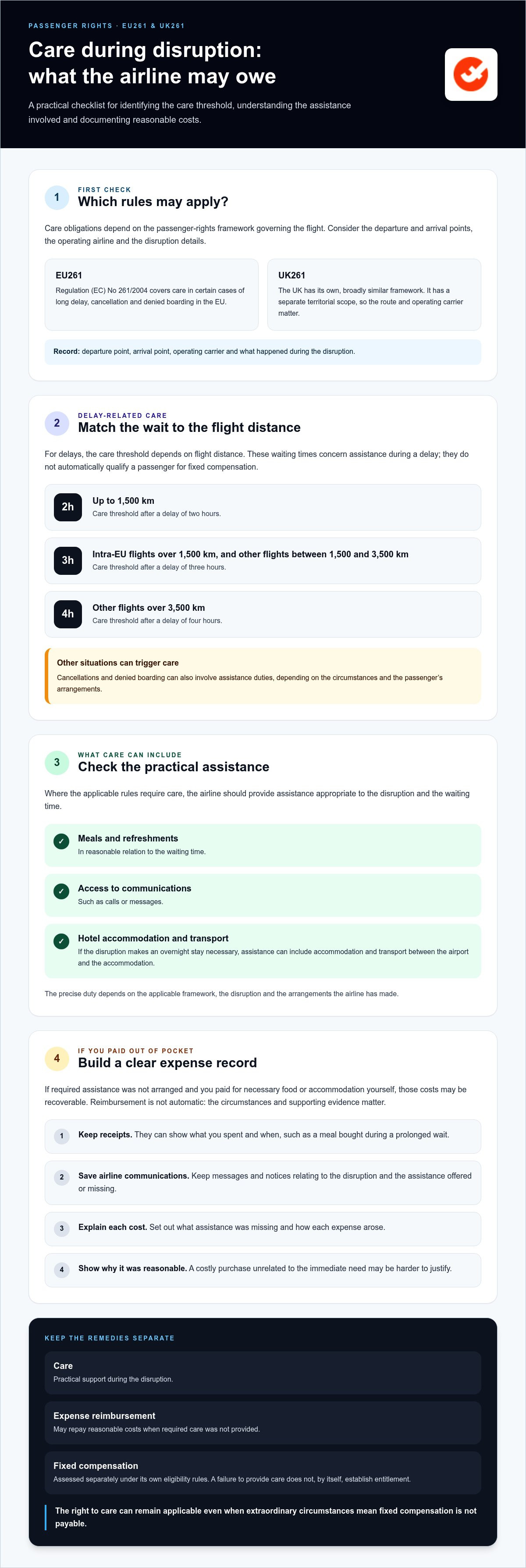
In the EU, the central framework is Regulation (EC) No 261/2004. The UK applies its own UK261 framework. Both provide for care in specified disruption circumstances. For long delays, the care threshold depends on flight distance and generally begins after two, three or four hours. Cancellations and denied boarding can also trigger assistance duties, depending on the circumstances and the passenger’s arrangements. The right to care can remain applicable even where extraordinary circumstances mean fixed compensation is not payable.
What assistance may an airline have to provide?
Where the applicable rules require care, the airline should provide meals and refreshments in reasonable relation to the waiting time, as well as access to communications such as calls or messages. If the disruption makes an overnight stay necessary, assistance can include hotel accommodation and transport between the airport and the accommodation. The precise duty depends on the applicable framework, the disruption and the arrangements the airline has made.
Care is practical support, not a cash award. If the airline does not arrange required assistance and you pay for necessary food or accommodation yourself, those costs may be recoverable. Whether reimbursement is due depends on the circumstances and supporting evidence.
Does a failure to assist automatically mean compensation is due?
No. A failure to provide care and eligibility for fixed flight compensation are assessed separately. Fixed compensation depends on whether the disruption meets the applicable legal conditions, and factors such as its cause may affect entitlement. A lapse in care does not, by itself, meet that separate test.
To request reimbursement, show that the expenses were reasonable and related to the assistance that should have been provided. For example, a receipt for a meal bought during a prolonged wait can show what you spent and when. A costly purchase unrelated to the immediate need may be harder to justify. Keep receipts and airline messages or notices, then explain what assistance was missing and how each expense arose. Reimbursement is not automatic: the applicable rules and facts determine the outcome.
Care is support during disruption. Reimbursement may repay reasonable costs when that support is missing. Fixed compensation is a separate payment assessed under its own eligibility rules.
When does the right to care apply under EU and UK flight rules?
The duty to provide care depends on which passenger-rights framework governs the flight. Regulation (EC) No 261/2004 covers care in certain cases of long delay, cancellation and denied boarding in the EU. The UK has a separate, broadly similar framework known as UK261. For delay-related care, the waiting-time threshold is linked to flight distance:
| Flight distance | Delay threshold for care |
|---|---|
| Up to 1,500 km | Two hours |
| Intra-EU flights over 1,500 km, and other flights between 1,500 and 3,500 km | Three hours |
| Other flights over 3,500 km | Four hours |
These thresholds concern assistance during a delay. They do not give passengers automatic entitlement to fixed compensation. The EU’s guidance on air passenger rights explains the assistance framework. The route and operating carrier help determine which rules apply.
Which flight situations can trigger a duty of care?
A cancellation or denied boarding can trigger care obligations, as can a delay once the relevant waiting-time threshold is reached. The type and timing of assistance depend on the circumstances, including whether you are waiting for rerouting. If an overnight stay is necessary, accommodation and transport may be required. These duties are separate from the tests for fixed compensation.
How do EU261 and UK261 differ for assistance claims?
The frameworks are similar, but they are not interchangeable. Consider where the flight departed and was due to arrive, and which airline operated it. EU261 generally applies to departures from an EU airport and to certain flights arriving in the EU on an EU carrier. UK261 has its own territorial scope. A route crossing borders may therefore need closer assessment before you make a claim.
Record the departure and arrival points, operating carrier and disruption details. These facts help you identify the framework to consider and organise a claim for assistance that was not provided.
Care expenses, flight compensation and refunds: which claim fits your situation?
A disruption may give rise to more than one possible remedy, but each addresses a different issue and has its own eligibility test. The table distinguishes immediate care from expenses you paid yourself, fixed compensation and a ticket refund. A claim for risarcimento per mancata assistenza volo usually concerns missing care or costs incurred because it was not provided, rather than an automatic fixed award.
| Remedy | Purpose | Useful evidence and assessment |
|---|---|---|
| Care | Practical assistance during a qualifying disruption, such as meals, refreshments or accommodation where required. | Keep disruption notices and records of what assistance the airline offered or failed to arrange. Whether care was due depends on the applicable rules and circumstances. |
| Expense reimbursement | Potential recovery of reasonable costs paid for necessary assistance the airline did not provide. | Retain itemised receipts and explain how each cost relates to the disruption. Eligibility depends on the expense and the evidence. |
| Fixed compensation | A separate payment available only when the disruption meets the relevant legal conditions. | Booking details and evidence of the disruption can help assess the claim. The eligibility test is separate from whether care was provided. |
| Ticket refund | Repayment for a ticket or unused part of a journey in circumstances where refund rights apply. | Keep the booking confirmation and records of the cancellation or travel choice. Refund eligibility depends on the applicable rules and circumstances. |
Can passengers recover reasonable expenses for missing assistance?
Potentially, if the airline was required to provide care and you had to cover a necessary expense yourself. The connection between the expense and the disruption matters. A meal during a prolonged wait or overnight accommodation after a disrupted journey may be relevant examples. Costs should be proportionate to the immediate need. Keep itemised receipts, as a bank statement alone may not show what you purchased.
Documented spending is different from inconvenience, frustration or other non-financial loss. A receipt can support a request to recover money spent, but it does not establish an automatic right to a separate award. The UK Civil Aviation Authority’s guidance on flight delays explains care obligations for flights covered by UK rules.
When might fixed compensation or a ticket refund be a separate issue?
Fixed compensation depends on its own conditions, including the type of disruption and the applicable passenger-rights framework. A ticket refund is a different remedy, linked to cancellation or choices about continuing the journey. You may need to assess more than one remedy, but qualifying for one does not automatically establish eligibility for another. Consider the rules for expenses, compensation and refunds separately rather than treating them as interchangeable claims.
How to document and claim for assistance the airline did not provide
A clear claim connects the disruption to the assistance that was missing and any costs you incurred as a result. Where possible, build your record as events unfold. A chronological account supported by documents makes it easier to explain what happened and distinguish a request for expense reimbursement from a separate claim for fixed compensation.
What evidence should a passenger keep?
Collect records that establish your journey, the disruption, your contact with the airline and any resulting expenditure. Keep copies or digital originals together, and note dates and times while the details are fresh.
- Journey records: booking confirmation, ticket details and boarding passes for each relevant flight.
- Disruption evidence: time-stamped airline notifications, airport notices and, where useful, photographs of information screens.
- Assistance requests: messages, emails, app conversations and notes of calls or discussions, including when they took place and what the airline said.
- Expense records: itemised receipts for relevant meals, refreshments, accommodation or transport, with a brief note explaining why each expense was necessary.
Keep airline instructions too, including any offer of vouchers, rerouting or accommodation. If you speak to airline staff in person or by telephone, promptly note when and how the conversation took place and its main points. Photographs can provide context, but should support rather than replace booking records, receipts or written correspondence.
How should the passenger present the claim?
Use a short, factual chronology. Identify the passenger and flight, describe the disruption, state what assistance you requested and record the airline’s response, or lack of one. Then list each expense separately, with its date and connection to the disruption. Attach copies of supporting documents, not originals, and retain a complete copy of your submission.
- Record the event: note the flight details, disruption and relevant times.
- Describe the missing assistance: explain what you needed and what you requested from the airline.
- Set out the costs: itemise expenses and connect each one to the disruption.
- Submit and retain: use the airline’s stated process, keep proof of submission, and save its response and any follow-up correspondence.
Keep an expense-reimbursement request distinct from a request for fixed compensation. They have different legal tests, so explain each request separately and do not present one as proof of the other. Complaint routes and deadlines vary by jurisdiction and claim type. Check the current rules that apply to your flight rather than relying on a general time limit.
Airflix provides legal assistance for flight-disruption claims, with real-time claim-status monitoring as the claim progresses. Find out more about Airflix’s flight-disruption legal assistance.
How Airflix supports a flight-assistance claim through to resolution
Once you have documented the disruption, missing assistance and related expenses, the next step is to assess the claim under the rules that apply to your flight. Airflix provides legal assistance for flight disruptions, helping organise the process and reduce the administrative burden of pursuing a claim. This can be useful when a risarcimento per mancata assistenza volo request needs to be considered alongside a separate claim for fixed compensation.
What happens when a claim is managed with legal assistance?
Flight details, disruption notices, airline communications and relevant expense records provide the factual basis for assessing a claim. Keeping those documents together makes it easier to show the sequence of events and the assistance you sought. The applicable rules and specific facts determine which remedies may be available. Legal assistance does not guarantee that a claim will succeed or that a particular amount will be recovered.
Airflix provides real-time claim-status monitoring, so passengers can follow progress through the claims process. If proceedings against an airline arise, Airflix provides legal representation in court. Legal assistance and status monitoring offer a structured way to manage a claim and follow its progress. The outcome depends on the evidence, circumstances and applicable law.
What are the next steps for a passenger?
Before pursuing a claim, organise the records that explain your journey and what happened:
- Booking confirmation, ticket details and boarding passes.
- Disruption notices and notes of relevant dates and times.
- Messages showing what assistance you requested and the airline’s response.
- Receipts and a brief explanation of how each expense related to the disruption.
Keep copies of these documents and distinguish a request to recover expenses from a request for fixed compensation. Clear records support an orderly assessment, but do not determine eligibility on their own. Claim procedures and deadlines can vary, so consider the route, operating carrier and circumstances when identifying the rules that apply.
Airflix’s flight-disruption legal assistance provides a structured way to manage a claim, with real-time status monitoring as it progresses. Read about Airflix’s flight-disruption assistance.
Take a clear next step with your flight claim
The key distinction is straightforward: an airline’s duty to provide care, reimbursement for reasonable expenses you paid yourself, and fixed flight compensation are separate rights with separate eligibility tests. For a risarcimento per mancata assistenza volo claim, clear records of the disruption, the assistance you requested and related spending can help present the circumstances accurately.
Organise your booking details, airline communications and receipts, then consider which remedy fits the facts of your journey. Airflix provides legal assistance for flight disruptions and real-time claim-status monitoring to help structure the claims process. Legal representation is also available if court proceedings arise. Eligibility and outcomes depend on the applicable rules and the individual case.
Explore Airflix’s flight-disruption legal assistance to take the next step with your claim.
Frequently Asked Questions
Can I claim compensation if an airline failed to provide meals or accommodation?
Possibly, but the remedy may be reimbursement of reasonable costs rather than fixed flight compensation. If the applicable rules required the airline to provide care and you paid for necessary meals or overnight accommodation yourself, you may be able to request repayment with supporting evidence. Fixed compensation has a separate eligibility test. A risarcimento per mancata assistenza volo claim should therefore identify which right was affected and what loss resulted.
Is reimbursement for meals the same as flight compensation?
No. Reimbursement seeks repayment of reasonable expenses you paid because required care was not provided, such as food during a qualifying wait. Fixed flight compensation is a separate payment assessed under the relevant passenger-rights rules and disruption circumstances. A receipt can support an expense claim, but it does not by itself establish eligibility for fixed compensation. Set out each remedy separately if the facts may support more than one claim.
What evidence do I need if the airline did not assist me?
Keep your booking confirmation, ticket details and boarding pass, along with time-stamped disruption notices and any instructions from the airline. Save emails, messages and app communications showing what assistance you requested and the response. Retain itemised receipts for expenses and note why each was necessary. Photographs of airport information screens may help establish the circumstances. Submit copies rather than originals, and keep a complete copy of your claim and the airline’s reply.
Does the right to care apply when a delay is caused by extraordinary circumstances?
Generally, yes. Under EU261, the airline’s duty to provide care can continue even when extraordinary circumstances mean fixed compensation is not payable. Depending on the applicable rules and disruption, care may include meals and refreshments, communications, and overnight accommodation with transport where necessary. The circumstances may affect whether fixed compensation is due, but do not automatically remove the separate duty of care. Check which framework applies to your route and operating carrier.
Can I claim for expenses I paid myself during a flight disruption?
You may be able to request reimbursement if the expense was reasonable, necessary and connected to assistance the airline was required to provide but did not. A receipt for a meal or necessary overnight accommodation can help show the amount and nature of the expense. Keep an itemised receipt and explain the circumstances. Repayment is not automatic, and inconvenience alone is not the same as documented expenditure.
How long do I have to claim for failure to provide assistance?
There is no single deadline that safely applies to every claim. Time limits depend on the country, applicable law and legal basis of the request. Reimbursement of care expenses and fixed compensation may not necessarily share the same limitation period. For flights under Italian jurisdiction, the stated period for compensation claims is two years; UK periods also vary by jurisdiction. Check the current deadline promptly rather than relying on a general rule.
Does EU261 or UK261 apply to my disrupted flight?
It depends on the route and operating carrier. EU261 generally covers flights departing from an EU airport and flights arriving in the EU when operated by an EU airline. UK261 is a separate framework with its own territorial scope. Check the departure and arrival airports, which airline operated the flight, and whether the journey involved a connection. These details help identify the rules relevant to your assistance claim.
What happens if the airline rejects my assistance claim?
Review the response against your timeline, evidence and the specific assistance you requested. If information is missing or a receipt was not considered, send a concise follow-up with supporting copies and a clear explanation of each expense. Keep the rejection and all correspondence. Complaint routes and escalation options depend on the applicable jurisdiction. Legal assistance can help assess next steps, including court representation where proceedings arise.


