

What if your flight lands somewhere other than the airport on your ticket, but the journey isn’t over? A diversion can leave you unsure how to reach your destination, what support the airline must provide and whether you can claim compensation. The question behind “diritti passeggeri in caso di volo dirottato” is not simply where the aircraft lands, but how the diversion affects your journey.
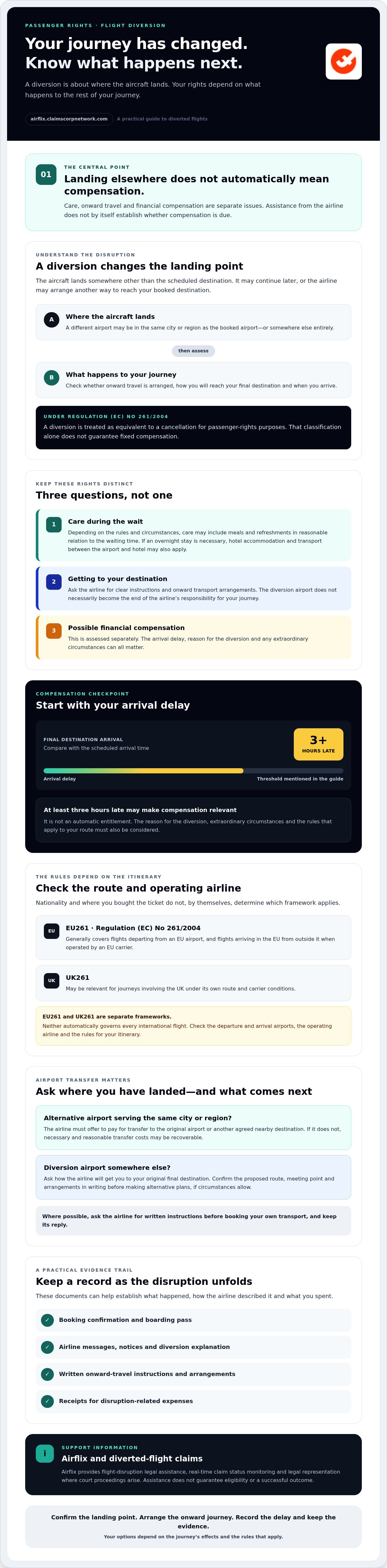
It’s easy to confuse the right to care with rerouting, reimbursement or financial compensation. These are separate issues: the airline’s assistance and arrangements to get you to your final destination don’t automatically mean you’re entitled to compensation. Under Regulation (EC) No 261/2004, compensation may be relevant if you reach your final destination at least three hours late, subject to the reason for the diversion and any extraordinary circumstances.
This guide explains what to ask for after a diversion, when a compensation claim may apply, and which records to keep. It also sets out practical steps for documenting the disruption and necessary expenses, so you can assess your options with clearer evidence.
Key Takeaways
- A diversion means the aircraft lands somewhere other than its scheduled destination, but that alone doesn’t establish a right to fixed compensation.
- The diritti passeggeri in caso di volo dirottato can depend on the disruption’s effects, including your arrival delay, route and the reason for the diversion.
- Confirm where you’ve landed and ask the airline for clear instructions on reaching your final destination and what assistance may apply.
- Keep your booking confirmation, boarding pass, airline messages and diversion notices, along with receipts for disruption-related expenses.
- Airflix provides flight-disruption legal assistance, real-time claim status monitoring and legal representation where court proceedings arise. Assistance doesn’t guarantee eligibility or a successful outcome.
What does a diverted flight mean for your passenger rights?
A flight diverts when it lands somewhere other than its scheduled destination. The aircraft may continue the journey later, or the airline may arrange another way for passengers to reach their booked destination. A diversion is therefore not necessarily a cancelled journey in the ordinary operational sense. Under Regulation (EC) No 261/2004, however, a diversion is treated as equivalent to a cancellation for passenger-rights purposes. That classification does not, by itself, guarantee fixed compensation.
A diversion describes where the aircraft lands; your rights depend on what happens to the rest of your journey and when you reach your final destination. To assess the diritti passeggeri in caso di volo dirottato, separate the event from its consequences: check whether onward travel is provided, how long the arrival delay is, and which rules cover the route.
How is a diversion different from a delay or cancellation?
A delay usually means the flight operates later than planned, while a cancellation means the scheduled service does not operate as booked. A diverted aircraft may still complete the journey after landing at an unscheduled airport, so the label used at the time may not explain the final outcome. Keep airline messages, notices and any written explanation of the disruption. These records can help establish what happened and how the carrier described it.
Which passenger-rights rules may apply?
The relevant framework depends on the itinerary and operating carrier, not simply on your nationality or where you bought the ticket. Regulation (EC) No 261/2004 generally covers flights departing from an EU airport, and flights arriving in the EU from outside it when operated by an EU carrier. The Regulation (EC) No 261/2004 sets out the EU framework for air-passenger rights, but check the specific itinerary against its scope.
For journeys involving the UK, UK261 may be relevant under its own route and carrier conditions. EU261 and UK261 are separate frameworks, and neither automatically governs every international flight. Check the departure and arrival airports, the airline that operated the flight, and the applicable rules before drawing conclusions about eligibility. A diversion may trigger passenger-rights protections, but whether a particular remedy or compensation applies depends on the circumstances and the rules governing that journey.
What must the airline do after a flight diversion?
A diversion may leave passengers at an airport from which they still need to reach their booked destination. Where Regulation (EC) No 261/2004 applies, the airline’s responsibilities can include care during the wait and arranging onward transport. These obligations are distinct from compensation: receiving meals or a transfer does not, on its own, determine whether a separate compensation claim is due.
Care and onward travel address the disruption as it unfolds; compensation is assessed separately, based on the applicable rules and the journey’s consequences. The exact assistance available depends on the circumstances and the rules covering the flight. The European Union’s official EU air passenger rights guidance outlines when care and other protections may apply.
What if the aircraft lands at another airport?
Ask whether the alternative airport serves the same town or region as the booked airport, or leaves you at a different destination. Where the airline lands at an airport serving the same city or region, it must offer to pay for transfer to the original airport or another agreed nearby destination. If it doesn’t, necessary and reasonable transfer costs may be recoverable. Ask the airline for written instructions before booking your own transport, where circumstances allow, and keep its reply.
If the diversion airport is elsewhere, ask how the airline will get you to the original final destination. Landing at a different airport doesn’t necessarily end its responsibility for onward transport. Confirm the proposed route, meeting point and arrangements in writing before making alternative plans, if you can.
Can passengers request meals, accommodation or transport?
During an extended wait, care may include meals and refreshments in reasonable relation to the waiting time. If an overnight stay becomes necessary, hotel accommodation and transport between the airport and hotel may also apply. Eligibility depends on the relevant rules and circumstances, so ask the operating airline what it will arrange rather than assuming every expense will be covered.
- Ask where to wait and how to access meals, accommodation and onward travel.
- If you pay upfront for necessary items or transport, keep itemised receipts and proof of payment.
- Save the airline’s response and check it against the rules applicable to your route.
For the diritti passeggeri in caso di volo dirottato, a clear record of what the airline offered and what you had to arrange yourself can help clarify your next steps. Keep receipts and written instructions together so you can assess any request for reimbursement against the relevant rules.
Does a diverted flight qualify for compensation?
A diversion alone doesn’t establish a right to fixed compensation. Under Regulation (EC) No 261/2004, eligibility may depend on whether you arrive at your final destination at least three hours later than scheduled, whether the regulation applies to your route, and why the diversion occurred. The operating carrier’s description of the event is relevant evidence, but the label “diversion” does not decide the claim by itself.
If the conditions are met and no applicable exception applies, fixed compensation is generally based on flight distance: €250 for flights up to 1,500 km, €400 for certain longer flights, and €600 for other flights over 3,500 km. These are regulatory amounts, not a guarantee of payment. Assess the route, circumstances and applicable legal rules before reaching a conclusion.
Why the final arrival time can matter
The time your aircraft lands at an alternative airport may not settle how late you reached the destination on your booking. For example, if you’re diverted to an airport serving the same city or region, you may still need a transfer to the airport originally scheduled. A Court of Justice of the European Union ruling confirms that landing at a nearby airport doesn’t automatically create an entitlement to fixed compensation. The precise assessment depends on the facts and applicable interpretation.
Keep evidence of both the landing time and when you reached the agreed or booked destination. This helps distinguish an unscheduled landing from completion of your journey.
How can the reason for diversion affect a claim?
Weather, operational issues or a medical emergency may be given as reasons for a diversion. Some events may qualify as extraordinary circumstances and affect whether compensation is payable, but that isn’t a blanket answer to every part of a claim. Consider the airline’s explanation alongside available records and the rules that apply to the route.
Ask the airline to state its reason in writing, and retain any notices or messages. Assistance and onward travel are separate from compensation, so a possible exception to compensation doesn’t automatically remove every other passenger right. For comparison, the U.S. Department of Transportation Fly-Rights explains the US framework; it isn’t a substitute for assessing EU or UK rules on a particular itinerary.
Assessing the diritti passeggeri in caso di volo dirottato means checking the final arrival, route, cause and evidence together. A claim-handling service may help review the case, but support doesn’t guarantee eligibility or a successful outcome.
What should you do immediately after a flight diversion?
Work through the disruption in order. First, confirm where the aircraft has landed and whether the airline plans to continue the flight or arrange onward travel. Next, ask the operating carrier for clear instructions, including where to wait and what support is available. Save the documents and messages that record the event. Once your immediate travel arrangements are clear, review the evidence and decide what follow-up is appropriate.
Keep a brief timeline as events unfold. Note when the aircraft landed, when you received instructions, any changes to the proposed journey and when you eventually reached your booked destination. Record conversations with airline staff, including the time and guidance given. This account can help you check whether written messages match what happened.
What evidence should passengers keep?
Collect documents that confirm both the original itinerary and the disruption. Keep digital copies where possible, and retain originals unless they’re specifically requested.
- Booking confirmation, boarding passes and any itinerary or ticket updates.
- Diversion notices, airline emails, text messages, app notifications and written explanations of the disruption.
- Details of scheduled and actual arrival times, including any onward transfer arranged by the airline.
- Itemised receipts and proof of payment for meals, accommodation or transport you paid for during the disruption.
Check that receipts show what was purchased and when. Keep the evidence together, for example in one folder, and note which expense relates to which part of the disruption. This makes it easier to provide a clear account if you contact the airline or assess a claim.
How should you contact the airline?
Use the operating carrier’s stated complaint channel and keep a copy of your message and any reference number. Set out the flight details, what happened and what you’re asking the airline to clarify. Request its explanation of the diversion, its rerouting decision and its response to any expenses in writing. If you speak to staff in person or by phone, make a note of the date, time and advice given.
Send copies rather than original documents unless the airline or an authorised representative specifically requires originals. Check that attachments are readable and keep your own copy of everything submitted. A concise, organised record can make the next steps clearer, whether you’re asking about expenses or assessing potential eligibility.
If you would prefer professional support, Airflix provides flight-disruption legal assistance and real-time claim status monitoring. The diritti passeggeri in caso di volo dirottato depend on the circumstances and applicable rules, so assistance doesn’t guarantee eligibility or a particular outcome.
How Airflix can help with a diverted-flight claim
Once you’ve gathered your travel documents and the airline’s explanation, professional assistance may help you assess whether there’s a potential claim to pursue. A diversion alone doesn’t establish eligibility. The route, arrival delay, reason for the disruption and applicable rules all matter, so an assessment should be based on the details of your journey rather than simply the fact that the aircraft landed elsewhere.
Airflix provides flight-disruption legal assistance, real-time claim status monitoring and legal representation where court proceedings arise. Claim-handling support can help organise the process, but it doesn’t guarantee that a claim is eligible, accepted or successful.
What happens when a passenger seeks claim assistance?
A review of a possible claim may involve examining the itinerary, disruption details, airline communications and evidence such as booking confirmations or receipts. These materials can help clarify what happened and which rules may be relevant. Before providing documents or starting a claim, check Airflix’s current service scope, terms and submission requirements.
Real-time status monitoring can provide updates on a claim’s progress. It doesn’t establish how quickly a matter will be resolved or determine its outcome. Keep copies of the documents you provide and any communications you receive, so your records remain complete.
When might legal representation become relevant?
If a dispute proceeds to court, legal representation may become relevant. Whether representation is available depends on the case, applicable procedures and service terms. Court involvement isn’t an automatic part of every claim, and seeking assistance doesn’t mean proceedings will be required.
To review Airflix’s current terms and available flight disruption claim assistance, visit its service page. Eligibility and outcomes depend on the individual case, so consider the details of your journey before deciding on the next step.
Take the next step with clear evidence
A diversion doesn’t automatically mean you’re entitled to fixed compensation. Your options depend on the applicable rules and the effects on your journey, including your arrival at the final destination. Keep airline communications, travel documents and receipts together so you can review what happened and support any enquiry.
Understanding the diritti passeggeri in caso di volo dirottato starts with separating immediate assistance and onward travel from a later compensation assessment. If you’re considering a claim, Airflix provides flight-disruption legal assistance and real-time monitoring of claim status. Legal representation may also be available where court proceedings arise. Assistance doesn’t guarantee eligibility or a particular result.
Review Airflix flight-disruption assistance to understand the available support and its terms. With a clear record of the disruption and a careful assessment of your circumstances, you can take your next step with greater confidence.
Frequently Asked Questions
Is a diverted flight automatically eligible for compensation?
No, a diversion alone doesn’t establish entitlement to fixed compensation. Eligibility may depend on the passenger-rights rules that apply, the route and operating carrier, the reason for the disruption and how late you reach your final destination. Before making a claim, compare the facts with the current legal requirements. Keep airline notices, travel documents and evidence of your arrival time to support that assessment.
Can I claim compensation if my flight lands at a different airport?
Possibly, but landing at another airport doesn’t settle the question by itself. The effect on your journey to the booked destination, the overall arrival delay, the airline’s response and the applicable rules may all be relevant. Ask the airline for written instructions about onward travel, and keep receipts if you arrange transport yourself. The legal treatment can differ depending on whether the alternative airport serves the same town or region.
What happens if my diverted flight returns to its departure airport?
It depends on what the airline arranges next. The service might continue on another flight, be cancelled or be replaced by an alternative route. Ask the carrier to explain the plan and any assistance in writing, and retain your booking confirmation and boarding pass. Returning to the departure airport doesn’t automatically determine whether care, onward travel or compensation is due. Those questions depend on the facts and applicable passenger-rights rules.
Does the airline have to pay for transport from an alternative airport?
The answer depends on the airport, your agreed destination and the rules that apply. If the aircraft lands somewhere other than your destination, ask the airline how it will arrange onward transport before paying for an alternative yourself, where circumstances allow. Request written guidance and keep receipts if you incur costs. Whether an expense can be recovered depends on the specific circumstances, so don’t assume every transport cost will be reimbursed.
Can I claim expenses after a flight diversion?
You may be able to seek reimbursement for certain reasonable expenses, depending on the circumstances and applicable rules. Keep itemised receipts and proof of payment for costs such as meals, accommodation or transport, along with any airline instructions or refusal. Record why an expense was necessary and when you incurred it. Submit your request through the airline’s stated process, but don’t assume every expense will qualify for reimbursement.
Does bad weather mean an airline never has to compensate passengers?
No, bad weather isn’t a blanket answer to every passenger claim. It may qualify as an extraordinary circumstance and affect entitlement to fixed compensation, but the assessment depends on the evidence and applicable law. It also doesn’t automatically resolve separate questions about care or rerouting. Keep the airline’s explanation and any relevant messages, then assess how the specific circumstances affect each potential right.
What documents do I need to make a diverted-flight claim?
Keep your booking confirmation, boarding pass, airline notifications and any written explanation of the diversion. Record scheduled and actual arrival details, plus instructions about rerouting or expenses. Save itemised receipts for costs you paid and note conversations, times and staff guidance. The documents required depend on the claim and the relevant submission process. Send copies through the appropriate channel and retain a complete record for your own reference.


