

Could the same flight disruption give one passenger a right to care, another a choice of refund or rerouting, and no automatic compensation? If you’re searching for “diritti passeggeri UE voli”, the answer depends on the route, the operating airline and what happened, not simply on how inconvenient the disruption was.
The rules can be confusing because meals and accommodation, a ticket refund or alternative flight, and fixed financial compensation are separate rights with different conditions. For flights in 2026, Regulation EC 261/2004 remains in force; reforms approved in July 2026 are expected to apply from the second half of 2027.
This guide explains how to check whether EU protections cover your itinerary, which remedy may fit a delay, cancellation or denied boarding, and what evidence to keep. It also covers how to approach the airline and when escalation may be appropriate. Claim assistance is an option if managing the process becomes difficult, but an assessment or representation can’t guarantee eligibility or payment.
Key Takeaways
- For diritti passeggeri UE voli, check your departure and arrival points, then identify the airline that operated the flight, not just the company that sold the ticket.
- Compare the practical options for your disruption before deciding what to request. Different remedies have different conditions.
- Keep your booking confirmation, boarding pass, disruption notices and dated receipts together to document what happened.
- Send your claim to the operating airline first. If the response is missing or unsatisfactory, check the appropriate escalation route.
- Airflix offers claim-status monitoring and flight-disruption legal assistance, but using a service does not guarantee eligibility or payment.
When do EU air passenger rights apply to your flight?
The diritti passeggeri UE voli are protections under Regulation (EC) No 261/2004, commonly called EU261. They may apply when a flight is disrupted, but coverage depends on where the journey starts and ends and which airline operates the flight. The airline that sold the ticket or appears as the marketing carrier may not be responsible for the affected flight. For an overview of the framework, see Regulation (EC) No 261/2004.
Route check
- Flight departs from an EU airport: EU261 generally applies, whether or not the operating airline is based in the EU.
- Flight arrives in the EU from outside it: EU261 generally applies when the flight is operated by an EU-based carrier.
- Flight neither departs from nor arrives in the EU: EU261 will generally not apply on that basis alone. Check whether another passenger-rights framework covers the route.
Iceland, Norway and Switzerland have relevant arrangements, but the precise scope can depend on the route and applicable rules. Check the details rather than assuming every itinerary is treated identically.
Does EU261 cover a flight departing from or arriving in the EU?
A flight from an EU airport to a destination outside the EU is generally within scope, including when a non-EU airline operates it. For a journey from outside the EU to an EU airport, the operating carrier generally needs to be EU-based. For example, a flight from an EU airport to a non-EU destination may qualify, while the return flight on a non-EU carrier may not. These are initial checks, not a final eligibility decision. The exact route and circumstances still matter.
Which airline and itinerary details should passengers check?
Check your booking confirmation and flight documents for the operating carrier, the airline that physically operated the disrupted flight. Another airline may have marketed or sold the ticket under a codeshare arrangement. This distinction can affect where to direct a complaint.
Also check whether connecting flights were booked together or separately. A single booking may matter when assessing a missed connection and the journey’s final destination; separate tickets can be assessed differently. Keep the full itinerary and identify the affected flight leg before deciding which rules may apply. If EU261 does not cover the route, other international rules may still provide protections. Check the relevant framework rather than assuming no rights apply.
What rights does EU261 provide beyond compensation?
The diritti passeggeri UE voli are not limited to a possible fixed-sum payment. Depending on the disruption and applicable rules, passengers may have separate rights to practical care, a refund or rerouting. These remedies serve different purposes, so receiving one doesn’t automatically mean you qualify for another. The European Union’s EU air passenger rights guidance explains how the available options depend on the circumstances.
Care, reimbursement and rerouting are different remedies
Care means practical assistance during a qualifying wait. It can include meals and refreshments and, when an overnight stay is necessary, hotel accommodation and transport between the airport and hotel. The conditions depend on the disruption and circumstances. Care is not a cash award for inconvenience, and it is separate from any compensation assessment.
Reimbursement returns the ticket price in situations where the applicable rules provide that option. Rerouting means travelling to the destination by an alternative arrangement. For cancellations and certain other disruptions, the rules may provide a choice between these options. Check what the airline offers and whether it suits your travel needs.
If necessary expenses arise because assistance wasn’t provided, keep dated, itemised receipts and records of your attempts to contact the airline. Keep spending reasonable and relevant to the disruption. A receipt documents an expense, but doesn’t by itself establish that reimbursement is due.
When does compensation differ from a refund or care?
Fixed-sum compensation is a separate question, not an automatic consequence of a cancellation, delay or denied boarding. Under the current EU261 framework, amounts are set by flight distance, but eligibility depends on the disruption and the circumstances. For delays, arrival time at the final destination is relevant; a long wait at the departure airport alone doesn’t settle the assessment.
For cancellations, factors such as when you were informed and what alternative travel was offered can affect whether compensation may be due. The airline’s stated reason also matters. Extraordinary circumstances may affect compensation eligibility when the legal test is met, but they don’t automatically remove every other right, such as applicable care or a choice of refund or rerouting. Assess the facts against the rules rather than treating the airline’s explanation as the whole assessment.
Baggage problems are separate. Loss, damage or delay to checked baggage may be considered under the Montreal Convention and relevant claim procedures, rather than as fixed-sum EU261 flight-disruption compensation. Keep baggage tags, reports and receipts separate from your flight-disruption records. If you want help managing a disruption claim, you can review flight-disruption legal assistance; an assessment or representation doesn’t guarantee eligibility or payment.
How do EU passenger rights differ by disruption and claim type?
The right next step depends on what went wrong. A cancellation, late arrival and damaged suitcase raise different questions, and none guarantees compensation by itself. Use this comparison to identify the relevant remedy and records to gather. The official text of Regulation 261/2004 sets out the EU261 framework; eligibility still depends on the route and facts of the case.
| Disruption | Immediate practical right | Possible compensation question | Evidence to retain |
|---|---|---|---|
| Cancellation | Where the rules apply, check your options for reimbursement or rerouting, and whether care is due while you wait. | May compensation be due, considering when you were told, the alternative offered and the reason for cancellation? | Cancellation notice, original booking and any rerouting offer. |
| Long delay | Care may be due during a qualifying wait. Ask the airline what assistance it will provide. | Was arrival at the final destination delayed by three hours or more, and do the cause and other conditions support a claim? | Booking, boarding pass, delay updates and actual arrival time. |
| Denied boarding | If you were involuntarily denied boarding, check the available care and travel options. | Was boarding refused against your will, and what reason did the airline give? The circumstances matter. | Boarding documents, written explanation and records of offers made. |
| Missed connection | Contact the airline promptly about onward travel and assistance. | Was the connection part of one booking, and what was the delay at the final destination? | Full itinerary, booking confirmation and records for each flight leg. |
| Baggage problem | Report damage, loss or delay through the airline’s baggage process. | This is generally a separate baggage claim, not EU261 fixed-sum flight-disruption compensation. | Baggage tag, report, photographs and receipts for relevant expenses. |
What changes after a delay, cancellation or denied boarding?
A departure delay and an arrival delay aren’t interchangeable. For a potential delay-compensation assessment, the relevant measure is generally the delay at the final destination, not simply the time spent waiting to leave. A cancellation raises a different question: where the rules provide the option, passengers may choose reimbursement or rerouting. Involuntary denied boarding is also different from choosing not to travel or being refused for another reason. Record what happened and ask the airline to state its reason.
Are missed connections and baggage covered by the same rules?
A missed connection on one booking may be assessed by looking at the journey’s final destination. Separate tickets can produce a different assessment, so keep proof of how the flights were booked. Baggage claims follow a separate process and may involve the Montreal Convention; check the applicable requirements and deadlines for that claim type. These distinctions are central to understanding which diritti passeggeri UE voli may apply. A disruption record supports an assessment, but doesn’t establish entitlement on its own.
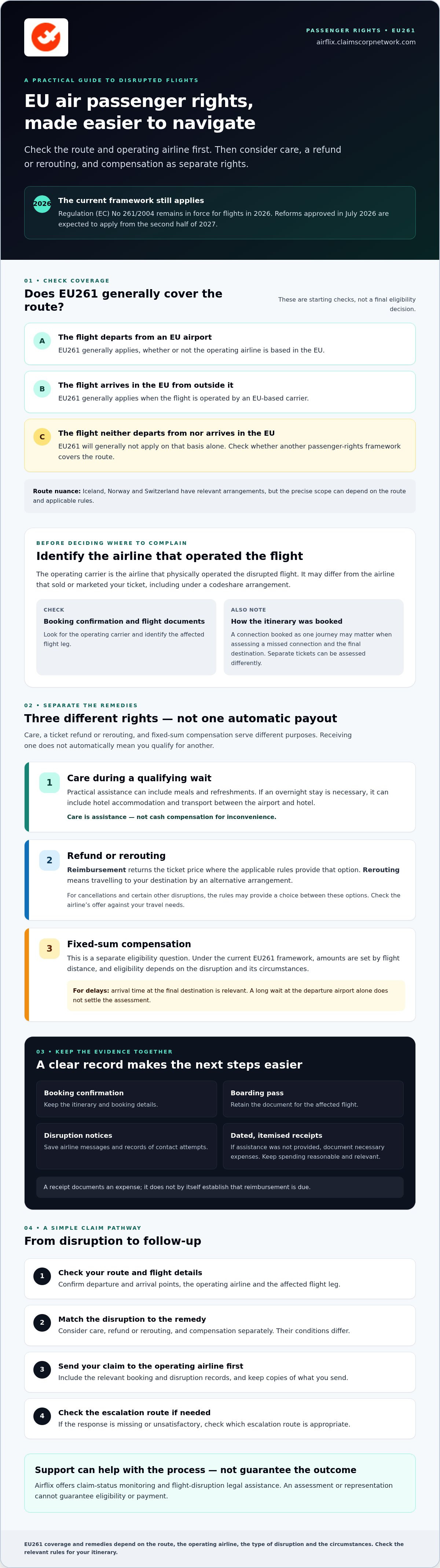
How should you document and submit an EU flight-rights claim?
A clear claim is easier to assess when you document the route, disruption and requested remedy together. Use this sequence to organise the process. The diritti passeggeri UE voli vary with the circumstances, so supporting records matter, but they don’t by themselves prove that a particular remedy is due.
- Confirm which rules may apply. Check the departure and arrival points, the operating airline and whether the journey was booked as one itinerary. Identify whether you’re making a flight-disruption complaint or a separate baggage claim.
- Identify the operating carrier. Review your booking and flight documents to distinguish the airline that operated the affected flight from the company that sold or marketed it.
- Collect relevant evidence. Bring together your booking confirmation, boarding pass, disruption notice, airline messages and any record of your actual arrival time. Keep dated, itemised receipts for necessary expenses, noting what each expense was for and why it arose.
- Write to the airline. State the flight details, what happened and the remedy you’re requesting. Keep your account factual, attach relevant copies, and save the submission, delivery confirmation and any response.
- Assess escalation. If the airline doesn’t respond or you disagree with its decision, check the appropriate next step for the country and claim type before proceeding.
What evidence should you keep after a flight disruption?
Keep originals where practical and store clear copies together. Useful records include the booking reference, boarding pass, airline notifications, written explanations, rerouting or refund offers, and evidence of when you reached your final destination. For additional expenses, note the date, amount and reason alongside each receipt. Submit only information relevant to the claim, and avoid sending unnecessary sensitive personal or financial data.
Where should an unresolved passenger complaint go?
Start with the operating airline and keep proof of when and how you complained. If the issue remains unresolved, the relevant national enforcement body may be able to review complaints about air-passenger rules. Alternative dispute-resolution schemes or court procedures may also be relevant, depending on the country, issue and circumstances. These routes aren’t identical, and filing deadlines can vary. Check current official national guidance for the correct body, process and time limit rather than relying on a general deadline.
If you’d prefer support managing a flight-disruption claim, review flight claim assistance information. Legal assistance and claim-status monitoring can support the process, but don’t guarantee eligibility or payment.
How can Airflix support a passenger pursuing flight-disruption rights?
After checking which rules apply, gathering evidence and approaching the airline, some passengers may want help managing the claim process. Airflix provides flight-disruption legal assistance and real-time claim-status monitoring. It’s an optional service, not an airline or public authority, and it doesn’t change the legal test for the diritti passeggeri UE voli.
What does flight-disruption legal assistance involve?
Airflix is designed to help passengers manage claims relating to flight disruptions, including delays, cancellations and denied boarding. Its claim-status monitoring lets passengers follow progress. If a matter proceeds to court, legal representation may be available as part of the service.
These are process features, not promises of compensation. Whether a claim qualifies, and what outcome may follow, depends on the itinerary, disruption, evidence and applicable law. A case assessment or legal representation doesn’t guarantee that a claim will be accepted or paid.
When might a passenger consider professional claim support?
Support may be worth considering if the facts are difficult to assess, correspondence with the airline has become complex, or a dispute remains unresolved. It’s still useful to understand the ordinary complaint route and keep your own records, including booking documents, notices and copies of communications.
Before proceeding, review the service terms and make sure you understand what assistance is included, how the process works and what information you’ll need to provide. Airflix offers subscription arrangements or a per-flight option; check the current terms for the applicable details.
For a clear next step, review flight-claim assistance options and decide whether professional assistance fits your circumstances. Eligibility and any eventual outcome depend on the case facts and the applicable rules.
Take the next step with a clearer claim plan
Start by checking whether EU261 covers your route and identifying the airline that operated the affected flight. The diritti passeggeri UE voli depend on the itinerary and disruption, so consider care, reimbursement or rerouting separately from fixed-sum compensation. No disruption automatically guarantees a payment.
Keep your booking documents, airline messages and relevant receipts together, then make a clear, evidence-based complaint to the operating airline. If the response leaves the issue unresolved, check the appropriate national escalation route and any applicable deadline. An organised record can help you decide which next step fits your case.
Airflix offers real-time claim-status monitoring and flight-disruption legal assistance for passengers who want support managing a claim. Legal representation may be available if court proceedings are required, but these services don’t guarantee eligibility or a particular outcome. Review flight-claim assistance options to understand the available support and process.
Frequently Asked Questions
Do EU passenger rights apply to every flight to or from Europe?
No. The diritti passeggeri UE voli depend on the route and operating airline, not simply on whether a flight touches Europe. EU261 generally covers flights departing from an EU airport, and flights arriving in the EU from outside it when operated by an EU-based carrier. Europe includes countries outside the EU, so a journey to or from one of them may not qualify on that basis alone. Check the full itinerary and operating carrier.
What is the difference between EU261 compensation and a flight refund?
A refund returns the ticket price where the applicable rules provide that option; compensation is a separate fixed-sum payment that may be due for certain disruptions. One doesn’t automatically replace or include the other. Depending on the situation, passengers may also have a choice of rerouting or a right to care. Check which remedies apply to your disruption, and don’t assume that receiving a refund means compensation is also payable.
Can I claim compensation if my flight is delayed?
Possibly, but a delay doesn’t automatically qualify for compensation. Under current EU261 rules, the delay at your final destination is central to the assessment; compensation may be considered when arrival is at least three hours late. The cause of the delay and other legal conditions also matter, including whether extraordinary circumstances apply. Keep records of scheduled and actual arrival times, airline updates and any explanation provided.
What happens if my flight is cancelled under EU rules?
Depending on the circumstances, you may be offered a choice between reimbursement and rerouting, and may have a right to care while waiting. Compensation is a separate assessment, not an automatic result of cancellation. Factors such as when the airline notified you, the alternative travel offered and the reason for cancellation can affect eligibility. Keep the cancellation notice, booking details and any rerouting or refund offer so you can assess your options.
Are missed connections covered by EU passenger rights?
A missed connection may be assessed differently depending on whether the flights were booked together or on separate tickets. With one booking, arrival at the final destination may be relevant; separate tickets can lead to a different assessment. Contact the airline promptly about onward travel and assistance. Keep the complete itinerary, booking confirmation, boarding passes and evidence of your final arrival time to document what happened.
Are lost or delayed bags covered by EU261?
No. EU261 concerns flight disruptions such as cancellations, delays and denied boarding. Lost, damaged or delayed baggage generally follows a separate claims process, which may involve the Montreal Convention. Report the problem to the airline and keep your baggage tag, written report, photographs and receipts for relevant expenses. Requirements and deadlines can vary, so check the applicable baggage-claim procedure rather than relying on the rules for a disrupted flight.
Where should I complain if an airline rejects my claim?
First, check the airline’s explanation and whether your evidence addresses the reason given. If the matter remains unresolved, the relevant national enforcement body may be able to review a complaint about passenger-rights rules. Alternative dispute-resolution or court procedures may also be available, depending on the country and claim. Keep copies of your submission and the airline’s response, and verify the correct escalation route and any applicable time limits through current official guidance.


