

A delay of three hours can make a compensation claim possible, but it doesn’t automatically mean the airline must pay. If you’re searching for “come fare reclamo per volo in ritardo”, start by checking when you arrived at your final destination and what caused the disruption. Under the rules currently in force, eligibility depends on these details, not simply on how long you waited at the airport.
It’s understandable to be unsure where to begin, which documents to gather or what to do if the airline rejects your request. Compensation is also separate from a ticket refund and from the assistance you may be entitled to during a long wait.
This guide explains how to check the main eligibility conditions, organise your evidence and submit a claim through the appropriate channel. It also covers what to do if the airline refuses or doesn’t respond, and distinguishes current rights under Regulation (EC) No 261/2004 from changes approved for a later date. A clear, well-documented request helps you assess your options without assuming the outcome in advance.
Key Takeaways
- Check the applicable passenger-rights rules, itinerary and operating carrier before deciding whether your delay may qualify.
- Distinguish a compensation claim from a ticket refund so you follow the right process for each request.
- To learn come fare reclamo per volo in ritardo, organise your booking confirmation, boarding pass, flight details and airline correspondence.
- If the airline refuses or doesn’t respond, compare its reasons with your evidence and check which escalation routes apply.
- Airflix offers flight disruption assistance, real-time claim-status monitoring and legal representation in court proceedings.
How to claim compensation for a delayed flight: start with the right checks
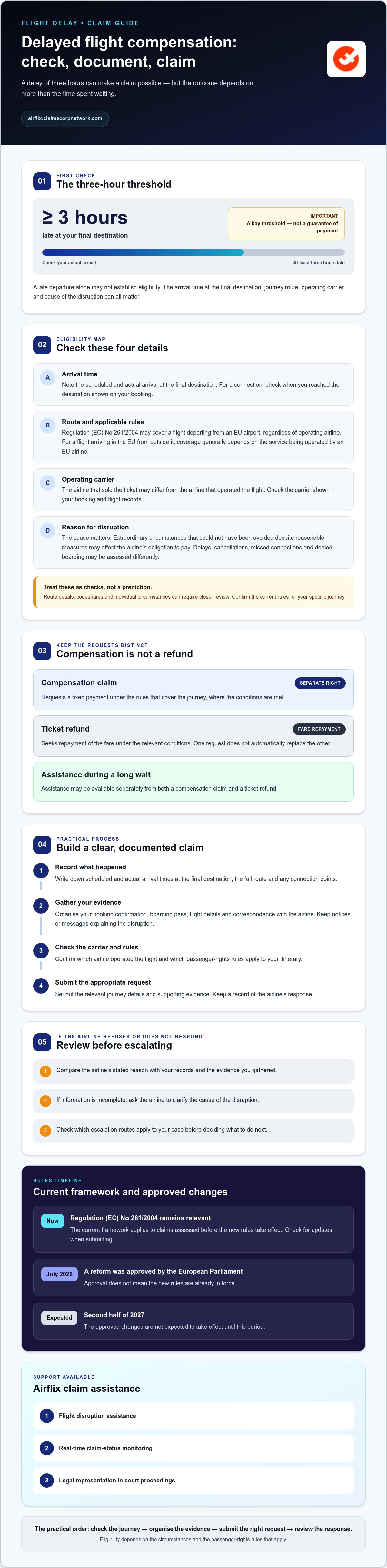
Before contacting the airline, establish what happened and which passenger-rights rules may apply. A delayed-flight compensation claim requests a fixed payment under the rules that cover the journey. A late departure alone may not establish eligibility. Your arrival time at the final destination, route, operating carrier and cause of the disruption can all matter.
This is different from asking for a ticket refund. A refund request seeks repayment of the fare under the relevant conditions, while a compensation claim concerns a separate right that may arise from a qualifying disruption. One request doesn’t automatically replace the other. The applicable rules determine which options are available in your case.
What details should you check before making a claim?
Start with your journey records, not an estimate based on the departure board. Note the scheduled and actual arrival times at your final destination, and keep airline or airport records that support them. If your booking included a connection, check when you reached the destination shown on the booking. The delay on the first flight may not tell the whole story.
Next, identify the airline that operated each flight. The airline that sold your ticket may differ from the operating carrier, so check your booking documents and flight details. Record the full route, including connection points, and check whether it falls within the relevant passenger-rights rules. The EU framework is set out in Regulation (EC) No 261/2004, but its application depends on the itinerary and carrier. Confirm the current rules for your specific journey before treating yourself as eligible.
Finally, identify the type of disruption. A delay, cancellation, missed connection and denied boarding may be assessed differently. Keep the airline’s notices and messages, and note any explanation it gave at the time.
Does every delayed flight qualify for compensation?
No. A delay doesn’t automatically mean compensation is due. Under the current EU rules, arrival at the final destination at least three hours late is a key threshold for a delayed-flight compensation claim. The cause also matters. Extraordinary circumstances that couldn’t have been avoided despite reasonable measures may affect the airline’s obligation to pay. These factors inform the assessment, but they don’t guarantee an outcome.
Compare your records with the airline’s written explanation and the rules that apply to your route and operating carrier. If the information is incomplete, ask the airline to clarify the reason for the disruption. For anyone researching come fare reclamo per volo in ritardo, this initial check helps identify the right type of request and the evidence to gather before submitting a claim.
Which passenger-rights rules apply to a delayed flight claim?
The main EU framework for assessing compensation and assistance after certain flight disruptions is Regulation (EC) No 261/2004. It doesn’t apply to every journey in the same way. The departure point, destination and operating airline can affect whether a flight is covered. The ticket seller may not be the airline that operated the service, so check the carrier shown in your booking and flight records.
The route and operating airline help determine which passenger-rights rules may cover a flight, so check both before assessing a claim. The official EU air passenger rights guidance outlines the framework. Check how it applies to your particular itinerary and circumstances.
When might Regulation (EC) No 261/2004 apply?
In broad terms, the Regulation may cover a flight departing from an EU airport, regardless of the operating airline. For a flight arriving in the EU from outside it, coverage generally depends on the service being operated by an EU airline. These are starting points, not a complete legal test. Connecting journeys, codeshares and particular routes can require closer review.
For example, a journey from an EU airport and a return flight to the EU may be assessed under different route conditions. Confirm the precise itinerary, operating carrier and current jurisdictional rules before relying on a general summary. In 2026, the European Parliament approved a reform in July, but the new rules are not expected to take effect until the second half of 2027. The current framework therefore remains relevant for claims assessed before then. Check for updates when submitting.
How can the reason for a delay affect a claim?
The airline’s explanation is another part of the assessment. A technical or operational issue may be treated differently from an event outside the carrier’s control, but the label in a message doesn’t settle the question by itself. Under the current framework, extraordinary circumstances may affect whether compensation is payable. Examples can include extreme weather, political instability or certain air traffic control strikes, depending on the facts and whether the situation could have been avoided through reasonable measures.
Keep the airline’s written explanation, disruption notices and later correspondence. If the stated cause is vague, ask the carrier to clarify it, then compare its response with the rules for your route. Don’t assume that every delay, or every event described as exceptional, leads to the same result. If you’re considering come fare reclamo per volo in ritardo, checking the route, operating carrier and stated cause helps you frame the claim accurately without treating eligibility as automatic.
How to submit a delayed-flight claim: a practical step-by-step process
A complete request is easier to assess when it clearly sets out the flight details, supporting evidence and outcome you’re seeking. First check which rules may apply to your route and operating carrier. Then follow a consistent process and keep a record of every communication.
What evidence should you gather before contacting the airline?
Collect documents that identify the journey and help establish what happened. Save digital copies and organise them by flight, particularly if your booking included connections.
- Booking confirmation and ticket details: Include the itinerary and passenger names.
- Boarding passes and flight information: Keep passes, flight numbers, travel date and scheduled times.
- Disruption records: Save airline emails, text messages, app notifications and any written explanation of the delay.
- Arrival evidence: Keep reliable records of the actual arrival time, if available, such as an airline notification or airport record.
- Expense receipts: Store receipts for reasonable costs incurred during the disruption separately from your compensation request. Whether these expenses can be claimed depends on the circumstances and applicable rules.
How should you write and submit the request?
Use the airline’s official claim channel and check its instructions before sending personal or booking information. ENAC’s guidance on how to submit a claim can help passengers identify the appropriate route in Italy. Keep your request concise, factual and specific.
- 1. Identify the journey: Provide the passenger’s name, flight number, travel date, route and booking reference.
- 2. Describe the disruption: State what happened and the recorded arrival delay. For a connection, explain the full itinerary and final arrival time.
- 3. State the remedy requested: Ask the airline to assess your compensation claim under the passenger-rights rules that apply. If you’re also seeking reimbursement of expenses or a ticket refund, identify that separately and explain the basis for each request.
- 4. Attach relevant evidence: Include copies of supporting records and refer to them clearly in your message.
- 5. Save your submission: Keep a copy of the completed form or email, attachments, confirmation and any case reference number. Follow up in writing and retain the response.
For passengers researching come fare reclamo per volo in ritardo, a clear paper trail is useful if the airline asks for more information or disputes the request. Keep the documents together so you can refer to the same evidence in any later correspondence.
If the airline rejects or ignores your flight delay claim
A refusal is a decision to assess, not necessarily the last available step. Check whether the airline has addressed the particular flight, the recorded arrival delay and the reason it gives. If it hasn’t replied, confirm that your request reached its official channel and note the submission date. Response periods and next steps depend on the applicable jurisdiction, so don’t rely on a general timeframe for every route.
How should you assess an airline’s refusal?
Focus on the reasoning, not the outcome alone. Does the airline explain how the stated cause affects your claim under the rules that apply? If its explanation is incomplete or doesn’t address a material point, ask for clarification in writing and keep the exchange factual. Disagreeing with the airline doesn’t, by itself, prove that compensation is due.
Keep the refusal, claim reference and supporting documents together. This gives you a clear record if you seek a further review and helps ensure that any follow-up addresses the airline’s actual reasons for refusing the request.
What options may remain after an unsuccessful claim?
Depending on the itinerary and jurisdiction, you may be able to contact a national enforcement body or use another dispute route. Confirm which authority is competent for your case and check its current submission procedure before escalating. For claims made directly to an airline in Italy, the airline has six weeks to respond. If it doesn’t respond within that period, or you’re dissatisfied with the answer, you can complain to ENAC. Verify the current process before submitting.
Professional assistance is another option, not a requirement or a guarantee of success. Airflix provides legal assistance for flight disruptions, real-time claim-status monitoring and legal representation in court proceedings. Check the service terms and eligibility criteria for your circumstances. For more information about support with come fare reclamo per volo in ritardo, review Airflix flight-claim assistance.
How Airflix can help manage a delayed-flight claim
After checking the applicable rules, gathering evidence and considering a direct claim to the airline, you may decide that assistance would make the process easier to manage. Airflix provides legal assistance for flight disruptions and monitors claims in real time. This support can help you keep track of a case, but it doesn’t guarantee that compensation will be awarded.
What support can a claims-assistance service provide?
Managing a claim means keeping flight details, supporting records and correspondence organised, then following the case as it progresses. Airflix offers assistance with flight disruption claims and real-time claim-status monitoring, giving passengers visibility into updates. A status update shows where the case stands. It doesn’t mean the airline has accepted the claim or that a particular outcome is certain.
Airflix also provides legal representation in court proceedings. This applies to court procedures and shouldn’t be confused with a guarantee that a claim will reach court or succeed. Before relying on any service, check what its support covers for your circumstances, including the eligibility criteria and applicable terms.
How can a passenger decide whether to seek assistance?
The choice depends on how much time you have, how comfortable you are managing written correspondence and how complex the disruption is. A straightforward case with clear records may feel manageable directly with the airline. A journey involving connections, an unclear explanation or a disputed refusal may need closer review. Assistance is an option, not a requirement.
Before submitting a claim through a provider, read the service terms carefully. Confirm eligibility, any applicable fees, what information or authority the provider needs, and how the claim will be handled. Ask how updates are communicated and what happens if the airline refuses. These checks help set realistic expectations and avoid assuming that monitoring or legal support guarantees payment.
If you’re weighing come fare reclamo per volo in ritardo, Airflix may help you manage a claim, with real-time status visibility and legal representation in court proceedings. Review the terms and confirm the service is appropriate for your case. Review Airflix flight-claim assistance.
Put your next claim step into practice
A delayed-flight claim is strongest when you assess the relevant rules, journey records and airline explanation together. Keep your request and follow-up in writing, and check the appropriate next route if the airline refuses or doesn’t respond. These steps turn come fare reclamo per volo in ritardo from a general concern into a clear process, while leaving the outcome to the facts and applicable rules.
If you’d prefer help managing a claim, Airflix is a specialised aviation claims service within the Claims Corporation Network group. Its services include real-time claim-status monitoring and legal representation in court proceedings. Review the service terms, eligibility and any applicable fees before deciding whether it suits your circumstances.
Review Airflix flight-claim assistance to see whether its support fits your case. Organised records and a clear understanding of your options can help you take the next step with confidence.
Frequently Asked Questions
Is my flight eligible for compensation if it arrived late?
It may be eligible, but arrival delay alone doesn’t determine the outcome. Under the current EU framework, the itinerary and operating airline must fall within the applicable rules, and the reason for the disruption can affect whether compensation is due. Extraordinary circumstances may change the assessment. If you’re deciding come fare reclamo per volo in ritardo, check your final arrival time, route and the airline’s written explanation before submitting a request.
How many hours does a flight need to be delayed before I can claim?
Under Regulation (EC) No 261/2004, arrival at your final destination at least three hours late is a key threshold for a delayed-flight compensation claim. The relevant time is generally arrival, not simply the delay at departure. Meeting this threshold doesn’t guarantee payment: the Regulation must apply to your journey, and the cause of the delay may also affect the assessment.
What documents do I need to make a delayed-flight claim?
Gather your booking confirmation, boarding pass, flight number, travel date and complete itinerary. For a journey with connections, include the records for each flight and evidence of when you reached your final destination, if available. Keep airline messages, disruption notices and written explanations. Save receipts for disruption-related expenses separately, as a request for those costs may be assessed differently from a compensation claim.
Can I claim compensation directly from the airline?
Yes. You can submit a written claim directly through the operating airline’s official claim channel. Identify the passenger and flight, describe the disruption factually, state the remedy you’re requesting and attach relevant evidence. Keep a copy of the form or email, attachments, submission confirmation and any reference number. Check the rules and submission procedure for your itinerary, as the correct route and applicable deadlines can vary.
What happens if the airline rejects my delayed-flight claim?
Review the refusal and compare its explanation with your flight records, arrival evidence and the rules that apply to your journey. If a point is unclear, ask the airline for clarification in writing. A refusal isn’t necessarily the end of the process, but disagreement alone doesn’t establish that compensation is due. Depending on the itinerary, you may be able to contact a national enforcement body or use another applicable dispute route.
How long do I have to claim compensation for a delayed flight?
The deadline depends on the applicable jurisdiction. In Italy, the legal deadline to bring a compensation claim is two years from the flight date, but ENAC advises passengers to submit within six months because some airlines may dispute later claims. Don’t assume that Italy’s timeframe applies to every route. Check the current deadline and procedure for your specific case, and keep proof of when you submitted the claim.
Can I use a claims-assistance service for a delayed flight?
Yes. A claims-assistance service is an option if you want support managing the process, but it isn’t required and can’t guarantee a particular result. Airflix provides legal assistance for flight disruptions, real-time claim-status monitoring and legal representation in court proceedings. Before proceeding, confirm that your case meets the service’s eligibility criteria and review its terms and any applicable fees. Updates show case progress, not whether compensation has been approved.


