

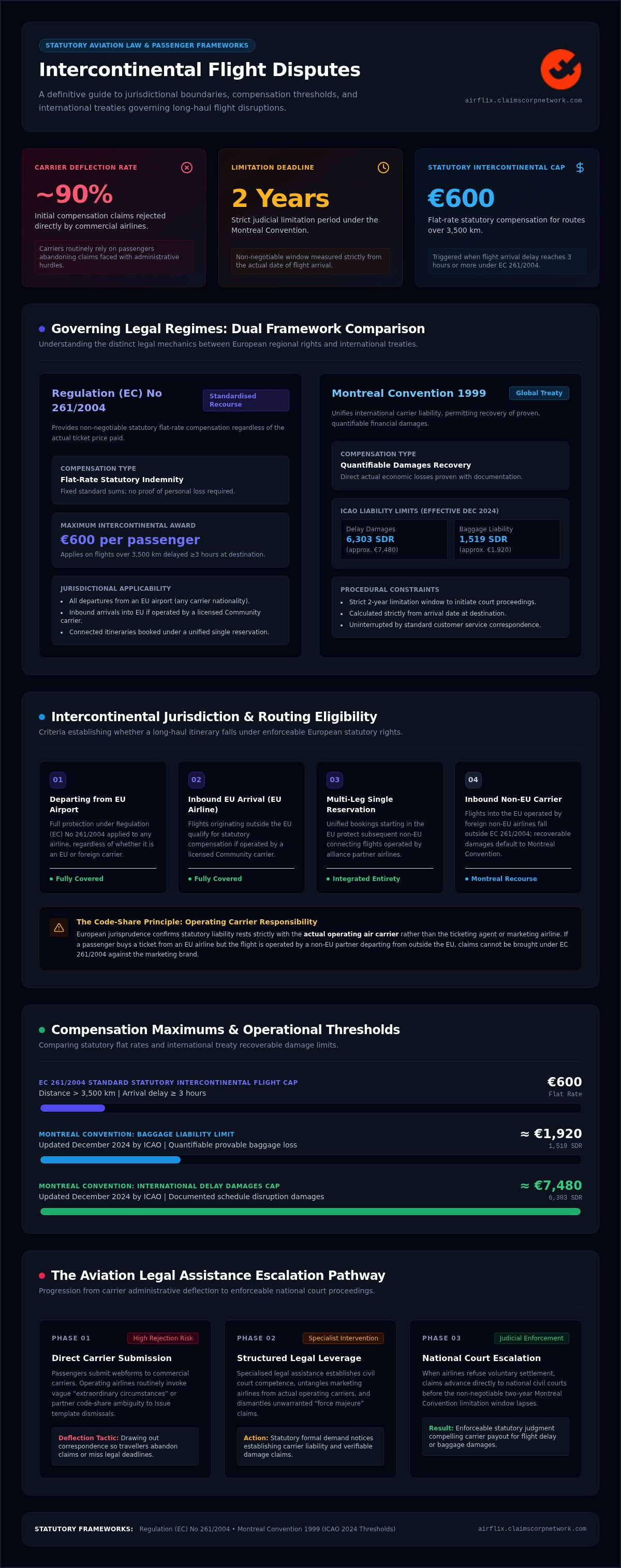
Airlines reject roughly 90% of initial passenger compensation claims, relying on the calculated assumption that travellers won't dispute procedural hurdles. When long-haul journeys cross international borders, operating carriers routinely exploit jurisdictional ambiguity between Regulation (EC) No 261/2004 and the Montreal Convention, citing vague extraordinary circumstances to dismiss valid filings. Engaging specialized assistenza legale per voli intercontinentali provides the structured leverage required to dismantle these carrier deflections, transforming an uneven administrative process into an enforceable statutory claim.
Most passengers know the frustration of waiting months for an opaque customer service response, only to receive a standard template denial. Dedicated legal assistance secures maximum statutory compensation for complex, disrupted intercontinental journeys, ensuring claims don't stall in administrative limbo but advance directly to national courts when airlines refuse to comply. Below, we examine the governing international frameworks in 2026, the essential steps for judicial escalation, and how modern tracking platforms restore complete operational transparency throughout the resolution cycle.
Key Takeaways
- Master the jurisdictional boundaries between Regulation (EC) No 261/2004 and the Montreal Convention to identify enforceable passenger compensation for long-haul routes.
- Discover why engaging dedicated assistenza legale per voli intercontinentali prevents international carriers from deflecting liability across multi-airline alliances and codeshare agreements.
- Learn how flight distance thresholds over 3,500 kilometres determine statutory compensation tiers up to €600 when arrival delays exceed operational tolerances.
- Examine the structured legal escalation pathway that progresses stalled correspondence into direct court proceedings when airlines refuse voluntary settlement.
- Gain complete visibility over complex cross-border proceedings through real-time claim tracking and dedicated baggage regress services.
What Governs Intercontinental Flight Disputes? Frameworks Beyond Domestic Borders
Intercontinental itineraries traverse distinct legal jurisdictions, creating overlapping layers of passenger protection. When a flight crosses borders, domestic consumer laws give way to international conventions and regional passenger frameworks. Airlines often claim that long-haul journeys outside Europe fall entirely beyond regulatory oversight. That assertion is legally inaccurate. In practice, securing statutory rights demands specialised assistenza legale per voli intercontinentali to establish precisely which civil courts possess competence over the operating carrier.
The Scope of Regulation (EC) No 261/2004 in Long-Haul Travel
European protections remain active across global itineraries under specific criteria established by European Union case law:
- Departure location: Any flight departing from an airport within the European Union remains covered by Regulation (EC) No 261/2004, regardless of the operating airline's nationality.
- Carrier licensing: Inbound flights originating outside the EU qualify for statutory compensation if the journey is operated by a licensed Community carrier and lands at an EU destination.
- Single reservations: Multi-leg journeys booked under a unified booking reference count as an integrated whole; a disruption on an outside-EU connection can trigger liability if the journey began at an EU airport.
- Statutory limits: Disruptions on intercontinental journeys exceeding 3,500 kilometres entitle passengers to €600 in flat-rate compensation when arrival delays reach three hours or more.
The Montreal Convention 1999 and Recoverable Damages
Where statutory European regulations do not apply directly, the Montreal Convention provides global recourse for provable, quantifiable damages. Established to unify carrier liability across international civil aviation, this treaty operates under different principles than standard European delay compensations.
Rather than providing predetermined flat-rate payments, the convention permits travellers to recover actual financial losses resulting directly from international schedule disruption. Liability limits are expressed in Special Drawing Rights (SDR). Effective December 2024, the International Civil Aviation Organization updated the delay damage threshold to 6,303 SDR (approximately €7,480), whilst baggage liability rose to 1,519 SDR (approximately €1,920).
Enforcing these rights requires attention to procedural constraints. The treaty establishes a strict, non-negotiable two-year limitation period from the arrival date to launch formal judicial proceedings. Airlines frequently draw out administrative correspondence to let this two-year deadline lapse. Engaging qualified assistenza legale per voli intercontinentali ensures claims transition into court before statutory windows close.
Why Do Intercontinental Flight Disruptions Demand Specialist Legal Representation?
Resolving long-haul travel disruptions involves far more than submitting an automated consumer webform. Airlines handle intercontinental routes through intricate operational structures designed to minimise liability. When a long-haul flight suffers an operational failure, carriers leverage international partnerships to deflect claims between partner organisations. Professional assistenza legale per voli intercontinentali dismantles these jurisdictional deflections by holding the true operating entity accountable under enforceable statutory frameworks.
Untangling Code-Share Partnerships and Operating Carrier Responsibilities
Modern intercontinental journeys regularly involve multiple carriers operating under a single marketing umbrella. A ticket bought through one European brand may feature connecting legs flown by foreign non-EU partners across international hubs. European jurisprudence confirms liability rests strictly with the actual operating air carrier rather than the ticketing agent or marketing airline. If a passenger's multi-leg itinerary begins at an EU airport under a single booking, non-EU connecting legs remain subject to EU Air Passenger Rights. Pinpointing the precise legal entity responsible for the disruption requires specialised knowledge of global commercial aviation agreements.
Challenging Extraordinary Circumstances Through Technical Evidence
Legal teams routinely encounter airlines citing unverified operational barriers to avoid statutory payouts. Carriers frequently claim:
- Vague meteorological restrictions: Airlines blame broad weather systems even when other carriers operated normally on the same corridor.
- Air traffic management constraints: Operational delays get attributed to third-party slot restrictions without providing mandatory flow-management documentation.
- Mechanical breakdowns: Ordinary technical defects are falsely framed as unpreventable external events.
European case law clearly affirms that premature component failure forms an intrinsic part of regular aircraft operations, not an extraordinary event. Overcoming bad-faith airline rejections demands hard evidence. Specialist legal counsel cross-references airline assertions with independent telemetric flight data, meteorological radar archives, and air traffic control slot allocations to disprove fabricated operational defences.
Operating airlines bank on passenger fatigue, knowing individual claimants rarely possess the cross-border resources to challenge corporate denials in civil court. Engaging structured Flight Disruption Legal Assistance levels this procedural imbalance, ensuring your claim moves beyond customer-service stalling tactics directly into formal pre-litigation recovery.
Evaluating Statutory Compensation Tiers and International Claim Eligibility
Statutory compensation under European legislation follows precise, non-negotiable metrics rather than subjective assessments of inconvenience. Eligibility depends strictly on direct orthodromic distance and the arrival delay recorded at the passenger's final destination ticketed under a single reservation. Delays occurring at intermediate transit hubs do not determine qualification on their own. Instead, European jurisprudence confirms that the timestamp when the aircraft doors open at the journey's ultimate terminal dictates whether the carrier owes statutory remedies. Undertaking an objective audit of complex multi-sector itineraries establishes whether airlines owe flat-rate statutory payments or international delay damages.
Distance Thresholds and Compensation Calculations
For intercontinental travel extending beyond the borders of the internal European market, statutory thresholds are distinct:
- Maximum statutory threshold: All flights covering more than 3,500 kilometres entitle passengers to €600 when arrival delay reaches at least four hours at the final destination.
- Statutory reductions: If the operating carrier arranges re-routing that delivers the passenger to their final destination with an arrival delay between three and four hours, the airline may reduce the statutory entitlement by 50% to €300.
- Denied boarding: Involuntary denied boarding caused by commercial overbooking triggers immediate liability for the full €600 distance tier without requiring an initial waiting period.
- Short-notice cancellations: Schedule cancellations communicated less than 14 days before departure require full statutory compensation unless the carrier provides timely re-routing within strict legal margins.
Addressing International Transit Luggage Disruption and Regress
Long-haul connections amplify operational vulnerabilities regarding checked luggage handling. When luggage fails to appear on international carousels, the Montreal Convention governs financial liability across bilateral routes, as outlined in the U.S. DOT Fly Rights documentation for transatlantic journeys. The liability ceiling currently stands at 1,519 Special Drawing Rights (approximately €1,920) per passenger for lost, damaged, or delayed baggage.
Carriers frequently dismiss delayed luggage claims on procedural technicalities. Preserving your statutory rights demands immediate completion of a Property Irregularity Report (PIR) before leaving the baggage reclaim area, followed by a formal written complaint delivered to the carrier within 21 days from the date the baggage was placed at your disposal. If the airline loses luggage permanently, claims must be lodged within two years. Securing dedicated assistenza legale per voli intercontinentali ensures proper baggage regress management, forcing operating carriers to reimburse all essential emergency purchases, damaged items, and replacement expenses incurred during your disruption.
The Structured Path of Aviation Legal Assistance: From Claim to Court
Airlines routinely treat individual passenger correspondence with automated denials, banking on procedural exhaustion. While public national enforcement bodies monitor industry compliance, they don't possess the mandate to recover individual monetary payouts for passengers. Securing statutory compensation requires a methodical escalation model that transitions from technical audit into formal judicial enforcement. Dedicated assistenza legale per voli intercontinentali delivers this end-to-end framework, replacing unilateral administrative delays with rigorous legal accountability.
Technical Validation and Out-of-Court Demands
The resolution workflow begins by assembling unassailable technical evidence before contacting the airline:
- Telemetry reconciliation: Flight data recorders, secondary surveillance radar paths, and European air traffic control records are cross-analysed to establish the exact timeline of operational disruption.
- Meteorological correlation: Historical airport weather observation logs (METAR) and terminal aerodrome forecasts (TAF) verify whether declared weather conditions legitimately precluded flight operations.
- Adjacent flight analysis: Performance tracking evaluates whether concurrent departures operated along identical routes during the same operational window.
Armed with verified flight logs, legal counsel serves a formal letter of claim directly on the carrier's legal department. Citing binding judicial precedents alongside documented operational facts immediately neutralises automated customer-service deflection scripts.
Enforcing Passenger Rights Through Judicial Court Representation
When an operating carrier persists in non-compliance, the dispute moves into national civil courts. Airlines frequently maintain aggressive refusal stances during administrative exchanges, only to settle immediately once formal judicial proceedings are registered on a court docket.
Direct court representation resolves key cross-border procedural hurdles that dissuade private individuals:
- Managing complex territorial service of process across international borders.
- Filing tailored pleadings in the competent national jurisdiction with appropriate evidentiary support.
- Defending against preliminary jurisdictional objections raised by foreign airline counsel.
A formal court judgment establishes a binding writ of execution. This judicial title enables direct asset enforcement against the carrier if voluntary settlement remains unpaid. Throughout this process, automated updates eliminate the ambiguity typical of international litigation. Claimants retain complete operational visibility through Real-Time Claim Status Tracking from the moment technical validation commences until funds are disbursed.
Streamlining Disruption Management with Airflix Aviation Solutions
Resolving cross-border travel disputes requires an institutional bridge between automated intake and direct judicial capability. Airflix delivers dedicated Flight Disruption Legal Assistance, operating under the established claims infrastructure of Claims Corporation Network (CCN), founded in 2014. Rather than abandoning complex claims when airlines issue boilerplate rejections, this structured service pairs technical data validation with direct judicial representation. For long-haul passengers and travel organisers, specialised assistenza legale per voli intercontinentali converts disputed administrative correspondence into enforceable statutory claims.
Institutional Expertise and Comprehensive Litigation Support
Operating across international air transport routes demands legal capabilities that extend well beyond standard domestic filings. Airflix manages passenger disputes encompassing long-haul flight delays, short-notice cancellations, denied boarding, and transit luggage disruptions. Through a dedicated Baggage Claim Regress service, passenger claims for delayed or lost luggage are systematically pursued up to the statutory limits established by the Montreal Convention. When an operating carrier refuses voluntary settlement during pre-litigation correspondence, legal teams initiate formal court procedures, appearing before competent civil jurisdictions to secure enforceable judgments.
Operational Transparency for Passengers and Travel Partners
Traditional legal dispute processes frequently leave claimants without updates across lengthy proceedings. Airflix resolves this opacity through proprietary Real-Time Claim Status Tracking, providing immediate visibility into every milestone from initial telemetry audits to courtroom hearings.
The platform provides structured service options tailored to different travel profiles:
- Flexible deployment: Passengers can access assistance per flight or through ongoing monthly and yearly subscriptions.
- Agency integration: Travel management companies and booking platforms can deploy a White-label Passenger Portal, managing disruption claims directly within their existing digital infrastructure.
- Cross-border oversight: Dedicated legal professionals coordinate jurisdictional procedures across borders, removing administrative friction for international travellers.
This disciplined combination of automated tracking and direct courtroom escalation delivers the systemic leverage required to hold international carriers accountable.
Securing Enforceable Passenger Rights in Global Air Travel
Operating carriers often rely on bureaucratic inertia, banking on the premise that passengers will abandon valid claims when faced with complex jurisdictional hurdles. Yet international aviation conventions and European statutory frameworks provide clear mechanisms to recover full compensation for long-haul disruptions. Success requires moving past generic complaint forms to establish direct accountability against non-compliant airlines.
Airflix bridges this gap by combining telemetry validation with formal courtroom escalation across international borders. Backed by Claims Corporation Network (CCN), a claims administrator operating since 2014, the platform pairs end-to-end judicial representation with Real-Time Claim Status Tracking. Whether resolving four-hour transatlantic arrival delays or coordinating Montreal Convention baggage regress, engaging structured assistenza legale per voli intercontinentali converts disputed claims into enforceable financial recoveries.
Take control of your passenger entitlements instead of accepting unilateral carrier rejections. Instruct Airflix for specialist flight disruption legal assistance to secure the statutory compensation your journey warrants.
Frequently Asked Questions
Does Regulation (EC) No 261/2004 apply to an intercontinental flight operated by a non-EU carrier?
Yes, but only if the flight departs directly from an airport situated within the European Union. If the flight originates outside the EU and is operated by a non-Community carrier, European statutory rules don't apply, even if the destination is European. Conversely, flights departing an EU territory remain fully protected under European consumer law regardless of the airline's registered nationality.
What is the maximum statutory compensation available for long-haul intercontinental flight disruptions?
The maximum statutory compensation payable under Regulation (EC) No 261/2004 is €600 per passenger. This flat-rate sum applies to all qualifying routes exceeding 3,500 kilometres when arrival delays reach at least four hours at the destination. The carrier may reduce this compensation by 50% to €300 if alternative re-routing keeps the eventual arrival delay under four hours.
Can I claim compensation if I miss a connecting flight outside Europe on a single ticket?
Yes, provided your entire itinerary was booked as a unified reservation originating at a European airport. European case law treats multi-leg itineraries as an indivisible journey. If a disruption causes a missed connection outside Europe, resulting in an overall arrival delay of three hours or more at your final destination, statutory rights apply. Dedicated assistenza legale per voli intercontinentali ensures foreign partner carriers don't evade shared liability.
How does the Montreal Convention differ from European passenger rights regulations on intercontinental routes?
European regulations provide fixed statutory sums for delay or cancellation, whereas the Montreal Convention covers provable financial losses. Applying globally across international civil aviation routes, the Montreal Convention enables recovery for quantifiable economic damages, accommodation expenses, and lost or damaged transit baggage up to 1,519 Special Drawing Rights (roughly €1,920), rather than offering automatic flat-rate compensation for lost time.
Why do airlines frequently deny valid intercontinental flight delay and cancellation claims?
Airlines reject approximately 90% of initial claims to limit corporate payout exposure, banking on passenger fatigue. Carriers routinely cite vague extraordinary circumstances, such as generic weather patterns or unverified air traffic management restrictions, without providing technical evidence. Because intercontinental claims carry the highest statutory tiers, airlines deploy administrative delays unless faced with structured pre-litigation documentation and judicial escalation.
What evidence is essential when pursuing legal assistance for a disrupted long-haul flight?
Passengers must retain boarding passes, electronic booking confirmations, bag tags, expense receipts, and any written disruption notices issued by airline ground staff. For luggage delays, the Property Irregularity Report (PIR) completed at the terminal is indispensable. Instructing specialized assistenza legale per voli intercontinentali pairs these passenger documents with independent radar archives and meteorological telemetry to dismantle carrier excuses.
What is the statutory limitation period for launching legal action against an international airline?
Limitation windows depend on the legal framework governing your dispute and the competent court handling the proceeding. Claims pursued strictly under the Montreal Convention carry an absolute, non-negotiable two-year deadline from the scheduled arrival date. For European statutory claims, deadlines vary under national civil procedures, generally between two and ten years. Commencing early legal action prevents valuable claims from lapsing.


