

What if the same international flight disruption could fall under different legal rules, depending on the route and the type of loss? That uncertainty can make the procedura risarcimento volo internazionale feel harder than it needs to be. Passengers are right to expect a clear answer, particularly when airline responses are slow and the distinction between EU261, UK rules and the Montreal Convention isn’t obvious.
The key is to establish which rules may apply before submitting a claim. This guide explains how to check eligibility, identify the appropriate legal route and organise the evidence for a well-supported claim. It also clarifies the difference between fixed compensation for certain disruptions and claims for losses such as delayed, damaged or missing baggage.
You’ll follow the process step by step, from recording what happened and contacting the airline to checking deadlines and considering further action if a claim is rejected. Where the administrative work becomes difficult to manage, Airflix provides flight disruption legal assistance, real-time claim status tracking and a separate baggage claim regress service. The aim is to give you a clear, practical route towards resolving your claim under the relevant British or EU framework.
Key Takeaways
- Learn how to assess whether UK261, EC 261/2004 or the Montreal Convention may apply to your disruption and the type of loss involved.
- Use a structured procedura risarcimento volo internazionale to move from recording the disruption to submitting a clear, evidence-based claim.
- Understand how flight distance can affect compensation and which records may support a claim for eligible expenses.
- Assess an airline’s extraordinary circumstances response and distinguish between causes of disruption before deciding how to proceed.
- See how Airflix’s legal assistance, baggage claim regress service and real-time claim status tracking can help reduce administrative work for passengers and travel agencies.
Understanding the Legal Framework for International Flight Claims
An international itinerary doesn’t automatically fall under one universal compensation scheme. The applicable rules depend on where the journey begins and ends, which airline operates the flight, and whether the claim concerns a travel disruption or a separate loss, such as damaged baggage. Establishing the right legal route is the first step in a procedura risarcimento volo internazionale.
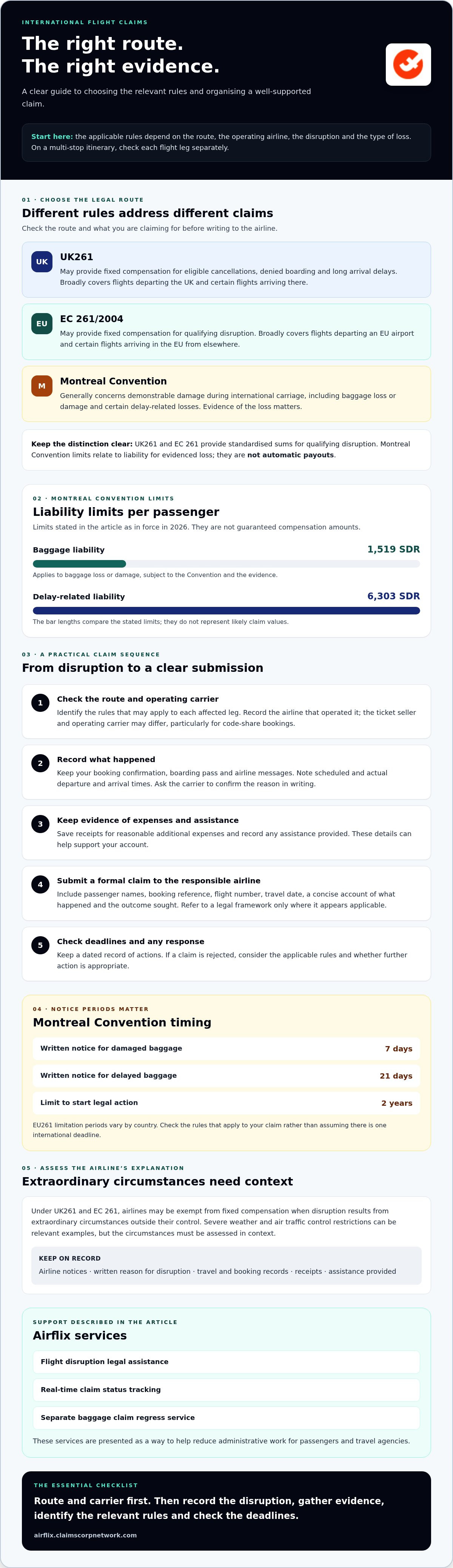
For eligible cancellations, denied boarding and long arrival delays, UK261 and EU Regulation 261/2004 may provide fixed compensation, subject to their scope and conditions. In broad terms, UK261 covers flights departing the UK and certain flights arriving there. EC 261/2004 covers flights departing an EU airport and certain flights arriving in the EU from elsewhere. The Regulation (EC) No 261/2004 sets out the EU framework. On a multi-stop itinerary, check each leg separately because different rules may apply to different flights.
EC 261/2004 vs. the Montreal Convention
The two regimes address different types of claim. EC 261 and UK261 provide standardised sums for qualifying disruption, while the Montreal Convention generally concerns compensation for demonstrable damage caused during international carriage, including baggage loss or damage and certain delay-related losses. Under the Convention, baggage liability is capped at 1,519 Special Drawing Rights (SDR) per passenger, and delay-related liability at 6,303 SDR per passenger, according to the limits in force in 2026. These are liability limits, not automatic payouts. Evidence of the loss matters.
The Montreal Convention doesn’t simply replace EU or UK passenger-rights rules on every international flight. You may need to consider the type of harm and the route to identify the relevant framework. Deadlines differ too. The Convention specifies written notice periods of seven days for damaged baggage and 21 days for delayed baggage, with a two-year limit to start legal action. For EU261 claims, limitation periods vary by country. Check the rules applicable to your claim rather than assuming there is one international deadline.
Eligibility Criteria for Disrupted Travellers
A delay or cancellation alone doesn’t determine eligibility. The relevant scheme, disruption, arrival impact and reason for the event all matter. Under UK261 and EC 261, airlines may be exempt from paying fixed compensation when disruption results from extraordinary circumstances outside their control. Severe weather and air traffic control restrictions can be relevant examples, but the circumstances must be assessed in context. Keep airline notices and travel records, and ask the carrier to confirm the reason in writing.
Code-share bookings need particular care. The airline that sold the ticket may differ from the carrier that operated the flight, and this distinction can affect which party handles a claim. Record the operating carrier for each leg alongside your booking details and route. Checking the route and operating carrier first helps you direct the claim to the appropriate airline and legal framework.
The Step-by-Step International Flight Compensation Procedure
A clear process reduces avoidable delays and makes it easier to respond if an airline challenges your claim. First identify the operating carrier and the legal framework that may apply, then keep a dated record of each action. The right procedura risarcimento volo internazionale depends on the route and disruption, so check which rules are relevant before submitting your claim.
Step 1: Record the disruption at the airport
Save your booking confirmation, boarding pass and any messages from the airline. Note the scheduled and actual departure and arrival times, and ask the carrier to confirm the reason for the disruption in writing. Keep receipts for reasonable additional expenses and record any assistance provided. These details can help support your account later.
Step 2: Submit a formal claim to the airline
Write to the airline responsible for operating the affected flight. Include passenger names, booking reference, flight number, travel date, a concise description of what happened and the outcome you’re seeking. Refer to UK261, EC 261/2004 or another relevant framework only where it appears applicable. The Official EU Air Passenger Rights guidance can help clarify EU rules.
Keep your message factual and attach copies, not originals, of supporting documents. Ask the airline to explain any refusal and identify the basis for its decision. Check its published complaint process for the response timeframe, then record the submission date and when you plan to follow up. There isn’t one universal waiting period for every international claim, so don’t assume the same deadline applies across carriers and jurisdictions.
Step 3: Escalate if the airline rejects or ignores the claim
If the airline refuses compensation or doesn’t respond within its stated timeframe, check the appropriate next step for the route and legal regime. An Alternative Dispute Resolution (ADR) scheme may be available for eligible disputes, while a National Enforcement Body may provide guidance or handle regulatory complaints. Their roles and processes vary, and a regulator’s review may not itself secure an individual payment. Confirm the appropriate route before escalating, especially where multiple countries or operating carriers are involved. For complex disputes, professional legal assistance can help assess the claim and provide representation in court proceedings where required.
Step 4: Track progress and keep a complete record
Log acknowledgements, requests for information and decisions in one place. Airflix’s real-time claim status tracking can help passengers and travel agencies monitor progress and identify outstanding actions. If managing correspondence becomes difficult, consider professional flight disruption legal assistance alongside keeping a clear record of the claim’s progress.
Calculating Compensation and Gathering Evidence
Separate fixed compensation from reimbursement for expenses or other losses. The amount and evidence required depend on the legal framework and the circumstances of the disruption. Start by confirming the route, arrival delay and reason for the disruption, then organise your records by claim type. This makes the procedura risarcimento volo internazionale easier to assess and helps prevent receipts for expenses being confused with a fixed-sum compensation claim.
Compensation amounts and arrival delay
Under EU Regulation 261/2004, fixed compensation is based on flight distance: €250 for flights of 1,500 km or less; €400 for intra-EU flights over 1,500 km and other flights between 1,500 and 3,500 km; and €600 for other flights over 3,500 km. For long-haul flights, an airline may reduce compensation by 50% if the arrival delay is less than four hours. These are EU amounts. Don’t assume they convert directly to a UK claim or apply to every international itinerary.
For assessing a delay, arrival time is the moment at least one aircraft door opens and passengers are permitted to leave. Compare this with the scheduled arrival time, not just when the aircraft lands or reaches its stand. For travel involving the United States, consult the U.S. Department of Transportation Fly Rights, as applicable passenger protections can differ from EU rules.
Build an evidence file
Collect records while the details are easy to verify. Keep copies of:
- Booking confirmation, boarding passes and any rebooking details.
- Baggage tags and airline reports or correspondence about delayed, lost or damaged luggage.
- Receipts for reasonable out-of-pocket costs, such as meals, accommodation or communication, together with a note of why each expense arose.
- Photographs of damage, the departure or arrival board, and written explanations from airline staff, where available.
- A dated timeline of announcements, actual arrival and contact with the carrier.
Records made at the time are especially useful because they establish what happened and when. Booking and flight records help confirm the itinerary; receipts substantiate claimed expenditure; photographs and written communications can support details the carrier disputes. No single document guarantees an outcome. In court, evidence is assessed as a whole, so keep originals where possible and submit legible copies.
For baggage claims under the Montreal Convention, act promptly: the 2026 limits require written notice within seven days for damaged baggage and 21 days for delayed baggage. The liability cap is 1,519 Special Drawing Rights (SDR) per passenger, not an automatic payment. Record the problem with the airline and retain the relevant documents. Care expenses and fixed compensation are distinct from reimbursement of actual costs, so check the rules that apply to your route before calculating the total claim.
Overcoming Airline Objections and Extraordinary Circumstances
An airline’s reference to “extraordinary circumstances” isn’t, by itself, enough to determine whether compensation is due. Under UK261 and EC 261/2004, the circumstances and their connection to the disruption need to be considered against the applicable rules. Severe weather, air traffic control restrictions and political instability may be relevant, but the details matter. Assess the carrier’s explanation, the evidence it provides and whether reasonable measures could have reduced the disruption.
Assess the cause, not just the label
Technical problems aren’t automatically extraordinary circumstances. The distinction between an ordinary operational fault and an unusual event outside the airline’s control can be important, but it depends on the facts and applicable law. Bird strikes and alleged hidden manufacturing defects may require careful examination rather than a blanket conclusion. Courts’ assessments are case-specific, so avoid assuming that every technical failure either qualifies or does not.
Weather objections also need context. Ask what conditions affected the flight, whether they prevented safe operation, and how they affected the particular route and time. A general reference to “bad weather” provides little detail on its own. Airport disruption can also involve different groups: a strike by an airline’s own staff may be assessed differently from action by air traffic control or airport personnel. The legal outcome depends on who was involved and how the event affected the flight.
The airline’s response should explain what happened and what steps it took to limit the impact. This is relevant to the “reasonable measures” assessment, but it doesn’t mean a passenger can assume an alternative flight or other specific action was always possible. Request a clear explanation and keep the reply.
Challenge a refusal with focused evidence
If a claim is rejected, ask the carrier to identify the specific cause, the flight leg affected and the basis for treating the event as extraordinary. Depending on the objection, you can request supporting material, such as relevant technical information or METAR weather observations. These may not be provided directly to passengers, and making a request doesn’t establish entitlement. Keep the refusal, follow-up messages, disruption notices and your own dated account together.
Set out any gaps or inconsistencies in a concise written response. If the airline stops replying, follow the escalation route that applies to the flight and jurisdiction rather than sending repeated, unstructured messages. Airflix provides flight disruption legal assistance, real-time claim status tracking and legal representation in court procedures. For support with reviewing an airline’s objection, read about Airflix’s flight claim assistance as part of a structured procedura risarcimento volo internazionale.
Professional Assistance: How Airflix Simplifies the Procedure
Managing an international claim can involve organising documents, handling airline correspondence and keeping track of next steps. Airflix, a Claims Corporation Network (CCN) brand, provides legal assistance for flight disruptions and baggage claims. Its services are available to individual passengers and travel agencies, helping them manage claim administration through a clearer, more structured process.
Digital visibility and legal support
Airflix’s real-time claim status tracking gives passengers visibility of progress without relying solely on separate emails and personal notes. It doesn’t guarantee an outcome or a particular timeframe, but it can make it easier to see where a claim stands. The separate baggage claim regress service also addresses passenger needs involving delayed, lost or damaged luggage.
Where an airline contests a claim or proceedings become necessary, professional legal assistance can help assess the matter and manage the relevant steps. Airflix provides legal representation in court procedures. The merits of the case and the supporting evidence remain central, so representation should not be understood as a guarantee of success. Passengers can consider whether professional support would help them manage the procedura risarcimento volo internazionale.
Support for travel agencies and partners
Travel agencies and operators can use Airflix’s white-label Passenger Portal to make claim support available under their own brand. It provides a dedicated channel for managing passenger cases, while Airflix supplies the associated legal assistance. This arrangement can help partners keep claim handling more consistent without presenting themselves as the legal provider.
Airflix offers monthly and yearly subscription models, as well as a per-flight option. The suitable approach depends on the partner’s or passenger’s requirements, so compare the available models before deciding. For travel agencies, the portal combines branded access with real-time case tracking. For individual travellers, legal assistance and claim visibility offer a more organised alternative to managing every administrative step independently.
Move from Claim Uncertainty to a Clear Next Step
A well-prepared claim starts with identifying the rules that apply, documenting the disruption and its costs, and directing a clear request to the responsible airline. The right procedura risarcimento volo internazionale also accounts for the possibility of an objection. Keep your records organised and check the appropriate escalation route if the airline refuses or doesn’t respond.
If you’d prefer professional support, Airflix provides flight disruption legal assistance backed by Claims Corporation Network (CCN). Real-time claim status tracking helps you follow progress, and legal representation is available in court procedures where required. Airflix also handles baggage claim regress, a separate service for passengers dealing with luggage issues.
Contact Airflix to take the next step with your flight compensation claim.
Frequently Asked Questions
What is the first step in the international flight compensation procedure?
Start by identifying the operating airline and recording what happened. Keep your booking confirmation and boarding pass, note the actual arrival time and save airline messages or disruption notices. Ask the carrier to confirm the reason for the delay, cancellation or denied boarding in writing. These details help establish which rules may apply and provide a factual basis for your claim before you contact the airline.
Can I claim compensation for a flight delay that occurred two years ago?
Possibly, but eligibility depends on the legal basis and the limitation period that applies to your route. Time limits for UK261 and EU261 claims vary by jurisdiction, so two years may be within time in some cases but too late in others. The Montreal Convention has a two-year limit to start legal action for claims within its scope. Check the relevant deadline promptly before taking further steps.
Does the Montreal Convention apply to my flight if it was not in the EU?
It can. The Montreal Convention concerns certain international air carriage claims and isn’t limited to flights within the EU. Its application depends on the itinerary and the countries involved, as well as the type of loss claimed. It may be relevant to baggage loss, damage or delay-related losses, while fixed compensation for a disruption may instead be assessed under UK261 or EU261 if that framework applies.
What happens if the airline offers me travel vouchers instead of cash?
Check the offer’s terms before accepting it, especially whether accepting the voucher settles or waives any part of your claim. Under EU261, compensation is generally paid in money unless the passenger agrees to another form, such as a voucher. If you prefer cash, state that clearly in writing and ask the airline to explain the legal basis and conditions of its offer. Rules may differ under other frameworks.
Is a strike by airport staff considered an extraordinary circumstance?
Not automatically. The assessment can depend on which staff are striking, their relationship to the airline or airport, and how the strike affected the flight. A strike by airline employees may be treated differently from industrial action involving air traffic control or airport staff. Ask the airline to identify the cause and explain why it considers the event extraordinary. The label alone doesn’t establish whether compensation is excluded.
How long does the international flight compensation procedure usually take?
There’s no single timetable for international claims. The duration can depend on the airline’s complaint process, the legal framework, the evidence required and whether the claim is escalated to a dispute-resolution body or court. Keep a record of when you submitted the claim and check the carrier’s stated response timeframe. If that passes without a meaningful reply, consider the appropriate escalation route for the jurisdiction.
Can I claim for a missed connection if the first flight was delayed?
You may be able to, but the outcome depends on factors such as whether both flights were part of one booking, the operating carriers, the arrival delay at your final destination and the rules governing the itinerary. Keep confirmation of both flights, boarding passes, rebooking details and communications showing why the connection was missed. Submit the complete journey information so the airline can assess the disruption in context.
Do I need a lawyer to take an airline to court for compensation?
Not in every case, but court procedures and representation requirements vary by jurisdiction and court. Before starting legal action, check the applicable procedure, deadlines and any requirement for legal representation. Professional assistance may help assess the claim and manage the process. Airflix provides flight disruption legal assistance, including legal representation in court procedures, and real-time claim status tracking for passengers monitoring a claim.


