

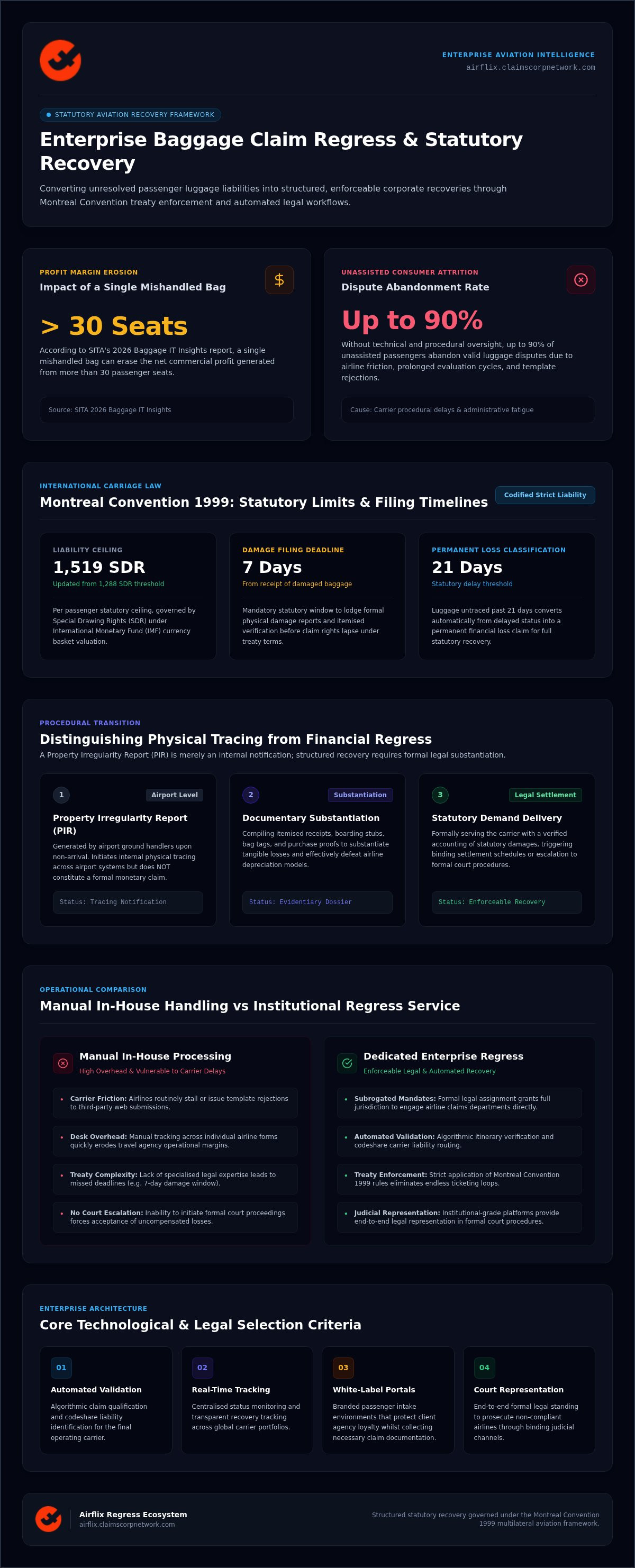
According to SITA's 2026 Baggage IT Insights report, a single mishandled bag can erase the net profit from more than 30 passenger seats. For travel agencies and corporate partners, chasing statutory losses through standard airline channels isn't commercially viable. Deploying a dedicated baggage claim regress service changes that dynamic, converting unresolved luggage liabilities into predictable corporate recoveries.
You already know the administrative friction of standard carrier disputes. Airlines systematically stall or reject third-party passenger filings, whilst the internal overhead of manually tracking damaged or delayed suitcases quickly erodes your margins. Interpreting strict treaties like the Montreal Convention often requires specialised legal expertise that doesn't scale across standard support desks.
This guide demonstrates how an enterprise baggage claim regress service streamlines airline luggage recovery, enforces statutory liability, and safeguards your operational margins. We'll examine how automated validation workflows, real-time tracking systems, and formal court representation eliminate manual bottlenecks and protect your revenue.
Key Takeaways
- Understand the precise operational mechanics of a baggage claim regress service and how it enforces statutory liabilities against non-compliant airlines.
- Master the critical liability ceilings and evidentiary filing deadlines mandated by the Montreal Convention 1999 to prevent claims from lapsing.
- Compare the hidden administrative overheads of manual in-house luggage dispute processing against scalable, automated third-party resolution models.
- Identify the core technological criteria for an enterprise partner, including real-time claim status tracking and branded white-label passenger portals.
- Discover how institutional-grade platforms provide end-to-end legal representation in court procedures to secure corporate financial recovery.
What Is a Baggage Claim Regress Service and How Does It Operate?
A baggage claim regress service is a structured legal mechanism through which an authorised third party asserts subrogated or assigned claims against commercial airlines to recover statutory passenger compensation under international aviation law. Standard consumer dispute channels rely on passive, individual complaints submitted through airline web forms. In contrast, institutional regress elevates these claims into legally substantiated recovery actions backed by formal procedural representation.
Travel management companies and booking agencies increasingly deploy these services to insulate client accounts from disruption. Airlines frequently use procedural friction, prolonged evaluation cycles, and template rejections to discourage individual travellers from pursuing legitimate compensation. Without technical oversight, up to 90% of unassisted passengers abandon valid luggage disputes. Partnering with a dedicated regress provider converts these stranded liabilities into structured, enforceable recoveries without burdening client-side operations.
The Legal Mechanics of Aviation Claim Regress
The regress workflow begins with the legal assignment of claim rights. The passenger transfers recovery authority to the designated service provider through a structured mandate. This legal transfer grants the specialist full jurisdiction to engage the carrier's claims department directly.
Airlines often stall individual consumer communications. However, they respond differently to formal, evidentiary filings citing binding obligations under the Montreal Convention treaty. Statutory notices issued by authorised claims specialists mandate strict statutory adherence, replacing endless customer service ticketing loops with concrete settlement timelines or immediate referral to formal court procedures.
Distinguishing Baggage Tracking from Financial Regress
A persistent operational point of confusion lies between physical tracing and financial recovery. When luggage fails to arrive at the carousel, ground handlers generate an airport Property Irregularity Report (PIR). This report is merely an internal notification that initiates physical tracing through airport systems; it does not constitute a formal compensation demand.
Transitioning from an open tracing file to an actionable monetary claim requires methodical substantiation:
- Loss Verification: Converting the incident into a permanent financial claim once luggage remains untraced past the statutory 21-day mark, or validating physical damage reports within seven days.
- Documentary Substantiation: Compiling itemised receipts, boarding stubs, bag tags, and proof of purchase to defeat carrier depreciation models.
- Legal Demand Delivery: Formally serving the airline with a verified accounting of statutory damages to trigger monetary settlement.
Statutory Frameworks Governing Airline Luggage Compensation
Cross-border commercial aviation operates under strict multilateral treaties that define carrier liability. For international journeys, passenger baggage rights rest entirely upon the Montreal Convention 1999. Unlike domestic consumer protections that award subjective damages, international carriage establishes a codified, strict-liability regime. Carriers often attempt to deflect accountability by misclassifying delays as extraordinary operational circumstances, but the Convention offers very few exclusions once baggage enters airline custody.
Navigating these claims requires precise itinerary verification. In codeshare operations involving multiple carriers, legal liability typically attaches to the final operating carrier that delivered or failed to deliver the luggage. Travel enterprises that integrate a formal baggage claim regress service bypass carrier obfuscation by anchoring financial demands directly to established treaty law.
Montreal Convention Liability Ceilings
Aviation liability is not denominated in local fiat currencies. Instead, the International Civil Aviation Organization caps recovery at 1,519 Special Drawing Rights (SDR) per passenger, an updated threshold from the previous 1,288 SDR limit following statutory reviews. SDR values fluctuate daily based on an international currency basket managed by the International Monetary Fund.
Crucially, this figure represents an absolute liability ceiling rather than a fixed payout. Passengers must prove tangible financial harm. During extended delays, claimants hold statutory rights to reimbursement for reasonable emergency purchases, such as toiletries and essential clothing. However, carriers routinely apply aggressive depreciation matrices to disputed contents unless challenged with proper documentation.
Crucial Timelines and Evidentiary Thresholds
Statutory recovery hinges entirely on strict limitation periods. Missing these legal deadlines forfeits all rights to compensation, regardless of carrier negligence:
- Damaged Luggage: Written notice must be formally lodged with the carrier within 7 days of receiving the damaged property.
- Delayed Luggage Expenses: Detailed claims for necessary interim purchases must be served within 21 days from the date the bag is returned.
- Permanent Loss: Luggage remaining untraced after 21 days transitions legally from delayed to permanently lost, unlocking maximum liability claims.
Succeeding under these parameters requires an exhaustive evidentiary trail. Recoveries demand the original boarding pass, baggage tag receipt, Property Irregularity Report, and itemised purchase receipts to withstand carrier legal scrutiny.
In-House Claim Handling vs Professional Regress Services
Internal baggage dispute administration quickly becomes an operational sinkhole for corporate travel desks. Chasing commercial carriers requires repeated follow-ups, manual document cross-checking, and lengthy jurisdictional assessments. When travel agencies attempt to absorb this workload in-house, administrative hours escalate rapidly whilst settlement outcomes remain unpredictable.
Professional recovery firms resolve this structural inefficiency through automation and procedural leverage. Rather than treating each disruption as an ad-hoc customer service incident, an institutional baggage claim regress service runs claims through structured validation pipelines. Organisations can bypass operational bottlenecks entirely and secure cross-border enforcement by routing unresolved disputes through specialised claims infrastructure.
Administrative Overhead and Resource Allocation
Handling passenger claims internally ties up high-value personnel on low-yield administrative tasks. Support teams spend hours drafting bespoke emails, auditing passenger receipts, and dialling unresponsive carrier support lines. During seasonal travel peaks or widespread flight disruptions, this influx of claims overwhelms frontline operations, diverting focus from revenue-generating sales and client relationship management.
Transitioning from an internal handling model to a specialised partner fundamentally restructures these costs:
- Operational Scalability: Shifting fixed payroll overheads to an external model that flexes effortlessly alongside seasonal disruption volumes.
- Processing Velocity: Replacing manual spreadsheet tracking with systematic digital workflows that cut end-to-end processing intervals from months to weeks.
- Error Elimination: Ensuring that all regulatory claims meet strict procedural formatting rules before airline submission, preventing tactical procedural rejections.
Recovery Rates and Legal Escalation Efficacy
Carriers manage their liabilities through attrition. Individual consumer complaints are easily deflected using automated denial letters that cite ambiguous operational exceptions. Without credible escalation mechanisms, internal corporate teams often accept low-ball airline settlements or abandon files altogether once communications stall.
Specialised regress operations shift the commercial equation. Airlines recognise which claim administrators maintain formal litigation infrastructure. When an enterprise claims manager demonstrates the operational capacity to initiate formal court representation across civil jurisdictions, operating carriers systematically shift their posture from evasive stalling to early settlement negotiations. Unassisted individual filings routinely languish, whereas structured legal escalation secures enforceable financial recovery.
Key Selection Criteria for an Enterprise Baggage Regress Partner
Selecting an institutional recovery provider requires scrutinising both technical infrastructure and legal operational reach. Corporate travel managers cannot afford manual intermediaries that merely forward PDFs to airline general inboxes. A robust baggage claim regress service must deliver automated case intake, full evidentiary verification, and direct integration into existing enterprise booking systems.
Data governance represents an equally critical benchmark. Handling passenger claims involves transmitting sensitive personal records, travel itineraries, and financial receipts across borders. Procurement teams must confirm that external providers comply fully with international data protection frameworks, maintaining encrypted data pipelines during bulk claim uploads. To modernise your luggage dispute workflows, implement an institutional regress solution that aligns with corporate compliance standards.
Technical Architecture and White-Label Capabilities
A modern claims ecosystem must minimise manual customer touchpoints through automated digital workflows. Rather than redirecting disrupted travellers to third-party consumer websites, agencies should deploy a branded environment that preserves client loyalty.
- API Integration: Direct programmatic links synchronise digital Property Irregularity Report (PIR) reference numbers, flight segments, and passenger rosters directly from agency management platforms.
- White-Label Portals: Customised interfaces present a seamless agency brand identity during document collection, status inquiries, and payout delivery.
- Real-Time Tracing Triggers: Automated notification engines deliver live updates on claim progression, deflecting inbound customer support tickets.
Jurisdictional Scope and Litigation Capacity
Software automation alone cannot overcome determined airline resistance. A recovery partner must possess actual judicial standing across key operating territories to enforce statutory liabilities when carriers refuse out-of-court settlements. Third-party software that lacks formal representation networks leaves claims vulnerable as soon as airlines issue standard rejection letters.
Organisations achieve higher settlement compliance by partnering with providers backed by established legal infrastructure capable of managing formal court procedures. These institutional networks maintain the procedural competence to escalate unresolved luggage files directly into competent civil courts. Commercial agreements should also provide structural flexibility, offering coverage models adapted for per-flight volume or subscription-based agency portfolios.
Modernising Baggage Recovery: The Airflix Regress Ecosystem
Modern travel organisations require an institutional recovery framework that replaces fragmented spreadsheets with enterprise reliability. Airflix functions as a specialised digital infrastructure designed specifically for corporate travel partners and agencies. The platform bridges the operational divide between disrupted travellers and recalcitrant carriers, managing the recovery journey from initial incident notification through to statutory enforcement.
By transforming luggage compensation from an administrative burden into a structured recovery pipeline, the Airflix ecosystem protects client loyalty. Corporate travel providers deploy our dedicated baggage claim regress service to eliminate manual friction, relying on automated protocols rather than labour-intensive manual follow-ups.
Institutional Backing and Digital Processing Infrastructure
Airflix operates with the established backing of Claims Corporation Network (CCN), a European Third Party Administrator handling complex cross-border claims since 2014. This institutional foundation ensures that recovery operations meet rigorous legal and regulatory standards across European jurisdictions.
The platform replaces manual document review with algorithmic intake workflows:
- Automated Dossier Validation: Algorithmic screening checks PIR numbers, airline routing, and receipts instantly, verifying legal merit before carrier submission.
- White-Label Passenger Portals: Travel organisers preserve their client relationships by hosting claims workflows under their own branding.
- Real-Time Claim Status Tracking: Centralised portfolio dashboards give agency operations total visibility over active files, recovery timelines, and carrier correspondence.
Comprehensive Legal Protection and Partner Empowerment
True operational leverage requires the capacity to enforce statutory rights through formal judicial channels. While standard claims aggregators abandon cases when carriers issue formal denials, Airflix provides comprehensive legal representation in case of court procedures against non-compliant airlines. Dedicated legal teams prepare civil filings, ensuring that valid claims aren't dismissed through carrier procedural delay.
Integration models accommodate diverse commercial operations. Partners can structure their engagement through flexible per-flight arrangements, monthly agreements, or comprehensive yearly subscriptions tailored to projected booking volumes. Forward-thinking travel organisations can deploy this specialised legal assistance to safeguard passenger trust, eliminate dispute overheads, and secure predictable corporate recoveries.
Transforming Luggage Disruption into Scalable Operational Recovery
Relying on manual spreadsheets and protracted correspondence with carrier customer care desks is no longer a viable strategy for commercial travel teams. Unresolved luggage disputes drain valuable internal hours and risk alienating corporate clients when operating airlines stall statutory settlements. Implementing an enterprise baggage claim regress service bridges this operational gap, converting stranded Montreal Convention liabilities into predictable corporate recoveries.
Airflix delivers turnkey white-label portal solutions engineered specifically for commercial travel providers. Powered by Claims Corporation Network (CCN), an established European TPA operational since 2014, the platform provides end-to-end legal regress infrastructure including cross-border court representation against non-compliant airlines. You don't have to absorb the administrative cost of carrier friction. Optimise your airline baggage recovery with Airflix today and reinforce your operational margins with institutional legal backing.
Frequently Asked Questions
What is a baggage claim regress service?
A baggage claim regress service is an institutional recovery mechanism that asserts legally subrogated rights against airlines for mishandled passenger luggage. Rather than managing informal complaints, a regress provider compiles formal documentation, calculates statutory exposure under international treaties, and issues enforceable financial demands. This framework eliminates manual administrative friction for travel businesses whilst ensuring airlines meet their statutory compensation obligations.
How does the Montreal Convention determine airline baggage compensation liability?
The Montreal Convention establishes a strict-liability framework for international carriage, capping carrier liability at 1,519 Special Drawing Rights per passenger. This treaty limit applies collectively to baggage destruction, damage, loss, or delay. Compensation isn't an automatic flat payout; passengers or their legal representatives must substantiate provable financial harm with verifiable receipts, ticket stubs, and depreciation schedules.
What is the role of a Property Irregularity Report in the regress process?
A Property Irregularity Report (PIR) serves as the primary evidentiary record establishing that luggage was mishandled while in airline custody. Issued at airport service desks upon arrival, this report assigns an official tracing file code. While a PIR initiates logistical locating efforts, it doesn't represent a monetary claim. Instead, it serves as the foundational legal prerequisite for subsequent regress recovery actions.
Can travel agencies pursue baggage compensation on behalf of their corporate clients?
Yes, travel agencies can pursue claims by partnering with a dedicated baggage claim regress service. Through digital mandates, passengers transfer claim administration rights to the agency or partner legal entity. Agencies can deploy customisable white-label portals to preserve client branding, tracking portfolios in real time whilst offloading complex cross-border carrier correspondence to specialised legal administrators.
What is the difference between baggage tracking software and legal regress services?
Baggage tracking systems focus purely on logistical monitoring, tracing physical barcode scans across airport hubs and handling networks. In contrast, legal regress services manage the financial and procedural enforcement of statutory carrier obligations. When physical recovery fails or items arrive damaged, a regress service converts incident logs into substantiated monetary demands backed by judicial representation.
How long does an airline have to locate delayed luggage before it is considered lost?
Under international aviation law, an airline has exactly 21 days from the date of flight arrival to locate and deliver delayed luggage. Once this 21-day statutory threshold expires without resolution, the luggage officially converts from delayed to permanently lost. At that point, claimants hold the right to file for maximum statutory compensation under the Montreal Convention liability cap.
What occurs if an airline rejects a legitimate baggage compensation claim?
If an airline rejects or ignores a substantiated claim, the dispute escalates beyond standard administrative channels. Institutional recovery partners evaluate the legal merit of the refusal, issuing formal notices before initiating civil litigation. Providers with established judicial standing, such as Airflix, manage direct legal representation in court procedures across European jurisdictions, compelling non-compliant carriers to settle.


