

An airline strike does not grant carriers an automatic legal shield against paying statutory disruption claims. When industrial walkouts halt departures, carriers frequently reject compensation requests by labelling the stoppage an unavoidable extraordinary circumstance. If you have experienced sudden flight cancellations, missing meal vouchers, or stonewalled support desks, this administrative pushback feels exasperatingly familiar. However, established European jurisprudence regarding diritti passeggeri in caso di sciopero draws a strict boundary between internal crew walkouts and third-party airport actions, ensuring that airlines remain legally accountable for their own labour disputes.
This comprehensive guide details your enforceable entitlements under passenger protection regulations, clarifying the criteria for statutory compensation and mandatory duty-of-care reimbursements. You'll learn how to determine whether a specific strike legally warrants compensation, secure full restitution for out-of-pocket accommodation and alternative transport, and build a substantiated claim using objective flight operational data. We examine the legal boundaries of carrier liability, the non-negotiable standards for passenger care, and the formal procedures required to overturn unjustified airline claim rejections.
Key Takeaways
- Distinguish between internal airline industrial actions and external airport walkouts to determine your statutory diritti passeggeri in caso di sciopero under established European jurisprudence.
- Clarify the mandatory duty-of-care obligations that airlines must provide immediately, including subsistence meals and overnight hotel accommodation, regardless of strike fault.
- Learn how to systematically preserve flight tracking records, receipts, and carrier notifications to counter automated extraordinary circumstance claim rejections.
- Review statutory criteria governing re-routing timelines, full ticket refunds, and fixed compensation tiers based on route distance.
- Understand the structured pathways for escalating unresolved claims through formal alternative dispute resolution mechanisms and decisive court representation.
Understanding Passenger Rights During an Airline Strike Under Regulation EC 261/2004
Air travel disruptions caused by industrial action operate within a precise statutory framework. Codified under Regulation (EC) No 261/2004, European legislation establishes robust, legally binding protections designed to shield travellers from commercial defaults. When staff walkouts ground flights, carriers routinely issue automated claim rejections, labelling the industrial dispute an unavoidable extraordinary circumstance to avoid financial settlements. Yet, statutory provisions governing diritti passeggeri in caso di sciopero separate labour stoppages into distinct legal classifications based on union affiliations, ensuring airlines cannot evade liabilities arising from internal operational disputes.
The Scope of European Air Passenger Protections
The territorial application of the regulation depends on the departure point and carrier registration. The legislation strictly covers:
- All flights departing from an airport located within an EU member state, regardless of the operating carrier's home nation.
- All flights arriving at an EU airport from a third country, provided the operating carrier holds an operating licence issued by an EU member state.
- All passengers holding confirmed reservations on affected itineraries who face sudden flight cancellations, substantial scheduling delays, or involuntary denied boarding.
Establishing the Legal Definition of a Disruption
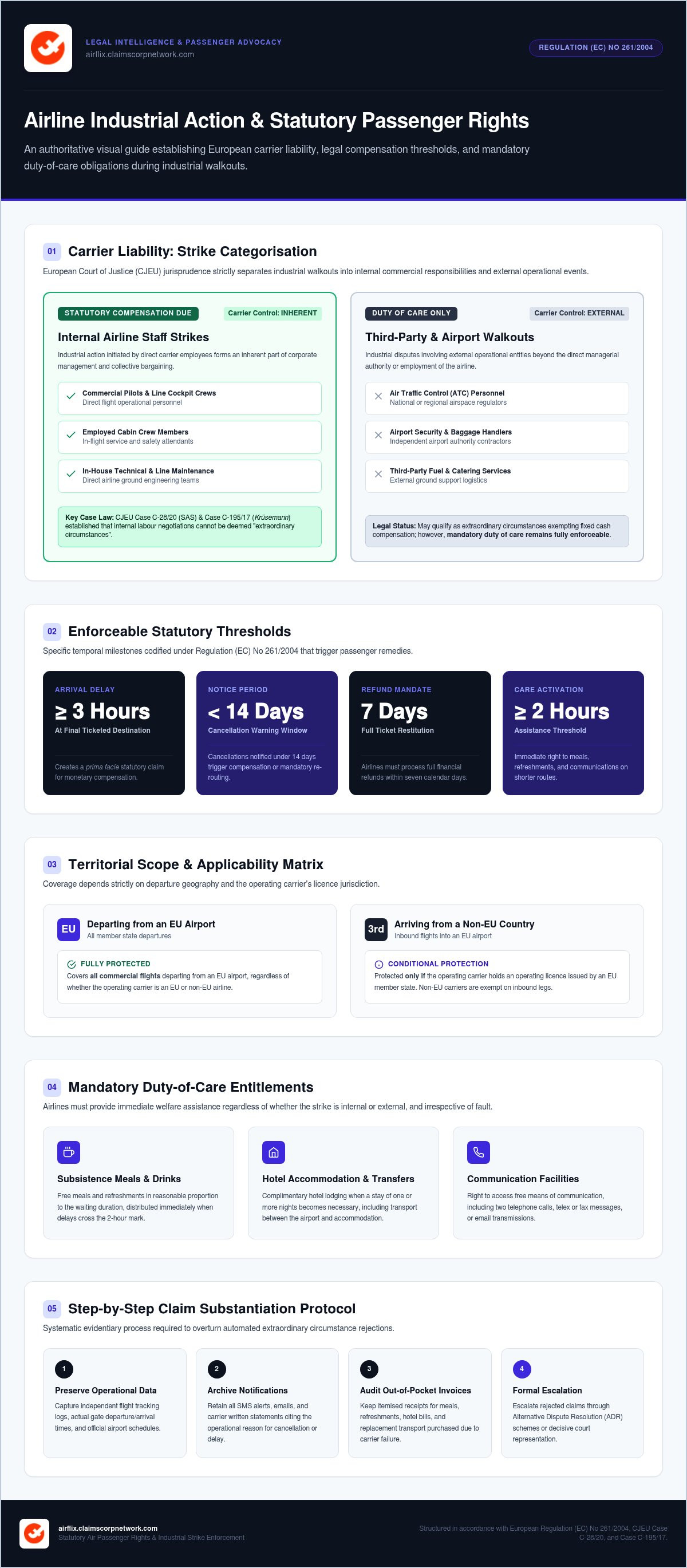
Statutory passenger rights during industrial strike actions define the legal protections, monetary damages, and mandatory welfare provisions guaranteed to passengers when labour walkouts disrupt scheduled commercial flights. Under European rules, disruptions trigger specific enforcement thresholds:
- Arrival Delays: Reaching the final ticketed destination three hours or more behind schedule creates a prima facie case for statutory compensation.
- Cancellations: Flight cancellations notified fewer than fourteen days before departure mandate immediate re-routing, a full ticket refund within seven days, or fixed statutory compensation.
- Assistance Triggers: Operating carriers must deliver immediate welfare, including meals, refreshments, and communication access, once delays exceed two hours on shorter routes.
Disruption liability hinges on whether the stoppage stems from internal staff negotiations or external operational events. Knowing your enforceable diritti passeggeri in caso di sciopero ensures that carriers remain accountable whenever manageable labour negotiations interrupt scheduled services.
Airline Staff vs Third-Party Strikes: Determining Compensation Eligibility
The legal root of an industrial walkout determines whether an airline owes statutory cash compensation or merely logistics support. European Court of Justice (CJEU) jurisprudence, particularly Case C-28/20 regarding Scandinavian Airlines System and Case C-195/17 (Krüsemann), establishes that internal union negotiations form an inherent component of running an airline. Consequently, when carrier management fails to resolve labour disputes with its own staff, it cannot treat the resulting walkout as an uncontrollable event. Passengers assessing their diritti passeggeri in caso di sciopero must first identify precisely who initiated the strike action.
Internal Airline Personnel Strikes
Walkouts organised by direct airline employees remain the operating carrier's commercial responsibility. Industrial action initiated by:
- Commercial cockpit crews and line pilots;
- Employed cabin crew members;
- Direct in-house technical and line maintenance teams;
falls squarely within managerial control. Because collective bargaining is normal corporate business, courts reject extraordinary circumstance defences for these stoppages. Carriers must pay full Article 7 compensation unless they provided valid cancellation notice at least fourteen days prior to departure.
External Airport and Air Traffic Control Walkouts
Disruptions triggered by third-party aviation entities sit outside an airline's corporate governance. Action organised by civil aviation air traffic controllers, independent airport security staff, or contracted ground handlers qualifies as an extraordinary circumstance. As clarified on the Your Europe air passenger rights portal, airlines are exempt from paying compensation in these cases. However, exemption requires carriers to prove they adopted all reasonable mitigation measures to prevent knock-on delays.
Compensation Thresholds and Statutory Brackets
When an internal strike establishes carrier liability, Article 7 of EC 261/2004 determines the payable fixed amounts based on route distance:
- €250: All flights covering 1,500 kilometres or fewer.
- €400: Intra-EU flights exceeding 1,500 kilometres, and non-internal routes between 1,500 and 3,500 kilometres.
- €600: Non-EU itineraries exceeding 3,500 kilometres.
Regardless of whether a strike is internal or external, statutory care mandates remain non-negotiable. Passengers facing unjustified liability rejections can engage specialised flight disruption legal assistance to audit carrier records and enforce applicable diritti passeggeri in caso di sciopero.
Essential Care and Assistance Obligations Airlines Must Provide During Strikes
Operating carriers face an unconditional duty of care under Article 9 of Regulation EC 261/2004 whenever industrial action grounds operations. While airlines frequently deny monetary compensation during external disruptions, statutory assistance mandates apply irrespective of strike causes. If a walkout forces long terminal delays, the operating airline cannot abandon stranded passengers. Travellers asserting their diritti passeggeri in caso di sciopero must understand that assistance obligations activate automatically once disruption breaches statutory duration thresholds.
Immediate Subsistence and Communication Provisions
Airlines must provide complimentary refreshments and meals in reasonable proportion to the waiting time. Waiting triggers depend on sector lengths: two hours for flights under 1,500 kilometres, three hours for longer intra-EU routes, and four hours for non-EU long-haul journeys. Carriers must also facilitate two telephone calls, faxes, or internet access sessions. When airport service desks fail to issue physical vouchers, passengers may purchase necessary sustenance and reclaim expenditures. However, alcoholic beverages and luxury dining items remain strictly non-reimbursable; claims must reflect reasonable, proportionate subsistence expenses.
Overnight Hotel Accommodation and Ground Transfers
When an industrial stoppage postpones departure until the following day, carrier welfare duties expand significantly. Airlines are legally required to provide:
- Complimentary hotel accommodation for one or more nights where an overnight stay becomes necessary;
- Direct, free transport connecting the airport terminal to the designated accommodation facility;
- Return ground transfers from the lodging quarters back to the terminal for the rescheduled departure.
Should the airline fail to arrange lodging directly, passengers retain full legal rights to book modest, mid-scale accommodation independently and submit receipts for direct monetary settlement.
Rerouting and Full Ticket Refund Mechanisms
Under Article 8, passengers confronted with cancelled departures or delays exceeding five hours hold an absolute election between reimbursement and alternative carriage. A traveller may choose a full ticket refund within seven days if the delay renders their trip purpose obsolete. Alternatively, carriers must offer re-routing to the final destination under comparable transport conditions at the earliest opportunity. Under the regulatory framework enforced by Italian civil aviation, travellers should also consult the normativa ENAC sugli scioperi del trasporto aereo, which safeguards mandatory daily flight bands (07:00-10:00 and 18:00-21:00) during Italian national actions. Preserving all original travel documentation remains vital to enforce comprehensive diritti passeggeri in caso di sciopero.
Step-by-Step Procedure to Document and File a Strike Disruption Claim
Airlines frequently contest passenger claims using automated extraordinary circumstance templates. To bypass these administrative barriers, travellers must compile objective operational records before initiating legal contact. Rigorous documentation proves delay lengths, establishes carrier notification timelines, and secures financial restitution under statutory diritti passeggeri in caso di sciopero frameworks.
Securing On-Site Terminal Evidence
Primary operational records must be gathered while still inside the terminal. Airport desk interactions quickly lose legal clarity once passengers depart the concourse. Ensure you:
- Request an official, written delay or cancellation certificate from airline customer service staff stating the explicit operational rationale.
- Photograph airport departure boards showing flight cancellation notices alongside visible airport time displays.
- Retain physical boarding passes, digital e-tickets, and automated SMS or email delay alerts issued by the carrier.
Archiving Expenses and Travel Invoices
Unplanned hotel visits, meal expenses, and ground transfers must be evidenced with detailed paperwork. Bank statements alone rarely satisfy airline claims departments because they lack product breakdowns. Retain every original itemised receipt showing merchant details, timestamps, and purchased products. If airline customer desks refuse immediate assistance, preserve screenshots of digital helpdesk queues or unanswered call records before procuring external accommodation. Each alternative travel invoice must clearly display dates, route origins, and transit destinations.
Submitting and Escalating the Formal Legal Claim
The administrative process begins by issuing a formal complaint letter directly to the operating airline's claims department. This submission must reference flight numbers, passenger booking references, and explicit statutory provisions under Regulation EC 261/2004. Italian transport regulations stipulate a thirty-day window for carriers to complete internal reviews and supply written legal responses. If the airline ignores this deadline or issues an unjustified rejection citing force majeure, passengers can escalate the dispute through dedicated legal channels.
Independent dispute specialists examine carrier disruption logs against historical radar data to verify whether a cancellation was genuinely unavoidable. Enforcing your statutory diritti passeggeri in caso di sciopero requires an evidentiary paper trail that holds carriers legally accountable. To bypass protracted airline disputes and initiate a verified recovery file, submit your disruption claim for legal review.
Securing Professional Legal Assistance and Court Representation Against Airlines
Airlines systematically exploit administrative friction to deter individual travellers from pursuing legitimate compensation claims. Because international air transport involves multi-layered jurisdictional rules, carriers often deploy generic legal rejections in the expectation that claimants will abandon their files. Professional dispute resolution recalibrates this relationship. By leveraging specialised aviation frameworks, legal practitioners convert complex administrative deadlocks into enforceable claims that uphold statutory diritti passeggeri in caso di sciopero.
Overcoming Unjustified Airline Dispute Rejections
When an airline attributes operational cancellations to extraordinary circumstances, individual consumers rarely possess the technical documentation required to challenge that defence. Aviation legal specialists evaluate carrier claims by cross-referencing public statements against independent flight tracking data, Eurocontrol flow management notices, and airport slot allocations. This forensic verification isolates the precise root cause of the disruption. If an airline claims that an external strike forced a cancellation, but flight operation logs reveal that other scheduled operators maintained routes along the same corridor, that blanket defence collapses under regulatory scrutiny.
The Mechanics of Enforceable Court Action
Cross-border dispute management bridges the divide between initial administrative complaints and formal judicial enforcement across European civil jurisdictions. The procedural workflow incorporates several distinct stages:
- Pre-Litigation Notice: Serving formal legal notices of default under Regulation EC 261/2004, setting precise statutory compliance deadlines for outstanding compensation and incurred expenses.
- Alternative Dispute Resolution (ADR): Escalating stalled files through approved national regulatory conciliation platforms, such as ConciliaWeb under the Italian Transport Regulation Authority.
- Judicial Proceedings: Instructing qualified aviation counsel to lodge formal claims before the competent Giudice di Pace or equivalent European small claims tribunals, where jurisdictional caps accommodate passenger transport damages up to €10,000.
- Real-Time File Tracking: Providing transparent digital visibility across all procedural phases, from initial letter dispatch to final monetary settlement execution.
Navigating cross-border judicial litigation requires institutional infrastructure that individual passengers cannot replicate. Passengers seeking objective claim evaluations and formal litigation backing can access Airflix legal assistance to secure their statutory passenger rights and enforce full financial compensation through binding court representation. Defending your diritti passeggeri in caso di sciopero through structured legal channels ensures non-compliant carriers face definitive legal obligations rather than indefinite delays.
Taking Decisive Action on Strike Disruption Claims
Securing rightful compensation following industrial flight cancellations requires persistence and procedural precision. Internal crew walkouts fall within direct carrier operational control, rendering airlines strictly liable for statutory payouts. Even when external strikes relieve airlines of compensation liabilities, duty-of-care obligations remain absolute; carriers must reimburse necessary subsistence and accommodation expenses. Preserving on-site evidence and detailed merchant receipts provides the concrete evidentiary foundation needed to overturn automated rejections.
You don't have to tackle prolonged carrier disputes alone. Powered by Claims Corporation Network European legal administration infrastructure, Airflix delivers transparent digital claim tracking alongside dedicated legal advocacy across jurisdictions. When carriers decline to honour your statutory diritti passeggeri in caso di sciopero, professional dispute management bridges the divide between administrative inaction and formal court compliance. Take control of your recovery today: check your eligibility and enforce your claim with Airflix to secure the statutory compensation and care expenses you are legally owed.
Frequently Asked Questions
Can I claim compensation if my flight was cancelled due to an airline staff strike?
Yes, you can claim statutory compensation if your flight was cancelled due to an internal airline staff strike. Under European Court of Justice case law, walkouts by pilots, cabin crew, or airline-employed technical personnel do not constitute extraordinary circumstances. Unless the carrier gave you at least fourteen days of advance cancellation notice, it must pay between €250 and €600 per passenger under Regulation EC 261/2004, determined by total route distance.
What is the difference between an airline staff strike and an air traffic control strike?
The fundamental distinction lies in managerial control and operational accountability. Airline staff strikes involve direct carrier employees, such as cockpit crews or flight attendants, meaning the disruption falls within carrier operational responsibility. Conversely, air traffic control walkouts involve third-party civil authorities entirely outside carrier governance. While internal strikes qualify for financial compensation under diritti passeggeri in caso di sciopero frameworks, external air traffic disruptions legally exempt airlines from paying monetary damages.
Does the airline have to pay for my hotel if a strike strands me overnight?
Yes, the operating carrier must arrange and finance hotel accommodation whenever a strike forces an overnight delay. This obligation applies under Article 9 of Regulation EC 261/2004, regardless of whether the stoppage was internal or external. Airlines must also provide free transport between the terminal and your accommodation. If ground staff fail to book your room directly, you can organise reasonable lodging independently and claim full reimbursement by submitting itemised receipts.
Can I get a full ticket refund if I decide not to travel due to strike delays?
Yes, you have a statutory right to abandon your journey and claim a full ticket refund if a strike causes a delay of five hours or more. Under Article 8 of Regulation EC 261/2004, the airline must process your complete monetary reimbursement within seven days. Choosing a refund relinquishes your entitlement to alternative carrier re-routing, but it does not extinguish any valid claims for statutory compensation resulting from internal airline industrial action.
How long do I have to submit a flight compensation claim after an airline strike?
Claim limitation deadlines depend on the national jurisdiction governing the contract of carriage. Under the Italian Navigation Code, passengers have a strict two-year limitation period from the scheduled arrival date to initiate compensation claims. Other European jurisdictions allow up to three, five, or six years. To preserve critical radar data and operational records, submit your disruption file promptly rather than waiting until statutory limitation deadlines approach.
What expenses can I reclaim from the airline during an extended strike disruption?
You can reclaim necessary and reasonable subsistence costs incurred while waiting for delayed departures. Reimbursable expenses include meals, non-alcoholic refreshments, essential telecommunications, overnight hotel lodging, and ground transport to and from accommodation. Airlines won't reimburse luxury purchases, alcoholic drinks, or consequential losses like missed event tickets. Retain all original, itemised merchant receipts displaying dates and item descriptions to ensure your expenditure claim satisfies carrier audit criteria.
Can airlines use extraordinary circumstances as an excuse to avoid paying strike compensation?
Airlines frequently cite extraordinary circumstances to deflect claims, but European courts severely restrict this defence for industrial actions. Binding CJEU rulings establish that internal staff walkouts are inherent operational risks, barring carriers from using force majeure exemptions. To assess disputed rejections under formal diritti passeggeri in caso di sciopero regulations, passengers can deploy specialist legal support to cross-examine airline statements against official aviation traffic logs and enforce legitimate statutory claims.


