

What if the main risk in a complex flight complaint isn’t the disruption itself, but treating every issue as one claim? A delayed connection, cancelled return flight and missing bag may all stem from the same journey, yet each may need a separate assessment and supporting evidence. Effective gestione reclami voli complessi starts by distinguishing those issues before correspondence, deadlines or case ownership become unclear.
For passenger-service teams and travel-sector professionals, fragmented records and inconsistent updates can make it difficult to see what has been reviewed, what remains outstanding and who owns the next step. A clear process won’t guarantee an outcome, but it can make decisions more consistent and communication more reliable.
This guide explains how to assess and route multi-issue cases, organise evidence across channels, assign ownership and provide useful status updates without making unsupported promises. It also considers when specialist assistance may be appropriate, including how flight-disruption legal assistance, baggage-claim regress and real-time claim status tracking can support different parts of the workflow. The aim is a structured, evidence-led approach that brings clarity to complex claims from initial review through resolution.
Key Takeaways
- Separate disruption, baggage and linked-journey issues so each can be assessed against its own evidence and relevant rules.
- Use a consistent intake process to capture passenger and flight details, timelines and correspondence in one case file.
- Apply a staged workflow with a named case owner, timestamped actions and proportionate progress updates.
- Effective gestione reclami voli complessi depends on clear routing and careful review. A complaint, reimbursement request and compensation claim are not interchangeable.
- When further support is needed, check the provider’s scope, evidence handling, case visibility and escalation approach before proceeding.
Why complex flight claims need more than a standard complaint
A single journey can produce several issues, each with different facts to establish and records to review. A complex flight claim is a case involving multiple issues, parties, evidence sets or decision points that need to be assessed and coordinated separately. The task is not simply to submit one complaint. It is to understand how the issues relate, identify the appropriate route for each and keep the overall case coherent.
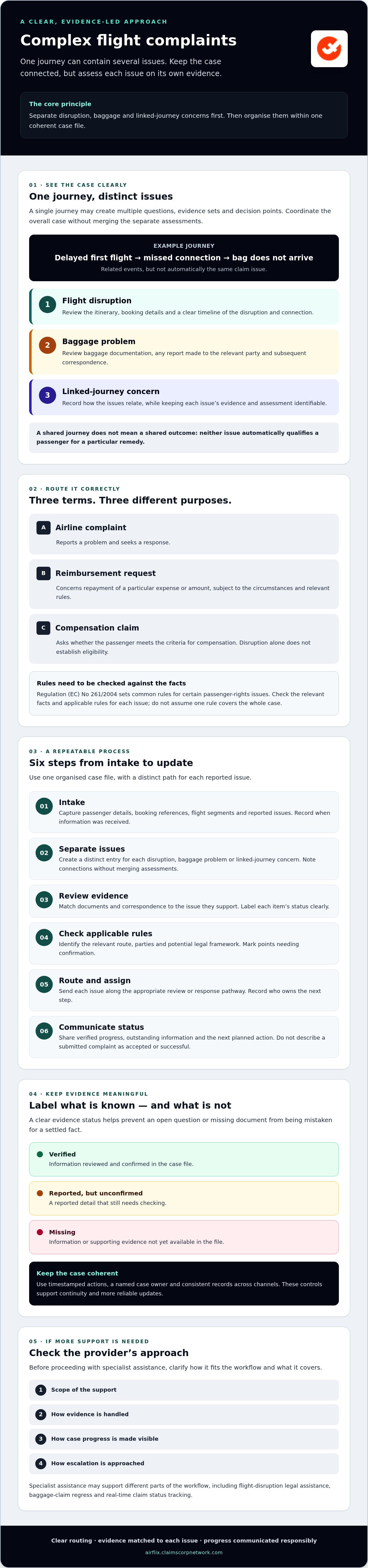
Three terms should not be treated as interchangeable. An airline complaint reports a problem and seeks a response. A request for reimbursement concerns repayment of a particular expense or amount, subject to the relevant circumstances and rules. A compensation claim asks whether a passenger meets the criteria for compensation. A disruption alone doesn’t establish eligibility. Regulation (EC) No 261/2004 sets common rules for certain passenger-rights issues. The EU Air Passengers Rights Regulation 261/2004 is a useful starting point, but the facts and applicable rules still need checking in each case.
What can make one journey produce several claim issues?
Hypothetical: A passenger’s first flight is delayed, causing them to miss a connection, and their checked bag does not arrive at the destination. The connection issue may require the itinerary, booking details and a clear disruption timeline. The baggage issue may call for baggage documentation, a report made to the relevant party and subsequent correspondence. These records support different assessments, even though both problems occurred on one journey. Neither issue automatically qualifies the passenger for a particular remedy.
This separation is central to gestione reclami voli complessi. If evidence is combined indiscriminately, a reviewer may overlook a missing document, confuse correspondence relating to one issue with another or reach a conclusion before the facts are clear. A coordinated case file keeps each issue distinct while showing how the issues connect.
Who needs a structured claims process?
Passengers need clarity about what has been reported, what evidence is still required and what the next review step is. Agencies and operators managing cases for clients also need consistent records, a named owner and updates based on verified progress rather than assumed outcomes. Without those controls, a case can receive conflicting updates or lose continuity as it moves between teams.
A structured process gives each issue an identifiable path while keeping the overall journey in view. Before seeking support, passengers and partner teams can clarify which issues need review, what evidence is available and what questions remain unresolved.
How to assess and coordinate a complex flight complaint
A consistent assessment process helps prevent a missing document or unresolved question from being mistaken for a settled fact. One itinerary can require distinct assessments for distinct claim issues, even when they share a timeline or passenger record. For effective gestione reclami voli complessi, organise the case as a whole, but review and route each issue on its own merits.
- 1. Intake: Capture passenger details, booking references, flight segments and the issues reported. Record when the information was received.
- 2. Separate issues: Create a distinct entry for each issue, such as a disruption, baggage problem or linked-journey concern. Note connections between them without merging their assessments.
- 3. Review evidence: Match documents and correspondence to the issue they support. Label information as verified, reported but unconfirmed, or missing.
- 4. Check applicable rules: Identify the relevant route, parties and potential legal framework for each issue. Mark legal points that need confirmation rather than assuming one rule covers the whole case.
- 5. Route for action: Assign each issue to the appropriate review or response pathway, and record who owns the next step.
- 6. Communicate status: Share verified progress, outstanding information and the next planned action. Don’t present a submitted complaint as an accepted or successful claim.
Build a complete, reviewable case file
Keep an organised case file with the booking confirmation, boarding documents, airline messages and other relevant records, where available. Add passenger and flight details, each flight segment, the reported-event timeline and actions already taken by the passenger. Timestamp incoming evidence and case actions so a reviewer can follow what happened and when.
Flag gaps clearly, such as an unconfirmed flight detail or a missing airline response, and assign a follow-up action rather than filling the gap with an assumption. Apply appropriate access controls and data-handling practices to the file, and confirm the operational requirements that apply to the organisation before setting them.
Separate eligibility checks from case administration
Good administration keeps a case moving, but it doesn’t establish eligibility. Check the framework relevant to the route and issue, and verify legal specifics before relying on them. For US-related passenger matters, the U.S. Department of Transportation's consumer protection office provides information on topics including delays, cancellations and baggage. Other routes may require a different reference.
Sending a complaint records an action; it doesn’t prove that a claim has been accepted or will succeed. If further review may be appropriate, clarify what type of specialist support is available, which issues it covers and what evidence it requires before deciding whether it fits the case.
How to handle overlapping disruption, baggage and compensation questions
A journey can involve a disruption, a baggage problem and a question about compensation, but that doesn’t create one automatic outcome. Each issue has its own facts, supporting records and possible assessment route. The relationship between issues matters too: a missed connection may be linked to an earlier delay, while a baggage report may need to be reviewed separately. In gestione reclami voli complessi, keep these strands connected in the case file without assuming they share the same rules or result.
| Issue | Key question | Records to review | Next review step |
|---|---|---|---|
| Disruption | Was the reported event a delay, cancellation or denied boarding, and what happened to the passenger’s itinerary? | Booking and itinerary, flight-segment details, relevant timings and airline communications. | Verify the event and route, then check the passenger-rights guidance that applies before assessing any claim. |
| Baggage | Was the bag delayed, damaged or reported lost? | Baggage report, available receipts or other relevant records, and correspondence with the airline. | Classify the reported issue and identify what evidence or follow-up is still needed. |
| Linked journey | Did one flight event affect a later segment or another reported issue? | Full itinerary, segment timings and messages that help establish the sequence of events. | Map the connection between events, then assess each issue under its potentially relevant rules. |
Disruption facts and compensation questions
Record the specific event rather than using “flight problem” as a catch-all. A delay, cancellation and denied boarding are distinct circumstances; a missed connection also needs to be considered in the context of the full itinerary. Timings and airline communications help establish what occurred, but don’t determine eligibility on their own. For applicable passenger-rights guidance in Italy, consult ENAC’s Guida ufficiale ai diritti dei passeggeri aerei. Check the relevant framework and current legal details for the particular journey before drawing conclusions.
Baggage records and connected claims
Keep delayed, damaged and lost baggage reports distinct, and retain baggage reports, receipts and airline correspondence where available. The Montreal Convention may be relevant to some baggage matters, depending on the applicable legal context. Confirm whether it applies before relying on it. Record a baggage issue in the same overall case as a related disruption, but assess it on its own evidence and applicable rules.
A practical workflow for tracking, escalating and communicating cases
A case is easier to manage when every stage has an owner and a recorded next action. A practical workflow can use these stages:
- Received: Record the date, reported issues and available documents.
- Information review: Identify missing or conflicting records and request clarification where needed.
- Assessment: Review each issue against its evidence and the potentially relevant rules.
- Airline contact: Record what was submitted, when and through which channel.
- Follow-up: Track responses, outstanding questions and the next action.
- Resolution: Document the outcome of each issue, including any that remain open or need another route.
Assign a named case owner, timestamp actions and keep the file current. This gives passengers and partner teams a consistent point of reference, even when separate issues need different handling.
Keep status updates useful and evidence-led
A useful update states what has happened, what remains outstanding and who is responsible for the next action. Distinguish between a claim being submitted, an airline response being received and a final outcome being recorded. Don’t promise a resolution date unless it can be supported. For clearer oversight, use status records that show completed actions, pending information and the next step.
Decide when a case needs specialist review
Escalation is a case-specific review decision, not an automatic step after airline contact. Conflicting records, multiple connected issues or an unresolved legal question may justify further assessment. Before referring a case, document why review is needed and what evidence has already been gathered.
- Are the passenger, booking and flight details recorded and checked?
- Are the issues separated, with supporting records matched to each one?
- Are discrepancies or missing documents clearly flagged?
- Is the relevant route or legal framework identified, with uncertain points marked for verification?
- Is the requested review within the specialist provider’s stated scope?
Airflix may be a specialist option where flight-disruption legal assistance or baggage-claim regress is relevant. Its service includes real-time claim status tracking, which can support oversight without determining eligibility or guaranteeing an outcome. Review the Airflix flight-claim assistance information and confirm whether its scope fits the case.
When specialist flight-claim management can support the process
Specialist support may be worth considering when a case includes several claim issues, requires legal review or needs ongoing status oversight. Choose based on the work required, not on an assumption that an external provider will secure a particular result. For effective gestione reclami voli complessi, check whether the service addresses the case’s needs and makes its scope clear.
What to clarify before choosing a claims support provider
Before proceeding, establish what the provider handles and how the process works. Confirm the claim types and case stages included, how evidence is received and reviewed, and how status information is shared. Ask what documents are needed for each issue and how the provider communicates missing information or requests further review.
Also check the service arrangement and applicable terms directly. Don’t assume that providers have the same fees, timelines or escalation procedures. Clear answers help passengers and partner organisations decide whether the support complements their own process and whether responsibilities are understood.
How Airflix fits passenger and partner workflows
Airflix’s passenger-focused services include flight-disruption legal assistance and baggage-claim regress. Real-time claim status tracking can provide visibility of case progress, while legal representation is available in court procedures. These services may be relevant when a passenger’s case needs support with disruption or baggage issues, but the appropriate route depends on the specific claim and available evidence.
Travel agents and operators have a separate option: Airflix also offers a white-label passenger portal for travel-sector partners. This is distinct from passenger legal assistance and can form part of a partner’s passenger-facing workflow. Organisations should confirm current service scope and portal capabilities before deciding how either option fits their processes.
Before choosing, compare the provider’s stated scope with the case requirements, review how documentation and status information will be handled, and understand the route for further review. Airflix can also provide legal representation in court procedures, where applicable to the service and case.
Explore Airflix flight-claim assistance to review the available support. Any assessment and outcome depend on the individual case facts and applicable rules; no particular result should be assumed.
Put a clear process behind every flight claim
Complex flight cases are easier to oversee when each issue is assessed on its own evidence while remaining connected to the wider journey. A consistent case file, named owner and timestamped actions help prevent fragmented records and unclear updates. A complaint, reimbursement request and compensation claim should not be treated as interchangeable: the relevant facts and rules determine the appropriate assessment.
That structure is the foundation of effective gestione reclami voli complessi. Where further support is needed, compare a provider’s service scope, evidence-handling approach, status visibility and escalation process before proceeding.
Airflix provides flight-claim support that includes real-time claim status monitoring and legal representation in court procedures. Travel-sector partners can also consider its white-label passenger portal. These services support different needs, and any assessment or outcome depends on the individual case facts and applicable rules.
Review the available scope and decide whether it fits your passenger or partner workflow. Explore Airflix flight-claim assistance to take the next step with a clearer basis for managing each case.
Frequently Asked Questions
What makes a flight claim complex?
Complexity can arise when one journey involves several events, claim types, airlines, sets of records or unresolved questions about applicable rules. A missed connection and a separate baggage issue, for example, may need distinct assessments. Complexity alone doesn’t establish eligibility or guarantee compensation. Separate each issue, build a dated evidence record and identify gaps. If facts conflict or the legal framework is unclear, seek qualified review before reaching conclusions.
Can one journey involve both a disruption claim and a baggage claim?
Yes. A passenger may report more than one issue from the same journey, such as a delayed connection and baggage that arrives late or damaged. Record each matter separately, then assess it against its own facts, evidence and potentially applicable rules. Don’t assume the same form, deadline or remedy applies to both. Confirm the correct process for each issue before submitting information or communicating an expected outcome.
How should an agency organise a complex flight complaint?
Begin with one case record containing passenger details, the complete itinerary, a dated event timeline, supporting documents and correspondence. Separate the reported issues within that record and assign a named case owner. Log actions and responses with dates, flag missing information, and give updates that distinguish verified facts from assumptions. For gestione reclami voli complessi, check relevant rules before making legal statements or promising an outcome, or refer uncertainties for appropriate specialist assessment.
What documents can help with a complex flight claim?
Useful records may include the booking confirmation, boarding documents, airline messages, a timeline of the disruption and, where relevant, baggage reports or receipts. The exact evidence depends on the issue and process, so this isn’t a universal checklist. Keep original files where possible and note when each item was received. Store passenger information using suitable access controls and data-handling practices, and confirm the organisation’s operational requirements.
Does a complex flight complaint automatically qualify for compensation?
No. A case’s complexity or number of reported issues does not establish entitlement to compensation. Eligibility depends on the specific facts, flight and rules applicable to that claim. Distinguish a request for information or reimbursement from a compensation claim, then check the relevant requirements before reaching a view. Submitting a claim records an action; it doesn’t mean the claim has been accepted or that compensation is assured.
When should a flight complaint be referred for legal review?
Consider referring a complaint for specialist legal review if records conflict, several claim issues overlap, applicable rules remain uncertain or further legal action may need consideration. First organise the timeline and supporting evidence, then state the precise question requiring review. A referral can help clarify what options may be available for the individual case, but it doesn’t guarantee compensation, a favourable decision or success in court.
Can passengers track the progress of a flight claim?
Progress tracking depends on the service handling the case and the status information it provides. A useful update identifies actions completed, responses received, information still outstanding and the next step. Airflix’s service includes real-time claim status tracking; confirm directly what access and case arrangements apply. A status update shows recorded progress, not necessarily that a claim has been accepted or that a final decision has been made.


