

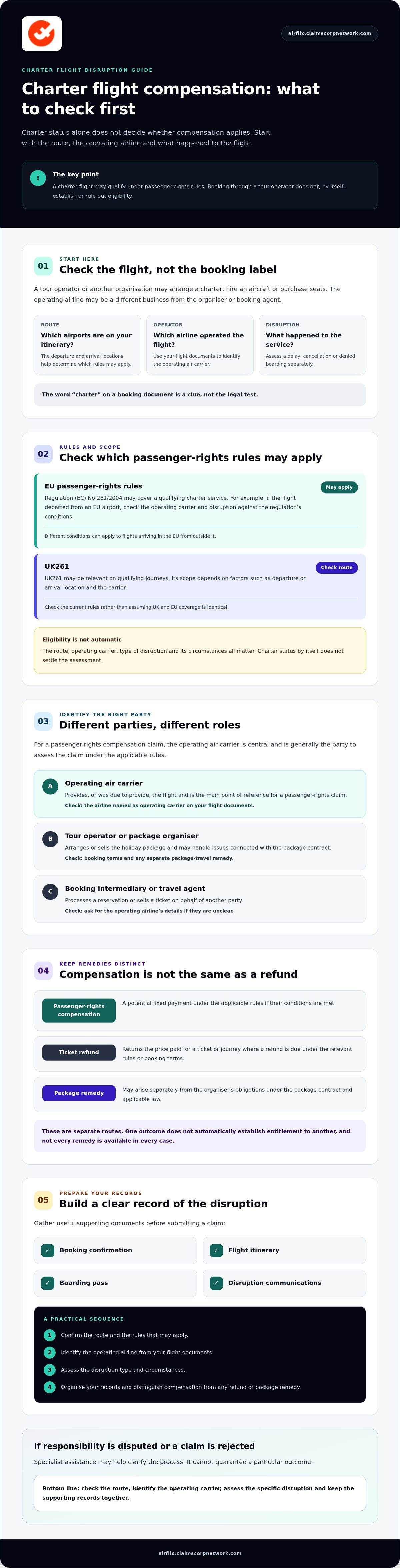
A charter booking doesn’t automatically rule out compensation. For risarcimento volo charter, the key questions are which passenger-rights rules apply to the route and which airline operated the flight, not whether you booked through a tour operator.
A cancelled or delayed charter flight may involve the airline, the travel company and a package-holiday booking, each with a different role. Compensation is also separate from a ticket refund or any remedy available under package-travel rules. Where EU passenger-rights rules apply, charter passengers may qualify for compensation, with responsibility resting with the operating air carrier.
This guide explains how to check whether a disruption may qualify, identify the right party for a claim and organise useful supporting records. It also distinguishes compensation from refunds and package-holiday remedies, helping you choose the relevant route before submitting a claim.
Key Takeaways
- Check the rules that apply to your route and disruption before deciding whether to pursue risarcimento volo charter.
- Use your flight documents to identify the airline that operated the service and where to direct your claim.
- Assess delays, cancellations and denied boarding separately, as each may involve different eligibility criteria.
- Gather your booking confirmation, itinerary, boarding pass and disruption communications before submitting a claim.
- If responsibility is disputed or a claim is rejected, specialist assistance may help clarify the process, but cannot guarantee a particular outcome.
Can a charter flight qualify for compensation? Start with the rules, not the booking label
Yes, a charter flight can qualify for passenger compensation, but charter status alone neither establishes eligibility nor rules it out. The assessment depends on the route, operating carrier, type and circumstances of the disruption, and the passenger-rights rules that apply. For risarcimento volo charter, start by checking those details rather than relying on how the flight was sold.
Compensation is a fixed payment that may be due under passenger-rights rules after a qualifying disruption; a fare refund returns the price paid for a ticket or journey under the applicable refund terms. These are separate remedies, and qualifying for one does not automatically establish entitlement to the other.
What makes a flight a charter flight?
A charter is arranged differently from a regular scheduled service. A tour operator or another organisation may hire an aircraft or purchase seats on a flight, then sell the journey as part of a holiday or another arrangement. The details can vary, so the word “charter” on a booking document does not, by itself, identify who operated the flight.
The operating air carrier is the airline that performed or was due to perform the flight. A tour operator may organise the holiday, while a booking agent or ticket seller handles the reservation. These roles can belong to different businesses. The channel through which you booked does not, by itself, determine eligibility or identify the party responsible under passenger-rights legislation.
Does passenger-rights legislation cover charter services?
Regulation (EC) No 261/2004 may apply to a charter service if the flight and carrier fall within its scope. The regulation covers qualifying flights rather than excluding a journey simply because it was chartered. For example, if your flight departed from an EU airport, check the operating carrier and disruption details against the regulation’s conditions. Different conditions can apply to flights arriving in the EU from outside it.
UK261 may also be relevant on qualifying journeys. Its scope depends on factors such as the departure or arrival location and the carrier. Check the route and operator against the current rules rather than assuming EU and UK coverage is identical.
Before drawing a conclusion, confirm the airports on your itinerary, the operating airline and what happened to the flight. A delay, cancellation or denied boarding may raise different questions, and the circumstances can affect the assessment. The booking label is a useful clue, not the legal test.
Who is responsible for charter flight disruptions?
Several organisations may appear in a charter booking, but they do not have the same responsibilities. For a passenger-rights compensation claim, the operating air carrier is central: it provides the flight and is generally the party to assess a claim under the applicable rules. The organiser or agent may help communicate with the airline, but that does not, by itself, make them responsible for statutory compensation.
Before submitting a flight-disruption claim, identify the airline that operated, or was due to operate, your flight. Check your itinerary, booking confirmation and flight details instead of assuming the holiday seller or ticket issuer is the right recipient.
| Party | Typical role | What to check |
|---|---|---|
| Operating air carrier | Provides the flight and is the main point of reference for assessing a passenger-rights claim. | Find the airline named as the operating carrier on your flight documents. |
| Tour operator or package organiser | Arranges or sells the holiday package and may handle issues connected with the package contract. | Review the booking terms and contact the organiser about any separate package-travel remedy. |
| Booking intermediary or travel agent | Processes a reservation or sells a ticket on behalf of another party. | Ask for the operating airline’s details if they aren’t clear in your documents. |
Compensation, refund or package-travel remedy?
These are different routes, even when they follow the same disruption. Passenger-rights compensation is a potential payment under the applicable rules if their conditions are met. A ticket refund concerns the fare for a journey that wasn’t taken, where a refund is due under the relevant rules or booking terms. A package-travel remedy may arise separately from the organiser’s obligations under the package contract and applicable law.
Don’t assume one outcome automatically replaces another, or that every remedy is available in every case. Check who sold the journey, whether it formed part of a package, what happened and which rules apply. The UK Civil Aviation Authority guidance on delays explains UK passenger-rights considerations, including compensation and refunds for qualifying journeys.
For a risarcimento volo charter claim, directing the statutory claim to the operating carrier helps keep it distinct from a request to the organiser or agent. If the correct recipient or next steps remain unclear, flight disruption legal assistance may help you structure the claim and monitor its progress. Assistance can clarify the process, but it can’t guarantee eligibility or payment.
When might charter flight delay or cancellation compensation apply?
A disrupted charter flight doesn’t automatically qualify for compensation. The claim depends on whether the relevant passenger-rights rules cover the journey, whether the disruption meets their criteria and whether an exception applies. Assess the route and operating carrier alongside what happened, rather than treating the charter label or the fact of disruption as decisive.
For a delay, the time you reach your final destination may matter, not just how late the aircraft departed. Check the applicable threshold and how arrival time is measured against the rules for your route. For a cancellation, consider how much notice you received, whether an alternative flight was offered and when that flight arrived. The diritti dei passeggeri del trasporto aereo overview from the Council of the European Union is a starting point for understanding EU passenger rights, but your individual circumstances still need assessment.
How delay and cancellation criteria affect a charter claim
Compare the original itinerary with what happened: scheduled and actual arrival times, any rerouting, and the airline’s cancellation notice. A delay, cancellation and denied boarding are distinct situations and may have different eligibility tests. Legal thresholds and interpretations can change or depend on the applicable regime, so confirm the current rules for your route before relying on a specific time limit or criterion.
The amount of any compensation also depends on the governing rules and the journey. Don’t rely on a figure from another route or legal regime. Compensation is conditional and remains separate from a refund, rerouting or assistance that may be available under the applicable rules.
When might an airline dispute the claim?
An airline may dispute what happened, the length of the delay, its responsibility for the flight or whether the disruption arose from extraordinary circumstances. The reason given is not conclusive on its own. Its nature, the available evidence and the relevant law all matter. In particular, a technical problem doesn’t automatically remove the right to compensation; the circumstances behind it need to be examined.
Keep disruption notices, rerouting messages and any explanation provided by the carrier. These records can help you compare the airline’s account with the sequence of events. A claim for risarcimento volo charter is easier to assess when it identifies the correct operating carrier and clearly sets out the route, disruption and supporting evidence. If the airline refuses payment, compare its reason with the applicable criteria before deciding what to do next.
How to make a charter flight compensation claim: evidence and steps
A well-organised claim makes it easier to explain what happened and assess whether compensation may be due. Keep copies of your records and submit the claim through the channel specified by the operating carrier. These steps can help you prepare a risarcimento volo charter claim without assuming that every disruption qualifies.
Evidence to gather
Collect documents that establish the booking, route and events. Useful records include:
- Booking confirmation and itinerary, including the flight date, route and operating carrier.
- Boarding pass or other travel document showing the flight taken, if applicable.
- Airline or organiser messages about a delay, cancellation, rerouting or the reason for the disruption.
- Your own record of what happened on arrival, including when you reached your final destination and any alternative journey taken.
- Copies of claim forms, submission confirmations and all replies, with dates.
Keep correspondence with the airline, tour operator and booking agent, and note which party provided each update. If an explanation was given verbally, make a dated note of the conversation and ask for written confirmation where appropriate. This gives you a record to refer to if the parties provide different accounts of the disruption.
Submit and track the claim
- Confirm the flight details. Check your itinerary and booking documents to identify the operating carrier and route.
- Organise the evidence. Arrange your booking records and disruption notices, then prepare a concise timeline that includes arrival or rerouting details.
- Check the claim route. Use the operating carrier’s current passenger-claims channel and follow its instructions. An organiser or agent may direct you, but don’t assume it is the right recipient for a passenger-rights claim.
- Submit and retain proof. Save the completed claim, supporting documents and confirmation showing when it was sent.
- Record and review the response. Log follow-up messages and the airline’s reply. If the claim is refused, keep the explanation and compare it with your evidence and the rules that apply to the journey.
There isn’t one deadline to assume applies to every charter journey. Claim procedures and limitation periods depend on the relevant jurisdiction, so check the current requirements for your route and carrier rather than relying on a general timeframe.
If you’d prefer structured support to prepare and monitor a disruption claim, review Airflix flight claim assistance. Assistance can help organise the process, but it can’t guarantee eligibility or a particular outcome.
When legal assistance can help with a charter flight claim
Specialist help may be useful if it’s unclear which airline operated the charter, the carrier disputes responsibility, or a claim has been rejected and you need to review the reason. Assistance may also help organise a claim when the passenger-rights rules, itinerary and disruption records need to be considered together. It can clarify the process, but can’t guarantee that a claim is eligible, that compensation will be paid or that it will achieve a particular outcome.
Before using a claims service, check what support it covers and what you’re authorising. Review the service terms, how passenger information will be handled, how updates are provided and what happens if the airline contests the claim. If court proceedings may arise, ask how that stage is managed and whether legal representation is available. Make sure you understand any applicable terms before proceeding.
How Airflix supports flight-disruption claims
Airflix is an aviation brand within Claims Corporation Network that provides flight-disruption legal assistance. Its service allows passengers to monitor claim status in real time, and legal representation is available if court proceedings arise. These services can provide structure and visibility as a claim progresses, but they don’t change the eligibility criteria or determine the outcome in advance.
For a risarcimento volo charter claim, preparation still starts with the flight details, the airline’s response and the evidence showing what happened. A service can help manage the process, but the route, disruption circumstances and applicable rules remain central to assessing the claim.
Before choosing flight-disruption legal assistance, check that the support offered matches your needs and read the relevant terms. Review your claim details, including any refusal or disputed responsibility, and seek appropriate assistance if you need help deciding what to do next. Review Airflix flight claim assistance.
Take the next step with a clear claim plan
Charter status alone doesn’t determine whether compensation is due. Check which passenger-rights rules apply to the route, identify the operating carrier and assess the disruption against the relevant criteria. Keep booking documents and disruption records together, and distinguish a compensation claim from a ticket refund or package-holiday remedy. These steps give you a clearer basis for pursuing risarcimento volo charter.
If responsibility is disputed or you’d prefer structured support, Airflix provides flight-disruption legal assistance for passengers and support for travel-industry partners. Passengers can monitor claim status in real time, and legal representation is available if court proceedings arise. Assistance can help manage the process, but it can’t guarantee eligibility, payment or a particular outcome.
Review your flight details and the airline’s response, then decide whether further support would be useful. Review Airflix flight claim assistance to take the next step with a better-organised claim.
Frequently Asked Questions
Can I claim compensation for a charter flight delay?
Yes, a charter flight delay may qualify for compensation, but the booking type alone doesn’t decide eligibility. Check which passenger-rights rules apply to the route and operating carrier, then assess the disruption against those rules. Record when you arrived at your final destination, including any rerouting, and keep relevant airline messages. These details help assess a claim for risarcimento volo charter, but don’t guarantee compensation.
Does EU261 apply to charter flights?
Regulation (EC) No 261/2004 may apply to a charter flight if the journey and operating carrier fall within its scope. The term “charter” doesn’t settle the question. Check the route, the airline operating the flight and the circumstances of the disruption, then verify the current legal requirements. If the flight was part of a package holiday, separate contractual or package-travel remedies may also need consideration.
Who is responsible for compensation on a charter flight?
The operating air carrier is generally the key party to identify for a passenger-rights compensation claim. A tour operator may have separate responsibilities relating to a package holiday, whilst a booking agent may simply have arranged the reservation. Check your itinerary and flight documents to establish which airline operated, or was due to operate, the service. The correct claim route can depend on the applicable rules and circumstances.
Can I claim compensation if my charter flight was cancelled?
A cancelled charter flight may qualify if the relevant passenger-rights conditions are met. The assessment can depend on when you were told, whether rerouting was offered, when you reached your destination and why the cancellation occurred. Keep the cancellation notice and details of any alternative flight. Charter status alone doesn’t determine the outcome, so check the rules that apply to your route before treating the cancellation as eligible.
What documents do I need for a charter flight compensation claim?
Keep your booking confirmation, itinerary and boarding pass, along with messages about the delay, cancellation or rerouting. Record the operating carrier and note when you actually arrived at your destination. Retain written communications with the airline, organiser or agent, plus copies of any claim form and response. A claims service may request further information, so follow its instructions and keep copies of everything you submit.
Can I claim from the tour operator instead of the airline?
It depends on the remedy. For passenger-rights compensation, identify the operating carrier and check the relevant claim route. A package-travel complaint or remedy may instead concern the tour operator’s responsibilities under the package terms and applicable rules. These routes aren’t automatically interchangeable. Review your booking documents to see whether the flight formed part of a package, and seek advice if responsibility remains disputed.
What if the airline rejects my charter flight compensation claim?
Read the airline’s explanation and compare it with your booking records, disruption evidence and the rules that apply to your journey. Keep the rejection and related correspondence, then decide whether further communication or specialist legal assistance may help. A refusal doesn’t prove that no entitlement exists, but it also doesn’t mean a challenge will succeed. Check any relevant response deadlines or limitation periods before taking further action.


