

What if passengers could access claims assistance under your brand, whilst specialist teams manage the casework? For travel agencies and operators, white label solutions for flight claims can extend disruption support without requiring internal teams to handle every case themselves.
That arrangement raises practical questions. Partners need to preserve a consistent customer experience, understand how claim progress is communicated and know what happens if a case proceeds to court. A branded portal is only one part of the decision: the service behind it must fit existing support operations and give partners useful visibility.
This guide compares the capabilities and workflows to consider, from flight-disruption and baggage-related claims assistance to real-time status tracking and legal representation in court procedures. It also looks at monthly, yearly and per-flight commercial arrangements, helping you assess which model fits your passenger journey and internal capacity.
Key Takeaways
- Assess white label solutions for flight claims by comparing claim scope, passenger branding, status visibility and legal assistance.
- Map each stage from passenger referral to claim outcome, with clear responsibilities for the partner and specialist case handlers.
- Plan how portal presentation, passenger updates and enquiries will fit into your existing customer-support processes.
- Compare monthly, yearly and per-flight arrangements against your flight volumes and operating needs.
- See how Airflix combines branded passenger access with real-time claim monitoring and legal representation in court procedures.
What white-label solutions for flight claims should deliver
A white-label flight-claims service gives passengers a route to claims assistance presented under a travel partner’s brand. The partner provides the customer-facing context, whilst the service supports claims relating to flight disruption and baggage. For travel agencies and operators, this can extend post-travel support without requiring their teams to manage every claim themselves.
This differs from standalone claims software, which provides tools for an organisation to operate its own case handling. It is also distinct from travel insurance sales and flight-information tools: a claims service assists passengers with relevant claims rather than selling cover or simply reporting flight details. The EU flight compensation regulations provide context for one framework relevant to certain disruption claims. The circumstances of an individual case and the rules that apply determine eligibility.
What does a white-label flight-claims service include?
The passenger portal is the branded access point, not the whole service. Behind it, claims assistance can include reviewing case information, managing claim-related steps and keeping the passenger informed as the case progresses. A useful comparison should make clear which cases are covered, how updates are provided and whether legal representation is available if court procedures arise.
Coverage matters. A passenger whose flight is disrupted may need different assistance from someone dealing with a baggage-related claim. Neither should be confused with a general flight-status enquiry or an insurance claim. Eligibility is case-specific, so a service should not suggest that every disruption or baggage issue will result in a successful claim.
When does a travel partner need a branded claims service?
Disruption can create a second wave of customer-support work after immediate travel arrangements have been addressed. Passengers may ask what steps to take, whether their case can be pursued and how to follow its progress. A branded claims route gives them a defined next step within the partner’s customer journey, whilst specialist handling supports cases that need more than routine travel assistance.
The partner still has a role: introducing the service, explaining how passengers access it and aligning customer communications with existing support processes. Real-time claim-status tracking can help partners give clearer updates. Teams should also know where to direct general travel enquiries and case-specific questions.
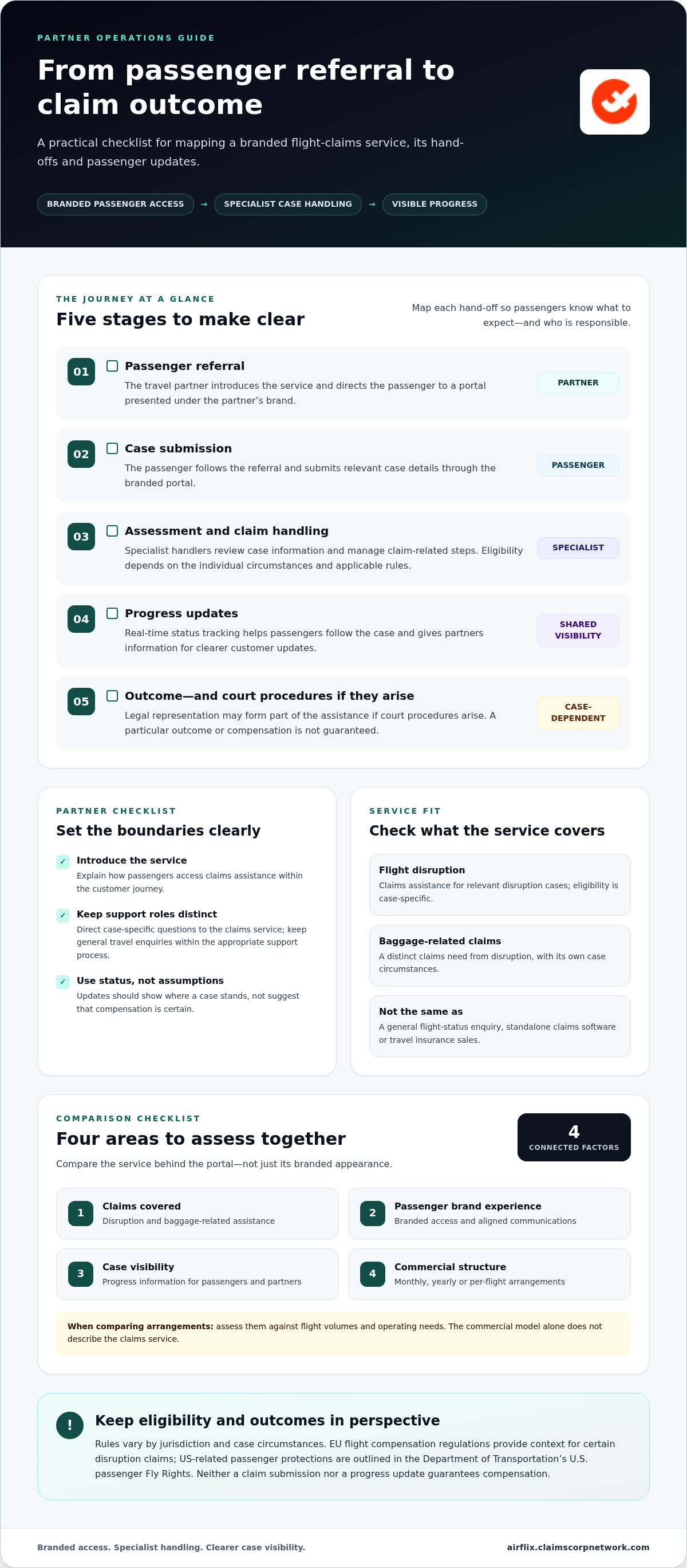
To compare white label solutions for flight claims, assess four connected areas: the claims covered, the passenger-facing brand experience, visibility of case progress and the commercial structure. Together, these show whether the service complements existing support operations and meets passengers’ needs without blurring responsibilities.
How a white-label flight-claims workflow moves from referral to resolution
A clear workflow shows where the travel partner’s role ends and specialist claim handling begins. The journey generally moves through passenger referral, case submission, assessment and handling, progress updates, then an outcome. Mapping these stages helps partners explain what passengers can expect without promising a particular result.
How do passengers enter and follow a claim?
The partner directs a passenger to a portal presented under its brand. For example, after a disrupted journey, a customer follows the referral, submits relevant case details through the portal and accesses claims assistance. Specialist handlers manage the claim, whilst the partner introduces the service and keeps its own communications clear.
Real-time claim-status tracking gives passengers visibility into case progress and helps partners respond more accurately when customers ask for an update. A status should show where the case stands, not imply that compensation is certain. Rules vary by jurisdiction and circumstances; for US-related passenger protections, the Department of Transportation’s U.S. passenger Fly Rights outlines relevant guidance. Useful status updates distinguish progress from outcome.
Specialist flight legal assistance supports the claims process behind the passenger-facing portal, with legal representation available if court procedures arise.
What happens when a claim requires legal representation?
Initial claims assistance and court representation are distinct stages. A case may first be reviewed and pursued through the relevant claims process. If court procedures arise, legal representation can form part of the assistance. This does not guarantee that a case will reach court, be accepted or result in compensation: the circumstances and applicable rules shape how it proceeds.
For the partner, the operational priority is to direct the passenger to the appropriate service and avoid interpreting case details beyond its role. Specialist handlers manage the claim, whilst status visibility helps the partner provide informed updates as the case progresses. The passenger can follow developments through the portal, and the partner can use available status information rather than relying on assumptions or repeated manual follow-up.
When assessing white label solutions for flight claims, map each hand-off: who refers the passenger, who handles the claim, how progress is shown and how court representation is addressed if needed. Clear boundaries make the branded experience easier to manage without suggesting that the partner controls the legal process or its outcome.
Compare flight-claims solutions by coverage, control and commercial model
A useful comparison looks beyond the portal’s appearance. Partners need to understand which passenger cases the service covers, how the branded experience works, what status information is available and how legal assistance is handled. The official EU air passenger rights explain rules relevant to certain disruption claims. A claims service should assess each case against its circumstances and applicable requirements.
Which service capabilities matter for flight claims?
Use these criteria to compare the assistance and passenger experience, rather than assuming that a branded interface includes a particular technical integration or feature.
| Criterion | What to assess |
|---|---|
| Claim scope | Does assistance cover flight disruption, baggage-related claims, or both? These are distinct from travel insurance sales and aircraft maintenance services. |
| Passenger branding | Can customers access claims assistance through a portal presented under the travel partner’s brand? |
| Status visibility | Can passengers follow case progress through real-time claim-status tracking, so updates reflect the current position? |
| Legal assistance | Is the scope clear about what happens if a case proceeds to court, including whether legal representation is provided? |
These distinctions keep the evaluation focused on aviation claims. A general travel tool may display flight information, whilst a claims service supports passengers pursuing relevant disruption or baggage-related matters. Compare the actual assistance and case visibility, not assumptions about technical features or the outcome.
How should partners assess commercial fit?
Commercial arrangements can be monthly, yearly or per flight. Each structure suits a different planning approach, so consider expected flight volumes, seasonal variation and how claims support fits existing customer-service processes. A partner with changing volumes may assess a per-flight model differently from one planning around a recurring subscription.
Consider how the arrangement aligns with internal responsibilities: who introduces the portal, who handles general travel enquiries and how the partner uses claim-status information. No single model suits every operation. Comparing these factors gives a more grounded view of fit than relying on price assumptions.
To see how branded passenger access is presented, explore the white-label passenger portal. Comparing coverage, visibility, legal assistance and commercial structure can help partners assess white label solutions for flight claims against their operating needs.
Plan a white-label flight-claims launch without losing brand oversight
A branded portal can sit within a travel partner’s customer journey, but a clear operating plan is still essential. Before introducing white label solutions for flight claims, decide how passengers will find the service, which team handles general enquiries and how case progress will inform customer communications. This keeps the experience consistent whilst distinguishing the partner’s support role from specialist claims handling.
What should the partner define before launch?
Map the passenger journey from disruption awareness to access to claims assistance. For example, decide where staff direct a passenger after a disrupted flight, what the referral message says and where the partner’s responsibility ends. Give customer-facing teams guidance that reflects the service scope, including flight-disruption and baggage-related claims, without implying that a claim is eligible or that compensation is assured.
Set internal ownership for practical hand-offs. A launch checklist can cover:
- Passenger access: identify where and how the branded portal is introduced.
- Brand presentation: align portal references and staff explanations with the partner’s usual customer communications.
- Enquiries: distinguish general travel-support questions from case-specific claim questions, and define where each is directed.
- Follow-up: agree who reviews available status information and how relevant updates are shared with passengers.
How can partners maintain useful oversight?
Real-time claim-status tracking gives partners and passengers visibility into case progress. It helps a team respond when a customer asks whether a case has moved forward, using the status shown rather than making assumptions. Progress visibility is not the same as control over case handling or its outcome, so staff guidance should make that distinction clear.
Define how questions needing specialist input are routed, and who owns that hand-off within the partner’s team. Keep oversight proportionate to the information available. A practical readiness review should cover the passenger journey, role boundaries, enquiry routing, update practices and staff guidance before the service is introduced.
With those responsibilities mapped, partners can preserve a coherent customer experience whilst offering specialist assistance beyond their internal travel-support role. Explore Airflix’s white-label passenger portal as part of planning a branded claims journey.
Why Airflix fits partners seeking branded flight-claims assistance
For travel agencies and operators, a flight-claims service needs to work at two levels: passengers need a clear route to assistance under the partner’s brand, and the casework needs specialist support. Airflix brings these elements together through a white-label passenger portal, real-time claim-status tracking and legal assistance that includes representation in court procedures.
What distinguishes Airflix’s aviation-focused service?
Airflix is a specialist aviation brand under Claims Corporation Network. Its passenger portal provides branded access to claims assistance for flight disruption and baggage-related issues, connecting the partner’s customer journey with specialist handling. Real-time tracking gives visibility into case progress, whilst legal representation supports cases that proceed to court. These capabilities describe the service scope, not a promise that every passenger is eligible or that a claim will succeed.
This combination matters when comparing white label solutions for flight claims. Branding shapes how passengers enter the service; tracking helps them follow progress; and legal assistance clarifies what support can extend to if court procedures arise. Together, these offer a more complete basis for evaluation than the portal interface alone.
What should the final buying decision rest on?
Start with passenger needs. If customers seek help with both disrupted flights and baggage-related claims, assess whether the service scope aligns with those enquiries. Then consider how the partner brand is presented, how case progress is made visible and how the service fits existing communication responsibilities. Monthly, yearly and per-flight arrangements can be considered against flight volumes, seasonal patterns and internal operating processes.
Reviewing the service scope alongside the passenger experience and case visibility helps partners assess how claims assistance could fit their operation. The final choice should reflect how coverage, customer communications and commercial structure work together.
To explore the branded passenger experience, explore Airflix’s white-label passenger portal.
Choose a claims service that fits your passenger journey
Selecting among white label solutions for flight claims means weighing more than the branded portal. The right fit depends on whether the service covers passengers’ flight-disruption and baggage-related claims, makes case progress visible and sets out how legal representation is handled if court procedures arise.
Clear partner responsibilities matter too. A defined referral journey, consistent customer communications and an appropriate commercial arrangement can help the service complement existing travel support without blurring who handles each step.
Airflix brings these elements together for travel agencies and operators through a branded passenger portal, real-time claim-status monitoring and legal representation in court procedures. Explore Airflix’s white-label passenger portal to see how it could fit your operation. With clear expectations and a considered workflow, you can offer passengers a structured route to claims assistance under your brand.
Frequently Asked Questions
What is a white-label solution for flight claims?
A white-label solution for flight claims lets a travel partner offer passengers access to claims assistance under its own brand. It can bring together a branded passenger portal, real-time claim-status tracking and specialist handling. Assess whether support covers flight disruption and baggage-related claims, how passengers enter the service and how its workflow fits existing customer communications. Case eligibility and outcomes depend on the circumstances and applicable rules.
How does a white-label flight-claims portal work?
A passenger uses a portal presented under the partner’s brand to seek assistance with a relevant flight claim. The service supports the claims process, and status information shows how the case is progressing. For example, a traveller referred after a disruption can use the portal to access assistance and follow case updates. The exact steps depend on the service workflow and claim circumstances. Portal access does not guarantee compensation or a particular result.
Can travel agencies offer flight-claims assistance under their own brand?
Yes. A white-label passenger portal allows a travel agency or operator to present claims assistance under its own brand. This gives customers a branded route to support after flight disruption or a baggage issue, alongside the partner’s existing travel communications. The partner should explain which claims the service handles, how passengers access it and where case-specific questions are directed. Clear wording helps maintain brand consistency without suggesting that every claim will succeed.
What should a travel partner compare when choosing a flight-claims solution?
Compare the claims covered, branded passenger experience, case-status visibility and scope of legal assistance. Establish whether support includes both flight-disruption and baggage-related claims, and whether legal representation is available if court procedures arise. Then consider how the workflow fits existing customer support, including referral and enquiry handling. These practical criteria help partners assess the service more clearly than broad technology claims alone, whilst keeping responsibilities and passenger expectations understandable.
Does a white-label flight-claims service guarantee compensation?
No. A white-label flight-claims service does not guarantee compensation, since eligibility and outcomes depend on the individual case and applicable rules. The service gives passengers a route to assistance and support with the claims process, but a claim may not succeed. Partners should use clear, measured language when introducing the service. Explain that portal access and progress updates indicate support and case movement, not a promised result.
How can partners track flight-claim progress?
Partners can use real-time claim-status tracking to see how a case progresses. This helps staff answer passenger enquiries using current status information, whilst specialist handlers continue managing the claim. For example, a team can refer to the displayed case stage rather than infer progress from the date of a customer’s last enquiry. Explain what updates indicate, and do not treat a status change as confirmation that compensation has been accepted or awarded.
Which commercial models are available for white-label flight-claims services?
Commercial arrangements can include monthly, yearly or per-flight options. The suitable structure depends on a partner’s flight volumes, seasonal patterns and operating requirements, including how claims assistance fits customer-support processes. Compare the commercial basis alongside the service scope and workflow, rather than treating the billing model as the only consideration. Review the terms for each arrangement against your operating needs before making a decision.


