

A long wait at the airport doesn’t automatically mean you’re owed compensation. The route, your delay on arrival and the reason for the disruption all matter, and the rules can differ between UK, EU and US journeys. Knowing how to claim for delayed flight compensation starts with identifying which passenger-rights rules apply to your itinerary.
It can be hard to know what to do next, especially when an airline’s response is unclear or a refund is confused with compensation. This guide explains how to check the relevant claim route, organise useful evidence and submit a clear request with the right journey details. It also covers what to do if the airline rejects your claim or doesn’t respond.
Record key information, including your actual arrival time and the reason the airline gave for the delay. Keep receipts if you incurred expenses. The steps below distinguish compensation from a refund when you choose not to travel, then explain how to pursue an unresolved claim. Airflix provides flight-disruption legal assistance, claim-status monitoring and legal representation in court proceedings.
Key Takeaways
- Start by checking which passenger-rights rules apply to your itinerary, including the operating airline and route.
- Gather journey records and relevant communications before making a claim. Evidence supports the facts but does not determine eligibility on its own.
- Learn how to claim for delayed flight compensation by setting out your journey details and request through the operating airline’s official channel.
- If the airline rejects or delays your claim, assess its explanation against your itinerary, records and the applicable rules.
- Specialist support can help with claim administration, status tracking and legal representation if court proceedings are needed.
How to Claim for a Delayed Flight: Start with the Right Rules
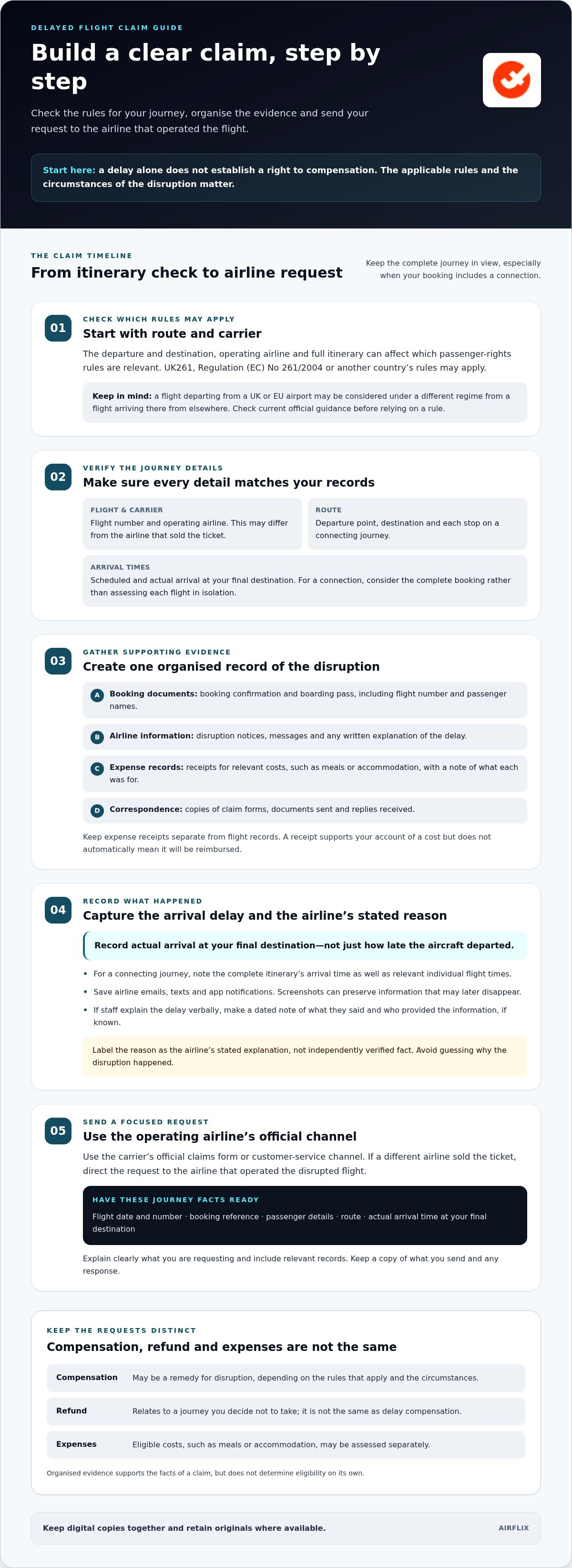
Begin by identifying the passenger-rights rules that apply to your journey. A delay alone doesn’t establish a right to compensation. The departure and destination, operating airline and full itinerary can all affect which rules apply. Checking these details first helps you choose the right claim route before contacting the airline.
A delayed-flight claim is a request for a remedy under the passenger-rights rules that apply to your journey. Depending on those rules and the circumstances, the remedy may involve compensation for disruption, a refund for a journey you decide not to take, or reimbursement of eligible expenses. These are separate requests. A ticket refund isn’t the same as delay compensation, and expenses such as meals or accommodation may be assessed separately.
Which passenger-rights rules may apply to your flight?
UK261, Regulation (EC) No 261/2004, or another country’s rules may be relevant. For example, a flight departing from a UK or EU airport may be considered under a different regime from a flight arriving there from elsewhere. The operating carrier can also matter. These examples are not a complete eligibility test, and similar-looking journeys can have different outcomes. For background on the EU rules, see the EU Flight Compensation Regulation. Check current official UK or EU guidance for the applicable scope and wording before relying on a rule.
What flight details should you check first?
Record the details that identify your journey and show how late you arrived. Keep your booking confirmation and airline updates, then note:
- the flight number and operating airline, which may differ from the airline that sold the ticket;
- the departure point and destination, including each stop on a connecting journey;
- the scheduled and actual arrival times at your final destination.
For a connecting itinerary, don’t assess each flight in isolation. The complete booking and final destination may be relevant to the rules and the delay being considered. Check that the details match your ticket and boarding documents. With the route and carrier identified, you’ll have a clearer basis for working out how to claim for delayed flight disruption without confusing compensation with a refund or an expense request.
What Evidence to Gather Before Claiming for a Delayed Flight
Collect your records before contacting the airline. An organised evidence file helps you explain what happened, support your account and respond to questions. It doesn’t prove that you qualify for compensation on its own. Eligibility depends on the applicable rules and the circumstances of the disruption.
Which documents and records can support a claim?
Keep copies of documents that identify the passengers, booking and disrupted journey. Use this checklist:
- your booking confirmation and boarding pass, including the flight number and passenger names;
- messages from the airline, disruption notices and any written explanation of the delay;
- receipts for relevant expenses, such as meals or accommodation, with a note of what each expense was for;
- copies of any claim form, supporting documents and correspondence you send to or receive from the airline.
Keep expense receipts separate from documents about the flight itself. This helps distinguish a request about disruption from a request to recover a particular cost. A receipt won’t automatically mean an expense is reimbursed, so retain it as evidence and explain why you incurred the cost. Store digital copies together and keep originals where available.
How to record the delay and its stated cause
Record the actual arrival time at your final destination, not just how late the aircraft departed. For a connecting journey, note the arrival time for the complete itinerary as well as the relevant individual flight times. Accurate arrival-time records show the delay experienced at the journey’s destination, not merely the time lost before take-off.
Save airline emails, text messages and app notifications as they arrive. Screenshots can preserve information that may later disappear from an app or booking page. If a member of staff explains the delay verbally, make a dated note of what they said and who provided the information, if known. Record it as the airline’s stated reason, not as independently verified fact. Avoid guessing why the disruption happened.
Keep all records together, including later replies and any documents you submit. The UK Civil Aviation Authority’s guidance on how to make a claim with the airline is a useful reference when preparing your submission. A well-organised file can also help you review the airline’s decision or explain your claim if you need to follow it up.
How to Submit a Delayed Flight Claim to the Airline
Once you’ve checked the relevant rules and gathered your records, send a focused request to the airline that operated the flight. A clear submission helps the airline identify the journey, understand what you’re asking for and respond to the points raised. Follow these steps:
- Find the correct channel. Use the operating airline’s official claims form or customer-service channel. If another airline sold the ticket, identify which carrier operated the disrupted flight and direct the request to it.
- Prepare the journey facts. Have the flight date and number, booking reference, passenger details, route and actual arrival time at your final destination to hand. For a connection, include the full itinerary and affected flights.
- State your request clearly. Explain what happened in neutral, factual language and identify the remedy you’re requesting. If you’re seeking compensation, say so. If you’re requesting a refund or repayment of an expense, make that a separate, clear request. Set out the basis for each without assuming one remedy automatically includes another.
- Attach relevant evidence and submit. Include documents that support the journey details and your account of the disruption. Use clear file names, such as “booking-confirmation” or “airline-delay-message”, and check that attachments are readable.
- Retain proof of submission. Save a copy of the completed form or message, attachments and confirmation. Record the date sent, any reference number and any response timeframe the airline gives you.
What to include in a clear claim message
Keep your message concise and specific. Identify each affected passenger, then give the flight date, flight number and booking reference. Describe the delay using your records, including the actual arrival time, and state why you believe the rules you identified apply. Avoid speculation about the cause or broad statements that don’t explain the remedy you’re seeking. Attach relevant evidence and label it so the airline can match it to your account.
How to submit and keep a reliable record
Submit through the airline’s designated channel and save its acknowledgement. If you don’t receive an automated confirmation, keep a copy of the sent message or take a screenshot of the submission page. Add follow-up correspondence to the same file so there’s a clear record of what you sent and when. This organised approach to how to claim for delayed flight disruption also makes it easier to follow up if the airline’s reply is late or incomplete.
If you’d prefer specialist support with claim administration, professional claim assistance is available. Airflix provides legal assistance and real-time claim-status monitoring. Submitting directly to the airline is also a practical first step if you want to manage your own request.
What to Do If the Airline Rejects or Delays Your Claim
A rejection or brief explanation from the airline doesn’t necessarily address every point in your claim. Review the decision against your itinerary, evidence and the passenger-rights rules that apply. This may confirm the airline’s position, reveal a missing fact or highlight a question that needs a clearer answer. Challenging a decision can’t guarantee a different outcome, but careful comparison helps you choose what to do next.
How to assess an airline rejection
Read the response closely. Identify the reason given, the flight or journey it refers to, and any rule or factual finding the airline relies on. Compare its explanation with your booking, arrival records and saved airline messages. If the airline’s account conflicts with a record, or its reply overlooks a material part of a connecting itinerary, refer to that specific point rather than simply repeating your original claim.
If the answer is unclear, write back with a concise request for clarification. Quote the relevant part of the response, explain which fact or question remains unresolved, and attach the record that supports your query. Keep the tone factual. The airline’s explanation may address its stated reason without resolving every issue, but disagreement alone doesn’t establish that a claim is valid.
When and how to consider escalation
If the airline doesn’t respond or maintains its rejection, check current official guidance for the relevant jurisdiction and type of claim. The appropriate route may depend on where the journey began or ended, which carrier operated it, and whether you’re seeking compensation, a refund or repayment of expenses. Depending on the applicable system, guidance may direct you to an aviation authority, dispute-resolution process or court route. The same escalation procedure doesn’t apply to every itinerary.
Before taking the next step, check the relevant body’s submission requirements and any applicable time limits. Keep a complete file containing your original claim, attachments, submission confirmation, airline reference, rejection or other response, and all follow-up correspondence. A dated record helps you explain the sequence of events and provide consistent information if the matter is reviewed elsewhere.
For specialist support after an unresolved airline response, explore flight disruption legal assistance. Airflix provides claim-status monitoring and legal representation in court proceedings where applicable. Understanding how to claim for delayed flight disruption also means reviewing the airline’s reasoning and identifying the appropriate next route.
When Specialist Flight-Claim Assistance Can Help
Submitting a claim directly to the airline is a practical option, particularly when the route, delay and requested remedy are straightforward. Specialist assistance can help if the itinerary involves connecting flights, the applicable rules are unclear, the airline has rejected the request, or you’d like support with claim administration and follow-up. It doesn’t remove the need to establish the relevant facts or mean that a claim will be accepted.
What professional claim support can take off your hands
Airflix provides legal assistance for disrupted-flight claims and support with managing claim-related information. Real-time claim-status monitoring lets passengers follow the progress of a claim. Airflix also provides legal representation in court proceedings where required, although not every claim will proceed to court. These services help manage the process, but don’t guarantee eligibility, airline acceptance or a particular result.
Consider what kind of support you need. You might be comfortable submitting the initial request yourself but want help if the airline disputes key facts or leaves the claim unresolved. Alternatively, you may prefer specialist assistance with claim administration from the outset. The right approach depends on the complexity of your journey, your records and how much of the process you want to manage directly.
A practical next-step checklist for passengers
Before deciding how to proceed, make sure you can identify the journey and explain your request. Gather:
- your booking confirmation, boarding passes and details of the affected passengers;
- the scheduled and actual arrival details, including the final destination for a connecting journey;
- airline messages, disruption notices and any written explanation of the cause;
- relevant receipts, with a brief note of the expense each one records.
Then identify which passenger-rights regime may apply and whether you’re seeking compensation, a ticket refund or repayment of a separate expense. These are different remedies, so state clearly what you’re requesting and why. You can submit directly to the operating airline or use specialist support for help with administration and progress tracking.
Understanding how to claim for delayed flight disruption means knowing the direct route and when additional support may suit your circumstances. If you need help managing your claim and tracking its progress, find out about Airflix flight-claim assistance.
Take the Next Step with a Clear Claim
Knowing how to claim for delayed flight disruption starts with checking which passenger-rights rules apply to your itinerary. Keep a clear record of the journey, arrival time and airline communications, then submit a specific request through the operating airline’s official channel. If the airline rejects or delays your claim, compare its explanation with your evidence and check the appropriate official escalation route.
Passengers who want specialist support can use Airflix, an aviation claims service developed by FlightClaimEU within Claims Corporation Network. Airflix provides legal assistance and real-time claim-status monitoring, with legal representation in court proceedings where applicable. These services support the claims process but don’t guarantee eligibility, acceptance or a particular outcome.
For legal assistance with your disrupted-flight claim and real-time status monitoring, start with Airflix flight-claim assistance.
Frequently Asked Questions
How do I claim compensation for a delayed flight?
First, identify which passenger-rights rules apply to your itinerary and check whether the disruption may qualify under those rules. Then send a clear request to the operating airline through its official claims or customer-service channel. Include the flight date and number, booking reference, affected passengers, actual arrival details and relevant evidence. State whether you’re seeking compensation, a refund or repayment of expenses, as these are separate requests.
Can I claim if the airline says the delay was caused by extraordinary circumstances?
Possibly, but the airline’s explanation alone doesn’t establish whether the circumstances qualify under the rules that apply to your journey. Compare its stated reason with your flight records and any messages or notices it provided. If the explanation is unclear or doesn’t address relevant facts, ask the airline to clarify its decision. Eligibility depends on the applicable rules and circumstances, so a challenge can’t guarantee a different outcome.
What evidence do I need to claim for a delayed flight?
Keep your booking confirmation, boarding pass, flight number, passenger details and records showing the scheduled and actual arrival times at your final destination. Save airline messages, disruption notices and any written explanation of the delay. Retain relevant receipts separately, noting which expense each one documents. This evidence can support your account, but doesn’t establish eligibility on its own. Keep copies of your claim, attachments and all replies.
Should I claim from the airline or my travel insurer?
For compensation under passenger-rights rules, submit the request to the operating airline. A travel-insurance claim is separate and depends on your policy’s cover, terms and exclusions. Check your policy if you’re seeking a benefit for costs or disruption it covers, and keep that request distinct from an airline compensation claim. A refund for a ticket you don’t use is also different from compensation or reimbursement of expenses.
How long do I have to claim for a delayed flight?
There isn’t one deadline that applies to every journey. Under UK rules, the current time limit is generally six years in England and Wales and five years in Scotland; the relevant period can depend on where a claim is brought. Under EU rules, deadlines vary by country. Check current official guidance for the applicable jurisdiction and route, and don’t assume that the airline’s response period is your legal claim deadline.
What should I do if the airline rejects my delayed-flight claim?
Read the rejection and identify the facts or rules the airline relied on. Compare its explanation with your itinerary, arrival records and saved correspondence. If a material point is unanswered or appears inconsistent, ask the airline for clarification and refer to the relevant evidence. If the matter remains unresolved, check current official guidance for the correct escalation route. The route depends on the applicable jurisdiction and type of request, and escalation doesn’t assure success.
Can I get help with a delayed-flight claim?
Yes. Airflix provides legal assistance for disrupted-flight claims, real-time claim-status monitoring and legal representation in court proceedings where required. The service is a specialised aviation claims service developed by FlightClaimEU within Claims Corporation Network. Assistance can support claim administration, but it can’t guarantee eligibility, airline acceptance or a particular outcome. Organise your booking and arrival records, airline correspondence and relevant receipts so the claim can be assessed using clear information.


