

What if the airline still treats your missing bag as delayed, even though you need to make a claim? When luggage is considered lost depends on the airline’s tracing process and the rules that apply to your journey. Legal assistance for lost luggage can help clarify the next steps, but a claim still depends on evidence, deadlines and which party is responsible.
It’s understandable to be unsure where to start. Report the missing bag to the airline and keep a record of the report. Receipts, baggage details and correspondence can also help support your account of what was lost and its value.
This article explains how to identify the appropriate claim route, what records to preserve and how to document the value of belongings. It also outlines how specialist baggage-claim assistance can help manage and progress a case. Airflix’s Baggage Claim Regress service supports this process with real-time claim status tracking and legal representation in court procedures where applicable.
Key Takeaways
- Distinguish a bag that is delayed from one considered permanently missing, as this can affect the next steps in a claim.
- The rules that apply may depend on your route, carrier and journey details, so identify the relevant claim route before proceeding.
- Compare direct airline contact, an insurer and legal assistance for lost luggage to understand who manages each part of the process.
- Organise your baggage report, luggage tag, itinerary, correspondence and evidence of the missing items before submitting a claim.
- Specialist baggage-claim support can help manage and follow a case as it progresses.
Lost luggage and legal assistance: what counts as a lost-baggage claim?
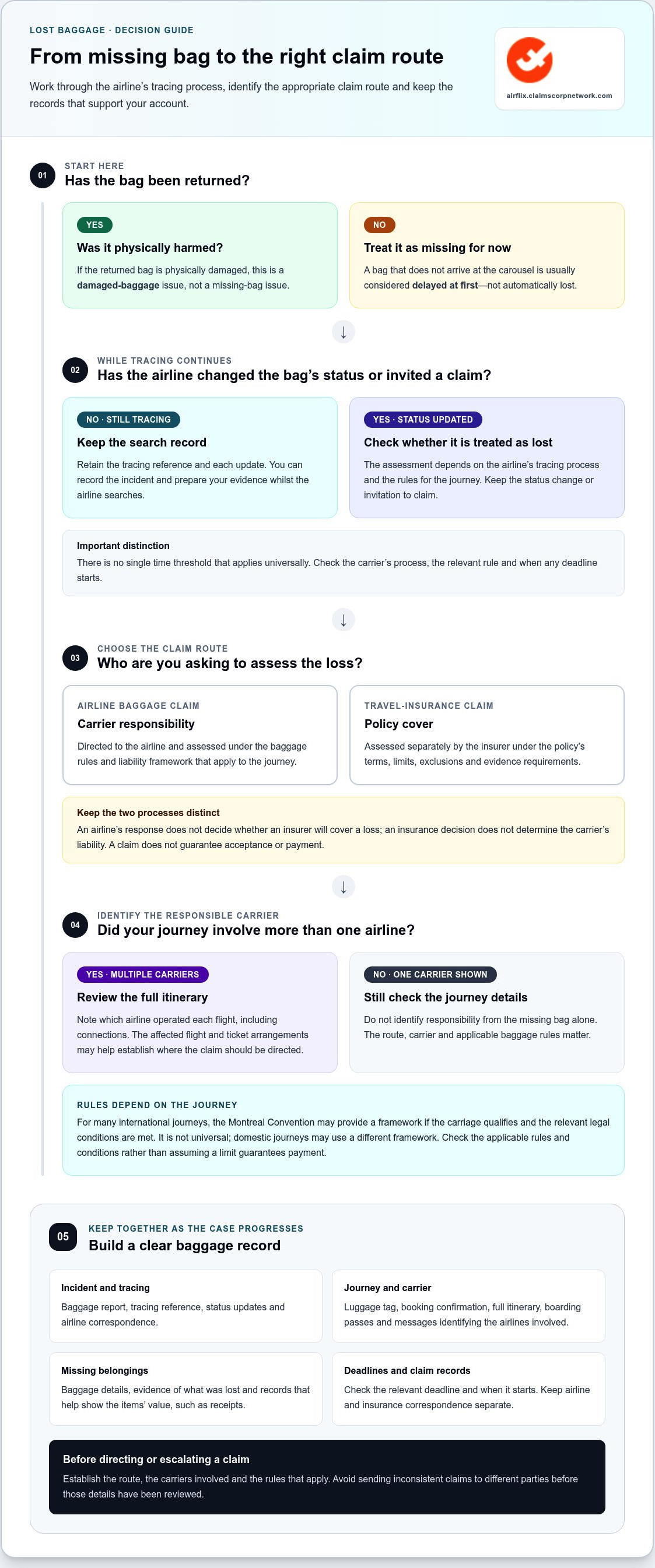
Lost luggage is baggage that hasn’t been returned to its owner and is treated as lost under the airline’s tracing process and the rules that apply to the journey. A bag that fails to arrive at the carousel is usually considered delayed at first, not automatically lost. Tracing and claim preparation can overlap: the airline may still be trying to locate the bag while you record the incident and prepare to pursue a claim.
The terms describe different problems. Delayed luggage is missing temporarily and may still be returned. Permanently missing luggage has not been recovered and may be assessed as lost under the applicable process. Damaged luggage has been returned but is physically harmed. The Lost luggage overview describes common causes and recovery processes, but it doesn’t determine the legal rules for an individual journey.
“An airline baggage claim asks the carrier to address its responsibility for baggage, whereas an insurance claim asks an insurer to assess cover under a separate policy.” Which party may be responsible, and what remedy may be available, depends on the route, carrier and applicable rules. Making a claim doesn’t guarantee that liability or payment will be accepted.
When is missing luggage treated as lost?
An initial delay doesn’t, by itself, establish that a bag is legally lost. The assessment can depend on the airline’s tracing efforts, how much time has passed and the rules governing the journey. There isn’t one time threshold that applies universally. Check the carrier’s process and the relevant rule, including when any deadline starts, rather than assuming that a fixed number of days settles the question.
Keep the tracing reference and any updates while the search continues. If the airline changes the bag’s status or invites you to submit a claim, retain that communication. It can help show how the case progressed. Legal assistance for lost luggage can help clarify the claim route and support the process, without determining the outcome in advance.
Airline claim or insurance claim: what is the difference?
An airline claim concerns the carrier’s responsibility for baggage under the rules applicable to the journey. It is directed to the airline and assessed according to the circumstances of the baggage issue and the relevant liability framework. The responsible carrier may not be obvious on a journey involving multiple flights, so retain the itinerary and documents identifying the airlines involved.
A travel-insurance claim is separate. It is handled under the terms, limits, exclusions and evidence requirements of the traveller’s policy. A decision under one route doesn’t establish entitlement under the other: an airline’s response doesn’t decide whether an insurer will cover a loss, and an insurance decision doesn’t determine the carrier’s liability. Keep the two processes and their correspondence distinct.
Who may be liable for lost luggage under baggage rules?
Responsibility for baggage doesn’t always follow the most visible part of a journey. A ticket may show one airline, while another operates a connecting flight. The applicable rules can depend on the route, the carriers involved and how the journey was arranged. Applicable baggage rules depend on the journey and the responsible carrier, so neither can be identified reliably from the missing bag alone.
For many international journeys, the Montreal Convention may provide a framework for assessing an airline’s responsibility for baggage. It isn’t a universal rule for every flight, and its application depends on the carriage and relevant legal conditions. Domestic journeys may be governed by a different framework. Other journey details may also affect the analysis.
How the Montreal Convention may apply
The Montreal Convention is relevant to qualifying international carriage, but a journey crossing a border doesn’t, by itself, establish that the Convention applies. The route and the legal status of the places involved can matter. Domestic journeys may be governed by a different framework, and other journey details may also affect the analysis.
Where the Convention is relevant, check liability limits and conditions against the current applicable rules. Don’t assume that a stated limit guarantees payment or that every item is treated alike. Before relying on a particular rule, establish which legal framework applies, what conditions it sets and how any relevant time limit is calculated.
Which airline should receive the claim?
Start with the itinerary rather than assuming that the airline named on the ticket is the only possible respondent. On a journey involving more than one carrier, the airline that operated the affected flight and the arrangements under which the ticket was issued may help determine where the claim should be directed. The correct route depends on the circumstances, so avoid sending inconsistent claims to different parties before those details are reviewed.
Preserve the booking confirmation, full itinerary, boarding passes and any messages identifying a change of carrier. Note which airline operated each leg, including connections, and keep the baggage report and tracing reference with those records. These details help establish the journey and identify the carrier or carriers relevant to the claim.
A structured claim review should establish the appropriate respondent before escalation. It can consider the route, the carriers and the applicable baggage rules, rather than treating every missing bag as the same legal case. Specialist baggage-claim assistance can support the process of pursuing a claim against the responsible party. It doesn’t guarantee a particular decision or outcome.
Keep any insurance correspondence separate. An insurer assesses a claim under the policy, while an airline claim concerns carrier responsibility. Information gathered for one may be useful when organising the other, but a decision on either route doesn’t automatically settle the other.
Compare the routes for seeking help with lost luggage
There are three distinct routes to consider: asking the airline to address its responsibility, submitting a claim to a travel insurer under a policy, or using specialist baggage-claim assistance to help manage a claim. The right route depends on what you’re seeking and the rules or policy terms that apply. These options aren’t interchangeable, and a decision on one doesn’t determine the outcome of another.
The comparison below sets out each route’s usual purpose, useful records and who generally manages the process. Exact requirements vary, so treat the document examples as preparation rather than a complete checklist.
| Route | Purpose | Documents typically needed | Who manages the process |
|---|---|---|---|
| Direct airline contact | Raise the baggage issue with the carrier and pursue its response under the applicable baggage rules. | Baggage report, luggage tag, itinerary, correspondence and evidence of the missing belongings. | The passenger submits and follows up with the airline. |
| Travel insurer | Ask for an assessment under the cover and conditions in the policy. | Policy details, baggage report, travel records, proof of loss and relevant airline correspondence. | The insurer assesses the claim under its policy terms; the passenger supplies the requested information. |
| Specialist baggage-claim assistance | Obtain support organising and progressing a claim against the responsible party. | Journey and baggage records, claim documents, communications and evidence relevant to the loss. | The assistance service supports claim management; the passenger may need to provide records and information. |
An airline claim concerns carrier responsibility. An insurance claim concerns policy cover, which may have separate conditions, exclusions and evidence requirements. You can consider both routes, but neither should be treated as a substitute for the other. Keep submissions and responses organised by route so that the basis of each request remains clear.
When might a passenger manage the airline claim directly?
Direct submission may suit passengers who are comfortable organising documents, explaining the circumstances and following up with the carrier. Keep a dated log of reports, emails, calls, reference numbers and replies. This creates a clear sequence if the airline requests more information or its position changes. If responsibility is disputed or the applicable rules are difficult to interpret, further legal assessment may be needed.
What can specialist baggage-claim assistance add?
Specialist assistance can help organise information and pursue regress against the party considered responsible, bringing claim records and correspondence into a managed process. Real-time status monitoring shows case progress, but doesn’t promise resolution or compensation. Claim support is also distinct from legal representation, which applies in court procedures. For support with progressing a baggage claim, explore Airflix’s baggage claim regress service.
How to prepare a lost-luggage claim: evidence and deadlines
A well-organised claim makes it easier to show what happened, when it was reported and what belongings are missing. Start recording details as soon as you discover the bag hasn’t arrived, then keep each document and update in one place. The applicable deadline can depend on the journey, the type of claim and the rules that govern it, so don’t rely on a general time limit.
Keep the baggage report, luggage tag, itinerary, airline correspondence and an itemised record with any available proof of ownership or value.
Use this sequence to build a clear claim file:
- Report the missing bag promptly. Notify the airline through its baggage-reporting process and retain the report or reference number. If you’re still at the airport, note where and when you reported it.
- Keep the travel and bag records together. Save your booking confirmation, itinerary, boarding passes and luggage-tag details. Photograph or scan paper records so you have a digital copy.
- Record what was inside. Prepare an itemised inventory, noting each item’s description and, where known, its approximate age and purchase details. Gather receipts, photographs or other evidence of ownership and value if available.
- Log updates and responses. Keep copies of emails, forms and messages, and make a dated note of calls, including who you spoke to and any reference given. Record changes in the bag’s tracing status.
- Check the route, then submit. Confirm which party should receive the claim and what evidence it requests. Send copies unless originals are specifically required, and keep the completed submission and proof of delivery.
Which records help support a missing-baggage claim?
Prioritise the baggage irregularity report, tag number, booking documents and airline correspondence. Together, these help connect the reported loss to a particular journey and show how the airline handled it. An inventory gives structure to the contents claim, while receipts or photographs may help substantiate individual items. Keep originals secure, submit copies where suitable, and retain dated digital records and backups.
How should passengers manage claim deadlines?
Send written notice promptly and preserve proof of submission, such as an acknowledgement or a copy of the completed online form. A notice period for reporting a baggage problem is distinct from a limitation period for bringing a legal claim. Their length, starting point and applicability can differ by claim type and legal framework. Verify the rules for the specific journey before relying on a deadline.
Specialist legal assistance for lost luggage can help organise claim information and move the process forward. Get support with preparing your baggage claim.
How Airflix supports a lost-luggage claim
Once you’ve identified the relevant claim route and gathered supporting information, the next task is to manage the case as it progresses. Airflix’s Baggage Claim Regress service supports passengers in pursuing a claim against the party considered responsible. This specialist assistance helps organise the claim and move it through its stages, while the facts of the journey and applicable baggage rules shape how each case proceeds.
Airflix provides real-time claim status monitoring, so you can follow the recorded stages of your case. This gives visibility into progress, not a guarantee of a particular decision, recovery amount or resolution date. Keeping track of updates helps you understand where the claim stands and whether further information or an appropriate next step is required.
What happens after a baggage claim is submitted?
The process is case-specific, but it can be understood as a sequence of review, management and follow-up. The submitted information is considered in light of the journey and the rules that may apply. The claim can then be managed against the party identified as responsible, with status updates helping you follow progress. If the circumstances or response require further action, the next step depends on the claim’s position and applicable process.
Airflix’s real-time claim status monitoring makes that progress visible. It doesn’t replace the underlying review or determine the outcome. Continue to retain relevant communications and respond to requests for information, so the case record remains complete as it moves through its stages.
For passengers seeking legal assistance for lost luggage, Airflix combines claim management with status visibility. Its Baggage Claim Regress service supports the process of pursuing a claim, without promising that the responsible party will accept liability or that a claim will result in payment.
When may legal representation become relevant?
Not every baggage claim proceeds to court. Many cases are handled through the claim process, but if court procedures become relevant, formal legal representation may be required under the applicable process. Airflix provides legal representation in court procedures. This is distinct from the administrative work of organising and progressing a claim, and it isn’t a necessary step in every case.
The decision about further action depends on the evidence, the response received and the rules governing the claim. A clear record of the case can help inform that assessment, while real-time status tracking lets you follow its progress. Neither tracking nor legal representation guarantees a particular outcome.
Explore Airflix’s passenger legal assistance to understand how it supports a baggage claim and its next steps.
Take the next step with a clear claim plan
A missing bag can leave important decisions unresolved, but your next move doesn’t need to be uncertain. Once you’ve identified the claim route and assembled the relevant records, consider whether you want to manage the process yourself or use specialist support to progress it. Legal assistance for lost luggage can provide structured support with a baggage claim, while real-time status monitoring helps you follow its progress. If court procedures become relevant, Airflix provides legal representation.
Airflix’s Baggage Claim Regress service supports the process of pursuing a claim against the responsible party. The facts and applicable rules shape how each case proceeds, and no particular outcome can be assumed.
Explore Airflix passenger legal assistance and take a considered next step with your baggage claim.
Frequently Asked Questions
Is lost luggage covered by airline liability or travel insurance?
Potentially both, but each route is assessed separately. An airline claim concerns the carrier’s responsibility under the rules applicable to the journey, while an insurance claim depends on the policy’s cover and conditions. Check whether the policy requires you to notify the insurer or provide the airline’s response, and keep each party’s correspondence. Legal assistance for lost luggage can help clarify the airline-claim process, but it doesn’t establish insurance cover.
Can I claim for luggage that the airline later finds?
You may still be able to seek consideration of losses caused by the period without your bag, but the basis and availability of any claim depend on the applicable rules and circumstances. Tell the airline when the bag is returned and update any open claim. Record the delivery date, the condition of the luggage and any reasonable expenses linked to the delay, then check which of these the relevant claim route will assess.
What evidence helps prove what was inside lost luggage?
An itemised inventory is a useful starting point. For each item, note its description, approximate purchase date and value, then match it with available evidence such as photographs, online order confirmations, bank statements or warranty records. Images taken before travel may show belongings packed or used on the trip. Link evidence to specific inventory entries so the information is easier to review than a collection of unlabelled files.
Can I claim for items in luggage without receipts?
Lack of a receipt doesn’t prevent you from documenting an item, but it may make its ownership or value harder to establish. Look for alternative records, such as card statements, product photographs, emails, warranties or evidence that the item was used during the trip. Explain clearly where an amount is estimated rather than supported by a purchase record. The airline or insurer will assess the evidence under the rules or policy that applies.
What should I do if the airline says my luggage was delivered?
Respond in writing and explain why you dispute the delivery record. Check with household members, reception staff or the place where bags are normally left, then compare the airline’s statement with your own timeline and any tracking information. Ask the airline to review the delivery details and retain its reply. If you still don’t have the bag, make clear that the matter remains unresolved and keep a record of each follow-up.
Does a luggage tracker prove that the airline lost my bag?
A tracker can help show where a device associated with your bag reported a location at a particular time, but it doesn’t by itself establish who had custody of the luggage or what happened to it. Save dated screenshots and note when the location was recorded. Share this information with the airline as supporting evidence, alongside your baggage report and travel records. Treat it as one part of the account, not proof on its own.


