

What if the hardest part of a flight disruption isn’t the delay itself, but working out which rights apply and keeping a claim moving? A passenger rights protection service can assess the circumstances, organise relevant information and manage the claim process. It can help you understand the next steps, but it cannot promise a particular outcome.
It’s understandable to feel uncertain. Passenger-rights rules can depend on the journey and the nature of the disruption, while gathering documents and following up with an airline takes time. Support can make the process more structured, but compensation is not guaranteed. The outcome depends on the details of the case and the rules that apply.
This article explains what a service can handle, how a claim typically progresses and what information is useful for an initial assessment. It also covers how real-time claim status tracking helps you follow progress, what escalation may involve and how legal representation can support a case that proceeds to court. You’ll finish with a practical list of what to prepare and what to expect at each stage.
Key Takeaways
- A passenger rights protection service can assess and manage claims, but support does not guarantee compensation.
- Claim handling typically moves from submitting journey details and evidence to pursuing the claim and monitoring its progress.
- Managing a claim yourself may suit you if you’re comfortable organising documents and handling airline correspondence.
- Gather your booking confirmation, flight details, airline correspondence and relevant disruption records for an initial assessment.
- Airflix provides flight-disruption assistance, baggage-claim recourse, real-time status tracking and legal representation in court proceedings.
What does a passenger rights protection service actually do?
A passenger rights protection service helps assess, administer and pursue a passenger’s claim when a journey has been disrupted or baggage has been affected. It can organise the case, review the available evidence and handle claim-related steps on the passenger’s behalf. It supports the pursuit of a claim; it does not guarantee compensation or determine the final decision.
This is different from travel insurance, which provides cover under an insurance policy and its terms. A claims service helps pursue a claim under passenger-rights rules that may apply to the journey. It is also distinct from an airline’s customer service team, which manages the airline’s operations and passenger communications, and from a regulator, which oversees compliance or complaint processes rather than administering every individual claim.
The relevant rules depend on the journey and the circumstances of the disruption, so not every case follows the same route. A service assesses the details against the potentially applicable framework and the evidence available. General background on passenger rights can explain the range of protections, but it does not establish the outcome of an individual case.
Which passenger problems can a protection service help manage?
Support can cover claims arising from flight disruption, as well as recourse for baggage issues. These are separate areas: a delayed or cancelled flight involves different facts and records from a baggage issue, so each claim needs to be assessed on its own details. A service can manage the claim process, but it cannot resolve the operational disruption itself. The airline remains responsible for decisions such as operating, cancelling or rerouting a flight.
What a claims service can and cannot promise
Administration or legal representation can help move a case through the process, but neither ensures compensation or a particular decision. The applicable legal rules, the quality and completeness of the evidence, and the airline’s response all affect how a claim proceeds. If a case reaches court, representation can support the passenger, but the outcome remains a matter for the court.
A managed claim is not an insurance policy or an automatic payout. It is structured assistance with assessing and pursuing a claim, with the result dependent on the case. Before proceeding, understand what support the service covers, what information it needs and how it will communicate progress. The value lies in organised case handling and visibility, not certainty about the result.
How passenger rights claim handling moves from assessment to resolution
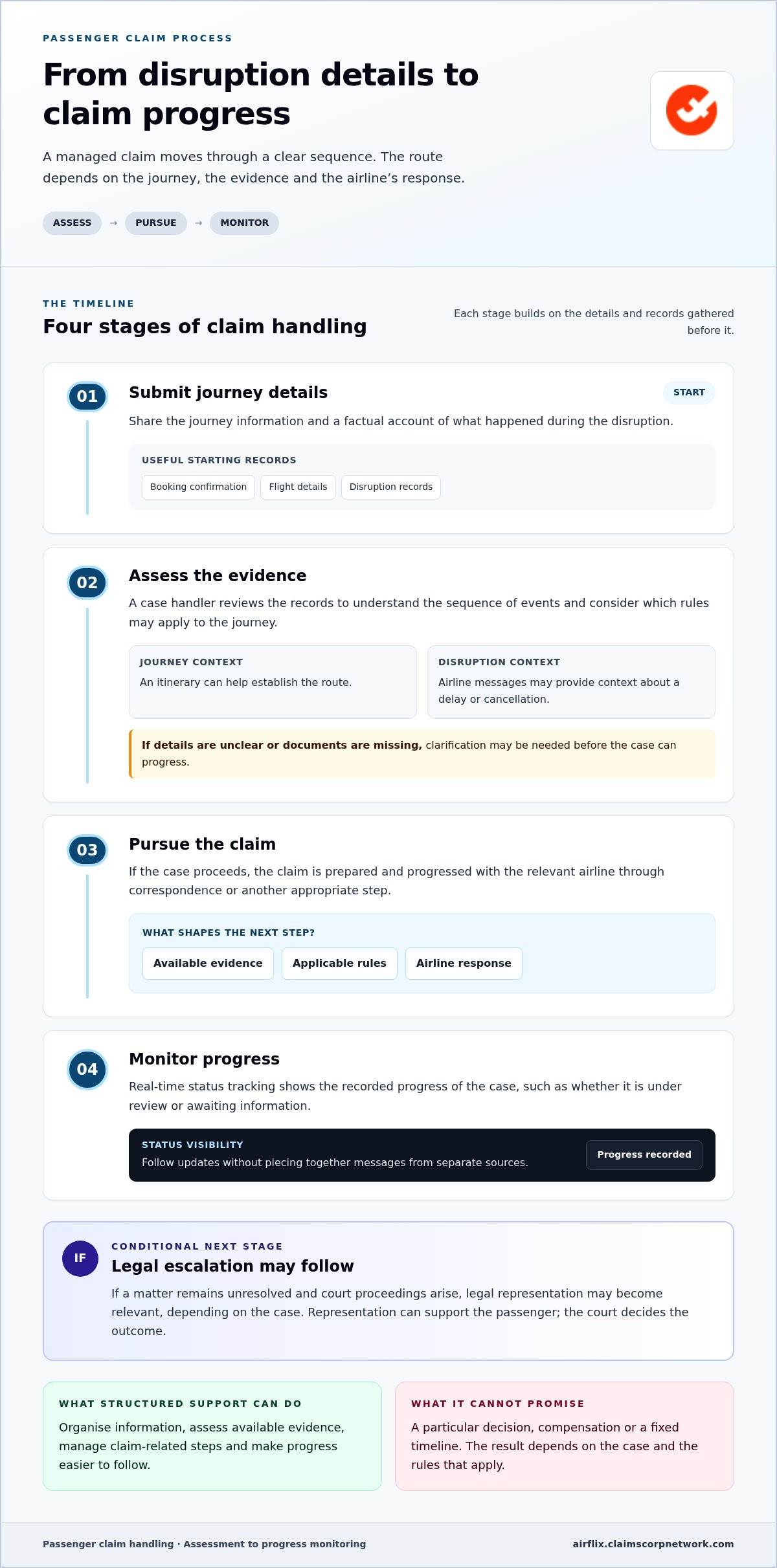
A managed claim follows a sequence: you submit journey details, the case is assessed against the available evidence, and the claim is pursued through relevant correspondence or another appropriate step. Progress is monitored as the case develops. This sequence keeps the process organised, although requests for further information or the airline’s response can affect what happens next. There is no fixed timeline or guaranteed agreement.
- Submit details: Provide the journey information and a factual account of what happened.
- Assess evidence: Review the records and consider which rules may apply.
- Pursue the claim: Prepare and progress the case with the relevant airline.
- Monitor progress: Follow updates and consider whether further action is appropriate.
In short, a claim moves from intake and evidence review to airline engagement and status monitoring. If the circumstances call for it, the process may include legal escalation.
What happens during the initial claim assessment?
The initial assessment brings together journey details, information about the disruption and supporting records. A case handler reviews these materials to understand the sequence of events and consider whether the case can proceed under the rules that may apply. If details are unclear or documents are missing, clarification may be needed before the next step. Assessment identifies a possible route for handling the case; it does not guarantee eligibility or compensation.
For instance, an itinerary can establish the route, whilst airline messages may provide context about a cancellation or delay. Passenger rights and complaint routes can differ by jurisdiction. For US-related journeys, the U.S. Department of Transportation's Fly-Rights guide provides consumer information on issues including delays, cancellations, overbooking and baggage. Such guidance can help orient passengers, but an individual claim still depends on its own facts and records.
How updates and legal escalation fit into the process
As the case is handled, real-time status tracking lets passengers follow its recorded progress. It can clarify whether a claim is under review, awaiting information or at another stage, rather than leaving the passenger to piece together updates from separate messages. Tracking improves visibility, but it cannot control when an airline responds or predict the final decision.
If the matter remains unresolved and court proceedings arise, legal representation may become relevant, depending on the case. Airflix provides flight-disruption legal assistance and representation in court proceedings. The next steps are shaped by the evidence, applicable rules and responses received, not by a standard timetable. A structured process makes case administration easier to follow without removing uncertainty about the result.
Passengers who want to start a claim can submit relevant journey information through Airflix. A clear account and the available records give the assessment a practical starting point; further handling depends on the case.
Using a passenger rights service or managing the claim yourself
There’s no single approach that suits every passenger. Managing a claim yourself can work well if you’re comfortable interpreting official guidance, organising records and corresponding directly with the airline. A passenger rights protection service may suit someone who would rather have the case administration coordinated and progress made visible. The key difference is who handles the work, not certainty about the result: neither route removes uncertainty about how a claim will be decided.
| Consideration | Self-managed claim | Managed assistance |
|---|---|---|
| Passenger effort | You prepare and send correspondence, then follow up as needed. | Claim administration is handled as a structured process, reducing the work you manage directly. |
| Document handling | You gather, organise and retain the relevant records. | Evidence is coordinated as part of case handling, with further information considered if needed. |
| Status visibility | You track replies through your own records and communications. | Real-time status tracking can show case progress in one place. |
| Escalation | You decide what follow-up to make and manage any next steps. | Support may include legal representation if the case proceeds to court. |
The comparison is about process and responsibility, not which route is more likely to succeed. Applicable rules, available evidence and the airline’s response continue to shape the outcome. A well-organised self-managed claim may be appropriate, just as structured assistance may be useful when the administrative burden is difficult to fit around other commitments.
When self-management may suit a passenger
Self-management may be practical if you’re comfortable consulting official guidance, keeping a clear record of events and writing directly to the airline. You remain responsible for retaining booking details and correspondence, noting when messages are sent and received, and tracking replies or requests. This route gives you direct control over communications and can suit passengers who have the time and confidence to manage each step.
When structured claim support may be useful
Structured support can help if you’d prefer coordinated evidence handling and a clearer view of case status rather than maintaining the process yourself. It may also be relevant if proceedings arise and legal representation is required. The choice depends on your available time, confidence in handling correspondence and the needs of the case. Before deciding, consider which tasks you want to manage personally and which you’d prefer to have organised as part of a service.
Whichever approach you choose, keep copies of what you submit and make sure the information is consistent. A managed service can organise the process, but it cannot guarantee a particular decision. Self-management can be a reasonable alternative, but it leaves you responsible for monitoring the claim and responding to developments. Choose the route that best fits your capacity and the amount of administration you’re prepared to take on.
What to prepare before using a passenger rights protection service
Preparing a few key records can make the initial assessment more straightforward. Gather documents that identify the booking, clarify what happened and show relevant communication or costs. You don’t need to determine which passenger-rights rules apply before submitting a case. Start with a factual account and the records you already have, then organise them by journey or issue so each item is easy to identify.
Use this checklist as a starting point:
- Booking confirmation or itinerary, including the booking reference.
- Passenger names, flight numbers and journey dates.
- Airline correspondence, such as emails, messages or notices about the disruption or baggage issue.
- Records connected with the event, including relevant receipts or other supporting documents where applicable.
Keep copies of everything you submit and retain the original files where possible. Check that names, dates and flight details are consistent across your records. If a detail is missing or uncertain, explain that rather than guessing. Gaps may mean the case handler needs clarification before proceeding, so a brief note about what you do and don’t have can make the file easier to understand.
Information to gather for a flight disruption claim
For a flight-related case, collect passenger names, booking details, flight numbers and journey dates. Add airline messages, notices or other records that describe the disruption. If you incurred relevant expenses, retain the receipts and note what each relates to. A short timeline can help connect the documents: record what happened, when the airline contacted you and any steps you took in response.
Keep the timeline factual. If you’re unsure of an exact time or can’t find a particular message, say so rather than filling the gap from memory. Save documents in a format that’s easy to read, and use clear file names to distinguish itinerary records from airline correspondence or receipts. These small steps make it easier to see which evidence supports each part of your account.
Information to organise for a baggage-related claim
Baggage issues call for records specific to the item and incident, rather than only flight-disruption documents. Gather baggage identification or claim records, incident documentation and correspondence about the issue. If the claim involves documented loss or expense, retain receipts or other supporting evidence. Keep these materials together and separate from unrelated journey records so the relevant details are easy to review.
Airflix provides baggage-claim recourse support as a distinct part of its passenger claim assistance. Before submitting, label digital files clearly and indicate which records relate to each passenger or bag if more than one is involved. Keep a copy of the information you provide. Accurate, consistent details help establish a clear record, although they cannot guarantee a particular claim decision.
Journey or baggage details for assessment can be submitted as passenger claim information.
How Airflix provides structured passenger claim support
Airflix brings flight-disruption legal assistance, baggage-claim recourse and case monitoring into a structured support process. Passengers can submit relevant journey information for assessment and claim handling, with progress visible as the case develops. This is practical assistance with claim handling, not an airline service, travel insurance policy or promise of compensation.
For a flight-disruption claim, the process centres on the details and evidence provided, followed by case administration and engagement with the airline. Baggage issues are handled as a distinct area of recourse, using information relevant to that issue. If a matter proceeds to court, Airflix provides legal representation in court proceedings. Whether a claim can proceed and how it is resolved depend on its circumstances, the applicable rules, the evidence and the response received.
That distinction matters. A passenger rights protection service can coordinate the steps involved, but it cannot control an airline’s decision or determine a legal outcome. Airflix supports the claim process and gives passengers a clearer view of its progress, without guaranteeing a result or a resolution date.
Passenger visibility through real-time claim status tracking
Real-time claim status tracking gives passengers visibility into the recorded progress of a case, helping them follow its movement without relying only on separate messages and personal notes. It supports clearer administration by showing where the claim stands as it is handled. Tracking does not predict when a response will arrive or what the decision will be. Visible progress helps passengers stay informed as their claim moves through the process.
A clear next step for passengers and travel partners
Passengers can begin by organising the relevant booking, flight or baggage information and submitting it through Airflix for claim support. Clear, accurate details give the case process a practical starting point; further handling depends on the information and circumstances involved. For travel agencies and operators, Airflix also provides a white-label passenger portal, a partner option for supporting passenger claim journeys under their own brand.
Airflix combines claim assistance with real-time monitoring and, where court proceedings arise, legal representation. These services provide a managed route through the work, while eligibility and outcomes remain dependent on the individual case. Passengers should provide accurate information and relevant documents when requested, and keep their own copies of important records.
Information for a flight-disruption or baggage claim can be submitted through Airflix.
Take the next step with a clear record
Turn what happened into a clear, documented account. Review your booking details and records, note any points that still need clarification, and decide whether you want to manage the correspondence yourself or use a passenger rights protection service to administer the case. A considered starting point makes it easier to understand what support may be appropriate.
Airflix supports flight-disruption and baggage claims, with real-time claim status monitoring and legal representation if court proceedings arise. These services help structure the claim process, but cannot guarantee compensation or a particular decision. The outcome depends on the circumstances, evidence and applicable rules.
Ready to put your journey information forward for assessment? Submit your passenger claim through Airflix. Begin with the records you have, provide accurate details and take the process one step at a time.
Frequently Asked Questions
Is a passenger rights protection service the same as travel insurance?
No. A passenger rights protection service helps assess and administer a claim under applicable passenger-rights rules; travel insurance is a separate policy governed by its own cover and exclusions. One does not replace the other. For example, if a disruption leads to extra expenses, a claim service may help pursue a passenger-rights claim, whilst whether an insurer covers those expenses depends on the policy terms. Treat them as distinct forms of support.
Can a passenger rights service guarantee compensation?
No. A service can organise and pursue a claim, but it cannot guarantee that compensation will be awarded. The decision depends on the applicable rules, the facts and evidence, and the response to the claim. Before proceeding, understand what the service will handle and how it will communicate progress. Assistance or legal representation is not certainty about the result.
What documents should I provide for a flight disruption claim?
Provide records that help identify the booking and clarify what happened, such as your itinerary and relevant airline messages. Use complete, readable copies, and keep the original files in case details need to be checked later. If a document covers several passengers or flight legs, indicate which information relates to your claim. If you don’t have a particular record, explain what’s missing rather than trying to recreate or guess its contents.
How can I track the status of a passenger claim?
Use Airflix’s real-time claim status tracking to see recorded updates and identify whether the claim has moved to another stage. Check for new information after receiving correspondence from the airline, and retain that message with your own records. If an update is unclear, note the point you need clarified and use the service’s communication route. Status visibility helps you follow administration, but does not indicate when a decision will be made.
Can a claims service help with delayed or damaged baggage?
Yes. Airflix provides baggage-claim recourse support. For a delayed bag, keep records that connect the baggage issue to your journey; for damage, photographs can help show the condition of the item. Retain any baggage identification and communications about the incident, and keep these materials separate from documents about a flight disruption. The relevant evidence depends on what happened, so provide a clear account alongside the records you have.
What happens if an airline rejects a passenger claim?
Keep the rejection and note the airline’s stated reasons. Compare its response with the information submitted, and identify whether it refers to a missing detail, a disputed fact or its interpretation of the rules. The rejection does not, by itself, establish whether further steps are appropriate. The case can be reviewed against its evidence and circumstances; if proceedings follow, legal representation may be relevant. No further step guarantees a different decision.


