

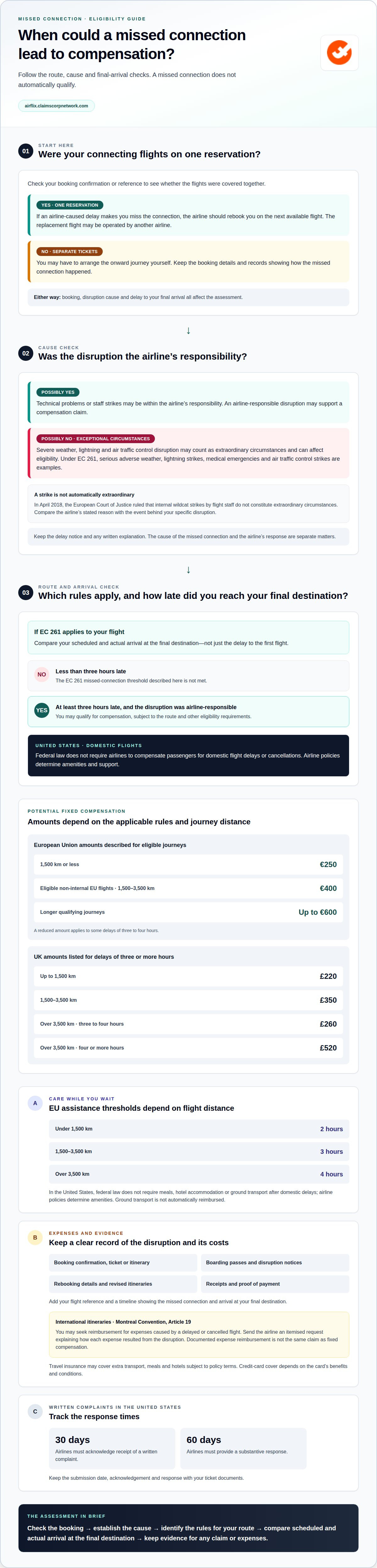
There’s no single global rule for a missed connection. Under EC 261, a claim for missed connection compensation due to airline fault may qualify when the disruption is the airline’s responsibility and you reach your final destination at least three hours late; eligible compensation can be up to €600. In the United States, federal law doesn’t require airlines to compensate passengers for domestic flight delays or cancellations.
A missed connection doesn’t automatically qualify you for compensation. The booking, cause of the disruption and delay to your final arrival all affect eligibility. With separate tickets, you may have to arrange the onward journey yourself.
This guide explains how to assess eligibility, how exceptional circumstances may affect a claim, and what rebooking and care to expect after an airline-caused disruption. It also covers what evidence to keep and how to move forward with your claim.
Key Takeaways
- Keep your booking confirmation and records of the disruption so you can establish how the missed connection happened.
- Separate airline-controlled causes, such as technical problems, from extraordinary circumstances that may affect compensation eligibility.
- Review whether all connecting flights were covered by one reservation, as this can affect who is responsible for getting you to your destination.
- If the airline caused the missed connection on a single booking, ask about rebooking on the next available flight and the assistance available while you wait.
- Consider Flight Disruption Legal Assistance when you need support pursuing a claim after assessing your eligibility.
What is missed connection compensation?
Compensation may be available if a covered disruption makes you miss a connection and arrive late at your final destination. Before preparing a claim, assess the cause, booking and arrival delay.
-
Identify the cause of the disruption
Record why the first flight was delayed and how that affected your connection. Technical problems or staff strikes may be within the airline’s responsibility; severe weather, lightning and air traffic control disruption may count as extraordinary circumstances. The distinction matters: an airline-responsible delay may support a compensation claim, while an event beyond the airline’s control can affect eligibility.
Ask what support applies during the wait. In the United States, federal law doesn’t require airlines to provide meals, hotel accommodation or ground transport after domestic delays; airline policies determine amenities. Under EU rules, care and assistance thresholds depend on flight distance: two hours for flights under 1,500 km, three hours for flights between 1,500 km and 3,500 km, and four hours for flights over 3,500 km. Don’t assume ground transport is automatically reimbursed.
Travel insurance may cover expenses such as extra transport, meals and hotels after an airline delay, subject to the policy terms. Credit-card coverage depends on the card’s benefits and conditions, so keep relevant purchase and expense records.
-
Review compensation and expense options
Compare your scheduled and actual arrival times at the final destination, not only the delay to the first flight. Under EC 261, eligible passengers may qualify when an airline-caused disruption leads to arrival at least three hours late. For eligible flights of 1,500 km or less, compensation is €250; the European Union sets €400 for eligible non-internal EU flights between 1,500 km and 3,500 km. Longer qualifying journeys may reach €600, with a reduced amount applying to some delays of three to four hours. UK amounts listed for delays of three or more hours are £220 up to 1,500 km and £350 from 1,500 km to 3,500 km. Over 3,500 km, the listed amounts are £260 for three to four hours and £520 for four or more hours.
For an international itinerary, Article 19 of the Montreal Convention provides a route to seek reimbursement for expenses caused by a delayed or cancelled flight. Submit an itemised request to the airline, explaining how each expense resulted from the disruption. Keep receipts and proof of payment; don’t treat reimbursement of documented expenses as the same claim as fixed compensation.
Gather your booking confirmation, ticket or itinerary, boarding passes, disruption notices, rebooking details and receipts. Include your flight reference and a clear timeline of the missed connection and arrival at your final destination. These records help link the disruption to your delay and any claimed costs.
Airline responsibility and extraordinary circumstances
Assess the cause of the missed connection separately from the airline’s response. This distinction affects compensation, rebooking and how to challenge a refusal.
-
Assess airline responsibility
Compare your scheduled itinerary with the departure and arrival records, then establish what caused the disruption. A technical problem or staff strike may indicate an airline-responsible cause. Keep your boarding pass, delay notice and any written explanation to document what happened before you missed the connection.
In the United States, federal law doesn’t require airlines to compensate passengers for domestic flight delays or cancellations. Airline policies still govern support for schedule and operational changes. American Airlines says it doesn’t cover special, incidental or consequential damages resulting from those changes, including a missed connection. This statement concerns damages, not whether other protections apply.
If your connecting flights share one booking reference, the airline should rebook you on the next available flight if a delay makes you miss the connection. The replacement may be operated by another airline. Save each revised itinerary and boarding pass, and record when you reach your destination.
For written complaints in the United States, airlines must acknowledge receipt within 30 days and provide a substantive response within 60 days. Record when you submitted the complaint, then retain the acknowledgement and response with your ticket documents.
-
Consider extraordinary circumstances
Read the airline’s stated reason carefully and compare it with the event that disrupted your flights. Under EC 261, serious adverse weather, lightning strikes, medical emergencies and air traffic control strikes are examples of extraordinary circumstances that may exclude compensation. Weather can affect operations, but the airline’s explanation should identify the event linked to your specific disruption.
Don’t treat every strike as automatically extraordinary. In April 2018, the European Court of Justice ruled that internal wildcat strikes by flight staff do not constitute extraordinary circumstances. Keep the airline’s notices and timeline, so your claim addresses its stated reason rather than a general reference to disruption.
For travel to or from Canada, American Airlines says the country’s Air Passenger Protection Regulations may provide additional protections, including compensation, when a delay or cancellation results from reasons within the airline’s control. Consider the route and cause before relying on this distinction.
If your claim is refused, compare the airline’s explanation with your records and the protections applicable to your route. If the dispute goes to court, legal representation may help support your case.
Connecting flights booked on one reservation
Check whether your connecting flights share one booking reference before assessing responsibility. In the United States, federal law doesn’t require compensation for domestic flight delays or cancellations; airline policies determine rebooking support and other amenities.
- Find the booking reference on your confirmation and compare it with each ticket and boarding pass. Flights bought together under one reservation form a single itinerary for assessing a missed connection, even if different airlines operate them. Separate tickets are treated differently: each airline is responsible for its own segment, and the onward carrier may treat you as a no-show.
Keep the confirmation showing your complete route. A shared reference helps establish that the flights were booked as one journey, rather than as separate trips you arranged.
- Identify the airline that caused the delay and the carrier responsible for your booking. If the first flight’s delay makes you miss a later flight on the same reservation, the airline should rebook you on the next available flight, even if another airline operates it.
At the airport, ask for the revised itinerary and keep its reference. Record the reason given for the disruption, because the cause affects compensation separately from the practical rebooking arrangements.
- For EU261 coverage, check the departure airport and reservation structure. A flight departing from a UK or EU airport may qualify; for an itinerary departing the EU, EC 261 generally covers the journey when its flights were purchased under one booking, regardless of where the disruption occurs. EU passengers are covered regardless of nationality on flights within Europe.
Different operating airlines don’t by themselves remove potential protection when flights share one reservation. Compare the original and replacement itineraries, then calculate the delay at your final destination, not just the delay to your departure.
- For a domestic connection in the United States, distinguish compensation rights from airline service policies. There is no federal requirement to pay compensation for an ordinary delay or cancellation. The U.S. DOT airline dashboard records airlines’ commitments for disruptions within their control, including rebooking, meal vouchers and hotel accommodation.
Major U.S. airlines set their own policies, so available support varies by carrier and disruption. American Airlines says it doesn’t cover special, incidental or consequential damages resulting from schedule or operational changes, including a missed connection.
- Allow enough time between flights when planning a connection. Allow enough time between flights when planning a connection, and check the airport, terminal and ticket itinerary before travel. A tight connection does not change whether the flights share one reservation; it can affect whether you reach the next gate in time.
If the airline rebooks you after a missed connection, keep your new boarding pass and note your arrival time. These records help distinguish the original delay from the final outcome of your journey.
Eligibility requirements for missed-connection compensation
Assess the booking, cause and final arrival time together. A missed connection alone doesn’t establish eligibility for compensation or a ticket refund.
- Match your tickets and boarding records to the reservation. For EU261 or UK261, connecting flights on the same reservation may qualify, even when different airlines operate them. A flight departing from a UK or EU airport may also fall within the rules. Separately booked flights are treated as separate journeys, so the second airline may regard you as a no-show.
Keep the confirmation showing your full itinerary and booking reference. For missed connection compensation due to airline fault, this evidence helps establish whether the flights formed one journey and which carrier handled each segment.
- Identify what caused the disruption and whether the airline was responsible. Technical problems and staff strikes are examples of airline-responsible causes that may support a compensation claim. Serious adverse weather, lightning strikes, medical emergencies and air traffic control strikes may count as extraordinary circumstances under EC 261.
For a domestic connection in the United States, an airline-caused missed connection means a carrier-controlled delay prevented you from boarding the onward flight. Federal law doesn’t require compensation for domestic flight delays or cancellations, so airline responsibility alone doesn’t create a federal right to compensation.
- Calculate the delay at your final destination, using your actual arrival time after any rebooking. Under EC 261, eligible passengers may qualify when an airline-caused disruption results in arrival at least three hours late. A shorter delay doesn’t meet that threshold for this compensation route.
Keep your original itinerary and replacement boarding pass. These records show the scheduled and actual journey and help demonstrate whether the disruption caused a late arrival. They also support an assessment of missed connection compensation due to airline fault by linking the cause to the final arrival.
- Separate a compensation claim from a request for a ticket refund. For a US credit-card purchase, the U.S. Department of Transportation says an airline must issue a cash refund within 7 business days when a flight is cancelled or significantly changed and the passenger chooses not to travel.
Accepting alternative transportation is different from declining travel and requesting a refund. Keep the airline’s change notice and record your decision, so your documents show which option you chose.
- Organise your evidence before submitting a claim. Include the reservation reference, ticket details, boarding passes, airline messages and a concise timeline of the delay and missed connection. If you’re seeking reimbursement, add receipts and explain how each expense resulted from the disruption.
Tell the airline what you’re requesting, such as compensation under applicable passenger rules or reimbursement for documented expenses. Set out the basis for each request separately, and keep a copy of your submission and the airline’s reply.
Airline-fault missed connections and rebooking
At the airport, contact the airline handling your booking and request rebooking after an airline-caused missed connection. Keep your original itinerary and ask what assistance applies while you wait.
- Ask the airline to rebook you on the next available flight to your destination. If both flights share one booking reference, the airline should arrange the onward journey, even if another carrier operates the replacement flight. Request an updated itinerary and keep its booking reference and boarding pass.
Compare the new arrival time with your original schedule. A later arrival on a replacement flight may affect a compensation assessment, which is based on the delay at your final destination.
- Record the cause and when you first asked for help. If airline staff cite a technical issue or operational change, save their explanation with your original ticket and disruption notice. If the cause is weather, air traffic control or a National Airspace System disruption, rebooking may be the main support available; most meal and hotel commitments don’t apply in those circumstances.
Keep these issues distinct in your notes. A rebooking record shows the airline’s practical response, while its stated reason for the disruption helps assess separate compensation rights.
- Ask about food, accommodation and transport while you wait rather than assuming they’re included. In the United States, federal law doesn’t require airlines to provide meals or hotels for domestic delays. The U.S. Department of Transportation airline dashboard records airline commitments for disruptions within their control, including rebooking, meal vouchers and hotel accommodation.
If airline fault leaves you waiting, the stated guidance says free care and assistance may be claimed after two or more hours. It also says the airline must arrange hotel accommodation if it hasn’t rebooked you or found a seat on a night flight by 6 PM. Keep receipts for costs you pay yourself.
- Before accepting a replacement flight, clarify whether it will take you to your original destination and whether it changes your ticket. If the new route involves another airline, ask the carrier managing your booking to confirm the arrangement in writing. Don’t buy a separate ticket before understanding the airline’s offer, as separate bookings can complicate responsibility for the rest of your journey.
For a cancelled or significantly changed US flight, a passenger who chooses not to travel may be entitled to a cash refund. The U.S. Department of Transportation says refunds for credit-card purchases must be issued within 7 business days.
- Build a record before leaving the airport. Save your original ticket, replacement itinerary, boarding passes, messages and receipts, and note whom you spoke with and where. Record when the disruption occurred and when you reached your destination; these details help distinguish rebooking arrangements from a later compensation or expense claim.
Keep the timeline and evidence together in one folder or document. This makes it easier to explain what the airline caused, how it responded and which expenses followed.
Airflix: Flight Disruption Legal Assistance
Airflix provides Flight Disruption Legal Assistance for passengers pursuing a claim after an airline-caused missed connection. Its support can help when you have gathered booking records, disruption notices and evidence of your final arrival time but need help handling the claim. If the dispute proceeds to court, Airflix also provides legal representation.
Keep your claim documents together, including the original itinerary, replacement boarding passes and relevant receipts. Clear records help explain the disruption and the outcome you’re seeking.
Contact Airflix to discuss Flight Disruption Legal Assistance for your missed-connection claim.
Move your claim forward with clear records
Turn your evidence into a concise account of what happened and the outcome you’re seeking. Separate the airline’s explanation from the effects on your journey to keep the central issue clear. A well-organised claim for missed connection compensation due to airline fault can make the next steps easier to manage.
Keep any related requests separate. If the disruption also involved baggage, Airflix offers a Baggage Claim Regress service. Airflix also offers a White-label Passenger Portal, a separate service from flight disruption assistance.
Before proceeding, organise your records and keep copies of correspondence. A clear timeline helps you explain the sequence of events and respond consistently if the airline requests further information.
For support with the next step, contact Airflix about your missed connection. A careful, evidence-led approach gives you a practical starting point.
Frequently Asked Questions
What happens if you miss your connection due to a delayed flight on US domestic flights?
For a domestic flight in the United States, federal law doesn’t require airlines to compensate passengers for an ordinary delay or cancellation. If both flights are on one booking and the first delay makes you miss the connection, ask the airline handling your reservation to rebook you. Airline policies determine other support, such as meals or accommodation. Keep the revised itinerary and receipts for expenses related to the disruption.
Different airlines, same booking: can I still claim?
Yes, the fact that different airlines operate the flights doesn’t by itself prevent a claim when the journey is on one reservation. Under EU261 or UK261, a missed-connection claim may be available when the flights share a reservation, subject to the applicable route, cause and arrival delay. For example, retain the booking confirmation showing both carriers and the full itinerary, alongside the replacement flight details.
Can compensation be reduced?
Yes. Under EC 261, compensation may be reduced by 50% when an alternative flight brings you to your final destination with a delay between three and four hours. The relevant comparison is your actual arrival against the original scheduled arrival, not simply how long the first flight was delayed. Keep both itineraries and the replacement boarding pass to show the arrival times.
What does it mean that flights must be in the same booking?
Connecting flights are on the same booking when you bought the journey as one reservation, rather than as separate tickets. Check your confirmation to see whether both flight segments appear together under the same reference. If you bought each flight separately, the onward airline may treat you as a no-show if you miss boarding, leaving you to arrange that ticket independently.
Will the airline rebook me for free if I miss my connecting flight?
If both flights are on one ticket and the first delay was the airline’s fault, the airline will usually rebook you without charge. Ask at the airport for the next available option and confirm that it reaches your booked destination. Keep the revised itinerary. If you bought the flights separately, the onward airline may not treat the missed flight as part of the first carrier’s booking.
Must an airline rebook passengers for free after a missed connection caused by its delay?
If a delay to the first flight causes you to miss a connection on one booking, the airline should arrange travel on the next available flight, including one operated by another airline. Ask the staff handling your reservation to record the new route and departure details. In the United States, airline commitments for disruptions within their control, including rebooking, appear on the U.S. Department of Transportation airline dashboard.
Can passengers get a refund if an airline-caused missed connection makes them abandon their trip?
A refund may be available if you choose not to travel after a cancellation or significant change. For US credit-card purchases, the U.S. Department of Transportation says a cash refund is due within 7 business days in those circumstances. Under EU261, a passenger delayed by five hours or more may request a ticket refund if they no longer wish to travel. Keep the notice and record your decision not to continue.
What are the deadlines for filing complaints or reimbursement claims with U.S. airlines?
U.S. airlines must acknowledge written complaints within 30 days and provide a substantive response within 60 days. For an expense reimbursement request, submit an itemized account with receipts and proof of payment.


