

A branded flight-claims journey doesn’t require building a system from scratch. White-label flight claims for tour operators let passengers access a service under the operator’s brand, while a specialist platform supports the claims process. Custom solutions offer more control over the technology, whereas affiliate arrangements put the operator in a referral role. The right model depends on brand control, development effort and ongoing costs.
The claims experience should fit the operator’s customer journey without creating an unnecessary technology or administration burden. Compare more than the model names: consider how passengers access the service, how claim progress is managed and how much of the experience carries the operator’s branding.
This article compares white-label, custom and affiliate flight-claim services by cost structure, technology and branding. It also explains what to consider when choosing an approach, so tour operators can assess which model best fits their operations and customer experience.
Key Takeaways
- Choose between white-label, custom and affiliate models by weighing brand control against the technology and operational work each requires.
- Map the full pricing structure, including any platform, transaction or payment-processing charges, before comparing options.
- Decide whether an API, ready-made platform or direct build best fits your desired level of control and development capacity.
- Set clear branding expectations for the passenger journey, from the first claim touchpoint through status updates.
- Consider a white-label passenger portal and real-time claim status tracking when you want passengers to manage claims within a branded experience.
White-label, custom, and affiliate solution comparisons
Tour operators can choose a branded service, a purpose-built system or a referral arrangement. Compare how each handles the passenger journey, claim administration and the operator’s role.
Branding and customisation
A white-label travel portal presents the passenger journey under the operator’s identity. A custom build can tailor interface details and integrations to specific workflows. An affiliate model usually offers less control over the claim experience because passengers continue through another organisation’s process. Before choosing, compare the visible branding, the information passengers receive and how the hand-off works.
Coverage and claim success rates
Coverage depends on the jurisdictions, disruption types and claim routes each service handles. Where applicable, passengers may pursue a refund, reimbursement or compensation, but the rules differ for US and international journeys. Eligibility can depend on the route, cause of disruption, carrier and applicable terms. Deadlines also vary by jurisdiction and claim type.
Claim success rates are useful only when their scope and calculation are clear. A figure should distinguish accepted claims from submitted claims and specify the routes and disruption categories it covers. Without that context, it cannot show how a service may perform for a tour operator’s passengers.
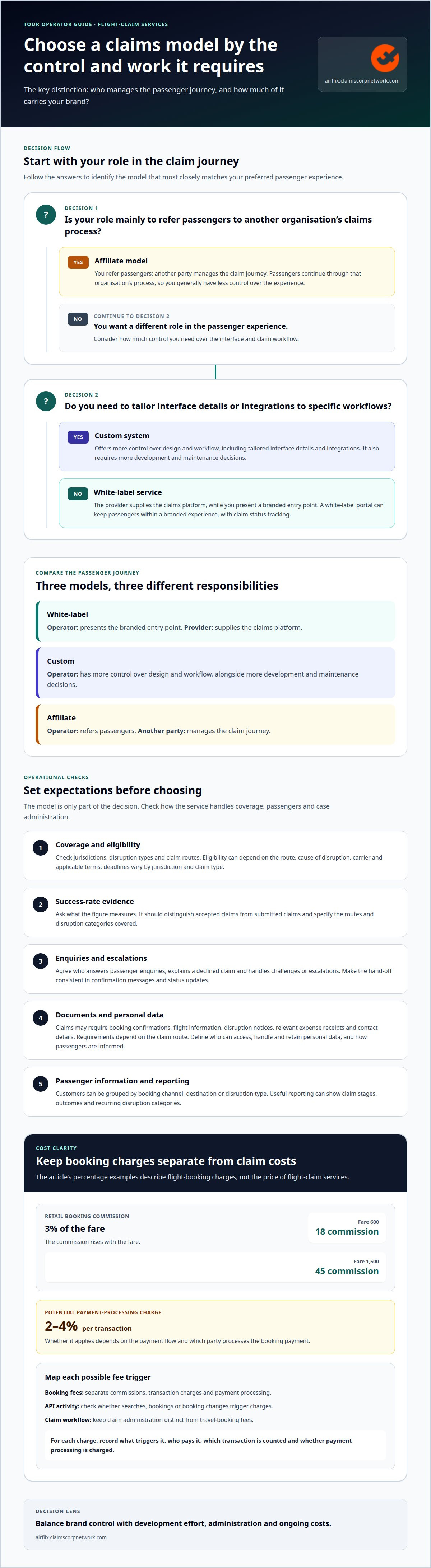
The three models divide responsibility differently. In a white-label arrangement, the provider supplies the claims platform and the operator presents a branded entry point. A custom system gives the operator more control over design and workflow, but also requires more development and maintenance decisions. With an affiliate model, the operator refers passengers and another party manages the claim journey.
Customer segmentation affects how the service is organised. A tour operator might group customers by booking channel, destination or disruption type, then use reporting to see where passengers need support. Useful analytics can show claim stages, outcomes and recurring disruption categories. This helps teams identify patterns without treating every passenger or itinerary as the same.
Customer service and dispute resolution also shape the passenger experience. Establish who answers enquiries, explains a declined claim and handles challenges or escalations. A clear hand-off, for example, tells passengers whether the operator or claims service is responsible for the next response. Keep that division consistent across confirmation messages and status updates.
Claim submissions typically rely on journey details and supporting records. Passengers may need booking confirmations, flight information, disruption notices, receipts for relevant expenses and contact details. Required documents depend on the claim route. Personal data creates privacy and reputational risks if it is collected, transferred or retained without a clear process. Define responsibilities for access, handling and passenger communications before integration.
API pricing models and transaction fees
An API connects software systems, but its pricing depends on what the connection handles. Tour operators should distinguish flight-booking transactions from passenger claim administration before comparing fees. Booking APIs may connect a booking engine with travel inventory and suppliers. Claim workflows instead manage passenger information, case progress and related communications.
In the retail commission model, the retailer pays the white-label provider a commission for customer flight bookings. A percentage-based commission rises with the fare: at 3%, a fare of 600 incurs 18, whilst a fare of 1,500 incurs 45. These examples describe booking charges, not the price of flight-claim services.
Payment processing is another potential booking cost. Payment processing fees for travel agencies using white-label portals may be 2-4% per transaction. Whether this applies depends on the payment flow and which party processes the booking payment. Agents should separate this charge from provider commission, so each booking cost is recorded once.
A useful cost comparison starts by defining the transaction. Does a charge apply when a passenger searches, books, changes a booking or completes payment? A flight reservation API can support searches, bookings and changes through a travel portal. Depending on the agreement, each activity may affect the operator’s total cost differently.
Inventory access also affects the commercial arrangement. In a wholesale model, retailers or aggregators buy travel products in bulk through an API feed. In a retail commission model, the provider receives a commission on customer flight bookings. Assess the operator’s role, volume commitments and payment responsibilities separately.
Before selecting an integration, build a simple cost map. Record what triggers a fee, who pays it, which transaction is counted and whether payment processing carries a charge. Then test a representative booking journey, from inventory search through payment and any booking change. This shows whether a quoted percentage applies to the fare, a transaction or another defined amount.
- Booking fees: identify commissions, transaction charges and payment processing separately.
- API activity: note whether searches, bookings or changes trigger charges.
- Claim workflows: keep claim administration distinct from travel booking fees.
For flight claims, the commercial discussion should focus on the claim workflow, not booking inventory or fares. Separating booking charges from claim administration helps tour operators map responsibilities and passenger interactions.
The page's pricing example uses a fare of 600 and a fare of 1,500; neither figure sets a price for claim administration.
API versus ready-made platform versus direct build
A white-label flight claims service can connect to a tour operator’s booking platform through an API or sit alongside it as a linked passenger journey. The integration can direct passengers from a booking confirmation and transfer relevant journey details where the systems support that exchange.
An API connects systems; it does not create a complete customer experience on its own. A flight reservation API can let customers search flights, book and make changes through a travel portal. For claims, map each hand-off: where passengers start a claim, which booking details are transferred and where they can follow progress. This keeps the claims journey distinct from booking-engine functions.
A ready-made travel platform provides an existing interface and workflow, reducing the need to design every component. Those figures concern travel portals, not flight-claim services. Check which functions are included, how the platform fits existing packages and which processes still require separate integration.
A direct build gives the operator control over the design, data flow and relationship with other travel systems. It also means the operator must define and maintain those components. A direct GDS integration can involve a substantial implementation effort. That timescale applies to GDS integration, rather than every custom platform or claim-service connection, but it shows why technical scope matters.
For a practical comparison, start with the passenger’s task. If passengers need to submit a disruption claim after booking, an existing claims journey can be linked from the operator’s confirmation page. If the aim is to combine booking, travel packages and claims in one environment, define how those activities will interact before choosing an architecture.
Next, assess the operating model. A platform can host the passenger-facing process, while an API connects selected functions to the operator’s system. A direct build can combine both approaches, but involves more design and maintenance work. The right choice depends on how much control the operator needs over the passenger journey and which systems already hold the booking information.
- Map the journey: identify where booking ends and claim submission begins.
- Define data exchange: specify which booking and flight details need to pass between systems.
- Compare operating effort: account for platform functions, integration work and ongoing ownership.
Before launch, test a representative passenger journey. Follow an example from booking confirmation to claim submission and status updates. Record each system involved, every manual hand-off and the team responsible for the next action. This helps determine whether an API connection, ready-made platform or direct build best supports the operator’s travel workflow.
Branding and co-branding options
Branding shapes how passengers recognise the claims journey after booking. A fully white-label presentation can use the tour operator’s name and visual identity, while co-branding identifies both the operator and service partner. An affiliate arrangement may instead direct passengers to a partner-branded page. This affects the transition passengers see, not the basis of their claim.
Map three touchpoints: the booking confirmation, the claim entry point and status communications. For example, a passenger who books a hotel-and-flight package might receive a confirmation from the tour operator, then follow a clearly labelled claim link. Consistent names and design help passengers understand that the claim relates to their travel reservation.
Customisation can cover practical details such as logo placement, colour, introductory wording and links back to the operator’s customer-service information. These elements should build recognition without obscuring who handles the claim. Compare the booking confirmation, claim page and status message to make sure passengers can identify the operator, service partner and next action.
Co-branding suits operators who want to retain a visible role while acknowledging a specialist partner. For example, the opening page could introduce the passenger benefit and identify the partner responsible for handling claims. Make the roles clear so passengers do not assume the tour operator makes claim decisions when another organisation administers the process.
Hotels and other travel partners add another consideration. When coordinating holiday and accommodation packages alongside platforms such as booking.ro, a hotel partner may share a booking journey with the operator, but the flight-claim experience should still identify the relevant reservation and flight. Place the claim link near the flight details rather than presenting it as a general hotel or package-enquiry route. This clarifies the context when a booking includes several travel components.
Loyalty programmes also need careful placement. Claims support can feature in the broader customer relationship, but do not present loyalty points or benefits as part of claim compensation unless the arrangement explicitly provides for them. Keep claim updates separate from loyalty communications so passengers can distinguish a case decision from a marketing message.
- Choose the identity: decide whether the journey is operator-branded, co-branded or partner-branded.
- Set the hand-off: state who receives enquiries and who manages claim updates.
- Review each touchpoint: compare booking confirmation, claim entry and status messages.
- Separate purposes: keep claims information distinct from hotel, package and loyalty messages.
Before launch, walk through a sample reservation from booking to claim status. Check the wording, logos and partner references at every step. A consistent presentation helps passengers understand how the claim fits their travel booking, while clear descriptions of each party’s role help protect trust.
White-label services for tour operators
A white-label flight-claims service gives passengers a claims journey presented under a tour operator’s brand. The provider supports the underlying process, while the operator determines how passengers encounter it. For example, a flight-disruption link can sit beside itinerary details in a booking confirmation rather than appearing as an unrelated service.
To launch, define the passenger journey, agree responsibilities with the service provider, configure branding and integration, then test a complete claim before introducing the service to passengers. A practical test follows an example from the booking record through claim submission and status communications, recording each hand-off.
- Define scope: identify which passengers and flight disruptions the service will address.
- Set responsibilities: assign claim handling, passenger enquiries and status updates.
- Configure the portal: align its branding and wording with the operator’s customer journey.
- Map information flow: specify which booking and flight details support claim submission.
- Test before launch: trace a sample itinerary through submission and subsequent updates.
This process separates the operator’s customer relationship from specialist claim handling. A white-label travel portal should make the next action clear, identify who manages the claim and show passengers where to follow progress. For example, the operator can introduce the service in a post-booking email, while the portal provides the claim-specific route.
For US passengers travelling internationally, a white-label service provides a branded access point and a claim-handling workflow. The applicable route and eligibility depend on the journey, disruption and relevant rules; the white-label presentation does not change those criteria.
International itineraries make clear claim routing especially important. A passenger travelling from the US on an international itinerary may need their claim assessed under the rules applicable to that journey. The intake process should capture itinerary and disruption details, then route the case for assessment. Avoid suggesting that every delay or cancellation will have the same outcome.
Before launch, define how the operator’s existing software interacts with the claims portal. A booking reference can connect a passenger to the right trip, while flight and disruption details support case assessment. Decide what information transfers, what passengers enter themselves and which team responds to missing details. This creates a defined process instead of an unclear hand-off.
Reporting should reflect the operator’s service model. For example, separate claim volumes by booking channel or disruption type, then review where passengers stop progressing. These insights can inform portal wording and customer communications. Align access to passenger information with assigned responsibilities, and distinguish operator communications from claim decisions.
The central decision is how the white-label travel platform fits the operator’s existing service. A linked portal can keep claim support separate from booking, while deeper integration can connect the journey more closely to itinerary records. Choose a model based on required hand-offs, the passenger experience and internal ownership. A clear launch plan makes the service easier to operate and explain.
Airflix: Flight Disruption Legal Assistance
Airflix provides Flight Disruption Legal Assistance for tour operators seeking support with passenger flight claims. Its White-label Passenger Portal gives passengers a branded route into the claims process, while Real-time Claim Status Tracking helps them follow progress. These services suit operators who want to connect claim support with their customer journey without building a claims workflow from scratch.
When a disruption also involves baggage, Airflix’s Baggage Claim Regress service addresses that separate claim need. Airflix also provides legal representation in court proceedings. The next step is to discuss how these services can fit your passenger journey and operating model.
Contact Airflix to discuss your requirements.
Set the next step for your passenger journey
The right white-label flight-claims arrangement for tour operators should fit the booking journey, clarify who manages each passenger interaction and work alongside existing systems. Turn those requirements into a practical operating model: decide where passengers enter the process, how responsibilities are divided and what the branded experience should communicate.
Airflix can discuss how its claims support fits the way your organisation serves passengers. A focused conversation can help you consider the passenger journey and the operational approach that suits your requirements, without committing to a particular platform design in advance.
Contact Airflix to discuss your options and take a considered next step towards a claims journey that works for your passengers and team.
Frequently Asked Questions
What are white-label flight claims services for tour operators?
They let tour operators offer passengers a branded route to manage flight-disruption claims, with handling supported by a specialist service. For example, a passenger whose return flight is disrupted can reach the claims process through the operator’s customer journey rather than starting with an unrelated search. White-label flight claims for tour operators can include a passenger portal and case-status visibility, helping operators explain what passengers should do next.
Which providers offer white-label flight delay and cancellation claims services for tour operators?
Airflix offers Flight Disruption Legal Assistance and a White-label Passenger Portal for this purpose. Tour operators can use these services to connect passengers with disruption-claim support through a branded experience. For instance, an operator handling a package booking can direct a passenger with a disrupted flight to the portal while keeping the claim process distinct from routine itinerary enquiries.
How much do white-label flight claims services cost, including setup fees and commission rates?
Airflix offers monthly, yearly subscription or per-flight arrangements. Pricing depends on the case and is provided after a quote request. Cost factors include the service arrangement, selected functionality and how the solution fits the operator’s workflow. Address setup fees or commission rates in the specific proposal rather than assuming they follow pricing for unrelated travel-booking platforms.


