

Flight problems may be enforceable through a claim when the disruption and journey meet the applicable rules. Under EU261, eligible passengers may receive €250, €400 or €600 per passenger, depending on the route and disruption; a customisable flight claim platform can organise eligibility review, claim submission and progress tracking.
It’s reasonable to want clear fees before handing over a claim, and to understand what happens if an airline refuses to pay. The process depends on passenger-rights rules, the available evidence and whether legal escalation is needed. A service’s fee arrangement should be clear before you proceed, so you can see how it affects any compensation recovered.
This guide explains how eligibility checks work, what flight coverage can include, how claims are submitted and tracked, and when legal representation may form part of the process. It also outlines how claim-service fees are structured, so you can understand the support available and decide on the next step.
Key Takeaways
- Understand how claim-service fee structures affect any compensation recovered, and what to clarify before proceeding.
- Eligibility checks assess the disruption, route, airline responsibility and applicable passenger-rights rules.
- Coverage depends on where a flight departs or arrives and which jurisdiction’s rules apply.
- A well-prepared claim package supports submission and gives the airline clear information to assess.
- Track meaningful claim updates and understand when a refusal may lead to legal escalation.
Commission fees charged by claim services
Commission models deduct an agreed share from compensation recovered. For passengers, the key comparison is the amount they retain after charges, not just the headline award.
Commission fees and passenger payouts
A commission reduces the compensation transferred to the passenger. For example, an eligible EU261 claim worth €600 leaves a net payout after the agreed service charge is deducted. The final amount depends on the fee terms and any other permitted deductions.
Before accepting an agreement, find out how the charge is calculated. Check whether it applies only to compensation or also to other sums recovered. Then establish when the service deducts it and whether taxes or separate costs affect the payment. These details show how much of an award the passenger will retain.
A customizable flight claim platform can make fee terms easier to compare by showing the deduction alongside the claim outcome. What matters is a clear calculation, not simply a quoted percentage. Passengers entitled to compensation should understand the net amount before authorising representation or claim submission.
No-win, no-fee terms
No-win, no-fee describes an arrangement where the service charge depends on a successful recovery. The label alone does not explain every possible cost or exception. The written agreement defines success, when a charge applies and whether additional expenses can arise.
Read the terms in sequence: identify the success condition, the charge trigger and deductions from compensation. Then look for provisions covering a withdrawn claim, an airline settlement or a rejected case. The label alone does not explain how these outcomes are handled.
For a €600 EU261 award, the agreement should make clear how the service calculates its deduction and what the passenger receives. The same check applies if the airline pays directly rather than through the service. Clarity on both payment routes helps the passenger understand the arrangement before proceeding.
Commissions and legal costs
A service commission and legal costs are not necessarily the same charge. The commission is the agreed remuneration for the service; legal costs may relate to formal proceedings. The contract should state whether legal work is included, charged separately or covered by different terms.
If an airline refuses a claim and court action becomes relevant, review how the agreement covers representation and related costs. Check who can authorise escalation, what expenses may be payable and whether a commission still applies after a court recovery. This helps distinguish the service fee from litigation expenses.
Before signing, compare the written terms with the claim stages described. For a contested EU261 claim, note whether the agreement changes once proceedings begin. A clear breakdown lets the passenger assess the potential net compensation, the scope of representation and any charge attached to each stage.
AI eligibility checks and claim-package generation
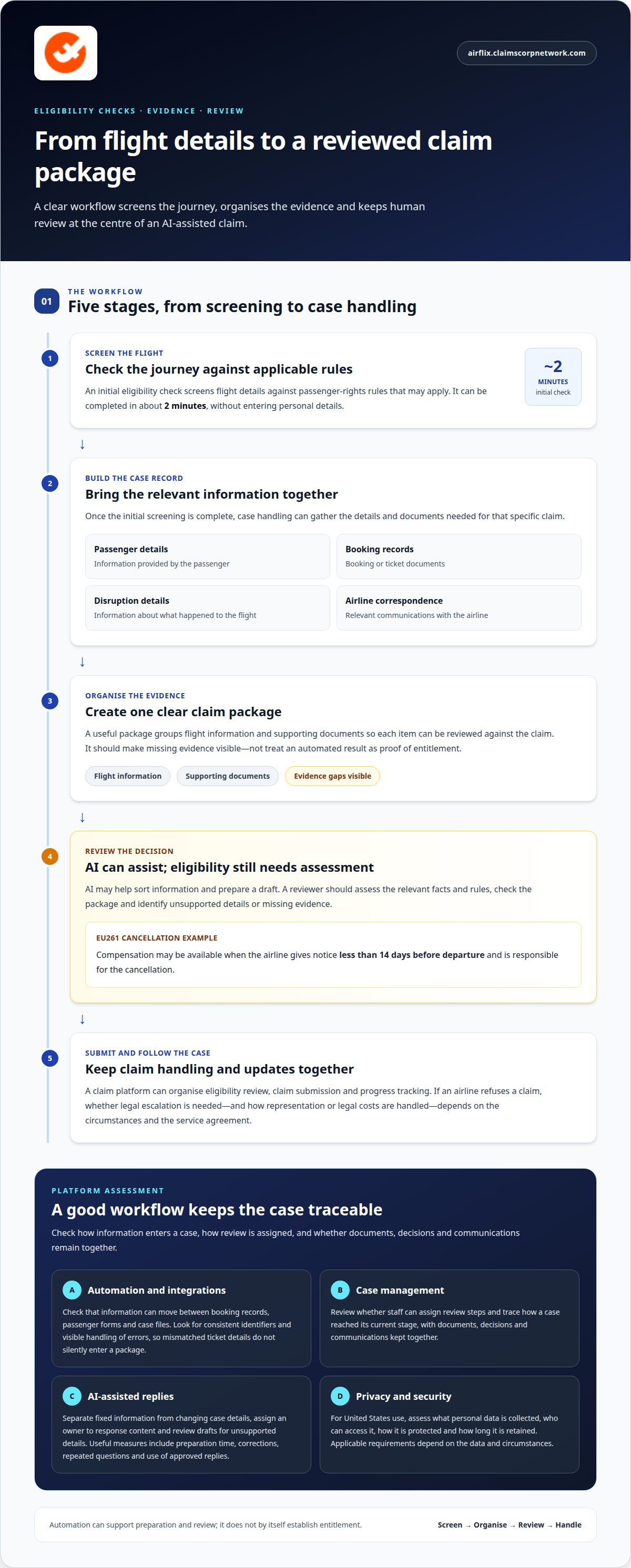
An eligibility check screens flight details against the rules that may apply. Under EU261, cancellation compensation may be available when the airline gives notice less than 14 days before departure and is responsible.
Organisations seeking branded passenger journeys can use white-label passenger platforms. Branding and workflow controls vary between platforms.
Assess automation, integrations and case management by checking how flight data enters a case, how staff review eligibility, and how documents and decisions are recorded. For privacy and security in the United States, assess what personal data the platform collects, who can access it, how it is protected and how long it is retained. Applicable requirements depend on the data and circumstances.
Claim-package generation
A claim package brings relevant flight information and supporting documents into one organised file. Much like structured research and document preparation in academic settings—where specialised guidance from services such as Pisanie Prac Zaliczeniowych i Dyplomowych helps ensure thoroughness—a useful workflow separates passenger-provided details, booking or ticket records, disruption information and airline correspondence, so each item can be reviewed against the claim.
AI can assist with sorting information and preparing a draft, but the decision still requires review. For example, a cancellation claim needs its notice date and the airline’s responsibility assessed under EU261. The package should make evidence gaps visible, rather than treating an automated result as proof of entitlement.
A passenger can complete an initial eligibility check in about 2 minutes without entering personal details. After that screening, claim handling can gather the information and documents needed for the specific case.
Automation, integrations and case management
Assess a customizable flight claim platform by the work it automates and the records it preserves. Check whether it can bring flight and passenger information into a case, assign review steps, and keep documents, decisions and communications together.
Integration quality matters when information moves between booking records, passenger forms and case files. Look for consistent identifiers and visible error handling, so mismatched ticket details do not silently enter a claim package. Reviewers should be able to trace how a case reached its current stage.
For AI-assisted replies, distinguish fixed information from changing case details and assign an owner to the response content. Useful measures include draft preparation time, agent corrections, unsupported details caught during review, repeated passenger questions and use of approved replies. These checks show whether automation helps staff handle cases accurately, not merely produce more drafts.
When assessing a white-label passenger portal, consider how its branding and workflow fit the passenger journey, case management and document handling. Automation should support clear review, while eligibility remains tied to the flight circumstances and applicable passenger rights.
Coverage across countries, airlines, and non-EU flights
Airlines, travel agencies and law firms can configure a platform’s intake forms, case stages, review rules and passenger communications. Because automation can misclassify routes or disruption causes, human review remains important before a claim advances.
Air passenger rights depend on the route, operating airline and jurisdiction. A flight departing the EU may fall under EU261 regardless of airline; an arrival into the EU from outside it is covered when operated by an EU airline, subject to conditions and exceptions.
UK261 covers departures from the UK on any airline, UK arrivals on UK or EU airlines, and EU arrivals on UK airlines. Canada’s APPR covers flights to, from and within Canada, including flights operated by foreign airlines. Turkey’s SHY rules, Brazil’s ANAC 400 and Canada’s APPR have different conditions and compensation amounts.
For a route crossing jurisdictions, record the departure airport, destination, operating airline and disruption. Then match those details to the applicable rules. A non-EU flight is not automatically outside passenger protections: an EU-operated flight arriving in the EU may still be covered by EU261.
Airline responsibility also matters. Under EU261, technical faults are not extraordinary circumstances according to CJEU ruling C-549/07. Eligibility still depends on the disruption and applicable conditions; a platform’s automated result should not replace assessment of the full case.
Airports and airlines play different roles in a claim. The airport may be relevant to where a disruption occurred, while compensation claims generally assess the operating airline’s obligations under the rules covering the flight. Keep the ticket, booking confirmation and airline messages together to establish the journey and communication history.
Passengers can submit a claim directly to the airline or use an app to organise submission and follow-up. Direct contact keeps the exchange with the airline in the passenger’s hands; an app can bring documents, correspondence and progress updates together. The chosen route does not change which jurisdiction’s rules apply.
If an airline rejects a claim, assess its response against the route, disruption facts and reason given. A demand letter can set out the passenger’s position and supporting evidence; keep the airline’s reply in the case record. If the explanation cites extraordinary circumstances, compare it with the evidence and relevant rules before deciding what to do next.
Automated services can miss unusual itineraries, code-share details or incomplete disruption records. A sound workflow flags uncertain cases for review, records why a claim appears eligible and preserves the airline’s response. This creates a clearer basis for assessing whether flight compensation remains available and how to proceed.
Claim submission and legal escalation process
Submitting a claim starts with matching the flight record to the disruption and applicable regulation. The process then moves through airline review and responses, followed, where needed, by legal escalation.
Submitting and processing claims
A platform needs enough information to identify the passenger, booking and affected flight. It can then organise the claim, attach supporting documents and submit it to the airline. The case record should capture the airline’s response and any further evidence requested.
If the airline rejects the claim, its stated reason and the surrounding circumstances inform the next step. The case can be assessed for legal escalation, including court representation if proceedings follow. Keep the rejection and supporting explanation in the claim record.
Claim processing time
Timing depends on the airline’s response and whether the case proceeds to court. Out-of-court claims can sometimes be paid in less than 3 months. Claims requiring legal action typically take 6 to 12 months, while court cases can take 3 to 6 months.
Flight compensation apps typically claim that payment takes eight to 12 weeks. Treat that estimate as a general processing expectation, not a fixed timetable for every case. The passenger’s claim route, airline response and escalation requirements all affect progress.
Deadlines also vary by country: the time limit to assert a flight claim ranges from 2 to 10 years. Identify the applicable country and claim type early, since a processing estimate does not extend a filing deadline.
Passenger and flight data
To process a claim, the platform needs passenger details and information identifying the journey. This usually includes the passenger’s name and contact details, booking reference, ticket, flight number, travel date, route and operating airline.
Disruption details matter too. Include what happened, such as a cancellation, delay or denied boarding, alongside airline notices and relevant correspondence. These records connect the passenger’s account with the flight and the airline’s stated circumstances.
Payment information serves a different purpose from eligibility evidence. It is used when compensation is ready for transfer, rather than to establish the booking. Keeping these functions separate helps limit unnecessary data collection during initial claim handling.
After submission, the case follows a practical sequence: the claim is checked against the booking, sent to the airline and updated when a response arrives. If the airline contests liability, its reason is reviewed against the flight circumstances and applicable regulation.
If court proceedings become necessary, legal representation can form part of the escalation. The passenger should understand the case stage, the response received and whether further action is under way. A clear case record supports these decisions and keeps the airline’s communications connected to the original submission.
Before submitting, make sure the passenger name, ticket and flight details match across the records. For example, a booking reference linked to the wrong travel date can complicate identification and delay review. Keep airline messages with the original itinerary so the claim record reflects both the journey and its disruption.
Flight-Delayed claim tracking and airline communication
A useful claim record connects the disruption, airline correspondence and next action. Under EU261, an arrival delay of 3 or more hours may qualify for compensation when the airline is responsible.
For EU261, arrival delay matters, not departure delay, according to CJEU ruling C-402/07. A flight that leaves late but makes up time before landing may need a different assessment from one arriving late. Record scheduled and actual arrival times, then match them against the airline’s explanation and the route’s applicable rules.
A cancellation claim record can include details about the cancellation and any airline notice. Under EU passenger law, cancellation compensation may apply when notice is given less than 14 days before departure and the airline is responsible. Keep the notice with the booking and any alternative-flight information, since timing and circumstances can affect assessment.
Denied boarding follows a separate route. Under US DOT rules, compensation can be up to $1,550. The case record should distinguish denied boarding from a voluntary change or flight delay, and capture the airline’s explanation and any offer made at the airport.
Each status update should state the confirmed claim stage, the latest meaningful development and any action the passenger needs to take. It should also say when the next communication is due. This gives passengers practical information instead of a generic message that the claim is still being handled.
Airline communication should be logged in the case history, including dates, replies and supporting documents. If the airline cites extraordinary circumstances, record its stated reason and assess it against the disruption evidence. Technical faults are not extraordinary circumstances under EU261, according to CJEU ruling C-549/07.
Tracking also helps distinguish an airline response from a resolution. For example, a request for a ticket or passenger document is an action item, while payment confirmation marks a later stage. Accepting an airline voucher does not waive the passenger’s right to cash compensation.
Clear language matters at every stage. Do not treat an acknowledgement as approval or a request for documents as rejection. A well-maintained status record shows passengers what has changed, what remains outstanding and whether an airline response needs further review.
Keep claim updates connected to the case record so passengers can follow the status, understand any action required and see when the next communication is due. This structure also helps staff distinguish confirmed developments from information still awaiting an airline response.
Airflix
Airflix supports passengers pursuing flight disruption claims and organisations managing claim workflows. Its Flight Disruption Legal Assistance covers disruption claims, with legal representation in court procedures. The Baggage Claim Regress service addresses baggage claims, while the White-label Passenger Portal and Real-time Claim Status Tracking support passenger access and visibility into claim progress.
Turn to Airflix when airline correspondence, claim administration or a contested case calls for structured support. The appropriate service depends on the issue: a disruption claim, a baggage claim, or a need to manage passenger access and status updates. This provides passengers and organisations with a clear path from identifying their need to choosing relevant assistance.
Contact Airflix to discuss support for your flight claim requirements.
Move your claim towards a clear next step
The next decision is how much of the claim process you want handled for you. An individual passenger may need support with a disrupted flight or baggage claim, while an organisation may need a branded way to manage passenger claims. Match that need to the type of assistance and workflow required, then consider how a customizable flight claim platform could fit your process.
Airflix provides Flight Disruption Legal Assistance, a Baggage Claim Regress service and a White-label Passenger Portal. These options serve different needs, from pursuing a disruption claim to managing passenger-facing claim administration. Start by identifying the issue you need to resolve and the level of support involved.
If you’re ready to discuss the next step, contact Airflix about your flight claim. A clear starting point can make it easier to move your case or passenger workflow forward.
Frequently Asked Questions
How do I enforce my rights in case of a flight problem?
Start by identifying the disruption and the passenger-rights rules that cover your journey. Keep your booking confirmation, airline notifications and any revised itinerary. Submit a claim explaining what happened and the remedy you seek. If the airline rejects it, retain the response and its stated reason with your records. Legal assistance can help assess whether further action, including court representation, is appropriate.
How long do passengers have to assert a claim?
There is no single deadline for every EU261 claim; the applicable national law and claim type determine the limit. In most EU countries, passengers have one to three years, whilst the UK period is six years. France and Spain allow five years. These examples are not interchangeable: establish which country’s rules govern the claim before relying on a deadline.
Is there a time limit to make my claim?
Yes. A claim must be brought within the limitation period that applies to its jurisdiction and legal basis. This filing deadline is separate from the time an airline or court takes to resolve a case. For example, a lengthy exchange with the airline does not by itself mean the deadline has been extended. Keep the flight date and disruption records together, and identify the relevant country’s limit promptly.
What is a customizable flight claim platform?
A customizable flight claim platform is a system organisations can adapt to manage passenger claims through configured workflows. Depending on its setup, it can organise claim intake, eligibility review, supporting records, case stages and passenger updates. A travel agency might use a branded portal for customer claims, while a legal team may need review and escalation steps. The platform manages administration; passenger entitlement still depends on applicable rules and case facts.
What are the pricing and commission fees for flight claim platforms?
Fees depend on the service scope, claim complexity and whether legal escalation is involved; the price is provided after a quote request. Commission-based arrangements deduct an agreed charge from recovered compensation, so the agreement should explain how it is calculated and whether there are other deductions. Compare the net amount payable, when the charge applies and how rejected or withdrawn claims are treated. Read the terms before authorising claim handling.


