

Building passenger rights technology in-house isn’t the only way to offer a branded service. Businesses use white label passenger rights software to focus on branding, sales and customer relationships while a provider manages the underlying platform, its development and support. This can suit a business whose strength lies in customer experience rather than building software.
An established platform can reduce the need for in-house development, but the arrangement also affects how responsibilities are divided and how much control each business has over the product. Pricing may be structured as a subscription or charged per flight, so the model determines how costs relate to usage.
This article explains what white-label software means in passenger rights, how partner responsibilities and pricing work, and how white-label differs from private-label. It also covers the trade-offs to help businesses assess whether a branded platform or a more extensively customised product better fits their operations.
Key Takeaways
- Assess whether your advantage comes from the customer experience or from owning and developing the underlying technology.
- Clarify how branding, customer relationships, development and technical support are divided between partners.
- Compare subscription and per-flight pricing against your expected usage and operating model.
- Choose between white-label and private-label software by weighing the level of customisation you need against the development investment.
- Review how licensing, customisation, support and customer-data access are handled in the partnership agreement.
Why Use White Label Software?
White-label software lets a business offer an existing platform under its own branding, without building the underlying technology. In passenger rights, it can support a customer-facing service while the business focuses on marketing and operations.
For US flights, passenger rights software can organise claim intake around relevant disruption details and applicable US Department of Transportation rules. The software can help organize claims, while eligibility may depend on the details of each case.
Marketing Features and Integrations
Marketing features help businesses present a consistent brand and communicate with customers through digital channels. White-label email tools can include customisable templates, automation and campaign analytics, helping teams organise messages and review engagement. A branded client portal can bring updates, analytics and file downloads into one dashboard. Clear communication matters throughout the customer experience, not just during the initial campaign.
White-label software also serves markets beyond passenger rights. Social media platforms, for example, can support scheduled posts, engagement monitoring and campaign analysis, while website builders and CRM tools help businesses personalise websites and manage customer relationships. Integration needs depend on the operation: an agency may prioritise campaign tools, while a passenger rights business may need a branded portal and claim-related communication. Choose a setup that supports the customer journey you intend to deliver.
In the United States, passenger-rights technology providers offer white-label platforms that partners can use under their own branding. The partner manages its brand and customer relationships, while the provider supplies the underlying platform. The right fit depends on whether the business needs a branded customer interface, technical support, or both.
Time to Market and Cost Efficiency
White-label software can shorten the route to market by letting a business launch with existing technology rather than develop a platform from scratch. It can also reduce the need for upfront development and in-house support. This can help a business test a passenger rights service without making software development its core operation.
The trade-off is control. A provider retains rights to its source code and may offer the same core solution to other businesses. Assess whether your differentiation comes from branding, marketing and customer experience, or from technical capabilities that require custom development.
Claims workflows also shape a platform’s practical value. Software can organise eligibility assessments, supporting documents and payout status. For example, a case record can connect a disruption description with submitted documents and the recorded outcome. Criteria and payment arrangements depend on the claim and the parties’ operating model, so treat the software as workflow support, not as the decision-maker.
White-label software development arrangements
A white-label arrangement divides responsibilities between the business selling the service and the team maintaining the platform. This affects branding, software development, technical support, ownership and the commercial relationship with end customers.
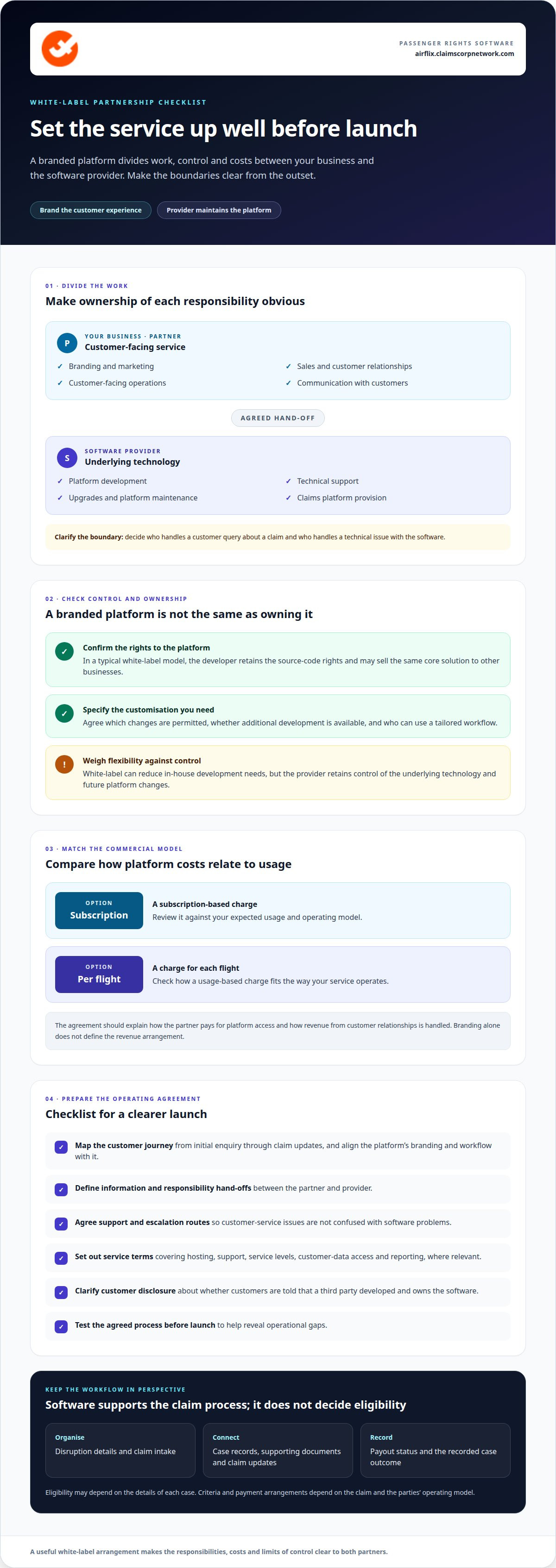
The partner generally manages branding, sales and customer relationships, while the software provider handles development, technical support and upgrades. For a passenger rights business, the partner can run the customer-facing service while the provider maintains the claims platform. Define this division before launch, particularly when customers need help with both the service and the software.
To integrate and launch a platform, map the customer journey from initial enquiry to claim updates. Then define which data and responsibilities pass between the partner and provider, and align the platform’s branding and workflow with that journey. Testing the agreed process can reveal operational gaps before customers use it.
Ownership is a key distinction. In a typical white-label model, the developer retains rights to the source code and can sell the same core solution to multiple businesses. The partner can use its own brand, but does not thereby own the platform or control its future development. A business seeking exclusive ownership or extensive technical control may need a different development arrangement.
Revenue depends on the commercial terms between the parties, not branding alone. The agreement should explain how the partner pays for access and earns from its customer relationships. It should also address customisations, additional development and any exclusivity. For example, a partner requesting a tailored claims workflow needs clarity on whether the change applies to the platform, who can use it and how it affects the commercial arrangement.
White-label software can reduce development risk because the partner launches with existing technology instead of building and maintaining a core system in-house. It can also reduce the need for in-house technical support. The trade-off is reliance on the provider for upgrades, support and platform changes. Define escalation routes and responsibilities so a customer query about a claim is not confused with a technical issue.
Agreements make those boundaries practical. They may state whether end customers are told that a third party developed and owns the software. For a SaaS platform, terms can also cover hosting, support, service levels, customer-data access and reporting. These details matter: the partner needs to understand how customer information is accessed and what happens when a platform issue affects claim operations.
Agreements can also specify permitted customisations and whether additional software development is available. Some cooperation agreements include exclusivity for a defined period. These terms shape how distinct the partner’s offer can be, how much influence it has over the platform and whether the provider can offer the same core solution elsewhere.
Partner team structure and pricing
A workable partnership assigns each operational task to a clear role, from campaign planning to technical escalation. The partner usually leads branding, sales and customer relationships, while the software provider manages the platform’s technical operation. This lets the partner manage its brand and commercial activity without building the software itself.
Within the partner business, a commercial lead can coordinate campaigns and customer communications. An operations lead can manage the hand-off between customer enquiries and claim processing, while a designated technical contact routes platform issues to the provider. These responsibilities can sit within existing roles rather than require separate hires. Define who owns each task so customers receive consistent responses.
For example, a customer asking about a claim should reach the partner’s service team, while a report that the portal will not load belongs in the technical support route. A simple responsibility map can record the issue, its owner and the next action. It also helps distinguish a question about claim progress from a problem accessing the platform or its data.
Pricing models change how partnership costs relate to activity. A monthly subscription creates a recurring charge, a yearly subscription sets the billing period across the year, and a per-flight model links charges to flight activity. These are payment structures, not measures of claim success. Compare each model with your expected workflow, volume and internal capacity.
Pricing depends on the case and is provided after a quote request. Relevant cost factors include the subscription model, flight volume, customisation and support scope. For instance, a partner planning campaigns around seasonal demand can consider how a recurring subscription fits quieter periods, while a per-flight structure ties the charge more directly to flight activity.
Before launch, align billing definitions with operational reporting. Specify what counts as a billable flight, how activity is reported and which team resolves discrepancies. If a report and an invoice differ, a clear source record helps trace the issue. Written terms should also distinguish standard platform support from separately agreed development work.
Staffing should follow the customer journey, not an assumed team size. A business with a small operations team might combine campaign coordination and customer communication, while assigning a distinct owner for technical escalation. Larger operations may distribute those duties across teams. Either way, documented ownership supports continuity when responsibilities change.
Review pricing alongside service responsibilities, reporting access and data handling. Even a simple billing model can create confusion if flight activity, customer support and technical incidents have no clear owners. Matching commercial terms to the workflow gives the partner a more reliable basis for planning campaigns and managing customer relationships.
White-label and private-label software comparison
Both models let a business offer software under its own identity, but they differ in development and control. For passenger rights platforms, that distinction affects launch investment, product customisation and ownership expectations.
White-label and Private-label Differences
White-label software is an existing platform that a business rebrands, while private-label software involves more extensive custom development. White-label usually means lower upfront investment and customisation focused mainly on branding; private-label generally requires greater investment but offers more scope to shape the product. The distinction matters when deciding whether a branded customer experience is enough or specific technical requirements warrant bespoke development.
For example, a white-label platform may let a partner offer claim services using its own logo, colours and customer communications, while the provider retains the source code. Customers see the partner’s identity, but the platform may also serve other businesses. A private-label project can give the partner more influence over functions and design, with added development work and investment.
Neither label alone describes every contractual right. A business should distinguish permission to brand and use software from ownership of its code, data or customisations. If the arrangement includes a transfer of US copyright ownership, 17 U.S.C. § 204(a) requires a written instrument of conveyance or memorandum signed by the owner of the rights conveyed. The contract should therefore identify exactly which rights, if any, are transferred.
Legal, Privacy and Consumer-protection Risks
These risks concern software ownership, customer-data handling and what customers understand about the service. They matter because a branded interface can obscure the provider’s role unless the agreement and customer journey clearly assign responsibilities.
For US operations, review the contract terms for ownership, customer-data access, hosting, support and reporting. SaaS agreements can address these areas. The partner should also define who handles customer requests involving personal information or claim records. Clear access rules reduce uncertainty between the partner and platform provider.
Customer-facing risks can arise if someone mistakes the software provider for the service operator or treats an automated status as a decision on claim eligibility. For example, a portal update should distinguish a recorded case stage from a final claim outcome. Clear wording about the partner’s role, claim process and status information helps set accurate expectations.
Compare the models against your operational needs. If you mainly need a consistent brand and a ready-made workflow, white-label software may fit. If your business needs substantial changes to platform functions or design, private-label development may be more suitable. The decision depends on how much control the customer experience requires and whether that control justifies custom software development.
White-label software definition
White-label passenger rights software is pre-built software that another business can rebrand, customise and resell. The provider supplies the underlying product, and the business presents it to customers under its own identity. For example, a travel business can offer a passenger-facing service without creating the core platform. The defining feature is the separation between the software’s source and the brand customers see.
A licence sets out how the business may use the software. It can allow the licensee to apply its own brand or trademark and present the product as its own. This resembles licensing an off-the-shelf product, but branding permission changes the customer-facing presentation. The licence does not itself transfer ownership of the software or source code.
Most white-label solutions are delivered as software as a service, or SaaS. The software is accessed online, while the partner applies branding such as its logo, colour scheme and domain. Those elements shape the customer’s first impression and help maintain a consistent identity across the business’s website and platform.
Branding is different from custom development. A partner may change the presentation without changing how the core software works. For instance, adding a company logo to a customer interface is a branding change; altering the underlying workflow is a product modification. Permissions, costs and responsibilities can differ between rebranding and additional development.
The provider’s role continues after the partner adopts the product. The provider may maintain the core platform and supply updates, while the partner manages its marketing and customer relationships. Understand how updates are managed and communicated, because software changes can affect customer-facing processes and ongoing engagement.
White-label agreements can explain whether end customers are told that a third party developed and owns the software. This affects how the business describes its service and responds to customer questions. For example, the partner can present a branded product while the agreement recognises the provider’s ownership of the platform. Clear terms keep those roles distinct.
In passenger rights operations, the definition helps distinguish the branded service, the licence to use the software and ownership of the underlying technology. When assessing a platform, identify which parts the business controls, which remain with the provider and what customisation the agreement permits. This makes the term useful beyond branding, especially when planning future changes or customer communications.
Airflix: Flight Disruption Legal Assistance
Airflix provides Flight Disruption Legal Assistance for businesses handling passenger claims after disrupted flights. Its White-label Passenger Portal supports a branded passenger-facing service, while Real-time Claim Status Tracking lets passengers follow case progress. These services can suit businesses seeking to combine a branded digital journey with legal assistance for flight disruption claims.
When a claim proceeds to court, Airflix also provides legal representation in court procedures. For baggage-related cases, its Baggage Claim Regress service addresses a separate passenger need. These services support different stages and types of passenger claims, while the distinction between white-label and private-label software remains the same.
To discuss how Airflix’s passenger rights services could fit your business, contact Airflix.
Shape the next stage of your passenger service
The next step is to connect your software decision with the service passengers will experience. Before moving forward, define the customer journey, the role your team will own, and how the branded platform should support that work. This gives discussions about white label passenger rights software a practical focus, centred on operational fit rather than branding alone.
Airflix offers a White-label Passenger Portal alongside Flight Disruption Legal Assistance and a Baggage Claim Regress service. These services can support businesses developing a branded passenger experience or adding assistance for disruption and baggage claims. The right starting point depends on the needs your business aims to address and how the services fit its operating model.
To discuss your project and how Airflix’s offerings may align with it, contact Airflix about your project. A clear operational plan is a useful foundation for moving ahead with confidence.
Frequently Asked Questions
What is a branded passenger rights platform and how does it work?
White label passenger rights software lets a business offer a passenger-facing digital service under its own brand using an existing platform. For example, a travel agency could direct a customer to a branded portal to follow a flight disruption claim. The software supports the service workflow, while the business maintains its customer relationship. The agreement defines how branding, platform access, case information and technical responsibilities are managed.
What features should passenger rights software include for airlines, travel agencies, and claims companies?
Useful capabilities depend on the organisation’s role in the passenger journey. A travel agency may value a branded portal for directing clients to claim support; a claims business may prioritise case-status visibility and a clear process for handling supporting documents. An airline assessing software for its own operations has a different use case. Define the users, the information they need and team hand-offs before deciding which functions matter.
What are the pricing models and typical costs for white-label passenger rights software?
Pricing models include monthly or yearly subscriptions and payment per flight. These structures link charges to different measures: the billing period for a subscription, or flight activity for a per-flight arrangement. No single typical cost applies across partnerships. Pricing depends on the case and is provided after a quote request; relevant factors include the pricing model, flight activity and agreed service scope for white label passenger rights software.
How do leading passenger rights software providers compare on features, integrations, and support?
Compare providers by the customer journey their platforms support, how they communicate case progress and which party handles technical support. For example, a portal with status tracking helps passengers follow their case, while the support arrangement determines where operational or access issues are directed. Assess integrations against the systems and data flows your business actually uses. These criteria support a practical comparison without assuming every platform works alike.
What branding, customisation, and API options do providers offer?
Branding can include a business’s logo, colour scheme and domain, subject to the licence and platform setup. Customisation may go beyond appearance when additional development is agreed. API access is a separate technical requirement, not an automatic feature of white-label branding. If you plan to connect the platform to case-management or customer systems, define the required data exchange and workflow, then ensure the partnership terms cover that integration.


