

A cascading delay is easier to manage when the next decision is clear before the disruption affects more bookings. A white label flight disruption portal can help travel agencies bring rebooking, compensation, accommodation, refunds and alternative travel options into a clearer process for passengers.
When schedules change quickly, scattered enquiries and unclear next steps make it harder to give travellers useful guidance. The options depend on the disruption, the journey and applicable passenger rights, so agencies need a way to present relevant choices without treating every case alike.
This article explains how a portal can support disruption decisions, what agencies should consider when delays cascade, and how passenger options differ for rebooking, compensation, accommodation and refunds. It also explains how legal assistance and claim-status tracking can support the wider response.
Key Takeaways
- Separate the disruption’s cause from its effects: the cause and journey can shape whether rebooking, compensation or accommodation may apply.
- Present passengers with clear choices, including rebooking and accommodation, while distinguishing these from refund options.
- For a U.S. flight scheduled to depart within 7 days, airlines must provide a status update within 30 minutes of becoming aware of a flight-status change, according to the U.S. Department of Transportation.
- Assess how booking and disruption information moves between systems before deciding how a passenger portal should fit into an agency’s workflow.
- For passenger claims and updates, Airflix offers Flight Disruption Legal Assistance, a White-label Passenger Portal and Real-time Claim Status Tracking.
Compensation and accommodation
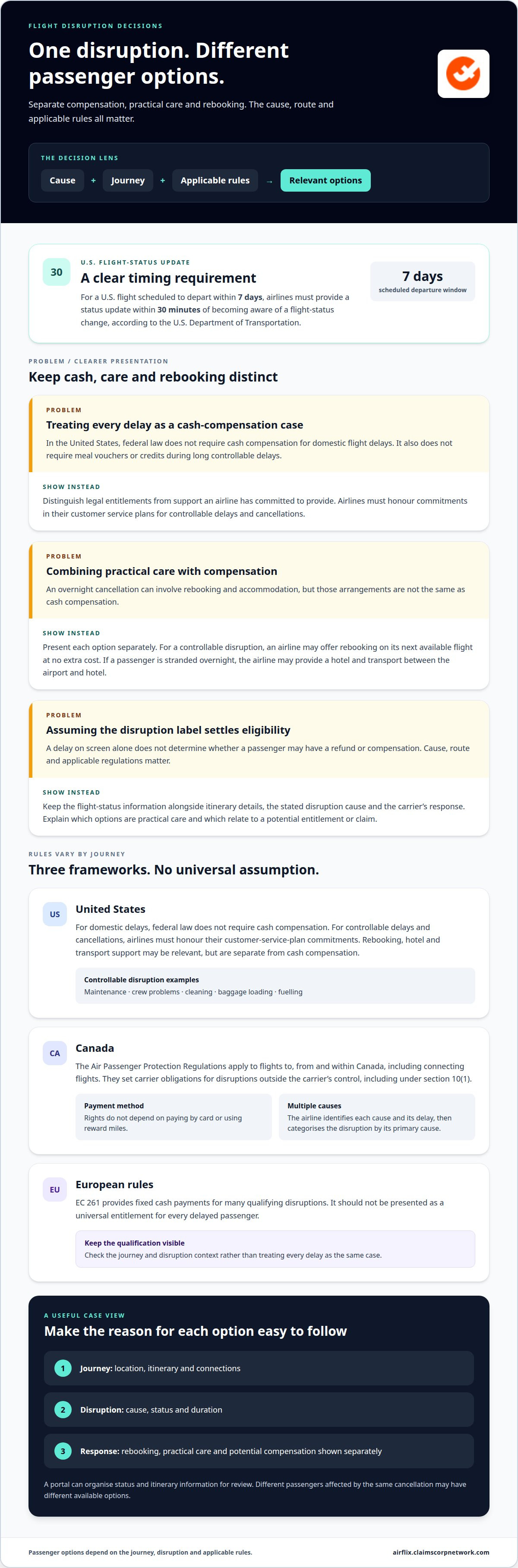
For a passenger, compensation and accommodation depend on the disruption’s cause, route and applicable regulations. A portal can compare flight-status information with itinerary details, then organise the relevant options for review. Eligibility for refunds or compensation depends on the rules covering that journey and the disruption, not simply on a delay appearing on screen. For flights scheduled to depart within 7 days, U.S. airlines must provide status updates no later than 30 minutes after becoming aware of a flight-status change, according to the U.S. Department of Transportation.
In the United States, federal law doesn’t require airlines to pay cash compensation for domestic flight delays. It also doesn’t require meal vouchers or credits during long controllable delays. However, airlines must honour commitments in their customer service plans for controllable delays and cancellations. Agencies can distinguish legal entitlements from support an airline has committed to provide. For example, a passenger facing an overnight cancellation can see the airline’s stated hotel and rebooking commitments alongside any applicable rights.
The cause matters. A controllable disruption is generally one caused by the airline, such as maintenance or crew problems, cleaning, baggage loading or fuelling. If an airline cancels a flight for a controllable reason, it may offer rebooking on its next available flight at no extra cost. Accommodation may also be relevant if a passenger is stranded overnight. An airline may provide a hotel and transport between the airport and hotel during a controllable disruption. These arrangements are distinct from cash compensation, so a portal should present them as separate options.
Canadian passengers face a different framework. The Air Passenger Protection Regulations apply to flights to, from and within Canada, including connecting flights. The regulations set carrier obligations for disruptions outside the carrier’s control, including under section 10(1). Rights under these regulations don’t depend on whether the passenger paid by card or used reward miles. When several causes affect a journey, Canadian airlines identify each cause and its delay, then categorise the disruption by its primary cause.
European rules differ again: EC 261 provides fixed cash payments for many qualifying disruptions. That framework shouldn’t be presented as a universal entitlement for every delayed passenger. A useful portal separates the journey’s location, cause, duration and carrier response, then explains which options relate to compensation and which concern practical care. This helps an agency avoid treating a meal, hotel, rebooking option or potential claim as interchangeable outcomes. Clear status records also help staff explain why two passengers affected by the same cancellation may have different available options.
Rebooking and disruption response
Rebooking decisions start with the carrier’s latest status, the affected itinerary and the reason for disruption. For certain disruptions outside an airline’s control, the carrier must provide a confirmed reservation on an eligible flight departing within 48 hours of the original ticket’s departure time. A portal can make that deadline visible beside the passenger’s current booking, helping staff distinguish an available alternative from an unresolved delay.
When delays cascade, one late inbound aircraft can affect several later departures. Agencies can group affected passengers by flight and connection, then compare each itinerary’s revised arrival with the original journey. A domestic passenger with a tight connection may need a different option from someone whose onward flight is still operating. Keeping bookings distinct helps prevent an update for one passenger from being mistaken for a decision about another.
The next step is to classify the disruption and record its stated cause. Examples include weather, crew issues or baggage loading, but the category alone doesn’t determine which alternatives apply. For Canadian journeys affected by multiple causes, the airline identifies each cause and its delay, then categorises the disruption by its primary cause. Recording the reason alongside the case status helps staff explain why options may differ across a connected itinerary.
Start the portal launch and branding process with the agency’s response workflow. Define the booking details staff need, the content of passenger-facing status messages and how rebooking choices will appear. Apply the agency’s name and visual identity consistently, then test scenarios such as a missed connection, a changed departure time and an itinerary with several operating carriers. Staff should also know who updates each case when the airline provides new information.
For data security and privacy, key risks include exposing passenger details or booking references to unauthorised users and displaying inaccurate case information. Payment handling creates a separate risk if sensitive payment data is collected or processed. Limit access to necessary information, set clear handling procedures and use an appropriate payment process instead of placing card details in general case notes.
Before presenting a replacement itinerary, compare its departure, connection points and final arrival with the passenger’s original plan. A flight that appears available may not preserve every connection, so show the complete route rather than only the first segment. If no suitable option is visible, mark the case for follow-up instead of presenting an incomplete route as confirmed. This makes it clear whether an alternative is proposed or the reservation is confirmed.
Useful case records connect the disruption reason, the passenger’s affected segments and the action taken. For example, if baggage loading delays one flight and a connection is missed, staff can record which segment changed and whether they offered a revised itinerary. Consistent records also help colleagues continue managing the case if further delays change the passenger’s route or expected arrival time.
Refunds and alternate travel arrangements
A refund and a replacement journey are different outcomes. When an airline cancels a passenger’s flight or makes a significant change, U.S. rules require a prompt refund if the ticketed passenger declines the alternative offered. This applies regardless of the reason for the cancellation or change. A passenger who accepts a replacement flight chooses to travel instead of taking that refund route, so the portal should make the choice clear before recording a response.
The U.S. Department of Transportation defines a long delay for refund purposes as three hours for a domestic flight and six hours for an international flight. Passengers are entitled to a full refund for a cancelled flight or a delay that reaches the relevant threshold. Passengers should check the applicable refund terms before accepting rebooking or other compensation. These are refund rules, not a general promise of cash compensation for every delay.
For an agency, this distinction matters at the airport. A passenger whose scheduled departure changes because of weather or air traffic disruption may prefer to continue travelling, even if the revised itinerary arrives later. Another passenger may decline the alternative and seek a refund instead. The portal should show the offered route, its departure and arrival details, and the passenger’s recorded decision. That record helps staff explain whether the case concerns a replacement journey or a refund request.
Canada uses a separate framework. Under section 18(1) of the Air Passenger Protection Regulations, eligible passengers affected by specified disruptions outside the carrier’s control must receive alternate travel arrangements or a refund. A Canadian refund required under those regulations must be provided within 30 days after the carrier becomes obligated to provide it. Eligibility and the applicable obligation depend on the disruption and the passenger’s circumstances; the United States’ refund thresholds should not be applied to a Canadian itinerary.
Presenting choices in distinct stages can prevent passengers from mistaking a proposed route for a completed refund. First, display the carrier’s current alternative and the affected flight segments. Next, explain whether the passenger is considering travel or declining the alternative. Then record the choice and relevant status, including any revised boarding details. A clear record matters if later updates change the route again.
For each case, retain the original itinerary, the airline’s cancellation or change notice, the alternative offered and the passenger’s response. If a connection through multiple airports changes, display the complete revised route rather than only one segment. Passengers may mistake a refund for compensation, but they are distinct outcomes. A portal should label each separately and avoid implying that accepting a replacement flight also means accepting a refund.
Which companies offer white-label flight disruption portals for travel agencies and airlines?
Providers generally fall into three groups: specialist flight-disruption services, travel-technology companies and passenger-claims businesses. Their portals can meet different needs. One may focus on presenting disruption information under an agency’s brand, while another may centre on claims or passenger support. Start by identifying the operational problem: helping travellers understand their options, managing case information or supporting claim handling.
For a travel agency, the right fit depends on how it handles disruption cases today. Consider a booking with a cancelled outbound flight and a separate return itinerary. Staff may need to see the affected journey, communicate changes under the agency’s identity and keep the passenger’s case separate from other bookings. A portal designed around passenger-facing information may suit this workflow better than a system built primarily for airline operations.
Airlines operate in a different context. Their teams may need to coordinate information across flights, airport processes and passenger communications. An airline assessing a portal can map the disruption journey from the first status change to the passenger’s next decision. For example, a missed connection may require staff to relate the disrupted segment to the rest of the itinerary, rather than treating each flight as an isolated record.
Compare providers by the work their portal supports, not by the “white-label” description alone. A practical assessment can examine:
- Passenger journey: whether the branded interface explains the status and next available choices clearly.
- Staff workflow: how teams organise cases, record decisions and continue follow-up.
- Claim handling: whether the service supports claim-related activity alongside disruption information.
- Commercial structure: whether the provider offers a subscription or per-flight arrangement that matches the organisation’s operating model.
- Technical fit: how the portal connects with the organisation’s booking and case-handling processes.
Use one realistic scenario to compare proposals. For instance, follow a passenger whose delay causes a missed connection, then trace what the passenger sees and what agency staff can manage. Note where the provider’s process distinguishes a proposed alternative from a confirmed change. This test reveals more than a feature list because it follows the case from disruption to resolution.
Finally, identify who owns each action. The agency may manage passenger communication, while another party handles claims or technical operations. Define these responsibilities before adopting a portal, including how staff pass a case between teams. A clear division helps prevent duplicate updates and gives passengers consistent information throughout a disruption.
How does a white-label flight disruption portal integrate with airline and travel booking systems?
Integration connects the passenger-facing portal with the booking and case information staff use to manage a disruption. The goal is to associate an airline status change with the correct traveller and itinerary. For example, a booking containing an outbound flight, a connection and a return segment needs to remain understandable as one journey, even when only one segment changes.
Start by mapping the information that needs to pass between systems. An agency can identify the booking reference, passenger details, flight segments, status updates and case notes its workflow requires. Then define which system is authoritative for each field. If an airline status feed and an agency booking record show different departure details, staff need a clear process for resolving the discrepancy before displaying an update.
Next, decide how updates move through the workflow. A useful integration plan specifies what event creates a case, which team reviews it and what information passengers can see. For a cancellation, for instance, the case should connect the affected flight to the rest of the itinerary. Staff can then assess a changed connection without losing sight of the passenger’s complete route.
Data mapping matters as much as the connection itself. Different systems may describe a flight status or passenger record in different formats. Agree how each status is translated, how missing information is handled and how duplicate records are identified. Test examples such as a changed departure time, a cancelled segment and a booking with multiple travellers. The goal is consistent case information, not simply moving data between screens.
Branding shapes the passenger interface, while integration governs the information behind it. An agency should define its name, visual presentation and message style, then check that these stay consistent as a case moves from booking data to passenger communication. The portal should distinguish an airline update from an agency message so travellers can tell what changed and who is providing the information.
Before launch, test the full journey with representative booking scenarios. Check that the right passenger sees the right itinerary, that an updated segment appears in context and that staff can find the case record. Include a correction scenario too: if a status changes again, the workflow should distinguish the latest information from earlier entries. Document who reviews exceptions and how unresolved mismatches are handled.
After launch, review the workflow against real case patterns. Look for repeated manual entry, mismatched flight details or updates staff have to reconcile across systems. These examples show where the process needs refinement without assuming every booking platform works in the same way. Use the findings to improve system mapping and clarify who handles exceptions.
Airflix: Flight Disruption Legal Assistance
Airflix provides Flight Disruption Legal Assistance for travel businesses handling passenger claims after a disruption. Its White-label Passenger Portal supports a branded passenger-facing experience, while Real-time Claim Status Tracking lets passengers follow claim progress. Airflix also provides a Baggage Claim Regress service for baggage-related claims.
These services support different stages of disruption response: passenger communication, claim handling and status updates. They can complement an agency’s operational process while keeping claim support distinct from travel decisions such as rebooking or refunds.
Contact Airflix to discuss how its passenger portal can fit your agency’s workflow.
Make your disruption workflow ready for the next change
The next step is to turn portal selection into a working process for your agency. Define who reviews incoming disruption information, who communicates with passengers and how unresolved cases move between teams. Clear ownership helps prevent conflicting updates when booking details or flight statuses change. It also gives staff a consistent basis for handling routine cases and escalating complex ones.
Use those responsibilities to assess whether a white label flight disruption portal fits the way your teams work. Map a representative passenger journey, from the first change notice to the final case update, and identify where staff need better visibility or coordination. This practical review helps define the right scope before implementation begins.
Airflix offers services relevant to disruption and passenger support. To discuss how a portal could fit your agency’s workflow, contact Airflix about disruption portals. A clear operating model is a constructive place to begin.
Frequently Asked Questions
How can you react faster when a delay starts cascading?
Set up a triage process to identify affected bookings, assign an owner and record each new change. For example, if one delayed flight disrupts several onward connections, group those cases under the same event while keeping each passenger’s itinerary separate. Use prepared message templates for initial updates, then tailor the next communication to each traveller’s route. This reduces repeated case sorting and helps staff focus on decisions that still need action.
What is a white-label flight disruption portal?
A white-label flight disruption portal is a passenger-facing digital service presented under an agency’s or airline’s own identity. It gives travellers a consistent place to view disruption-related information and access relevant support. For example, an agency could use its branding on a case page while staff manage passenger enquiries through their established workflow. The portal’s purpose and capabilities depend on how the organisation configures it and which services are connected.
What flight disruption services can a white-label portal provide, such as rebooking, refunds, and compensation claims?
A portal can bring disruption information and passenger support together in one branded journey. Depending on the connected services, it may present rebooking choices, explain refund processes, collect claim details or show claim progress. These functions serve different purposes: choosing a new itinerary is not the same as pursuing a compensation claim. Agencies should make each action clear so passengers understand whether they are changing travel plans, requesting a refund or pursuing a claim.
How do flight disruption portals handle EU261 and other international passenger compensation regulations?
They can organise the journey and disruption details needed to assess a claim under the relevant passenger-rights framework. The applicable rules depend on factors such as the route, carrier and cause, so a portal should distinguish jurisdictions rather than apply one standard globally. For an EU261-related case, it can help capture the itinerary and disruption records for review. Legal assessment remains separate from simply displaying a flight-status update.


