

Can a partner portal for flight claim management make claims easier to oversee without weakening your relationship with passengers? When several cases need follow-up, keeping each customer informed can become a task in its own right. Agencies also need a way to offer claims assistance without taking on the work of running a legal claims operation.
A structured partner arrangement can make responsibilities clearer. A white-label passenger portal lets an agency offer claims assistance under its own brand, while real-time claim-status monitoring gives partner teams a reference point for passenger updates.
This guide explains how a portal can support flight disruption and baggage claims, how status information can help teams communicate consistently, and what to consider before introducing claims assistance through a partner. It also outlines how Airflix’s white-label portal connects travel agencies and operators with flight disruption assistance, baggage claim regress and legal representation in court procedures. The aim is to show how an organised process can support passengers while keeping the partner relationship central.
Key Takeaways
- A partner portal for flight claim management gives agencies a structured route to connect passengers with claims assistance and follow case progress.
- Map each step from a passenger’s first report to a claim update, so staff know their responsibilities and passengers know what to expect.
- Compare white-label, referral and manual approaches by workload, brand continuity, passenger experience and status visibility.
- Agree claim categories, staff responsibilities and update practices before introducing the process. Avoid implying that eligibility or outcomes are guaranteed.
- Airflix connects its white-label passenger portal with flight disruption assistance, baggage claim regress and real-time claim-status monitoring.
What does a partner portal for flight claim management do?
A partner portal for flight claim management gives travel agencies and operators a partner-facing route to connect passengers with claims assistance and oversee case progress. It provides an organised point of access, rather than leaving staff to track each enquiry through scattered notes or separate communications. The portal supports coordination and visibility; it does not, by itself, establish whether a passenger is eligible or guarantee compensation.
That distinction matters. A portal is not simply an airline contact directory, where a passenger looks up how to reach a carrier, nor is it general aviation operations software for managing flights or operational services. Its focus is passenger claims and their progress. The rules relevant to a particular case depend on its circumstances and the applicable framework. For context, Regulation (EC) No 261/2004 is one part of the passenger-rights landscape that may underpin flight disruption claims.
For a partner, the practical role is to connect a customer with a claims process while maintaining continuity of service. The agency can remain a familiar point of contact, while the claim is handled through the partner arrangement. That does not make the agency responsible for deciding legal eligibility. Portal access and oversight are operational functions; assessing a claim is a separate part of the process.
How a partner portal differs from a passenger complaint directory
A public complaint directory helps passengers find airline contact information or guidance on making a complaint. A partner portal is designed around an agency’s work with its customers: it brings claims assistance into the service journey and makes progress easier for partner teams to monitor. It can give staff a consistent route to refer a case and follow its status when a customer reports disruption, rather than relying on individual, ad hoc approaches.
The distinction between process and outcome should remain clear. A portal can organise case access and show claim status, but visibility does not mean a claim will qualify or succeed. Agencies should not present an initial disruption report as a confirmed entitlement. Eligibility is considered through the claims assessment process, not determined by the portal’s access and monitoring functions.
Who uses flight claim management portals?
Travel agencies and operators can use these portals to support passengers after a delayed, cancelled or otherwise disrupted flight. Agency teams handling customer enquiries can use claim-status information to give a clearer account of where a case stands, instead of leaving passengers without a useful progress update.
In a white-label arrangement, the passenger-facing service can sit under the partner’s brand. This keeps the claims journey connected to the relationship the agency already has with its customer, while the portal provides a structured route to assistance. The agency can decide how customers are introduced to that route and how staff handle related questions, without presenting the portal as an airline directory, an operations platform or a promise of compensation.
How a flight claim management portal supports the partner workflow
A portal gives a partner a consistent way to move from a passenger’s report of a flight problem to claims assistance and progress updates. The agency guides the customer into the relevant process, then uses available case-status information to support follow-up. This creates a clearer hand-off than treating every enquiry as a separate exchange without a shared view of progress.
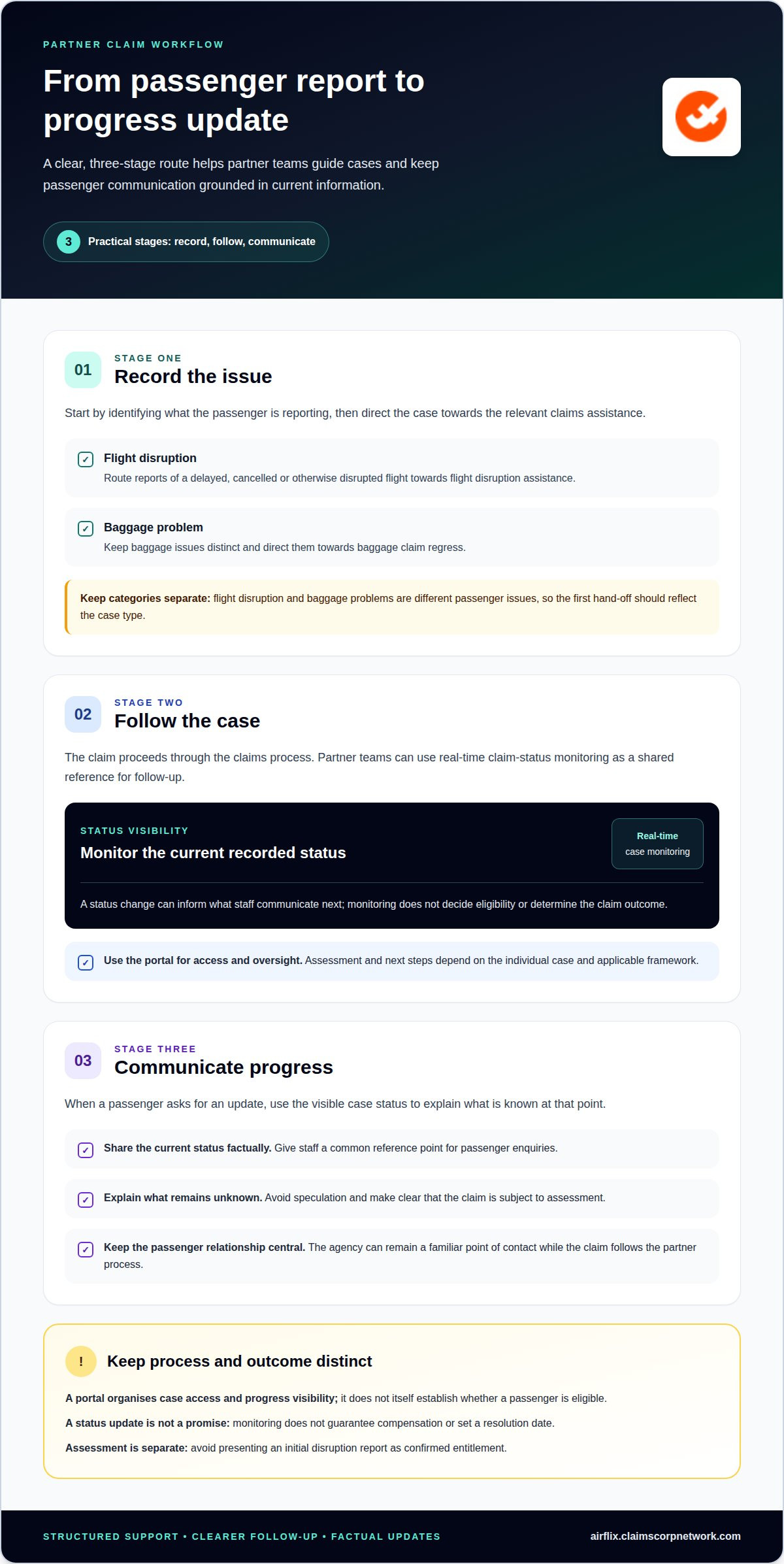
A practical workflow can be organised around three stages:
- Record the issue. Establish whether the passenger is reporting flight disruption or a baggage problem, then direct the case towards the relevant claims assistance.
- Follow the case. The claim is handled through the claims process, with its status monitored in real time.
- Communicate progress. Use the visible status to answer passenger enquiries factually and explain what is known at that point.
From disruption report to claim progress
Flight disruption assistance and baggage claim regress address different types of passenger issue, so a clear first hand-off helps keep each case on the right track. An agency might receive one enquiry about a disrupted journey and another about a baggage problem. The partner process should distinguish these categories rather than treating them as the same claim. Assessment and next steps depend on the case; the portal provides access and oversight, not an eligibility decision.
Real-time claim tracking means monitoring a case’s current recorded status so partners can base follow-up on its latest progress. It helps staff see whether there is a status change to communicate, but it does not set a resolution date or guarantee compensation. The European Commission air passenger rights guidelines provide official context for passenger rights relating to air travel. A partner portal supports administration around a claim; it does not replace applicable rules or assessment of an individual case.
Keeping passenger communication clear
Visible case progress gives agency staff a shared reference point when a passenger asks for an update. Rather than speculate, a team member can relay the current status and explain that the claim remains subject to assessment. This helps protect trust: an update describes what is happening, while a promise of compensation predicts an outcome the portal cannot guarantee.
Teams can also agree where questions should go. Routine enquiries about the customer journey can remain with the agency, while questions requiring claims expertise can be directed through the established flight legal assistance route. This keeps communication coherent without implying that agency staff determine the legal merits of a claim.
For travel partners considering this approach, the Airflix partner portal connects a branded passenger journey with real-time claim-status monitoring. It gives partners a practical basis for coordinating follow-up and keeping passenger updates tied to visible case progress.
White-label portal, referral route or manual handling: compare the models
Choosing a model means balancing how much of the passenger journey the agency wants to manage with the staff time available for follow-up. A white-label portal keeps claims assistance within a partner-branded experience and provides structured case oversight. A referral route directs passengers to a claims service, while manual coordination leaves more of the administration with agency staff.
| Model | Passenger experience | Agency workload | Brand continuity | Claim-status visibility |
|---|---|---|---|---|
| White-label service | Claims assistance is presented through a partner-branded passenger journey. | Staff guide customers into the service and can refer to available case progress. | Strong, as the passenger-facing service sits beneath the agency’s brand. | Structured oversight is available through claim-status monitoring. |
| Referral route | The passenger is directed to a separate claims service. | Initial coordination is limited, though staff may still receive follow-up questions. | Less continuous, as the passenger moves away from the agency’s own journey. | Agency teams may have less direct visibility of case progress. |
| Manual case coordination | The agency manages communication directly with the passenger. | Staff coordinate enquiries and follow-up using their own processes. | Direct contact remains with the agency. | Progress depends on the information available to staff through their follow-up. |
When a white-label claims portal fits an agency
A white-label model suits agencies that want claims assistance to form part of their customer journey, rather than sending passengers to a generic external experience. The agency provides the branded point of access, while the claims partner handles the claims work. Branding does not mean the agency performs legal assessment or controls the outcome. Airflix’s white-label passenger portal is designed for travel agencies and operators seeking this kind of structured, branded access.
A partner portal for flight claim management can be a practical fit when brand continuity and case oversight matter alongside a clear boundary between customer service and claims handling. Before adopting the model, map where passengers encounter the service, which team handles questions and how status information will inform updates. These decisions help make the arrangement part of an established service journey, rather than an isolated referral.
What manual handling and referral models require
Manual coordination may suit an agency that wants to manage the customer relationship directly, but staff need a consistent way to record enquiries, follow up and communicate what they know. Without a shared claims-status view, different team members may find it harder to track progress consistently. A referral route can reduce the agency’s role in case coordination, but may also leave its teams with less direct visibility when passengers return with questions.
Neither model is automatically right for every partner. Compare whether each approach gives passengers a clear route to assistance and gives agency staff enough visibility to communicate accurately, without implying that the agency decides eligibility or guarantees compensation.
Prepare your agency to manage flight claims through a partner portal
A clear internal process helps staff use a partner portal consistently, even when passenger enquiries arrive through different channels. Before introducing a partner portal for flight claim management, agree how a customer moves from the first report to claims assistance, who handles each hand-off and what the agency will communicate as a case progresses.
Use this preparation checklist to define the working arrangement:
- Map the customer journey. Decide how passengers will learn about claims assistance, where they begin the process and which agency team receives questions at each stage.
- Separate claim categories. Distinguish flight disruption matters from baggage-related claims so staff can direct enquiries to the relevant assistance route.
- Assign responsibilities. Identify who receives an initial enquiry, who checks available case progress and who communicates updates to the passenger.
- Set an escalation route. Agree how questions requiring legal assistance are passed on, rather than asking general customer-service staff to interpret a claim’s legal merits.
- Agree update practices. Decide how staff will explain status changes, airline responses and known next steps, and where they will record passenger communications within the agency’s established process.
Define the cases and responsibilities your team will handle
Write down what happens when a passenger reports a disrupted flight, then create a separate route for a baggage issue. This distinction gives staff a useful starting point without assuming every case follows the same handling path. For each category, identify who receives the enquiry, directs the passenger to claims assistance and responds to follow-up.
Set an escalation path for questions that go beyond a routine progress update. Staff should know where to direct a passenger seeking legal guidance and what information they can provide themselves. Clear boundaries help keep customer service useful without blurring the line between agency coordination and legal assessment.
Set expectations for passenger updates
Agree in advance how the team will describe a case that is still being assessed, a response from an airline or a change in recorded status. Use factual language that reflects the information available at the time. If there is no new progress to report, staff can say so plainly rather than suggest a resolution date or outcome.
Claim-status visibility shows where a case stands; it is not a decision that compensation is due. This distinction is useful in staff guidance and passenger messages. A status update describes progress, while eligibility and outcome depend on the claims assessment. Consistent wording helps avoid presenting a submitted claim as an approved one.
Record passenger communications through the agency’s usual process, including the update shared and any agreed follow-up. This gives colleagues a clear handover if another team member responds to the next enquiry, while keeping the explanation aligned with the case information available.
To review how this partner approach can support a branded claims journey, review Airflix’s partner approach.
How Airflix supports partners with flight claim management
Airflix gives travel agencies and operators a way to offer flight claims assistance through a partner-facing service, without building a claims operation within the agency. Its white-label passenger portal supports a branded route for customers, while real-time claim-status monitoring gives partner teams a reference point for follow-up. The service connects this portal with flight disruption assistance and baggage claim regress, keeping distinct passenger issues within a claims-focused arrangement.
A branded passenger route supported by claims expertise
A white-label portal allows a partner to present claims assistance under its own brand. The passenger’s service journey remains associated with the agency or operator, while Airflix provides the claims service behind that experience. This separates the partner’s role in supporting the customer relationship from specialist handling of the claim itself.
For an agency, the practical value is a defined route to offer assistance after a disrupted flight or baggage issue, with claim progress available for monitoring. Airflix also provides legal representation in court procedures where a claim proceeds to that stage. This is part of the support available, not a promise that a claim will succeed or result in compensation. Partners can explain the service while keeping expectations about eligibility and outcomes measured.
Real-time status monitoring can support more coherent passenger communication. When a customer asks for an update, the agency can refer to the available case status rather than relying solely on a separate internal follow-up trail. The information helps staff describe recorded progress, but it should not be presented as a prediction of when a case will conclude.
Choose a commercial arrangement that fits your operation
Airflix offers monthly, yearly and per-flight commercial arrangements. The appropriate model depends on how the partner plans to make claims assistance available and how it fits the agency’s operating needs. Considering the intended customer journey, the team responsible for enquiries and the expected pattern of use can help frame that discussion.
Before deciding, partners can outline which passenger groups will be offered the service, how flight disruption and baggage cases will be introduced, and how staff will handle status enquiries. These operational questions help connect the commercial arrangement to the service the agency intends to provide, without assuming a particular case volume or claim outcome.
Airflix provides the branded portal and claims assistance behind the partner’s passenger journey. For agencies and operators seeking a structured way to offer flight claims support, the next step is to discuss Airflix partner claim management and the commercial arrangement suited to their operation.
Put a clear partner process into practice
Turn the model that fits your agency into a workable passenger journey. Decide how customers will enter claims assistance, which team owns each hand-off and how staff will keep communication accurate as a case progresses. These choices give a partner portal for flight claim management a defined role in your service, rather than leaving its use to individual judgement.
Before introducing the process to customers, walk through a sample enquiry with the people who will handle it. Check that each person knows where to direct a passenger, what information they can share and how to pass on questions that need further assistance. A short internal review can reveal gaps in responsibilities or wording before they affect the customer experience.
Align the arrangement with your agency’s operating needs. Clear responsibilities and a suitable commercial structure help staff explain the service consistently, while keeping passenger expectations realistic. With a considered process in place, claims support can become a more coherent part of the customer journey. Explore a partner arrangement with Airflix and identify a practical way to move forward.
Frequently Asked Questions
Is a flight claim management portal the same as travel insurance?
No. Airflix provides flight disruption legal assistance and baggage claim regress, while travel insurance is a separate product category. The portal gives partners a route to these claims services and a way to monitor case progress. It is not an insurance policy or a substitute for one, and insurance cover is not included. For example, a passenger reporting a disrupted journey can be directed to claims assistance without describing the service as insurance.
What commercial models are available for Airflix partner services?
Airflix offers monthly, yearly or per-flight arrangements. These are different ways to structure a partner relationship, not fixed public prices or a stated set of inclusions. An agency can consider how it intends to make claims assistance available and how that approach fits its operation before discussing an arrangement. The relevant model depends on the partner’s needs; fees or minimum terms should not be assumed from the model names alone.
Can Airflix support baggage-related claims as well as flight disruption cases?
Yes. Airflix’s services include baggage claim regress alongside legal assistance for flight disruptions. These are distinct case types, so an agency should describe the passenger’s issue accurately when directing them to support. For example, a report about a delayed bag should be identified as baggage-related rather than recorded as flight disruption. Neither a baggage issue nor a disrupted flight automatically qualifies for compensation.
Does Airflix provide legal representation if a flight claim reaches court?
Yes. Airflix provides legal representation in court procedures relating to claims. This forms part of its legal assistance service, but it does not mean every claim will proceed to court or that a particular result is assured. Claim-status monitoring concerns a case’s progress; legal representation is support in proceedings if they occur. Agency staff should keep those functions distinct when explaining the service to a passenger.
Who is the Airflix partner portal designed for?
The white-label passenger portal is designed for travel agencies and operators that want to offer claims assistance to their customers. It supports a partner-branded passenger-facing service, with Airflix providing the claims assistance behind it. For instance, an agency can introduce the service as part of its customer support after a journey problem, while keeping its own team’s role focused on guiding the passenger through the process.
Can partners see the progress of a passenger’s claim?
Yes. Airflix includes real-time claim-status monitoring, which can help partners make passenger updates more informed. If a customer asks whether anything has changed, staff can refer to the available case status rather than infer an outcome. Status visibility does not give the partner control over an airline’s decision, confirm eligibility or guarantee compensation. The partner portal for flight claim management supports oversight, not a particular claim result.


