

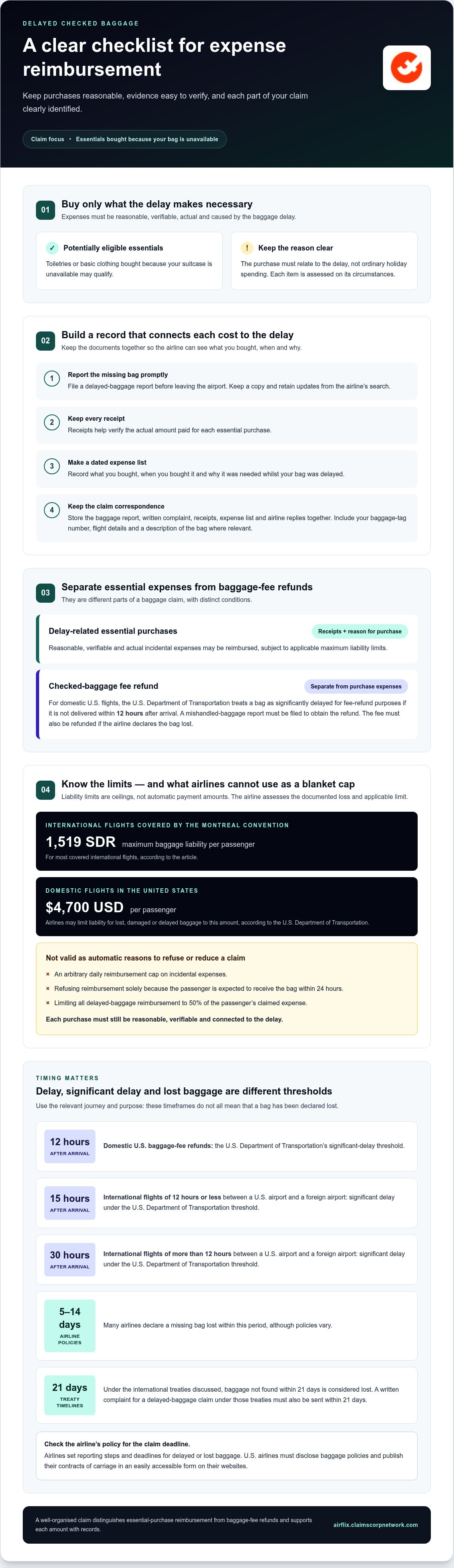
A checked bag doesn’t have one universal date on which it becomes lost. Under the international treaties discussed here, baggage is considered lost if it hasn’t been found within 21 days, while many airlines declare a bag lost under their own policies after five to fourteen days. Understanding which timeline applies is central to legal support for undelivered luggage and any related expense claim.
A delayed bag can leave you paying for essentials while the airline searches, and reimbursement rules depend on the journey and the type of expense. This guide explains when baggage may be considered lost, which reasonable and verifiable expenses caused by a delay may qualify for reimbursement, and what records can support a claim.
It also explains how airline reporting steps and claim deadlines fit into the process, including the difference between domestic and international travel. With these details, you can assess the status of missing luggage and the basis for seeking compensation.
Key Takeaways
- Report delayed baggage to the airline promptly, keep a copy of the report and retain updates about the search.
- Keep receipts for essential purchases made while waiting, as reasonable, verifiable expenses may support a reimbursement claim.
- An airline cannot impose an arbitrary daily cap on incidental expenses, though liability limits may apply.
- An inventory of the bag’s contents, supported by receipts or other evidence of value, can help substantiate a lost-baggage claim.
- Legal assistance can help organise the claim and address disputes over compensation or supporting evidence.
Airline responsibility for locating missing checked baggage
Airlines are responsible for locating checked baggage that does not arrive, and prompt reporting helps create a record of the search. The applicable delay threshold depends on the journey.
When missing baggage is considered lost
A bag may be treated as lost under an airline’s policy or an international treaty, and the distinction affects the claim. Most airlines declare missing bags lost between five and fourteen days after a flight, although their policies vary. Under the international treaties discussed, baggage not found within 21 days is considered lost. The relevant timeframe helps passengers understand when to move from a delay report to a lost-baggage claim.
For international flights of 12 hours or less between a U.S. airport and a foreign airport, the U.S. Department of Transportation considers a checked bag significantly delayed if it is not delivered within 15 hours after arrival. For international flights of more than 12 hours between a U.S. airport and a foreign airport, the U.S. Department of Transportation sets that threshold at 30 hours after arrival. These thresholds identify significant delay, not the point at which every airline declares a bag lost.
Claim procedures, deadlines and policy disclosure
Airline claim procedures set out the reporting steps and deadlines for delayed or lost baggage. File a delayed-baggage report before leaving the airport, keep a copy, and stay in contact with the airline while it searches. Airlines generally require a property irregularity report for lost property. Reporting promptly gives the airline details to identify the bag and document its handling.
Submit the lost-luggage claim within the deadline set by the airline. For a delayed-baggage claim under the international treaties discussed, send a written complaint within 21 days. Keep the report, written complaint and airline replies together, so the dates and information remain clear. A baggage-tag number, flight details and a description of the bag can help connect the claim to the airline’s search.
U.S. airlines must disclose baggage policies, including fees and lost-baggage compensation policies, and publish their contracts of carriage in an easily accessible form on their websites. Read the relevant policy to find the reporting requirements, claim deadlines and compensation process. These documents explain the airline’s procedures, but keep your own copies of reports and correspondence too.
Travel insurance may cover lost baggage or delay-related losses, such as essential purchases and baggage fees, depending on the policy. Credit cards used to buy tickets may also include lost-luggage cover. Renters’ or homeowners’ insurance may apply as well, subject to a deductible.
Compensation for reasonable, verifiable expenses during baggage delays
Airlines must compensate passengers for reasonable, verifiable and actual incidental expenses incurred while checked baggage is delayed, subject to maximum liability limits. The expense must result from the delay, not ordinary holiday spending. Toiletries or basic clothing bought because your suitcase is unavailable may qualify. Keep each receipt and record what you bought, when, and why. A dated expense list links purchases to the period without your bag.
Baggage-fee refunds are separate from reimbursement for essential purchases. For domestic U.S. flights, the U.S. Department of Transportation considers a checked bag significantly delayed for baggage-fee refund purposes if it is not delivered within 12 hours after the flight arrives. A passenger must file a mishandled baggage report with the airline to obtain a refund for a significantly delayed bag. The airline must also refund the fee when it declares the checked bag lost.
Liability limits depend on whether the journey is domestic or international. For most international flights covered by the Montreal Convention, the maximum baggage liability is 1,519 Special Drawing Rights per passenger currently. For domestic flights in the United States, airlines may limit liability for lost, damaged or delayed baggage to $4,700 USD per passenger, according to the U.S. Department of Transportation. These limits set a ceiling, not an automatic payment amount. The airline assesses the documented loss and applicable limit.
Reimbursement rules also constrain how airlines assess delay expenses. Airlines may not set an arbitrary daily reimbursement cap for incidental expenses. They may not refuse reimbursement solely because the passenger is expected to receive the bag within 24 hours. Nor may they limit all delayed-baggage reimbursements to 50% of a passenger’s claimed expense. Each purchase still needs to be reasonable, verifiable and connected to the delay.
For a disputed claim, organise the airline’s response, baggage report, receipts and expense list together. Compare the response with the items claimed and the applicable domestic or international liability limit. If the airline rejects an expense, identify whether its reason concerns necessity, evidence, the delay or the applicable limit. A clear written explanation helps show whether the disagreement is about proof or the rules.
Legal assistance can help assess the airline’s reasons against the claim record and the relevant baggage liability rules. A review can identify missing documents, distinguish baggage-fee refunds from expense reimbursement, and clarify which amounts relate to the delay. For example, a receipt for replacement toiletries supports a different claim from the original baggage fee. Keeping those amounts separate makes the request easier to assess.
Arbitrary limits on reimbursement
A reimbursement ceiling is not necessarily a valid liability limit. Airlines may not impose an arbitrary daily cap on incidental expenses during a checked-baggage delay. Such a cap can exclude reasonable expenses simply because they arise on a later day. Applicable liability limits, by contrast, can restrict total compensation for baggage claims. Distinguish a daily cap from the liability rules that govern your journey.
This distinction matters when an airline offers a set amount per day, regardless of your actual costs. If you buy necessary clothing because your bag is still missing, submit the receipts and explain why the delay made the purchase necessary. The airline must assess reasonable, verifiable and actual incidental expenses rather than rely on an arbitrary daily ceiling. A receipt alone does not establish necessity, so link each purchase to items unavailable in your checked bag.
Some baggage contents require a different assessment. Airlines must compensate passengers for the original purchase price of assistive devices, including wheelchairs, hearing aids, walkers and prosthetics. The stated baggage liability limits do not apply to these devices. For example, a wheelchair claim should identify the device and its original purchase price, rather than treating it as an ordinary personal item.
An item’s category alone does not justify rejecting a lost-baggage claim. Airlines may not deny compensation solely because a bag contained money, jewellery, electronic devices or silverware. You still need to establish what was lost and its value. List each item separately and provide available evidence, such as a purchase receipt or appraisal. The reason for a refusal matters: rejecting an item by category is different from disputing the evidence.
Responsibility for excluded categories depends on the journey. For domestic travel, airlines are not required to compensate passengers for items excluded from liability in their contracts of carriage. For international travel, including the domestic segment of an international itinerary, airlines are responsible for excluded-category items if they accepted them for transportation. Note whether the airline accepted the item and keep any record showing that it did.
Checked-baggage components have specific protection: airlines cannot exclude liability for damage to wheels, handles, straps and other components. Describe the damaged part precisely and photograph it before repairs or disposal. For a broken handle, for instance, identify the bag and show the damage clearly. These details help distinguish component damage from ordinary wear or a claim about the bag’s contents.
If the airline applies a limit, ask which rule it relies on and how it calculated the amount. Compare its explanation with the journey type, the item claimed, proof of value and any record of acceptance. This review can show whether the dispute concerns an applicable liability limit, an excluded category or an unsupported daily cap. Treating each issue separately makes the claim easier to assess.
Aviation lawyer assistance
An aviation lawyer can review the facts, applicable rules and evidence in a baggage dispute. This can help when an airline rejects a claim, offers an amount that appears inconsistent with documented losses, or disputes responsibility. The lawyer examines the itinerary, baggage report and airline correspondence. These records help establish what happened and which issues need a response.
Journey details matter. A lawyer can distinguish a domestic U.S. flight from an international itinerary and assess which baggage liability rules apply. The Montreal Convention governs many international baggage claims, while domestic U.S. claims are subject to separate liability rules. Connecting flights can complicate the assessment, particularly when an international journey includes a domestic segment. The full itinerary and ticket documents help clarify the route under review.
Reviewing the evidence is another practical part of legal assistance. A lawyer can organise the baggage tag, property irregularity report, inventory, receipts and airline replies into a consistent claim file. For example, if the airline says an item was not in the suitcase, an inventory and purchase evidence may help address that specific dispute. Clear records also help distinguish the value of lost contents from expenses caused by the delay.
A lawyer can examine the airline’s stated reason for reducing or refusing compensation. The response may rely on a liability limit, an exclusion in the contract of carriage or a dispute about proof. Each issue requires a different reply. Evidence of an item’s purchase value does not, by itself, establish that the airline accepts responsibility, so address both the evidence and the airline’s reasoning.
If an unresolved compensation claim concerns a U.S. airline, passengers can submit an online complaint to the U.S. Department of Transportation. The airline must respond in writing within 60 days to a complaint filed with the Department about an unresolved compensation claim. Legal assistance can help present the chronology and supporting documents clearly, so the complaint identifies the claim, the airline’s position and the outstanding issue.
If the alleged loss occurred during a Transportation Security Administration checkpoint inspection, the claim route differs from an airline baggage claim. If you believe a TSA agent lost or damaged your property, you can submit a claim directly to the TSA with supporting details such as receipts, appraisals and flight information. Identifying whether the airline or checkpoint handling is at issue helps direct the complaint to the appropriate party.
If a dispute may proceed to court, a lawyer can assess the claim documents and explain the procedural issues involved. The review can cover the airline’s contract of carriage, the claimed loss and evidence for each item. Keep copies of submissions and replies in date order. A coherent file gives legal representation a clear starting point and helps focus the case on the unresolved compensation issue.
How can passengers document baggage contents and prove the value of lost items?
Start with an itemised inventory of each missing possession instead of estimating one total for the suitcase. Record each item’s description, brand, approximate purchase date and condition before travel. Separate clothing, electronics, jewellery and other belongings so each item can be matched to its evidence. An entry such as “black noise-cancelling headphones” is more useful than “accessories”.
Next, gather documents that support ownership and value. Receipts and invoices show purchase details, while bank or card statements may help identify a transaction if the original receipt is unavailable. Product photographs, warranty records and order confirmations can also help identify an item. For a valuable possession, an appraisal may provide further evidence. Keep copies with the inventory rather than sending irreplaceable originals.
- Purchase evidence: retain receipts, invoices and order confirmations.
- Identification: note brands, models, colours and distinguishing features.
- Condition: describe whether the item was new, used or visibly worn.
- Supporting records: include photographs, warranty documents or appraisals where available.
Use realistic values that account for an item’s age and condition. A receipt shows what an item originally cost, but not necessarily its condition when packed. For example, distinguish a recently purchased coat from one worn regularly for several years. The airline may assess contents subject to depreciation and applicable maximum liability limits, so do not treat the original purchase price as an automatic payment amount.
Connect the inventory clearly to the journey. Match the report to the baggage-tag number, flight details and suitcase description. If the suitcase contained a camera, list its make and model and attach purchase evidence or a photograph showing the item. This helps compare the claimed contents with the bag and the airline’s handling record.
Organise the claim file by item, labelling evidence to match each inventory entry. Save the submitted version alongside the airline’s replies. If the airline questions a particular possession, respond directly with its corresponding receipt, photograph or appraisal. For property believed lost or stolen during a Transportation Security Administration security check, supporting details may include receipts, appraisals and flight information.
For help organising evidence and pursuing a baggage claim, Airflix’s Baggage Claim Regress service can support the process. A structured inventory and supporting documents give the claim a clear basis for assessment.
Airflix: Flight Disruption Legal Assistance
Airflix provides Flight Disruption Legal Assistance for passengers with unresolved baggage claims. When an airline disputes responsibility, delays a response or challenges the evidence, its Baggage Claim Regress service can support the claim process. Real-time Claim Status Tracking lets passengers follow a claim’s progress, while the White-label Passenger Portal enables organisations to provide passengers with a claims interface under their own brand.
These services can help when a passenger has reported missing luggage, gathered supporting records and needs assistance pursuing a claim. They can also support organisations managing baggage claims for passengers. The next step depends on the claim’s status and the assistance needed. Contact Airflix to discuss support for your baggage claim.
Move your baggage claim towards resolution
Turn your records into a clear account of what remains unresolved. Identify the outcome you are seeking, such as a decision about the missing bag or a response to a disputed expense. A focused claim makes it easier to explain the issue and decide how to proceed.
Legal support for undelivered luggage can bring structure to a claim when the airline’s position and your evidence do not align. Airflix assists with baggage claims, giving passengers and organisations a way to discuss the issue and the support needed. Share the current claim status and the airline’s response so the discussion can focus on what remains unresolved.
If you’re ready to discuss your case, contact Airflix for baggage claim support. A clear next step can make a complex claim easier to manage.
Frequently Asked Questions
When does an airline consider a bag lost?
Airlines commonly declare a missing bag lost between five and fourteen days after the flight, although policies vary. Under the international treaties discussed, a bag not found within 21 days is considered lost. These are distinct measures: an airline’s policy may set its own declaration point, while the treaty period applies to covered international journeys. Check which timeframe applies to your itinerary before treating a delayed bag as formally lost.
How can an aviation lawyer help?
An aviation lawyer can review the itinerary, airline correspondence and claim evidence to identify the issues in dispute. Legal support for undelivered luggage can help when an airline challenges responsibility or the value claimed. For example, a lawyer can compare evidence for a missing laptop with the airline’s reasons for disputing it. They can also help organise a response or prepare for court proceedings.
What laws protect my baggage?
For domestic travel in the United States, Department of Transportation rules address airline baggage liability and passenger claims. Many international baggage claims fall under the Montreal Convention, which covers lost, delayed and damaged luggage. The itinerary matters, including whether a domestic flight forms part of an international journey. Keep your ticket and route details together to help identify which rules apply to your baggage problem.
What are airlines’ responsibilities when your bag is delayed?
Airlines are responsible for locating checked baggage that does not arrive at its destination. They must compensate passengers for reasonable, verifiable and actual incidental expenses caused by a delay, subject to maximum liability limits. Essential clothing bought because a suitcase has not arrived may qualify. Link each purchase to the delay and keep supporting evidence, rather than combining these expenses with unrelated trip spending.
What should a passenger do if their bag is missing after a flight?
Report the missing bag to the airline before leaving the airport and keep a copy of the report. Record the baggage-tag details, flight information and a clear description of the suitcase. Keep the airline’s search updates and submit the required written claim within its stated deadline. If the bag contained valuable items, prepare an inventory and gather available purchase evidence to identify them.
What are passengers’ legal rights when checked luggage is delayed or never delivered in the United States?
Passengers can report the problem, seek reimbursement for reasonable and documented expenses caused by a delay, and claim compensation for lost baggage under the applicable rules. A baggage-fee refund may also be due if a checked bag is lost or significantly delayed. If the airline leaves a compensation claim unresolved, passengers can file an online complaint with the U.S. Department of Transportation. Keep the airline’s decision and supporting records for the complaint.
What is the airline liability limit for lost, delayed or damaged baggage on domestic flights?
For domestic flights in the United States, airlines may limit liability for lost, damaged or delayed baggage to $4,700 USD per passenger, according to the U.S. Department of Transportation. This is a maximum liability limit, not a fixed payment for every claim. The claimed loss, available evidence and applicable airline policy remain relevant when assessing compensation. Keep the baggage report and evidence of the items together.
What is the airline liability limit for baggage on international flights under the Montreal Convention?
For most international flights covered by the Montreal Convention, the maximum baggage liability is 1,519 Special Drawing Rights per passenger currently. Special Drawing Rights are the unit used for this limit, so the figure is not a fixed amount in US dollars. The limit applies per passenger, and the itinerary must fall within the Convention’s coverage. Preserve the ticket and route information alongside the claim documents.


