

A receipt helps, but it doesn’t make every purchase recoverable: airlines must reimburse reasonable, verifiable and actual incidental expenses incurred while baggage is delayed, subject to maximum liability limits. That is the basis of a lost luggage cost recovery claim: keep evidence of essential purchases and report the bag promptly. For domestic US flights, airlines may limit liability for lost, damaged or delayed baggage to a maximum of $4,700 per passenger, according to the U.S. Department of Transportation.
A delayed suitcase can leave you paying for essentials before your belongings arrive. Keep receipts and report the problem promptly to create a clear record of what happened and what you spent.
This guide explains how to report delayed luggage, document interim expenses and claim for missing or damaged belongings. It also covers how airline liability limits apply, why they differ between domestic and international journeys, and how to organise evidence for your claim.
Key Takeaways
- Report a delayed bag promptly and keep the airline’s written record of your report.
- Save receipts for essential interim purchases and proof of purchase for belongings that are lost or damaged.
- Check the deadline that applies to your route and airline, as reporting and claim windows can differ.
- Understand that airline liability limits can affect what you recover, and that a final settlement may account for the value of your belongings.
- Separate reasonable delay-related expenses from claims for lost or damaged items when organising your paperwork.
Reporting a delayed bag and filing a property loss claim
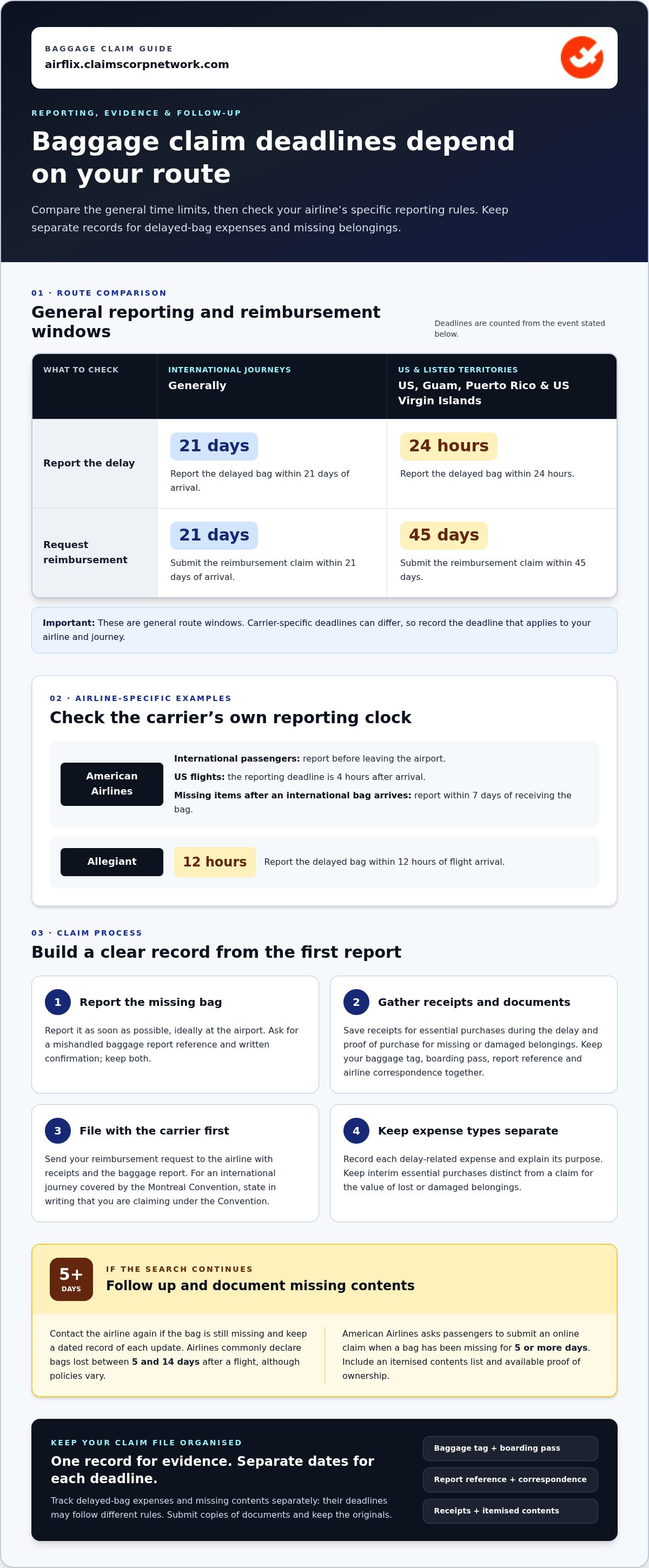
Report a delayed bag promptly, then submit the claim within the deadline for your route. International trips generally require a delay report and reimbursement claim within 21 days of arrival; US, Guam, Puerto Rico and US Virgin Islands trips have a 24-hour reporting deadline and a 45-day reimbursement deadline.
- Report the missing bag to the airline as soon as possible, ideally at the airport. Ask for a mishandled baggage report reference and written confirmation, then keep both. Deadlines vary by carrier: American Airlines asks international passengers to report before leaving the airport, while its US-flight deadline is 4 hours after arrival. Allegiant requires a report within 12 hours of flight arrival.
-
Gather receipts and claim documents
Collect receipts for essential items bought during the delay, such as basic toiletries or clothing, and proof of purchase for missing or damaged belongings. Keep your baggage tag, boarding pass, report reference and airline correspondence together. Record each expense and explain its purpose, such as why you needed replacement clothing while your checked bag was delayed. Submit copies and keep the originals.
-
File claims with the carrier and insurer
Send your reimbursement request to the airline with your receipts and baggage report. For an international journey covered by the Montreal Convention, state in writing that you are claiming under the Convention. Make a claim with the carrier before relying on travel insurance, as insurers generally require this first. If the airline denies your claim or its payment leaves losses uncovered, send the decision and supporting documents to your insurer.
-
Follow up on bags missing five or more days
Contact the airline again if the search continues, and keep a dated record of each update. Airlines commonly declare bags lost between five and fourteen days after a flight, although their policies vary. American Airlines asks passengers to submit an online claim when a bag has been missing for 5 or more days. Include an itemised contents list and available proof of ownership.
- Track each deadline separately, because a delayed-bag expense claim and a claim for missing contents may follow different rules. For example, international delayed-bag claims are due within 21 days of arrival, while American Airlines allows 7 days after receiving an international bag to report missing items. Put the applicable dates in your file and submit documents within the carrier’s stated window.
Domestic baggage liability limits
If the airline denies a lost-baggage claim, request its written decision and compare its valuation with the applicable liability limit. The route determines which limit applies, while the airline’s lost-bag declaration and your evidence of value affect the calculation.
-
Check the applicable liability limits
Identify whether your journey was domestic or international, then match the claim to its governing limit. For domestic U.S. flights, airlines may limit liability for lost, damaged, or delayed baggage to a maximum of $4,700 per passenger, according to the U.S. Department of Transportation. For most international flights covered by the Montreal Convention, the maximum is 1,519 Special Drawing Rights currently per passenger. The payable amount depends on the proven loss and applicable limit.
Keep your flight itinerary and baggage claim record together. A connecting journey involving international travel may require closer review of which flight and carrier the claim concerns. Don’t assume the domestic ceiling applies simply because part of the journey took place within the United States.
-
Account for depreciation in compensation
Compare the airline’s valuation with the age, condition and purchase evidence for each lost item. Airlines may deduct depreciation when calculating compensation, so provide receipts or other proof of purchase and describe each item’s condition before travel. A receipt for a recently purchased suitcase, for example, supports its original price, while photographs can help show its condition.
Ask the airline to explain each deduction. List the suitcase separately from its contents, and don’t claim the original purchase price as the current value without supporting details. If the bag can be repaired, distinguish repair costs from replacement value. Airlines are responsible for repairing or reimbursing baggage damaged while under their control, subject to maximum liability limits.
- Record when the airline classifies the baggage as lost. Airlines commonly declare a missing bag lost between five and fourteen days after the flight, although policies vary. Until then, keep search updates and your baggage reference number. Once the carrier confirms the loss, prepare an itemised list of contents with purchase evidence and condition for each item, rather than submitting one unsupported total.
- If the airline denies your claim, request its reasons and calculation in writing. Compare the decision with your itinerary, inventory, receipts and applicable limit, then reply with specific omitted items or valuation errors. Keep copies of the denial and subsequent correspondence. If your credit card includes baggage cover, review its claim requirements and provide the carrier’s decision and evidence of any unpaid loss.
What is lost luggage reimbursement?
Reimbursement may cover eligible expenses during a delay and some losses after a bag is declared lost. Keep these claims separate: interim purchases address immediate needs, while a final settlement concerns the bag and its contents.
- Sort each cost by claim type. An expense caused by a bag delay is different from compensation for the missing suitcase and belongings. Airlines are required to reimburse reasonable, verifiable and actual incidental expenses during a delay, subject to maximum liability limits. A clear schedule helps the airline assess each item without confusing temporary needs with the final property claim.
-
Record essential interim expenses
List each essential purchase made while your bag is delayed and connect it to the period without your belongings. Basic toiletries or necessary clothing are examples; discretionary upgrades are harder to justify as essentials. Keep itemised receipts and note why each purchase was needed. An airport shop receipt can show the date and amount, while a brief note links the purchase to your delayed bag.
Claim actual expenses, not estimates or rounded totals. Airlines generally expect receipts for delay-related purchases, so match each receipt to a line in your expense list. This makes the reason, amount and timing of each request easier to assess.
-
Account for deductions in the final settlement
Ask the airline to itemise its final offer for the suitcase and its contents. Lost luggage reimbursement typically covers the difference between the actual cash value of lost belongings and the carrier’s claim payment. Compare the calculation with your inventory, proof of purchase and any earlier payment, rather than treating the settlement as a separate payment of every item’s original purchase price.
Check exclusions as well as deductions. Reimbursement policies may exclude cash, furs, tickets and checks, and airlines usually don’t compensate for stress or inconvenience. Keep delay expenses separate from property losses so interim essentials aren’t mistakenly counted as the value of missing belongings.
- Submit your interim expense request and property claim as separate, clearly labelled parts of your paperwork. For example, identify a toiletries receipt as a cost caused by the delay, then list the missing suitcase separately with its contents and supporting evidence. This distinction shows whether each amount concerns an actual expense or lost property.
- Compare the airline’s response with your evidence and the liability limit. Airline compensation usually covers bare essentials during a delay and part of the cost of replacing or repairing lost luggage and its contents. If the payment doesn’t fully cover your losses, keep the carrier’s decision and settlement breakdown with your records. These documents help establish what remains unpaid.
Maximum airline liability for lost or damaged bags
Check the route and type of baggage against the applicable liability framework before assessing a settlement. The airline’s maximum responsibility sets a ceiling, not an automatic payment for every claim.
- Identify whether the journey was domestic or international, and whether the item was checked. For domestic U.S. flights, airlines may limit liability for lost, damaged, or delayed baggage to a maximum of $4,700 per passenger, according to the U.S. Department of Transportation. This is the ceiling; the amount offered still depends on the loss established by the claim and the carrier’s assessment.
- For most international flights covered by the Montreal Convention, the maximum baggage liability is 1,519 Special Drawing Rights currently per passenger. The Convention’s limit is approximately $2,175.00 US per passenger currently. Treat this as a maximum, not a fixed award: document the loss and compare the airline’s calculation with your evidence. The Convention’s limit can apply to checked and unchecked baggage on covered international journeys.
- Check which treaty governs if the itinerary or carrier’s response refers to the Warsaw Convention. For international travel subject to that Convention, checked-baggage liability is limited to $20 per kilogram, up to $640. Unchecked-baggage liability is limited to $400 per passenger. These limits differ from Montreal Convention limits, so don’t assume one treaty applies to every international flight.
- Record the airline’s lost-bag declaration and the date it classifies the checked bag as lost. Airlines commonly declare a bag lost between five and fourteen days after the flight, although policies vary. If the bag arrives damaged instead, photograph the damage and keep the baggage claim record. For Allegiant domestic flights, report damaged bags within 12 hours of arrival and missing contents within 24 hours.
- Submit an itemised claim with proof of purchase, photographs and a clear description of each loss. Airlines are responsible for repairing or reimbursing baggage damaged while under their control during transportation, subject to maximum liability limits. If repair isn’t possible, the airline may depreciate the bag’s value when negotiating compensation. Request a written breakdown of the valuation and any deductions.
- Flag assistive devices separately from ordinary luggage. Under 14 CFR Part 382, the stated United liability limit does not apply to loss, damage, or delay involving wheelchairs or other assistive devices. For international air travel, liability for lost or damaged assistive devices is subject to the maximum liability limit under the applicable international treaty. Identify the device clearly in the claim and retain its supporting records.
What expenses can travelers recover for lost luggage?
Separate costs incurred during a delay from losses claimed after the airline declares a bag lost. For a lost luggage cost recovery claim, reimbursement concerns reasonable, verifiable, actual expenses and property losses, subject to maximum liability limits.
- Sort each cost by when and why you incurred it. During a delay, airlines are required to reimburse reasonable, verifiable and actual incidental expenses, subject to maximum liability limits. After a bag is declared lost, the claim concerns the bag and its contents. A toiletries receipt belongs with interim expenses; the missing suitcase belongs in the property inventory.
This distinction keeps the two parts of your lost luggage cost recovery claim clear. Label each receipt with its purpose and date, then keep it separate from the list of missing belongings. Replacement clothing bought during a delay, for example, is an interim expense, not evidence of the suitcase’s value.
- Claim necessary interim purchases and keep itemised receipts. Airline compensation for a baggage delay usually covers bare essentials, not every purchase made while travelling. Toiletries or basic clothing are practical examples. A non-essential upgrade is harder to link to an immediate need caused by the delayed bag.
For each purchase, record what you bought and why you needed it. Match the receipt to the period without your luggage and submit the actual expense, not an estimate. If a receipt includes essentials and unrelated items, identify the relevant lines in your lost luggage cost recovery paperwork.
- List missing belongings separately and support their value with evidence. Include each item’s purchase details and any available proof of ownership. Lost luggage reimbursement typically covers the difference between the actual cash value of lost belongings and the carrier’s claim payment. It isn’t necessarily the original purchase price of every item.
Compare the airline’s settlement with your inventory. Policies may exclude cash, furs, tickets and cheques. An itemised list distinguishes excluded property from other contents and helps identify what the airline assessed or left out.
- Include repair or replacement evidence for damaged baggage. Airlines are responsible for repairing or reimbursing baggage damaged while under their control during transportation, subject to maximum liability limits. Keep photographs and any repair assessment with your claim. If the airline values a damaged bag, compare any depreciation deduction with its age, condition and purchase evidence.
- Claim a refund of the checked-bag fee if a U.S. airline declares your checked bag lost. The airline must refund the fee paid to transport it. Record this refund separately from interim essentials and the value of the bag’s contents, so each part of your lost luggage cost recovery request is easy to assess.
Keep your claim focused on recoverable categories. Airlines usually don’t pay compensation for stress or inconvenience caused by a luggage problem. List actual expenses, documented property losses, eligible repair costs and applicable baggage fees as separate items.
Airflix: Flight Disruption Legal Assistance
Airflix offers a Baggage Claim Regress service for baggage claims that need further handling after an airline response. If a carrier has denied your claim or its settlement doesn’t address your documented loss, this service can help with the next steps. Keep the airline’s decision, claim reference, receipts and itemised loss information together so the claim can be reviewed with its supporting evidence.
Airflix also provides Flight Disruption Legal Assistance, including legal representation in court proceedings. Real-time Claim Status Tracking lets you follow your claim’s progress. These services support claim handling; they don’t replace airline reporting deadlines or the evidence needed to substantiate a claim.
Contact Airflix to discuss baggage claim assistance for your case.
Take the next step with a clear claim record
An organised file gives you a practical basis for deciding what to do next. Keep the airline’s response, your evidence and any outstanding loss together, then identify the specific issue that still needs attention. A lost luggage cost recovery claim may involve separate questions about expenses, property value and the airline’s assessment, so a clear record helps keep them distinct.
Airflix offers a Baggage Claim Regress service for baggage claims and Flight Disruption Legal Assistance, including legal representation in court proceedings. Its White-label Passenger Portal supports passenger claim workflows. These services provide different forms of claim support, depending on the task at hand.
If you want support with a baggage claim, contact Airflix to discuss your case. A considered next step can help you move forward with greater clarity.
Frequently Asked Questions
Can I file an interim expense reimbursement claim if I made purchases to cover essential items?
Yes. You can claim reasonable, verifiable and actual incidental expenses caused by a baggage delay, subject to applicable liability limits. A lost luggage cost recovery claim may include essentials bought while your bag was unavailable. Submit receipts showing what you bought and when, and explain why each item was needed. For example, a receipt for basic toiletries can support an interim expense request. Keep these purchases separate from claims for missing belongings.
Can the airlines exclude liability for certain items?
Yes. Airline baggage policies may exclude some belongings from reimbursement, including cash, furs, tickets and cheques. Review the carrier’s terms and identify any excluded item separately in your inventory rather than assuming all contents receive the same treatment. For other belongings, provide evidence of ownership and value. The policy and the airline’s assessment can affect what its settlement covers.
What about damage to the wheels, handles, or straps of baggage?
Report damage to wheels, handles or straps to the airline and document the bag’s condition before using or repairing it. Photographs from several angles can show which parts are affected; a repair assessment can describe the work required. Keep the baggage report and any written response with those records. The airline’s responsibility depends on whether the bag was under its control during transportation.
What are airlines’ responsibilities when they damage your baggage?
Describe the damage clearly and provide photographs, proof of purchase or repair information where available. For example, show whether a cracked suitcase shell prevents normal use or a broken wheel needs repair. The carrier may assess the damage and the bag’s value when deciding on compensation.
What happens next?
After you submit a claim, the airline assesses your report, evidence and requested compensation, then communicates its decision. Compare the offer with the items and expenses you claimed, and ask for a written explanation of any difference. Keep a dated record of messages and documents. If the carrier denies your claim or leaves part of your documented loss unpaid, its decision can help you organise the next steps in your lost luggage cost recovery claim.
What should a passenger do if his or her bag is missing after taking a flight?
Report the missing bag to the airline promptly, preferably before leaving the airport, and obtain a report reference or written confirmation. Keep your baggage tag and travel documents, then give the carrier a clear description of the bag and its contents. Passengers travelling in the U.S., Guam, Puerto Rico or the U.S. Virgin Islands must report delayed bags within 24 hours of arrival. Requirements can differ by route and airline.
How much compensation do airlines pay for lost luggage in the U.S.?
There is no automatic fixed payment for every lost bag. For domestic U.S. flights, an airline may apply a liability ceiling, while the assessed claim depends on your documented loss and the carrier’s calculation. The amount offered for lost luggage cost recovery may therefore be below the maximum. If a U.S. airline declares a checked bag lost, it must also refund the fee paid to transport it.
What is the DOT liability limit for lost or delayed baggage?
For domestic U.S. flights, airlines may limit liability for lost, damaged or delayed baggage to a maximum of $4,700 per passenger, according to the U.S. Department of Transportation. This is a maximum liability limit, not a guaranteed payout. The airline assesses the claim against evidence of loss, and the applicable rules depend on whether the itinerary is domestic or international.


