

Extraordinary circumstances don't automatically remove every passenger right. Under EU261, they can exclude delay or cancellation compensation only when the airline proves both that extraordinary circumstances applied and that it took reasonable measures. A refund or rerouting after cancellation is separate from fixed compensation, a distinction central to complex flight claim management.
An airline’s explanation may not settle whether you have a claim, especially when a disruption involves weather, safety or operational issues. The applicable rules, the cause of the disruption and the available evidence all affect which passenger rights may apply.
This guide explains how to assess the effect of extraordinary circumstances on a claim, which records to keep, and how to submit and follow up. It also compares managing a claim yourself with using a claim-management service, including how each approach handles rule assessment, evidence and case progress.
Key Takeaways
- Identify which passenger-rights framework applies to your route before deciding what to claim; the departure point, destination and operating airline can all matter.
- Build a clear evidence file with booking details, disruption notices, receipts and a record of your communications with the airline.
- For involuntary denied boarding, review the compensation check promptly: you generally have 30 days from its date to decide whether to accept the amount.
- Compare the time and follow-up involved in handling a claim yourself with the structured support and status tracking available through a claim-management service.
- Use a consistent process to record each case, assess the evidence and track its progress through to resolution.
Flight Delayed or Cancelled?
In the United States, federal rules and the Montreal Convention may govern delay, baggage and injury claims; international routes can also engage EU261, UK261 or Canada’s APPR. According to the European Union, Regulation (EC) No. 261/2004 grants compensation rights to air passengers. With codeshares or connections, map each flight to its operating airline, ticket and disruption records before assessing the claim.
Domestic Delay and Cancellation Compensation
For domestic trips in the United States, airlines aren’t federally required to compensate passengers simply because a flight is delayed or cancelled. Separate refund rights may apply: a departure or arrival change of 3 hours or more on a domestic flight is considered significant under the U.S. Department of Transportation’s flight refund rules. Review the revised itinerary, the reason given and whether you still want to travel.
Denied Boarding and Disruption Claims
A denied-boarding claim depends on whether the passenger was involuntarily bumped and when substitute transport reaches the destination. A passenger generally has 30 days from the date on the check to decide whether to accept its amount.
For eligible EU261 flights, compensation depends on route distance and the applicable conditions. According to the European Union, flights up to 1,500 km can qualify for €250 per passenger; flights entirely within the EU over 1,500 km fall in the €400 compensation band per passenger. An arrival delay of at least three hours at the final destination can qualify when other requirements are met. A cancellation refund or rerouting is separate from fixed compensation.
For international itineraries, Article 19 of the Montreal Convention allows passengers to claim reimbursement from the airline for expenses resulting from a delayed or cancelled flight. Keep receipts and connect each expense to the disruption, such as necessary accommodation or transport. The airline’s assessment turns on the loss claimed and the evidence linking it to the delay.
Extraordinary circumstances don’t automatically remove every right. Under EU261, they can exclude delay or cancellation compensation if the airline proves the circumstances and that it took reasonable measures. The cause matters, but so does the response: retain the airline’s explanation, notices and rerouting details to assess both parts of the test.
Travel insurance is a separate route for eligible expenses, not a substitute for airline rights. Policies may cover eligible delay expenses after 3-12 hours, depending on their terms. For trip cancellation or interruption, review the policy’s covered events and required evidence, then keep booking records, receipts and disruption notices together.
For a codeshare or missed connection, record the operating airline for each flight, the scheduled and actual times, and the final destination shown on the booking. This gives the person handling the claim a clear timeline to assess, rather than treating each flight as an unrelated delay.
Managed flight disruption claims
Managed claims bring flight records, passenger evidence and applicable rules together for review. The process identifies each disruption, then links its cause and impact to the passenger’s journey.
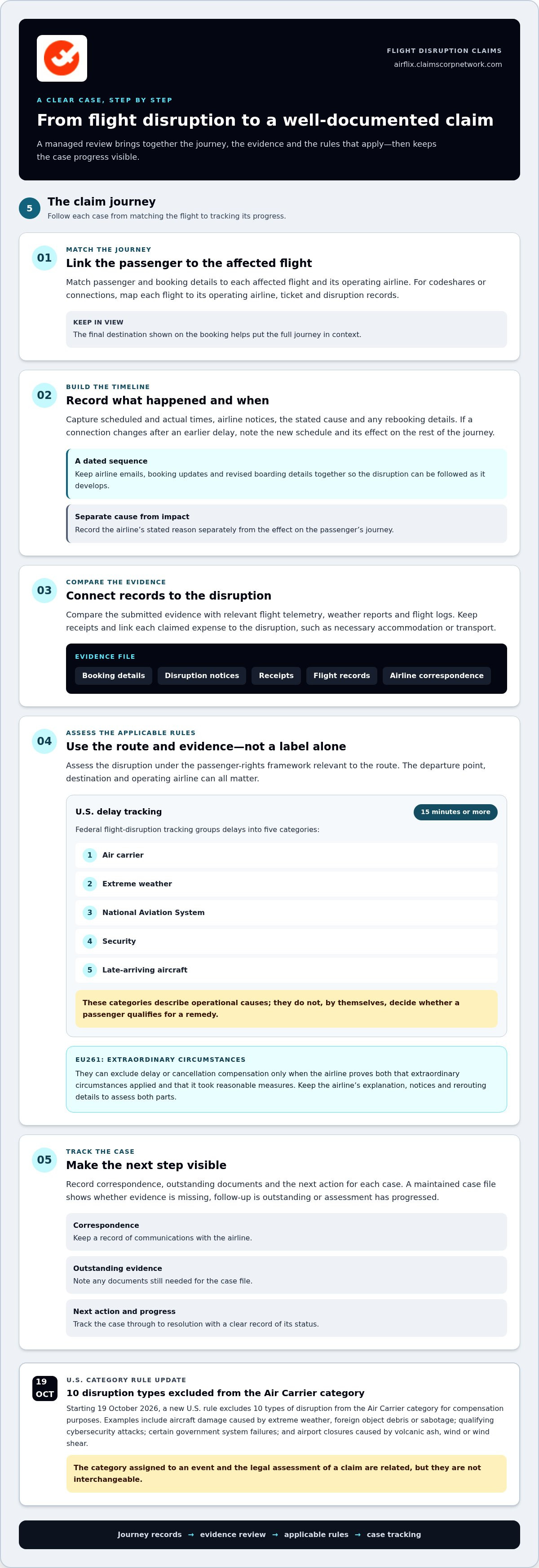
In the United States, federal flight-disruption tracking categorises delays of 15 minutes or more into five categories: air carrier, extreme weather, the National Aviation System, security and late-arriving aircraft. These labels describe operational causes; they don’t, by themselves, decide whether a passenger qualifies for a particular remedy. The claim still needs to be assessed against the rules that apply to its route.
Starting 19 October 2026, a new U.S. rule excludes 10 types of disruption from the Air Carrier category for compensation purposes. Examples include aircraft damage caused by extreme weather, foreign object debris or sabotage; qualifying cybersecurity attacks; certain government system failures; and airport closures caused by volcanic ash, wind or wind shear. The category assigned to an event and the legal assessment of a claim are related, but they are not interchangeable.
A consistent managed review can follow a clear sequence:
- Match passenger and booking details to the affected flight and operating airline.
- Record scheduled and actual times, notices, stated causes and rebooking details.
- Compare submitted evidence with relevant flight telemetry, weather reports and flight logs.
- Assess the disruption under the passenger-rights framework relevant to the route.
- Record correspondence, outstanding documents and the next action for each case.
Monitoring an upcoming flight helps you track itinerary changes as they happen. Keep airline emails, booking updates and revised boarding details together. If a connection changes after an earlier delay, record the new schedule and its effect on the rest of the journey. A dated timeline shows how the disruption developed, rather than leaving a single alert without context.
Alerts are most useful when they identify the affected flight and the change that needs attention. An overbooking notice, for example, is different from a weather-related cancellation. Record the airline’s stated reason separately from the impact on your journey. This helps distinguish an operational update from information relevant to assessing a claim.
For airline claims teams, combining flight records with passenger submissions can reduce manual verification errors. A well-maintained case file also shows whether evidence is missing, correspondence is outstanding or assessment has progressed. Visibility across the claim lifecycle supports a consistent review, particularly when a disruption affects several flights or passengers.
Steps for documenting and filing flight claims
A well-organised claim connects the disruption to its effect on your journey and the remedy you seek. Create a dated record for each affected flight, then submit a concise account with documents supporting each point.
Documenting Flight Delays and Cancellations
Start with the booking confirmation and keep the original schedule alongside every revised itinerary. Record the flight number, operating airline, departure and arrival times, and when you received each delay or cancellation notice. For a missed connection, include both flights and the final destination to make the sequence clear.
- Save emails, text alerts, app notices and screenshots showing schedule changes.
- Note the explanation given by the airline, including weather, operational issues or overbooking.
- Keep boarding passes and rebooking confirmations, including details of substitute transport.
- Retain receipts for expenses linked directly to the disruption, such as accommodation or transport.
- For baggage problems, preserve the baggage report, claim reference and receipts for necessary purchases.
- Write a brief timeline while events are fresh, distinguishing what happened from what the airline stated.
Make each document easy to match to a point in your claim. For example, label a hotel receipt with the disrupted flight date and explain how the cancellation led to the overnight stay. If an airline notice changes, keep both versions instead of replacing the earlier one. This shows what information was available at each stage.
Claim Submission and Document Management
Before submitting, identify the correct airline and claim route for the affected flight. Check that the passenger name, booking reference and flight details match across the form, ticket and supporting documents. State what happened, the outcome you seek and which documents are attached. A focused submission helps the airline assess the relevant facts without searching through unrelated material.
- Separate the claim summary from supporting records, and give each file a descriptive name.
- Submit copies of receipts and notices, keeping originals and a complete local record.
- Save the submission date, confirmation message and any claim reference.
- Log each reply and request for evidence, then respond with the specific document requested.
- Track open questions and the next follow-up action in one case record.
For written complaints under the U.S. Department of Transportation rule described for airline complaints, airlines must acknowledge receipt within 30 days and send a substantive response within 60 days. Record both dates against the complaint. For EU261 claims, there is no universal three-year deadline; the applicable time limit depends on the case. Submit promptly and retain proof of when the claim was sent.
Denied boarding compensation and settlement options
At the airport, establish whether the airline involuntarily denied you boarding or you accepted an offer to travel later. This distinction matters when assessing compensation and any proposed settlement. Keep the boarding pass, booking confirmation and written explanation together, and record what the airline offered and when.
For U.S. involuntary bumping, the compensation amount depends on the substitute transport and arrival delay. Where substitute arrangements aren’t made or the stated arrival-delay threshold is exceeded, the minimum doubles to 400% of the one-way fare, or $2,150, whichever is lower.
Compare the written offer with the actual flight details before accepting. Note the original arrival time, replacement itinerary and arrival time at your destination. A changed connection may affect the overall delay, so keep records for every flight. If the airline offers travel credit or another settlement, retain its terms and distinguish it from any separately stated compensation amount.
A passenger generally has 30 days from the date on the check to decide whether to accept its amount. Use that period to review the check, the itinerary and the airline’s explanation. Keep a copy of the check and any accompanying letter. If the offer is unclear, ask for the calculation and the arrival information used, then record the response with the claim documents.
Organise the case around key decisions instead of sending an unstructured bundle of files. For a flight departing from a U.S. airport, record the denied boarding, whether you volunteered, the replacement transport and the final arrival. For an international itinerary, identify the route and operating airline, then assess which passenger-rights rules apply. These details help distinguish a compensation claim from reimbursement or other travel expenses.
- Save the boarding pass, booking record and written boarding refusal.
- Record whether you volunteered or were involuntarily denied boarding.
- Keep the airline’s settlement terms, check and any response in one file.
- Compare the original and replacement flight details, including destination arrival.
- List expenses separately and retain receipts linked to the disruption.
For a claim involving connecting flights or multiple airlines, map each flight to its operator and scheduled arrival. This prevents a replacement flight on one segment from obscuring the outcome of the overall journey. A clear settlement review should show the evidence considered, the amount offered and the decision made, whether you accept the offer or pursue the claim further.
Comparing self-managed claims with claim-management services
Managing a claim yourself gives you direct control, while a service can organise assessment and follow-up. The right approach depends on the booking, destination, available evidence and work involved across the affected flights.
Claim-management services may use a monthly or yearly subscription, or a per-flight arrangement. The price depends on the case and is provided after a quote request. Factors include the claim’s complexity, the number of flight segments and whether court representation is required.
Managing a claim yourself can suit a straightforward disruption involving one airline and a complete booking record. Submit the claim, attach supporting documents and track replies. A boarding pass, cancellation notice and expense receipts help connect the evidence to your journey. You also keep direct oversight of correspondence and any proposed settlement.
A service can help when a claim involves several operating airlines, disrupted connections or different passenger-rights rules. The work may include organising flight details, assessing evidence, preparing submissions and managing follow-up. Some services also provide real-time claim status tracking, giving passengers a record of progress beyond email threads.
Compare the practical responsibilities before choosing:
- Eligibility assessment: Who identifies the relevant rules and checks the disruption against them?
- Evidence handling: Who organises booking details, boarding passes, notices and receipts?
- Airline correspondence: Who submits the claim and responds to requests for further records?
- Case visibility: How can you see whether the claim is awaiting evidence, under review or resolved?
- Escalation: Does the service include legal representation if court procedures arise?
- Payment structure: Is the arrangement subscription-based or charged per flight, and what case factors shape the quote?
A single delayed flight on an upcoming journey may be manageable with your own records and direct contact with the airline. A booking involving a missed connection, a codeshare and different operating airlines needs a clearer timeline. A service can bring the affected flights and case documents together, while you provide accurate passenger and booking information.
Complex flight claim management is not automatically easier with either approach. Manage a claim yourself when you can identify the applicable route, assemble the evidence and keep up with follow-up. Consider a managed service when multiple flights, airlines or procedural steps are difficult to coordinate. Before proceeding, compare the written scope, tracking process and payment structure.
Airflix: Flight Disruption Legal Assistance
Airflix provides Flight Disruption Legal Assistance for passengers managing airline disruption claims. Its support can help organise the process when eligibility, evidence or follow-up across disrupted flights is difficult to handle independently.
For baggage-related claims, Airflix also offers a Baggage Claim Regress service. Real-time Claim Status Tracking lets you follow case progress, and legal representation is available if court proceedings arise. These services can help when a claim needs structured oversight beyond an initial request to the airline.
If you need managed support with a disruption claim, contact Airflix to discuss the next step.
Make your next claim easier to manage
Use the experience of a disruption to create a clearer process for future travel. Keep a consistent record for each booking, note which airline operated each flight and retain the outcome alongside the original claim. This makes it easier to distinguish a new disruption from an earlier case, particularly for journeys with connections or codeshares.
For passengers and organisations managing cases, complex flight claim management works best when each claim has an owner, a record of decisions and a defined next step. Airflix provides Flight Disruption Legal Assistance for disruption claims, a Baggage Claim Regress service for baggage cases and a White-label Passenger Portal for passenger claim workflows.
Choose the approach that fits the case: manage a straightforward claim directly, or use structured support when the evidence and follow-up become difficult to coordinate. Contact Airflix about your claim to discuss the next step. A clear process can help you move forward with greater confidence.
Frequently Asked Questions
Do extraordinary circumstances remove all my rights?
No. For eligible EU261 flights, extraordinary circumstances can exclude fixed delay or cancellation compensation only when the airline proves the circumstances applied and that it took reasonable measures. They don’t automatically remove separate rights, such as a cancellation refund or rerouting. For example, assess the compensation question separately from what happened to your ticket after cancellation, and keep the airline’s explanation alongside its rebooking or refund offer.
How do I claim, and which documents should I keep?
Submit a clear claim to the relevant airline, linking the disruption to the outcome you seek. Keep your booking confirmation, boarding pass, airline notices, revised itinerary and receipts for disruption-related expenses. For a missed connection, include details for each flight and the final destination. Save your submission confirmation and the airline’s replies together, so you can see what was sent and respond to requests for further evidence.
How much compensation could I receive?
The amount depends on the rights framework, route and circumstances of the disruption. For eligible EU261 flights, the European Union sets compensation at €250 per passenger for flights up to 1,500 km, and €400 for flights entirely within the EU over 1,500 km. Other eligible routes over 3,500 km can fall in a €600 band, with reductions possible under specified conditions. In the United States, involuntary-bumping compensation depends on the fare and substitute transport.
What Do Airline Passenger Rights Actually Cover?
Passenger rights can cover distinct matters, including fixed compensation, cancellation refunds or rerouting, delayed-flight expenses, denied boarding and baggage claims. Which remedy applies depends on the route, airline, disruption and applicable rules. For example, a refund or rerouting after cancellation is separate from fixed compensation. On an international itinerary, Article 19 of the Montreal Convention can support a claim for expenses resulting from a delayed or cancelled flight.
Which rules apply in the UK, Turkey, Brazil and Canada?
The applicable regime depends on the route and airline. UK261 covers departures from the UK with any airline, arrivals in the UK with UK or EU airlines, and EU arrivals with UK airlines. Canada’s APPR covers flights to, from and within Canada, including foreign-airline operations. Turkey’s SHY and Brazil’s ANAC 400 are also relevant passenger-rights rules on some flights. Record departure, arrival and operating-carrier details to identify the route involved.
What is complex flight claim management?
Complex flight claim management means coordinating the assessment and handling of a passenger claim when multiple details affect its route, evidence or progress. A case might involve a codeshare, a missed connection, different operating airlines and expenses after a cancellation. The process brings these details into one file, identifies the applicable rules and tracks correspondence. This helps distinguish the remedy you seek from the evidence needed to support it.
What types of airline claims are considered complex?
Claims become more involved when they include several flight segments, different operating airlines, a missed connection or multiple potential remedies. A disrupted journey could raise separate questions about arrival delays, cancellation options and expenses. Baggage problems or denied boarding may require different evidence. Complexity comes from coordinating the facts and applicable rules, not simply from the length of the passenger’s account.
How do airline ticket rules and international treaties affect flight claims?
Your ticket and itinerary help establish which flights you booked, the operating airlines and your intended destination. They’re important evidence, but the passenger-rights rules applicable to the route determine which remedies may be available. For international delays, Article 19 of the Montreal Convention concerns reimbursement of resulting expenses. Keep the ticket, any booking changes and receipts together, then connect each expense to the relevant disrupted flight.


