

A cancelled flight doesn’t automatically mean compensation, but a booking can involve claims for more than one passenger. If you’re seeking cancelled flight claim assistance, EU passenger rules say compensation may be available when the airline is responsible and gives less than 14 days’ notice. The amount depends on flight distance, with compensation ranging from €250 to €600 per person.
It’s also important to distinguish compensation from a ticket refund: the rules and remedies vary by country, and a refund may be available even when compensation isn’t. The circumstances of the delay or cancellation, and whether you took a replacement flight, all matter.
This guide explains when a delay or cancellation may qualify for compensation, what booking and disruption details to gather, and how claim deadlines vary by country. It also covers practical points to consider when claiming for another passenger, including a child, so you can decide what to do next.
Key Takeaways
- Check which passenger-rights rules apply to your route, how the airline handled the disruption and whether you may be due compensation, a refund or both.
- Under the EU Passenger Rights Regulation, compensation for flights shorter than 1,500 kilometres is €250 per person, when the eligibility conditions are met.
- Keep your booking confirmation, disruption notices and receipts together; clear records can help support a claim for expenses or compensation.
- Claim deadlines differ by country: the article compares the time limits in Germany, France and the UK, so you can identify which may apply.
- When claiming for another passenger, including a child, organise the relevant passenger and booking details before submitting the claim.
Delayed or canceled flight?
A cancellation or delay may lead to compensation, a refund, or both, depending on the route and circumstances. Start by distinguishing compensation for disruption from a refund of the ticket price.
Distance-Based Compensation Amounts
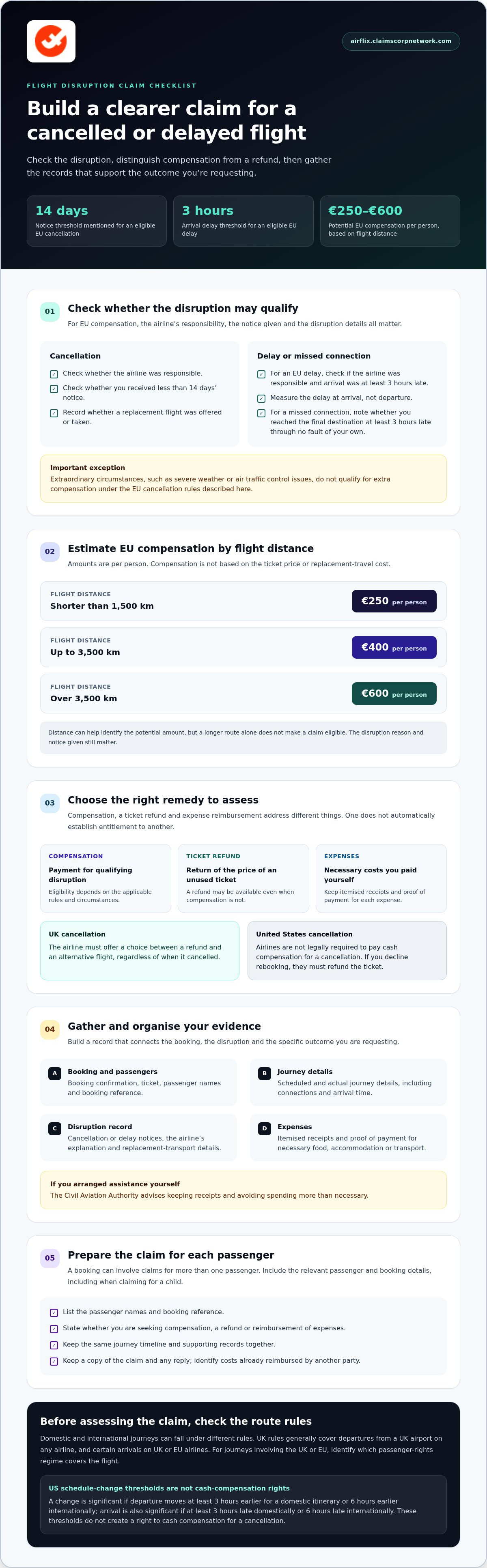
Under EU rules, compensation amounts vary according to the flight’s distance. That distinction helps you estimate the applicable amount before assessing the other eligibility conditions. According to the European Commission, compensation for flights shorter than 1,500 kilometers is €250 per person. According to the European Commission, compensation for flights up to 3,500 kilometers is €400 per person. For flights over 3,500 kilometers, potential compensation is €600 per person.
Compensation is not a calculation of the ticket price or the cost of replacement travel. Establish the journey distance from your itinerary, but remember that a longer route alone does not make a claim eligible. The reason for the disruption and the notice given also matter.
Eligibility After Cancellation or Disruption
Eligibility depends on the disruption, its cause, the notice provided and the rules covering the journey. For an EU cancellation, compensation may be available when the airline is responsible and gives less than 14 days’ notice. A cancellation caused by extraordinary circumstances, such as severe weather or air traffic control issues, does not qualify for extra compensation.
Delays can also qualify under EU rules when the airline is responsible and arrival is at least 3 hours late. The relevant delay is measured at arrival, not departure. A passenger who misses a connection through no fault of their own may qualify if they reach the final destination at least 3 hours late. Keep the cancellation notice and actual arrival details together.
Cash Compensation for Cancellations
Cash compensation is a payment for qualifying disruption; a refund returns the price of an unused ticket. They address different losses, so receiving a refund does not establish whether compensation is also due. In some cases, both may be available, including when an airline cancels at very short notice and offers no replacement flight.
For a cancellation covered by UK rules, the airline must offer a choice between a refund and an alternative flight, regardless of when it cancelled. In the United States, airlines aren’t legally required to pay cash compensation for a cancellation. They must refund the ticket if the passenger declines rebooking. Before accepting a voucher or alternative travel, read the offer carefully and identify which remedy it provides.
Domestic and International Compensation Rules
Domestic and international journeys can fall under different rules, so the route and departure or arrival country matter. In the United States, a schedule change is significant if departure moves at least 3 hours earlier for a domestic itinerary or 6 hours earlier internationally. A change is also significant if arrival is at least 3 hours late domestically or 6 hours late internationally.
US schedule-change thresholds identify significant changes; they don’t create a right to cash compensation for a cancellation. If a passenger declines rebooking, a ticket refund is the relevant remedy. For journeys involving the UK or EU, check which passenger-rights regime covers the flight. UK rules generally cover departures from a UK airport on any airline, and certain arrivals on UK or EU airlines. The applicable regime can affect eligibility and the remedy available.
What do I need to claim compensation?
Build a record linking your booking to the disruption and the remedy you’re seeking. Travel insurance and credit-card benefits may cover eligible losses if their terms include the reason for cancellation and you meet the conditions. These are separate from airline compensation or a ticket refund, so check the relevant policy or card terms and keep the documents for each claim separate.
For an airline claim, gather your booking confirmation, ticket, cancellation or delay notices, and details of any replacement transport. Record the reason given by the airline, your actual arrival time, and any missed connection. If you paid for necessary food, accommodation or transport yourself, keep itemised receipts. The Civil Aviation Authority advises passengers who arrange assistance themselves to retain receipts and avoid spending more than necessary.
Organise your evidence around the outcome you’re requesting. A concise claim should identify:
- The passenger names and booking reference.
- The scheduled and actual journey details, including connections.
- The airline’s explanation and disruption notifications.
- Whether you seek compensation, a refund, or reimbursement of expenses.
- Receipts and proof of payment for each expense claimed.
Submit the claim through the airline’s designated process and keep a copy of your submission and any reply. If you also claim through an insurer or card provider, use the same timeline and evidence, but explain which costs another party has already reimbursed. This helps distinguish overlapping requests from separate losses.
For controllable disruptions in the United States, refund rights do not mean automatic cash compensation. Airlines must refund the ticket when passengers decline rebooking after a cancellation or significant change. The US Department of Transportation’s refund rules for significant flight changes were passed in October 2024. State whether you accept the alternative transport or want the applicable refund, and retain the airline’s offer.
A claims service can organise evidence, assess the airline’s stated reason against relevant passenger-rights rules, submit a claim and manage correspondence about a refusal. Passengers seeking cancelled flight claim assistance may find this useful when an airline disputes responsibility or records span a disrupted connection. You’ll still need accurate booking details and a clear account of events.
Airline duty of care is separate from compensation. Under UK legislation, passengers stranded by a covered cancellation must receive reasonable food and drink, a way to communicate, overnight accommodation when needed, and transport to and from that accommodation. During a tarmac delay, airlines must provide food and water no later than 2 hours into the delay. If assistance isn’t provided, record what happened and keep receipts for reasonable costs. Reliable cancelled flight claim assistance starts with organised evidence of both the disruption and any unmet duty of care.
Claim deadlines in different countries
The time allowed to pursue a flight-disruption claim depends on the country’s rules. Don’t assume that the departure airport alone determines the deadline when travelling between countries. First identify the route, airline and disruption date, then establish which country’s claim period applies. Keep the booking confirmation and cancellation notice together, as they help identify the flight and its timeline.
Deadlines in Germany, France and the UK
In Germany, passengers can assert a claim against an airline up to 3 years after a disrupted flight. The deadline is calculated at the end of the year. In France, passengers have 5 years to file a flight-disruption claim. In the UK, the filing period is 6 years. These periods differ, so a claim that appears timely under one country’s rules may face a different limit under another’s.
Use the applicable country’s period as a planning limit, not a reason to delay. For example, a passenger whose destination was in France should establish whether French rules govern the claim before relying on the 5-year period. The destination alone may not settle which rules apply. The itinerary and circumstances must be considered together.
Work out which deadline matters
Before calculating a final date, collect your booking, ticket, airline correspondence and details of the disrupted journey. Note the scheduled travel date, when the airline informed you, and whether it offered replacement transport. These records distinguish the original booking from a changed itinerary and provide a clear chronology if the airline disputes your claim.
Then compare the journey with the rules of the relevant country. A flight departing from an airport in one country and arriving in another can raise a jurisdiction question. Don’t simply select the longest period in the list. Germany’s 3 years, France’s 5 years and the UK’s 6 years are country-specific periods, not interchangeable extensions.
Keep the claim moving
Prepare your claim promptly, even if the legal deadline seems distant. A clear file should identify the passenger, booking reference, flight route, disruption and requested remedy. Keep copies of your claim and the airline’s response. If the airline asks for further details, retain its request and your reply with the original documents.
Travel insurance and card benefits may have separate notification requirements, so record those terms separately from the airline claim deadline. An airport conversation or an alternative flight offered by the airline doesn’t replace a written record of the disruption. Organising dates and documents early makes it easier to identify the relevant filing period and act before it expires.
Claims for other passengers, including children
You can organise a claim for travel companions, but each passenger’s booking and disruption details matter. Start with the names on the tickets and identify who is making the claim for each passenger. For a child, a parent or guardian can manage the paperwork and keep the child’s details linked to the family booking.
Eligibility still depends on the route, the airline’s responsibility and the disruption circumstances. Under EU rules, the European Commission sets compensation for flights shorter than 1,500 kilometres at €250 per person. That amount is assessed per eligible passenger, so include every traveller’s name rather than submitting only the lead booker’s details. A child’s age alone doesn’t establish the outcome; the journey and applicable rules matter.
Before submitting a claim for a child, gather the same journey evidence as for an adult and check that the child’s ticket and passenger details appear in the documents. A family booking confirmation may show several travellers under one reference, but the claim should make clear which passenger experienced the disruption. If the airline’s form asks who is submitting the claim, distinguish the adult representative from the child passenger.
Useful records include:
- The booking confirmation and ticket details for each traveller.
- Cancellation or delay notices naming the affected flight.
- Any alternative journey offered, including rebooking details.
- Receipts for necessary expenses, matched to the passenger who incurred them.
- Written permission or representative details if an adult claims for another adult.
For another adult, agree who will handle correspondence and keep a record of that person’s authority to act. This helps prevent duplicate submissions if two travellers from the same booking contact the airline separately. Keep copies of the claim and any reply, and clearly identify the remedy requested for each passenger.
Weather can affect eligibility. Under the stated rules, a cancellation caused by extraordinary circumstances such as bad weather does not entitle passengers to extra compensation. Keep the airline’s explanation with the cancellation notice, as the reason matters when assessing each traveller’s claim. A replacement flight may also change arrival details, so record the final destination and arrival time for every passenger.
When several people are affected, organise evidence by booking reference and passenger name before filing. For example, a parent travelling with two children can identify all three travellers, list each ticket and attach the same cancellation notice if it applies to everyone. Clear, accurate passenger details help the airline assess each claim without confusing the adult submitting it with the people whose rights are being claimed.
How do cancellation compensation rules differ for domestic and international flights?
A flight’s domestic or international status can affect which rules apply, but the country and route also matter. For a US itinerary, the Department of Transportation’s significant-change thresholds differ by journey type. For domestic itineraries, a departure moved at least 3 hours earlier or an arrival at least 3 hours later is significant. For international itineraries, the corresponding thresholds are 6 hours.
US schedule-change thresholds identify significant changes; they don’t establish a right to cancellation compensation. US airlines aren’t legally required to pay cash compensation for a cancelled flight. If a passenger declines rebooking, the airline must refund the ticket. Distinguish the remedy you’re seeking: a ticket refund, rather than cash compensation for disruption.
For flights involving the EU or UK, assess the route against the relevant passenger-rights regime. EU rules may apply to a flight departing from an EU airport or arriving there on an EU airline. UK rules generally apply to flights departing from a UK airport on any airline, flights arriving at a UK airport on a UK or EU airline, and flights arriving in the EU on a UK airline. For cross-border journeys, a domestic-or-international label isn’t enough to identify the applicable rules.
Consider a passenger flying from a UK airport to an overseas destination. UK rules may apply because the flight departs from the UK, even if the destination is elsewhere. For a flight arriving in the UK, the airline’s status matters under the stated UK coverage. Keep the departure and arrival airports, airline and booking details together when identifying the rules for your itinerary.
For a US passenger facing an international schedule change, compare the revised itinerary with the original booking. A departure moved 6 hours earlier or an arrival delayed 6 hours meets the stated significant-change threshold. For a domestic US trip, the threshold is 3 hours. Record the change and the airline’s offered alternative, then decide whether to accept rebooking or seek the ticket refund that applies when rebooking is declined.
Use this sequence to assess the route:
- Identify the departure and arrival countries and airports.
- Record the airline operating each flight, including connecting legs.
- Compare the original schedule with the revised departure and arrival times.
- Separate any refund entitlement from a claim for compensation.
When a journey includes several connecting flights, assess the itinerary as a whole before deciding which rules to rely on. Keep the original booking with any revised itinerary, as these records show how the planned departure and arrival changed. A clear route record also helps explain the basis of a claim if the airline questions which passenger-rights regime applies.
Airflix: Flight Disruption Legal Assistance
Airflix provides Flight Disruption Legal Assistance for passengers pursuing a claim after a cancelled or disrupted flight. It can help organise the claims process and address disputes with an airline, including cases that proceed to court. This support is most relevant when you’ve gathered your booking and disruption records but need help progressing the legal claim.
Real-time Claim Status Tracking lets you follow your claim’s progress. Airflix also offers a Baggage Claim Regress service for eligible baggage issues. These services address different types of travel disruption, so identify whether your matter concerns a flight or baggage.
Contact Airflix for information about support with a flight disruption claim.
Choose a clear next step for your claim
A disruption can leave several issues unresolved, from a disagreement with the airline to a separate baggage problem. Decide which outcome you’re pursuing and focus your next step on that issue. If the airline disputes responsibility or the claims process becomes difficult to manage, cancelled flight claim assistance can help you progress the matter with a structured legal approach.
Airflix offers Flight Disruption Legal Assistance and a Baggage Claim Regress service. Its White-label Passenger Portal helps organisations manage passenger claims. These offerings serve different needs, so consider whether you’re pursuing an individual flight claim, a baggage matter or a passenger-portal solution.
For support with a flight disruption claim, contact Airflix for help. A considered next step can make it easier to progress your claim with purpose.
Frequently Asked Questions
Am I entitled to a refund of the ticket price?
A refund may be available when a covered cancellation means you don’t take the booked flight. Under UK rules, the airline must offer a refund or an alternative flight, and you can recover the cost of any unused part of the ticket. In the United States, a passenger who declines rebooking after a cancellation is entitled to a ticket refund. Keep the original booking and any replacement-flight offer to show which travel you accepted or declined.
Can I Get Cash Compensation if My Plane is Cancelled?
Cash compensation depends on the rules covering the flight, the cause of the cancellation and the notice given. EU and UK rules may provide compensation when their eligibility conditions are met. In the United States, airlines aren’t legally required to pay cash compensation for a cancellation; if you decline rebooking, the required remedy is a ticket refund. Don’t treat a refund, voucher and compensation as interchangeable: each provides a different remedy.
Do passenger rights apply in the event of a strike?
Yes, passenger rights can still apply, but a strike doesn’t automatically mean compensation is due. Under the stated rules, a cancellation caused by extraordinary circumstances, including an airport-staff strike, doesn’t qualify for extra compensation. A refund or assistance may be a separate matter. Keep the airline’s explanation and cancellation notice, and note whether the strike involved airport staff or the airline, as the stated cause is relevant to assessing compensation.
Does UK law apply to my flight?
UK flight rules generally apply to flights departing from a UK airport on any airline, flights arriving at a UK airport on a UK or EU airline, and flights arriving in the EU on a UK airline. For example, a flight departing from the UK may be covered even if its destination is elsewhere. Check the operating airline and both airports on your itinerary, particularly if your booking includes connecting flights.
How do I enforce my rights in case of a flight problem?
Start by making a written claim to the airline. Identify the flight, disruption, passengers and remedy you’re seeking. If the airline refuses, ask it to explain its decision and keep its response with your booking and correspondence. If the dispute remains unresolved, organise the evidence into a clear timeline and consider legal assistance to pursue the claim. This also helps distinguish a compensation dispute from a request for a refund or expenses.
When must an airline provide a refund for a cancelled flight?
The payment deadline depends on the country’s rules and how you paid. For a US airline ticket, a refund after rejecting alternative transport is due within 7 business days for a credit-card payment. For another payment method, the US Department of Transportation says it is due within 20 calendar days. Keep the airline’s offer and your response, since they help establish when the refund obligation applies.
How can passengers file a claim with an airline for a cancelled flight?
Use the airline’s claim channel and include the booking reference, passenger names, flight details and cancellation notice. State clearly whether you’re seeking compensation, a refund or reimbursement for expenses. For a family booking, list each affected passenger rather than relying only on the lead traveller’s details. Save a copy of the submitted form and any acknowledgement so you can track the correspondence and respond consistently if the airline requests clarification.
What documents and evidence are needed to claim expenses after a cancelled flight?
Keep itemised receipts, proof of payment and a brief note explaining how each expense arose from the cancellation. For example, match a hotel receipt to the overnight stay and the airline’s disruption notice. The Civil Aviation Authority advises passengers who arrange assistance themselves to retain receipts and avoid spending more than necessary. Separate expenses by passenger and date, and exclude costs already reimbursed by the airline or another source.


