

A delay does not automatically entitle every international passenger to cash compensation. The international flight compensation procedure depends on the route, the operating airline and the type of disruption. Under UK261, listed compensation ranges from £220 for flights up to 1,500 km to £520 for flights over 3,500 km, with the amount depending on distance and delay.
It can be difficult to know whether you’re entitled to a refund, compensation or care while you wait, especially when different rules apply across borders. Start by identifying which passenger-rights rules cover your flight, then match your circumstances to the remedy you’re seeking.
This guide explains when a delay may qualify for a refund or compensation, how to submit a claim to the airline and what to do if it’s rejected. It also sets out UK261 compensation amounts and deadlines, alongside the relevant rules for US flights and claims under the Montreal Convention, so you can understand the process before deciding your next step.
Key Takeaways
- A two-hour delay does not create an automatic right to cash compensation everywhere; the applicable rules and arrival delay matter.
- For international delay expenses, the Montreal Convention provides a route to claim from the airline, with receipts helping to support reimbursement.
- Under EU Regulation 261/2004, eligible delays can lead to compensation of up to €600, depending on the flight and circumstances.
- Send a claim to the airline that operated, or was due to operate, the flight, and keep your flight records and receipts for any escalation.
- UK261 compensation is £220, £350 or £520 according to flight distance; the article also explains the claim deadline and how to proceed.
Can you claim compensation for a 2-hour delay?
Two hours alone doesn’t create a universal right to cash compensation. Under EU rules, some passengers may receive care after two hours, while compensation generally depends on arrival delay, route and applicable rules.
For international flights, delays, cancellations, involuntary denied boarding, and lost, delayed or damaged baggage may give rise to claims under different passenger-rights rules. The route, operating airline, type of disruption and any documented loss determine which rules apply.
Eligibility after flight delays
Delay eligibility depends on the arrival time and the passenger-rights regime covering the flight. Under EC 261, an eligible passenger may qualify for compensation when arrival is at least three hours late. A two-hour wait can instead trigger assistance on flights of 1,500 kilometres or less; longer categories have different thresholds.
For eligible flights of 3,500 kilometres or more, compensation may be reduced by 50% when arrival is three to four hours late. Keep the itinerary and evidence of actual arrival, since departure delay alone doesn’t establish the arrival delay used for eligibility. A refund is a separate remedy, not an automatic substitute for compensation.
Montreal Convention delay claims
Article 19 of the Montreal Convention allows passengers on international itineraries to claim proven expenses or loss caused by delay from the airline. Submit the claim to the carrier, explain how the delay caused each expense, and attach receipts. A delay claim may depend on the loss caused by the delay, rather than being a fixed payment for every delayed journey.
If the airline denies a claim, court action may be possible where the passenger believes the carrier failed to take all measures reasonably required to avoid the delay damage. A court claim may be subject to a time limit, so check the applicable rules before proceeding. Keep the airline’s response and all supporting records.
Keep expense evidence. If the airline doesn’t provide required care, retain receipts for reasonable costs incurred during the disruption. These may support a reimbursement request, which is separate from fixed compensation under passenger-rights rules.
The Montreal Convention also covers baggage claims: compensation for lost, delayed or damaged baggage can reach 1,000 SDRs. Report the baggage problem to the airline and preserve the report, baggage records and receipts relevant to the loss.
For cancellations and denied boarding, check which passenger-rights regime applies rather than assuming a two-hour delay threshold decides the claim. Under EC 261, cancellation notice and rerouting circumstances can affect compensation; baggage claims instead depend on the documented baggage problem and resulting loss.
Can You Get a Refund or Compensation for a Delayed Flight?
Passenger rights depend on the route, operating airline and disruption, so an international ticket doesn’t have one universal rule. US Department of Transportation refund rules differ from EU261 and UK261: the first focuses on refunds after qualifying cancellations or significant changes, whilst the latter regimes may provide fixed compensation.
A refund, expense reimbursement and fixed compensation are separate remedies, each with its own conditions. Depending on the circumstances, a passenger may be entitled to more than one.
EU261 route and airline eligibility
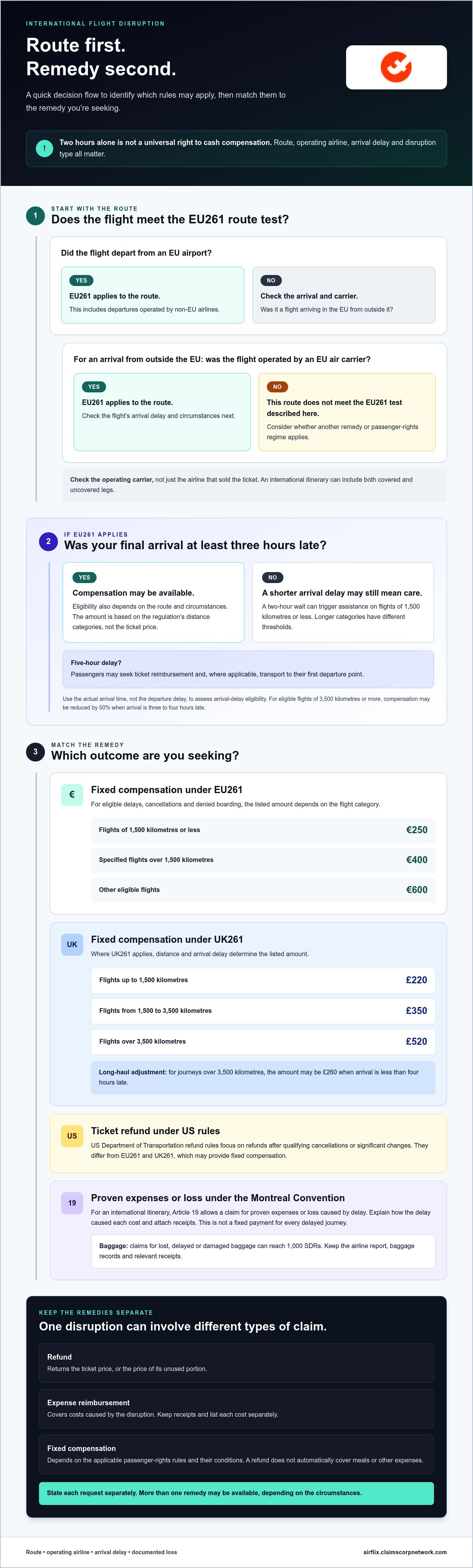
EU Regulation 261/2004 eligibility depends partly on where a flight departs and which airline operates it. This route test matters because an international itinerary can include covered and uncovered legs.
EU261 applies to departures from an EU airport, including flights operated by non-EU airlines. For a flight arriving in the EU from outside it, coverage applies when an EU air carrier operates the flight, but not when a non-EU carrier does. Check the operating carrier, rather than relying only on the airline that sold the ticket.
For eligible delays, arriving at your final destination at least three hours late may qualify you for compensation. Air traffic disruption alone does not determine eligibility: the route, arrival delay and circumstances of the disruption all matter.
EU261 and UK261 compensation amounts
EU261 sets fixed amounts by route distance for eligible delays, cancellations and denied boarding. The amount matters because it’s based on the regulation’s categories, not the ticket charge.
Eligible EU261 delays can receive €250 for flights of 1,500 kilometres or less, €400 for specified flights over 1,500 kilometres and €600 for other eligible flights. A five-hour delay also gives passengers the right to seek reimbursement and, where applicable, transport to their first departure point.
UK261 lists £220 for flights up to 1,500 km, £350 for flights from 1,500 to 3,500 km, and £520 for flights over 3,500 km. For long-haul journeys over 3,500 km, the amount may be £260 when arrival is less than four hours late. Distance and arrival delay therefore affect the applicable amount.
Separate refunds, expenses and compensation claims
A refund returns the ticket price, or the price of its unused portion. Expense reimbursement covers costs caused by the disruption, while fixed compensation is determined by the relevant passenger-rights rules. State each request separately so the airline can assess the remedy you’re seeking.
For an eligible EU disruption, ticket reimbursement is due within seven days. Keep expense receipts and list each cost separately from any fixed-compensation request. A ticket refund does not automatically cover meals, accommodation or other costs incurred during travel.
US rules use a different threshold. According to the U.S. Department of Transportation, a significant international flight delay is one exceeding six hours from scheduled departure. Since 2024, eligible passengers must receive automatic refunds after cancellations or significant changes if they reject alternative bookings and other compensation offers. The refund covers the amount paid, including taxes and fees, minus any used ticket portion.
For an international journey with connecting flights, identify each operating airline and the final arrival time before filing. A delay can affect eligibility differently under EU261, UK261 and US refund rules, so match the claim to the route and disruption rather than treating every delay as a refund event.
Flight compensation claim submission and escalation
Submit a written claim to the airline that operated, or was due to operate, the disrupted flight. Identify your departure, destination and reason for claiming so the airline can assess whether you qualify.
Submitting a compensation claim
A compensation claim formally asks the operating airline to assess your entitlement. Send it to the correct carrier, especially if a different airline sold your ticket.
Use the airline’s claim channel and identify the passenger, flight and travel date. Describe the disruption, specify whether you’re seeking fixed compensation, reimbursement or a refund, and cite the relevant rule if you know it. Keep your submission and acknowledgement together. If the airline rejects your claim, ask for its reasons in writing and respond with relevant evidence.
Documents and evidence for claims
Your evidence should link the booking to the disruption and any resulting expenses. A complete record also helps distinguish a delayed-arrival claim from a request to recover costs.
Include your booking confirmation and boarding pass, if available, along with the flight number, airport and scheduled destination. Add airline messages explaining the delay, cancellation or denied boarding, and record your actual arrival time. For reimbursement, attach itemised receipts and explain how each expense resulted from the disruption. For delayed baggage, keep the mishandled baggage report and purchase records.
Keep copies of your documents, not just the originals. A dated timeline can clarify when boarding was announced, when the departure changed and what alternative travel the airline offered. For instance, a hotel receipt is more useful alongside the cancellation notice and an explanation of why an overnight stay was necessary.
Claim-handling times vary by route and complexity. Standard claims submitted through claims apps are estimated to take 3-6 weeks, while claims requiring legal escalation are estimated at 8-16 weeks. Court proceedings can take 6-18 months. These are distinct stages, so an airline’s initial response time is not the same as a final court outcome.
A no-win-no-fee claims service may handle correspondence and legal escalation in exchange for a fee or commission if the claim succeeds. Before authorising representation, read the agreement carefully. Check the deduction, whether it applies to compensation or recovered expenses, and what happens if the airline refuses payment. Fee and commission terms vary by service, so review the written terms rather than assuming a standard rate.
If you handle the international flight compensation procedure yourself, keep the claim reference and send follow-ups through the same channel. If you escalate, include the airline’s final response, your original submission and the evidence supporting your case. A consistent record makes it easier to show what you claimed and why.
When airlines do not provide additional compensation
An airline may refuse fixed compensation even when a disruption caused inconvenience. That does not automatically remove separate rights to care, a refund or reimbursement. Those rights depend on the route and circumstances.
Requesting compensation from the airline
A direct request asks the carrier to assess compensation under the rules that apply to your ticket. Keep the submission focused, and distinguish fixed compensation from care or expense reimbursement.
Send the airline your flight details, booking reference, scheduled departure and arrival, and actual arrival time. Describe the disruption and state the remedy you’re seeking, such as compensation under the relevant passenger-rights regulation. If the carrier declines, ask for its reason in writing and keep the response with your records. A two-hour delay alone does not require US airlines to pay compensation.
Keep requests for care costs separate from a fixed-compensation claim. If you arranged meals or transport because the airline did not provide assistance, retain receipts and explain how each expense arose. A receipt proves what you spent, but does not by itself establish entitlement to fixed compensation.
Complaining directly to the airline
A complaint records what happened and asks the airline to address a specific failure or claim. A clear written account is important because it creates a record for any later escalation.
Use the carrier’s complaint channel and include the flight number, ticket details, disruption and outcome you’re seeking. Attach relevant receipts or airline messages, then keep a copy and any complaint reference. If the reply addresses a refund but not compensation, explain that these are separate requests and ask the airline to respond to each.
Care and assistance may still apply even when fixed compensation is unavailable. Under the applicable European rules, care includes two telephone calls, faxes or emails, as well as meals and refreshments reasonable for the waiting time. If an overnight stay is necessary, it includes hotel accommodation and transport between the airport and hotel where needed.
For EU journeys, the stated assistance thresholds depend on distance: two hours or more for flights of 1,500 kilometres or less, three hours or more for intra-community flights over 1,500 kilometres and other flights between 1,500 and 3,500 kilometres, and four hours or more for longer categories. These are care thresholds, not automatic compensation awards.
If a cancellation disrupts your travel, you may choose rerouting under comparable transport conditions as soon as possible, or at a later convenient date, subject to seat availability. If you decide not to continue, you may request a refund for unused segments and completed segments, with return to the departure point shown on your ticket.
Ask the airline to set out its rebooking and care arrangements in writing. For an eligible US refund, vouchers or travel credit cannot replace cash unless you explicitly approve. If you face an overnight wait, record the assistance offered and keep receipts for costs you paid yourself.
UK261 compensation amounts and claim deadlines
UK261 sets fixed compensation bands for eligible disrupted flights, based on distance and, on some long-haul journeys, arrival delay. The amount and filing deadline are separate questions, so check both before submitting a claim.
Compensation by flight distance
UK261 compensation varies according to the distance category for the flight. Identifying the correct band matters because the amount is fixed rather than calculated from the ticket price.
The listed amounts are £220 for flights up to 1,500 km, £350 for flights from 1,500 to 3,500 km, and £520 for flights over 3,500 km. For example, a flight in the 1,500 to 3,500 km band falls under the £350 category, not the short-haul amount.
Distance is measured between the relevant points, not by adding the route’s individual legs. The Irish Aviation Authority says these passenger-rights distances must be calculated using the Great Circle Method. For connecting journeys, use the applicable distance calculation rather than assuming the distance is the sum of each leg.
Compensation amounts and reductions
For eligible flights over 3,500 km, arrival delay can change the listed UK261 amount. This matters because a long-haul claim may fall into a reduced band even when the distance category is unchanged.
The listed amount is £520 when the delay is at least four hours, and £260 when it is less than four hours. Compare the scheduled arrival with the actual arrival, then apply the stated long-haul delay category. The applicable figure is compensation, not a refund of the ticket charge.
A cancellation or delay may also involve separate rights to care, rebooking or reimbursement. For example, accommodation during an overnight wait is distinct from fixed compensation. Keep records of the carrier’s offer and your expenses, then state each remedy separately in your claim.
The stated UK261 filing deadline is six years. Claim guidance also says claims may concern flights operated within the last three years. Treat the filing deadline and the flight period described as separate points when reviewing a past disruption; retain the booking, flight date and correspondence to identify the claim clearly.
Before submitting, record the route, distance, scheduled arrival and actual arrival. For cancelled flights, retain the airline’s notice and any rerouting details, since the disruption circumstances help explain the remedy requested. A written claim should identify the relevant UK261 amount and include supporting travel records.
Review your UK261 claim options and organise the flight details, arrival evidence and airline correspondence before proceeding.
Airflix: Flight Disruption Legal Assistance
Airflix provides Flight Disruption Legal Assistance for passengers seeking support with a disrupted-flight claim. It can help when an airline has rejected a compensation request or the claim needs further legal handling, including court procedures.
For baggage problems, Airflix also offers a Baggage Claim Regress service. Real-time Claim Status Tracking lets passengers follow their claim’s progress. Since these services address different issues, identify whether your case concerns a flight disruption or baggage.
Contact Airflix to discuss support for your flight disruption or baggage claim.
Put your next claim step in order
A clear international flight compensation procedure starts by identifying what needs resolving: a disrupted-flight claim, a baggage issue or passenger-claim administration. Keep these needs distinct to identify the next action and the records required. Not every airline problem is the same type of claim.
Airflix offers Flight Disruption Legal Assistance for disruption claims and a Baggage Claim Regress service for baggage matters. For passenger operations, its White-label Passenger Portal provides a separate way to manage claims through a branded portal. Choose the option that fits the matter you need to progress.
If you’re ready to discuss support for your flight claim, contact Airflix about your flight claim. A focused enquiry is a practical next step towards organising the matter and moving it forward.
Frequently Asked Questions
Are US or non-EU passengers eligible for compensation under EU law?
Yes, nationality alone doesn’t determine eligibility under EU261; the route and operating airline do. A US passenger departing from an EU airport may be covered, even on a non-EU airline. For a flight from outside the EU to an EU destination, EU261 applies when an EU carrier operates it. Check the operating airline on your booking, as the ticket seller may be a different company.
Can You Get Airline Compensation if You Miss a Connecting Flight?
Possibly, if the missed connection results in an eligible delay at your final destination under the passenger-rights rules covering the journey. A late first leg, for example, may make you arrive substantially later than planned even if that leg’s delay seemed modest. Keep records for each flight and your final arrival time. The route, operating airline and reason for the disruption affect whether fixed compensation applies.
What exactly is ‘care and assistance’?
Care and assistance means practical support during a qualifying wait, rather than fixed compensation for the disruption. Under the applicable European rules, it can include meals and refreshments, two telephone calls, faxes or emails, and hotel accommodation if an overnight stay becomes necessary. Transport between the airport and hotel is included where needed. Keep receipts if you pay for necessary care because the airline didn’t provide it.
What if my airline refuses to refund me?
Ask the airline to provide its refusal and reasoning in writing, then compare that explanation with the rules covering your flight. For a US flight affected by a cancellation or significant change, eligible passengers who reject alternative bookings and other compensation offers are entitled to an automatic refund. Keep your booking, messages and refund request together. If the dispute concerns Montreal Convention delay damages, court action may be pursued in the circumstances described by that Convention.
When can you get a cash refund?
A cash refund may be due if you reject the airline’s alternative travel after a qualifying cancellation or significant change. Under US Department of Transportation rules, eligible refunds must be issued automatically and promptly. Vouchers or credit cannot replace them unless you explicitly approve. For eligible EU disruption claims, ticket-cost reimbursement is due within seven days. A refund covers the ticket payment, not necessarily separate expenses or fixed compensation.
Which international flight compensation laws apply to U.S. travelers, including EU261, UK261, and Montreal Convention?
The route and carrier determine which rules may apply to a US traveller. EU261 can cover departures from an EU airport and certain inbound flights operated by EU carriers; UK261 has its own flight coverage and compensation bands. The Montreal Convention addresses proven loss caused by international flight delays and baggage problems. US Department of Transportation rules govern refunds for qualifying US-related cancellations and significant changes. One itinerary may raise more than one claim type.
How much compensation can passengers receive under EU261 and UK261 based on flight distance and disruption?
Eligible EU261 compensation ranges from €250 for flights up to 1,500 kilometres, to €400 for specified medium-distance flights and €600 for other eligible flights. UK261 lists £220 up to 1,500 km, £350 from 1,500 to 3,500 km, and £520 over 3,500 km. For eligible UK261 long-haul flights, the listed amount is £260 when arrival is less than four hours late. Route and arrival delay affect the amount.
How do I file an international flight compensation claim with an airline step by step?
Send your claim to the airline that operated, or was due to operate, the flight. Keep a record of each stage:
- Gather your booking confirmation, boarding pass and flight details.
- Record the disruption, actual arrival and the remedy you seek.
- Attach relevant airline messages and receipts for expenses.
- Save the submission reference and request written reasons if refused.
For a Montreal Convention delay claim, explain how the delay caused your documented loss.


