

What if the word “strike” on a disruption notice doesn’t tell you whether you’re entitled to compensation? Passenger rights during strikes depend on who took industrial action, which rules apply to your journey and what happened to your flight. An airline strike may be treated differently from action by air traffic controllers or airport staff.
When plans change, it can be difficult to know what to do, especially if you’re trying to reach your destination or facing extra costs. A strike may affect your right to compensation, but it doesn’t automatically remove other rights. Depending on the circumstances, you may still be entitled to care, rerouting or a refund.
This guide explains how to distinguish the main types of strikes and what those differences can mean under the rules that apply to your route. It also sets out what to ask the airline, which messages and receipts to keep, and how to approach a claim if compensation is disputed. Airflix provides legal assistance for flight disruptions, including real-time claim-status monitoring and representation in court proceedings where applicable.
Key Takeaways
- Identify which group is striking, as the source of disruption can affect whether compensation may apply.
- Separate compensation from care, rerouting and a refund. One outcome does not automatically rule out another.
- Passenger rights during strikes depend on the route, the disruption and the rules that apply.
- Check official flight updates, contact the airline and keep relevant messages and receipts.
- If an airline disputes a claim, Airflix provides legal assistance, real-time claim-status monitoring and court representation where applicable.
Passenger rights during strikes: what changes when a flight is disrupted?
A strike-related disruption occurs when industrial action contributes to a flight delay, cancellation or other change to the planned journey. The word “strike” alone doesn’t establish whether compensation is payable. The identity of the striking workers, the disruption’s effect and the rules governing the route all matter.
Separate four possible outcomes. Compensation is a potential payment assessed under specific eligibility rules. Care means practical assistance while you wait, such as meals or accommodation where required. Rerouting means an alternative journey to your destination, whilst reimbursement means a refund in situations where the relevant rules provide that choice. These rights have different purposes and conditions, so receiving one doesn’t necessarily settle whether another applies.
A strike does not automatically remove every passenger right.
Which passenger rights may remain during strike disruption?
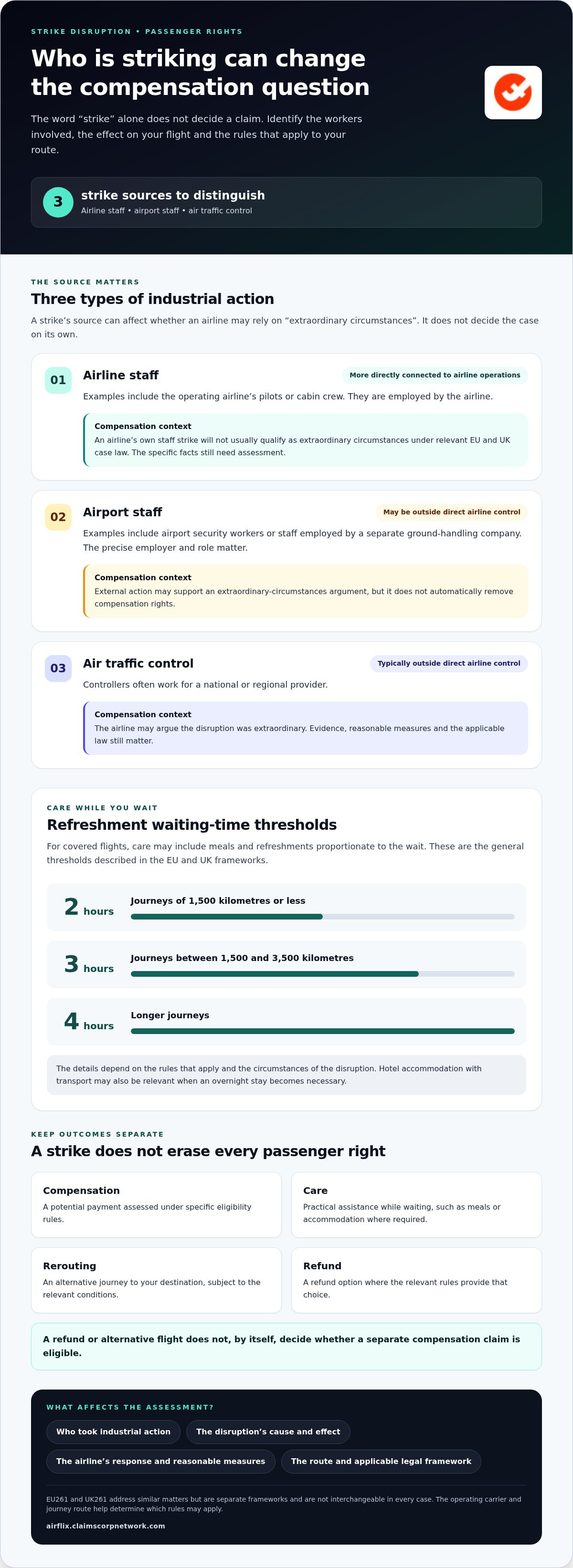
Under EU and UK passenger-rights frameworks, care may include meals and refreshments proportionate to the waiting time, and hotel accommodation with transport when an overnight stay becomes necessary. For covered flights, the waiting-time thresholds for refreshments are generally two hours for journeys of 1,500 kilometres or less, three hours for journeys between 1,500 and 3,500 kilometres, and four hours for longer journeys. The details depend on the applicable rules and circumstances.
If a flight is cancelled, passengers may have a choice between a refund and rerouting, including travel to the destination at the earliest opportunity or at a later date, subject to the relevant conditions. A delay of five hours or more may also create a refund option under EU and UK rules. This is distinct from compensation: an alternative flight or refund doesn’t, by itself, determine whether a separate compensation claim is eligible.
Which rules may apply to your journey?
Regulation (EC) No 261/2004 sets passenger rights for certain flights connected with the European Union. EU Regulation 261/2004 is often referred to as EU261. UK261 is a separate framework retained in UK law, with its own jurisdictional application. They address similar matters, but shouldn’t be treated as interchangeable in every case.
The departure and arrival points, the operating airline and the jurisdiction connected with the journey can help determine which framework applies. A flight operated by one carrier may be subject to different rules from a similar journey operated by another, depending on its route. Journeys outside the EU and UK may fall under different national rules, so don’t assume EU261 or UK261 covers every disrupted flight.
For a specific journey, establish the operating carrier and route before assessing the available rights. Check current official guidance on the legal scope of EU261 and UK261 and how each applies to your itinerary. Then consider care, rerouting, reimbursement and compensation separately.
How the type of strike affects passenger rights
Start by identifying who took industrial action, not simply whether a flight notice mentions a strike. Under EU and UK passenger-rights rules, that distinction can affect whether an airline may rely on “extraordinary circumstances” to defend a compensation claim. It doesn’t decide the case on its own: the disruption’s cause, the airline’s response and the applicable legal framework also matter.
| Strike category | Who is taking action? | How directly is the cause controlled by the airline? | What it may mean for compensation |
|---|---|---|---|
| Airline staff | For example, the airline’s pilots or cabin crew. | They are employed by the operating airline, so the action is more directly connected to its operations. | Under relevant EU and UK case law, an airline’s own staff strike will not usually qualify as extraordinary circumstances. The specific facts still require assessment. |
| Airport staff | For example, airport security workers or staff employed by a separate ground-handling company. | The workers may be outside the airline’s direct control, but the precise employer and role matter. | External action may support an extraordinary-circumstances argument, but it doesn’t automatically remove compensation rights. |
| Air traffic control | Air traffic controllers, often working for a national or regional provider. | Typically outside the airline’s direct control. | The airline may argue the disruption was extraordinary, subject to the evidence, its reasonable measures and applicable law. |
Airline staff strikes and compensation assessment
The Court of Justice of the European Union considered airline employee strikes in Krüsemann and Others (Case C-195/17) and related transport rulings. These decisions support treating strikes by an airline’s own employees differently from external industrial action. In the UK, the Court of Appeal’s decision in Civil Aviation Authority v Ryanair DAC [2022] EWCA Civ 76 also addressed airline pilot and crew strikes. The details of a particular disruption still matter. The existence of a strike is not, on its own, proof that an airline qualifies for an exemption.
Airport and air traffic control strikes
Industrial action by airport or air traffic control workers may be outside the operating airline’s control. That can make an extraordinary-circumstances defence more relevant, but it doesn’t determine the outcome. The airline’s reasonable measures and the connection between the strike and the specific cancellation or delay need consideration. The European Commission guidance on air passenger rights explains the EU framework; UK journeys require consideration of UK261 and its application.
The strike organiser can point towards the relevant legal test, but only the full circumstances and evidence can determine a particular claim. Compare the airline’s stated reason with flight updates and any available details about the striking workforce. If the airline disputes a claim or its explanation is unclear, Airflix’s flight-disruption legal assistance can help assess the case and manage its progress.
Compensation, rerouting or refund: compare the possible outcomes
A disrupted journey can lead to more than one type of remedy, but each serves a different purpose. A replacement flight helps you continue travelling; a refund returns the ticket price when the rules give you that option. Care addresses practical needs during a wait, while compensation is a separate payment assessed against eligibility criteria. An airline offering rerouting hasn’t necessarily answered whether compensation is due.
- Rerouting: After a covered cancellation, you may be entitled to travel to your destination on an alternative service under the applicable rules. This is intended to get the journey back on track, not to compensate you for the disruption.
- Refund: In certain situations, including cancellation or a qualifying long delay, you may be able to choose reimbursement of the ticket instead of travelling. Check the options and conditions that apply to your route before accepting a different arrangement.
- Care: Depending on the disruption and relevant framework, the airline may need to provide reasonable assistance such as food, refreshments or accommodation while you wait. This is practical support, not a cash compensation award.
- Compensation: A separate claim may be considered if the disruption meets the applicable eligibility requirements. Its assessment can depend on the cause, the delay or cancellation, and whether an exception applies.
When might rerouting, reimbursement or care apply?
For journeys covered by EU261 or UK261, cancellation can give passengers a choice between rerouting and a refund, subject to the rules and circumstances. A delay of five hours or more may also bring a refund option. An airline may arrange an alternative flight, but that doesn’t mean a passenger must treat it as a refund or as compensation. Consider whether you still need to reach the destination and what option the airline is actually offering.
Care may be relevant when disruption leaves passengers waiting for an extended period or requires an overnight stay. If assistance isn’t provided and you have to pay for reasonable essentials, keep itemised receipts and note why each expense was necessary. Don’t assume every purchase will qualify for reimbursement. The Civil Aviation Authority passenger guidance explains UK rules on delays and assistance.
When might compensation be considered separately?
Compensation depends on the legal framework applicable to the journey and the facts behind the disruption. The type of strike may be relevant, as may the airline’s explanation and evidence. A refund, replacement transport or reimbursement of reasonable expenses addresses a different loss or need, so none automatically proves or disproves a compensation claim.
Keep airline messages, booking details and receipts together. If a travel-insurance policy is involved, any payment under it is governed by the policy terms and is separate from the airline’s legal duties. Insurance reimbursement doesn’t determine whether the airline owes a refund, care or compensation. For passenger rights during strikes, assess each possible outcome on its own terms and against the rules that apply to the journey.
What to do when a strike disrupts your flight
Clear records and timely decisions can make a disruption easier to manage and help you assess a later claim. Follow this sequence, keeping immediate travel arrangements separate from any decision about compensation.
Actions to take before travelling to the airport
Check the airline’s flight status and latest instructions before setting off. Compare them with official airport updates, which may help clarify whether the terminal or relevant services are affected. If the flight is cancelled, don’t assume you must still attend the airport. Check the airline’s guidance on where to get assistance and how it will handle your booking.
- Confirm the disruption. Check the flight number and date on the airline’s official channels. Recheck before departure, as arrangements can change.
- Save the notice. Keep cancellation or delay messages, emails and screenshots showing the date and time. Save any instructions about airport attendance, rebooking, refunds or assistance.
- Ask what options are available. Contact the airline through its stated support channels and keep a record of its response. Note whether it offers rerouting, a refund, care or another arrangement, as these address different needs.
- Keep strike information in context. Record what the airline says about the cause and note any relevant official updates. A news headline can provide context, but it doesn’t establish which workers were involved or prove the legal cause of your particular disruption.
- Track what happens to your journey. Retain your booking confirmation and boarding pass, and record actual departure and arrival times. If you miss a connection, keep the details of that leg and any revised arrangements.
- Document necessary expenses. Keep itemised receipts for reasonable disruption-related spending, such as meals, accommodation or local transport. Add a brief note explaining why each expense was needed and how it related to the delay.
Records to keep after a delay or cancellation
Store your documents together, digitally or in a folder, and keep copies of original files where possible. Include the booking confirmation, boarding passes, airline notices, support correspondence, evidence of actual arrival time and relevant receipts. This creates a clearer timeline if the airline later disputes what happened or how long the disruption lasted.
Passenger rights during strikes can turn on details that are easy to lose during a stressful journey: the wording of a notice, when an update arrived, or the reason given for a delay. Make factual notes while events are fresh, and distinguish what you directly observed from what the airline or another source reported.
Quick checklist: “Check official updates, follow the airline’s instructions, save every notice, record actual journey times and keep itemised receipts.”
If you’ve kept the relevant records and want help assessing a disputed flight disruption, request flight-disruption legal assistance from Airflix.
How Airflix can support a strike-related flight claim
Once you’ve established what happened to your flight and kept the relevant records, decide whether to pursue a claim. Passenger rights during strikes can involve fact-specific questions about the disruption, the operating airline and the rules that apply. Airflix provides legal assistance for flight disruptions, with claim-status monitoring and legal representation in court proceedings where applicable. No service can guarantee that a claim will succeed: the assessment and outcome depend on the evidence and applicable law.
What claim assistance can help manage
A strike notice may not explain which workers took action or how that action affected a particular flight. Airflix’s legal assistance helps manage the claim process by considering the available flight and disruption information against the relevant passenger-rights framework. The airline’s explanation and the records you retained can be important to that assessment.
Airflix provides real-time monitoring of claim status, so you can follow progress as the matter proceeds. If a case reaches court, legal representation is provided where applicable. These are practical parts of claim support, not a promise of a particular decision, payment or timeframe.
What happens after deciding to pursue a claim?
The claim process begins with the journey details and the disruption record. Organising the information you already have can make the circumstances clearer and help distinguish the airline’s explanation from what the documents show.
- Provide the flight details. Include the booking information, flight number, route and travel date so the journey can be identified.
- Describe what occurred. Set out whether the flight was cancelled, delayed or rerouted, and share the airline’s notices or explanation of the strike.
- Supply supporting records. Relevant evidence may include booking confirmations, boarding passes, correspondence, journey times and receipts connected with the disruption.
- Allow the circumstances to be assessed. The claim is considered against the evidence, the applicable passenger-rights rules and any relevant legal decisions. The facts may affect whether a claim can proceed and its eventual outcome.
Keep your own copies of the records and communications you submit. If the airline disputes the cause of disruption or relies on an exemption, consider that explanation alongside the evidence rather than treating it as the final word on eligibility.
Airflix provides flight-disruption legal assistance, including real-time claim-status monitoring and legal representation in court proceedings where applicable. If you want support with a strike-related claim, explore Airflix’s flight-disruption legal assistance.
Take the next step with a clear claim record
A disruption can leave unanswered questions even after travel arrangements are resolved. Use the records you’ve gathered to decide whether you want to pursue a claim, and keep clear the distinction between what happened and what the airline says caused it. That gives any assessment a more practical starting point.
If you’d like support with that process, Airflix provides flight-disruption legal assistance and real-time claim-status monitoring. Legal representation in court proceedings is provided where applicable. The assessment and outcome depend on the individual facts and the rules that apply, so no claim result can be assumed in advance.
For help with your next step, explore Airflix flight-disruption legal assistance. Understanding passenger rights during strikes is a useful first step. Organised evidence and considered support can help you move forward with greater confidence.
Frequently Asked Questions
Is an airline always required to pay compensation when a strike cancels a flight?
No. A strike cancellation doesn’t automatically mean compensation is payable, or that the airline is exempt. The assessment may depend on who organised the action, how it affected the flight and which rules govern the journey. For example, an airline’s own employees taking action may be assessed differently from air traffic controllers. Passenger rights during strikes must be considered alongside any separate entitlement to care, rerouting or reimbursement.
Can I get a refund or another flight if a strike disrupts my journey?
Possibly. Depending on the disruption and the rules applying to your flight, you may be offered a choice between a refund and rerouting. Check whether an alternative itinerary reaches the same destination and note any changes to connections or travel dates before accepting it. Keep the airline’s written offer and your response. A refund or replacement flight concerns your travel arrangements; it doesn’t decide whether you can also claim compensation.
Does an airport strike count as an extraordinary circumstance?
It can be relevant to an airline’s argument that a disruption was outside its control, but the phrase “airport strike” doesn’t determine the legal result. For example, security staff may work for a separate employer, whilst some ground operations may be contracted or organised differently. The workers involved, their relationship to the airline and the steps taken to manage the effects all matter. Assess the flight’s actual cause under the rules that apply.
What should I do if my flight is delayed because of a strike?
Start by checking the airline’s latest flight information and instructions, then keep a dated record of updates as the expected departure changes. If you’re travelling with others, retain each person’s booking and boarding information, as claims are assessed for individual passengers. Ask the airline what assistance or onward travel it is arranging. After the journey, write down the actual arrival time and keep expense records separate from evidence relating to compensation.
Can I claim compensation for a missed connection caused by strike disruption?
A missed connection may be relevant, particularly if it changes when you reach your final destination, but it doesn’t establish eligibility on its own. Keep details for both the delayed flight and the missed onward service, including whether they appeared on one booking or separate bookings. Record the final arrival time and any replacement arrangements. The complete itinerary, the cause of disruption and the applicable rules need to be assessed together.
What evidence should I keep for a strike-related flight claim?
Keep documents that establish both your planned journey and what actually happened: booking confirmations, boarding passes, airline messages, cancellation or delay notices, and evidence of arrival time. For expenses, retain itemised receipts and note the reason for each purchase, such as an unplanned overnight stay. Save strike updates with their source and date, but treat them as background rather than proof of the airline’s legal responsibility.
How can legal assistance help with a strike-related flight claim?
Legal assistance can help organise the flight record, consider the disruption against the applicable passenger-rights rules and manage claim communications. Airflix provides real-time claim-status monitoring and legal representation in court proceedings where applicable. This support doesn’t guarantee that a claim will be accepted or succeed. The outcome depends on the evidence, the circumstances of the disruption and the law governing the journey.


