

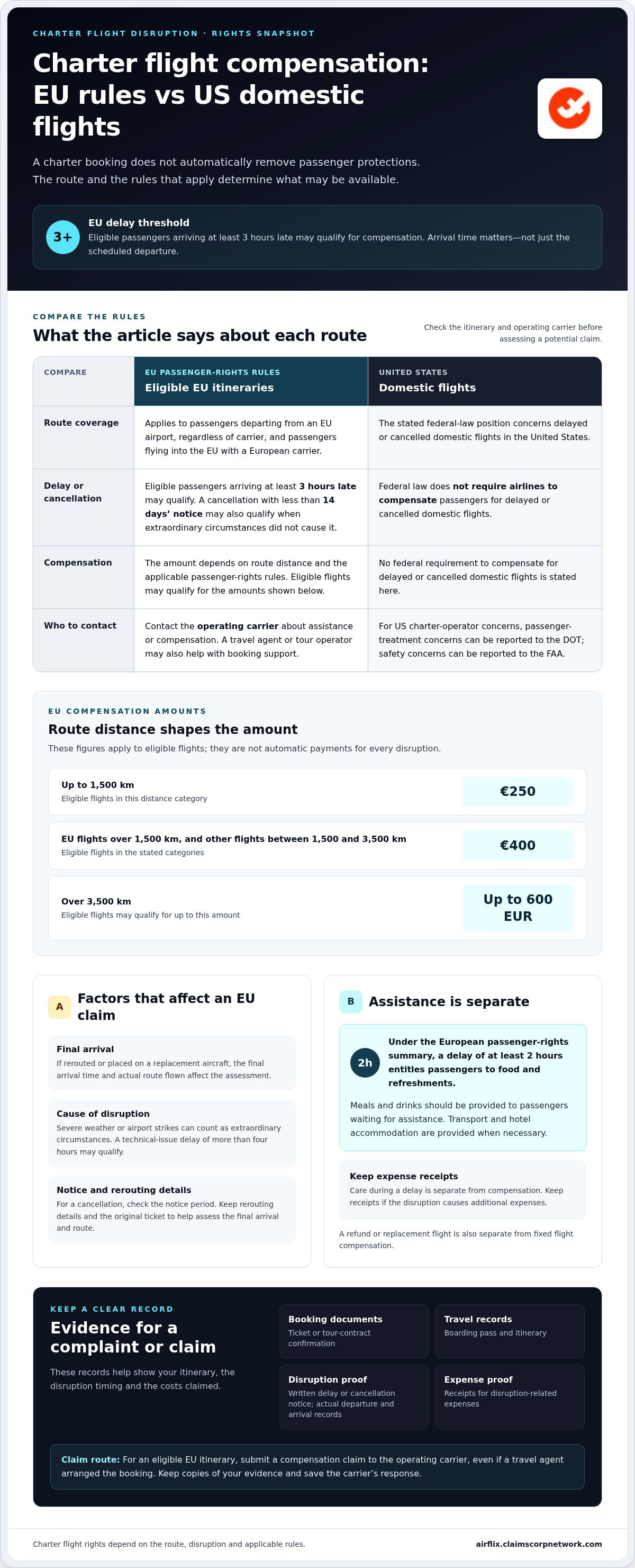
A charter booking doesn’t automatically rule out charter flight compensation. Under EU passenger-rights rules, eligible passengers arriving at least 3 hours late may qualify for compensation, with the amount depending on the route; the Publications Office of the European Union lists €250 for eligible flights up to 1,500 km and €400 for specified longer flights, while eligible flights over 3,500 km may qualify for 600 EUR. In the United States, federal law doesn’t require airlines to compensate passengers for delayed or cancelled domestic flights.
It’s understandable to expect a refund or replacement flight when a charter journey is cancelled, but these are separate from compensation, and the rules depend on the route. The carrier generally operates the flight and is responsible for any passenger assistance or compensation owed. A travel agent or tour operator may also help arrange support.
This guide explains when a disrupted charter flight may qualify for compensation, how delays and cancellations affect eligibility, and whether to contact the operating carrier or travel agent. It also covers refunds and replacement flights, the records that can support a claim, and how Flight Disruption Legal Assistance can help with the claims process.
Key Takeaways
- Check where the charter flight departed from and which passenger-rights rules apply before assessing compensation eligibility.
- Contact the operating carrier about assistance or compensation; the travel agent may also help if the booking was made through one.
- Assess a refund or replacement flight separately from compensation, as each addresses a different part of a disruption.
- Keep booking documents, boarding passes, disruption records and receipts to support a claim.
- Review the flight’s cause, arrival impact and rerouting details to understand how they affect a potential claim.
Compensation for delayed charter flights - how to obtain it?
A charter booking may still fall under passenger-rights rules when a flight is delayed or cancelled. Eligibility for charter flight compensation depends on the route, arrival delay, cause of disruption and applicable law.
Delay and cancellation eligibility
Delay and cancellation eligibility means assessing whether a disruption meets the rules for compensation, rather than assuming every late departure qualifies. Under EU Regulation 261/2004, eligible passengers arriving at least 3 hours late may qualify. A cancellation with less than 14 days’ notice may also qualify when extraordinary circumstances did not cause it. These distinctions help separate compensation from a refund or replacement flight.
For eligible flights up to 1,500 km, the Publications Office of the European Union lists €250 compensation. For eligible flights within the European Union over 1,500 km and other flights between 1,500 and 3,500 km, it lists €400. Eligible flights over 3,500 km may qualify for up to 600 EUR. The applicable amount depends on the route and relevant passenger-rights rules.
Arrival time matters, not just the scheduled departure time. If you take a replacement aircraft or are rerouted, the final arrival time and actual route flown affect the assessment. For example, a charter flight delayed by more than four hours because of technical issues may qualify, while severe weather or airport strikes can count as extraordinary circumstances under EU rules.
Care during a delay is separate from compensation. Under the European passenger-rights summary, a delay of at least 2 hours entitles passengers to food and refreshments. Passengers waiting for assistance should receive meals and drinks, with transport and hotel accommodation provided when necessary. Keep receipts if disruption causes additional expenses.
You may pursue a separate claim for lost, delayed or damaged baggage. It is distinct from a flight-delay claim. Report the problem to the carrier and keep evidence of the loss, damage or related expenses.
Evidence and complaint routes
For a complaint or claim, gather booking records, travel documents and proof of the disruption. Keep your ticket or tour-contract confirmation, boarding pass, written delay or cancellation notice, actual departure and arrival records, and receipts for disruption-related expenses. Together, these documents help establish your itinerary, the timing of the disruption and the costs you are claiming.
In the United States, passengers can report consumer concerns about a charter operator to the U.S. Department of Transportation. Safety concerns can be reported to the Federal Aviation Administration. Public charter operations are subject to DOT and FAA regulations, so direct your complaint to the relevant agency based on whether it concerns passenger treatment or aircraft safety.
For denied boarding, distinguish charter travel from covered U.S. flights: the U.S. denied-boarding compensation rules described for covered flights do not apply to charter flights. For an eligible EU itinerary, submit a claim for charter flight compensation to the operating carrier, even if a travel agent arranged the booking. A tour operator may also assist, particularly with package-tour arrangements.
Make your complaint specific: include the flight details, what was disrupted, the effect on your arrival and the remedy you are seeking. Attach copies of your evidence, keep the originals and save the carrier’s response. This gives you a clear record if the claim needs to be escalated.
If my flight is delayed or cancelled, should I first contact the carrier or travel agent to assert my rights?
Contact the operating carrier first about a delayed or cancelled charter flight. The carrier operates the aircraft and is responsible for any passenger assistance or compensation owed. If a travel agent arranged your ticket, contact them too for booking support. For example, the agent can help identify the carrier, explain the package agreement and pass on details of the disruption.
EC261/2004 applies to flights chartered by travel agents, including journeys within the EU and between the EU and third countries. A charter booking therefore doesn’t, by itself, remove passenger protections. Under EU Regulation 261/2004, coverage applies to passengers departing from an EU airport, regardless of carrier, and passengers flying into the EU with a European carrier. The itinerary and operating carrier determine which route applies.
For a delayed arrival, passengers may qualify for compensation when they reach their destination more than 3 hours late under the stated EU rules. A cancellation should prompt the carrier to offer a replacement flight or refund. If the replacement means arrival more than 3 hours late, passengers may also qualify for compensation. Keep the original ticket and the carrier’s rerouting details, as the final arrival and actual route help assess the claim.
Replacement transportation can raise a separate question about costs. Before buying another ticket, ask the carrier in writing what replacement flight or refund it is offering. The price difference for a new ticket is not the same as fixed flight compensation: it concerns the cost of reaching your destination under the booking and disruption arrangements. Keep your receipts and original agreement, especially if an agent arranged the charter.
Charter passengers and commercial-airline passengers receive the same EU Regulation 261/2004 protections when the journey falls within its coverage. The distinction is not simply whether the ticket says “charter”; route, operating carrier, arrival delay and cancellation circumstances remain relevant. In the United States, federal law doesn’t require airlines to compensate passengers for delayed or cancelled domestic flights, so EU and US journeys can produce different outcomes.
For an international itinerary, Article 19 of the Montreal Convention may allow reimbursement for expenses caused by a delayed or cancelled flight. Keep receipts and explain how each expense resulted from the disruption. If the carrier does not resolve the complaint, retain its response and follow the applicable complaint process. For a package tour, the travel agent or tour operator can assist with arrangements, whilst the operating carrier remains the first contact for flight rights.
What rights do charter flight passengers have?
EU Regulation 261/2004 covers charter passengers on flights departing from a European airport, regardless of citizenship or residence. It also covers passengers travelling into the EU with a European carrier. These protections concern assistance and compensation during qualifying disruptions, so a charter ticket does not automatically remove passenger rights. The itinerary and operating carrier help establish which rule applies.
For an eligible delay, passengers arriving at their destination at least 3 hours late may qualify for compensation. A missed connection can also qualify when the passenger reaches the final destination at least 3 hours late and the airline was at fault. Extraordinary circumstances, including severe weather or airport strikes, can prevent compensation under EU rules. The cause of disruption therefore matters, not simply the length of the wait.
Passengers waiting during a disruption have care rights as well as potential compensation rights. Under the European passenger-rights summary, a delay of at least 2 hours entitles passengers to food and refreshments. If necessary, transport and hotel accommodation should also be provided. For a disrupted package tour, the tour operator is responsible for arranging a replacement flight and providing meals, transport and accommodation whilst passengers wait.
Yes. Under EU passenger-rights rules, passengers should receive meals and drinks during qualifying waits, and transport and hotel accommodation if necessary. For a cancelled flight, passengers should be offered a replacement flight or refund. For package tours, the tour operator arranges replacement transport and assistance during the wait.
Private and business jet passengers should distinguish a privately arranged rental from a charter flight sold to passengers. The agreement can set out the aircraft type, schedule, payment terms and liability clauses. Passenger protections depend on the route and applicable rules, while the contract helps clarify the parties’ responsibilities. For example, a passenger travelling on a travel-agent charter within EU coverage remains protected by EU Regulation 261/2004.
Aviation safety responsibilities can depend on the contract and the circumstances of an incident. Airlines classified as common carriers have a heightened responsibility to ensure passenger safety. In aviation injury cases, victims face a lower burden of proof than in other types of accidents. These principles concern safety claims, which are separate from compensation for a delayed arrival or cancellation.
In Britain, passengers may receive up to 520 GBP in compensation, depending on flight distance. Passengers downgraded to a lower cabin class must be repaid between 30% and 75% of the original ticket price, depending on distance. Keep the booking agreement and disruption records together, since they help distinguish a compensation claim from assistance, a refund, or a cabin-class repayment.
Replacement flights and refunds
After a cancellation, passengers should be offered a replacement flight or refund under the passenger-rights summary for this article. These options address the unused journey and are distinct from compensation for disruption. A replacement flight can preserve your trip, while a refund returns the fare for the affected booking. Read the offer carefully before accepting, especially if the new itinerary changes your destination or travel arrangements.
The charter contract helps explain the arrangements between you, the operator and any travel agency. It may specify the aircraft type, flight schedule, payment terms and liability clauses. Check its cancellation and delay provisions, then compare them with the carrier’s written offer. For example, a contract may identify who arranges replacement transportation, while passenger-rights rules may separately provide for a refund or compensation.
For a disrupted package tour, the tour operator is responsible for arranging a replacement flight and providing meals, transport and accommodation while passengers wait. This is separate from an individual charter agreement. Contact the operator about package arrangements and the operating carrier about flight rights. Keep both responses to see which party is handling rebooking and which is addressing the flight claim.
In the United States, refund options for flight disruptions may depend on the circumstances and payment method. Under the stated rule, airlines must process refunds within seven business days for credit-card purchases. For other payment methods, the deadline is 20 calendar days. These deadlines concern refund processing, not the time taken to arrange a replacement flight.
Separate the fare refund from any claim for compensation. A refund concerns the ticket payment, while compensation is assessed under applicable passenger-rights rules. For example, an eligible EU flight may qualify for compensation alongside a refund when cancellation notice was less than 14 days and the passenger did not accept the airline’s alternative booking. The cause of disruption and the route remain relevant to eligibility.
Before deciding, compare the replacement itinerary with your original ticket. Note the new departure and arrival times, destination and any changes to your travel plans. If you accept a replacement, keep its confirmation and your original booking. If you choose a refund, keep the cancellation notice and proof of payment. These records help distinguish a flight refund from reimbursement for expenses caused by the disruption.
For international travel, the Montreal Convention may allow reimbursement for expenses caused by a delayed or cancelled flight under Article 19. Keep receipts and link each expense to the disruption. National rules and charter agreements can differ, so identify the operating carrier, the travel agency and the contract terms before making a claim. This gives each request a clear basis: rebooking, refund, compensation or expense reimbursement.
The charter contract may set out cancellation and delay provisions, as well as flight schedules, payment terms and liability clauses. It may identify who must arrange replacement transportation, while any refund or compensation may be provided separately under passenger-rights rules.
Compensation eligibility for disrupted charter flights
Eligibility turns on the route, the disruption and its effect on arrival. A charter ticket alone neither grants nor removes passenger rights. Under EU Regulation 261/2004, the rules cover flights departing from an EU airport, regardless of the passenger’s citizenship, and flights into the EU operated by a European carrier. Start by identifying the operating carrier and the departure and arrival airports. Then assess the disruption under the rules applying to that itinerary.
For a delayed flight covered by EU rules, arrival at the final destination at least 3 hours late may qualify for compensation. A missed connection can qualify if the passenger arrives at least 3 hours late and the airline was at fault. The final arrival time matters, including after rerouting. The actual route flown can also affect the calculation, so retain the carrier’s revised itinerary alongside the original booking.
Cancellation notice is another eligibility factor. A cancellation communicated less than 14 days before departure may qualify if extraordinary circumstances did not cause it and the passenger does not accept the airline’s alternative booking. Severe weather and airport strikes are examples of circumstances that may prevent compensation under EU rules. A refund or replacement flight addresses the cancelled journey separately, so assess that remedy independently from compensation.
For eligible EU flights, compensation depends on distance and route. The applicable tiers include €250 for flights up to 1,500 km, €400 for eligible flights within the EU over 1,500 km and other flights between 1,500 and 3,500 km, and up to 600 euros for eligible flights over 3,500 km. These amounts are not determined by the charter price. A Warsaw-to-Spain charter delayed by more than four hours because of technical issues is an example likely to qualify.
Different rules apply to domestic US delays: federal law does not require airlines to compensate passengers for delayed or cancelled domestic flights. US denied-boarding compensation rules also do not apply to charter flights. For international charter journeys, the Montreal Convention may allow reimbursement for expenses caused by delay under Article 19. Keep the claim focused on the rule matching the route and disruption, rather than combining distinct legal bases.
Submit an eligible EU compensation claim to the operating carrier. Include the booking confirmation, boarding pass, departure and arrival records, cancellation notice and receipts for disruption-related expenses. If the carrier rejects the claim, its stated reason helps identify the disputed point, such as the arrival delay or disruption cause. Assess your disrupted-flight claim when you need support with the claim process.
Airflix: Flight Disruption Legal Assistance
Airflix provides Flight Disruption Legal Assistance to passengers pursuing a claim after a disrupted charter flight. It can help organise the claim and supporting documents, including booking confirmation, boarding passes, disruption records and expense receipts. This support can be useful when the operating carrier’s response leaves questions about eligibility or the next step. Airflix also offers Real-time Claim Status Tracking, so you can follow progress through the process. For baggage issues, its Baggage Claim Regress service addresses a separate type of claim. Legal representation is available in court procedures. Contact Airflix to discuss support for a disruption or baggage claim.
Put your next claim on a clear footing
Keep each disruption record connected to the issue it supports. A flight claim, baggage problem and passenger communication process may require different handling, so separating them can make responsibilities clearer for travellers and the organisations supporting them. Airflix offers Flight Disruption Legal Assistance and a Baggage Claim Regress service for these distinct needs. Organisations managing passenger-facing processes can also use its White-label Passenger Portal.
If the rules suggest you may have a claim, gather the relevant booking and disruption documents before proceeding. Airflix can support the next stage of charter flight compensation claims, while eligibility still depends on the route and circumstances. A focused review can clarify which issue to pursue and which records are relevant, without treating a refund, compensation claim and baggage matter as interchangeable.
Contact Airflix about claim support and take the next step with a clearer view of the process.
Frequently Asked Questions
How Much Compensation Can You Receive?
Under EU rules, the amount depends chiefly on flight distance and route. Eligible flights up to 1,500 km are listed at €250; eligible EU flights over 1,500 km and other flights between 1,500 and 3,500 km are listed at €400. Eligible flights over 3,500 km may qualify for up to 600 EUR. These figures concern qualifying disruptions, not automatic payments for every delay or cancellation.
Can I get compensation in addition to a refund?
Yes, a refund and compensation can address separate losses. For example, a cancelled flight with less than 14 days’ notice may qualify for compensation when extraordinary circumstances did not cause it and the passenger does not accept the airline’s alternative booking. A refund concerns the ticket payment; compensation concerns the qualifying disruption. Keep the refund decision and any alternative-flight offer with your claim records.
Can you get flight compensation in other countries like the US or Canada?
Yes, passenger remedies depend on the country, route and type of disruption. US federal law does not require compensation for delayed or cancelled domestic flights, although international itineraries can involve claims for delay-related expenses under Article 19 of the Montreal Convention. In Canada, assess the journey under the rules applicable to that itinerary and carrier; US rules do not automatically apply to a Canadian flight.
Do the rules applicable to handling and compensation apply to insured flights in business or private jets?
Insurance does not by itself determine whether passenger-rights rules apply. The route, operating carrier and booking arrangement matter. A privately arranged aircraft rental may involve a direct agreement with the operator, while a travel-agent charter is assessed under the applicable passenger rules. Review the contract for liability and disruption terms, then distinguish any insurance claim from a claim against the carrier or operator.
How am I protected as a passenger in Europe?
EU Regulation 261/2004 protects passengers departing from an EU airport, regardless of citizenship, and passengers arriving in the EU on a European carrier. Depending on the disruption, protections can include care during a wait, a refund or replacement flight, and compensation. For instance, a passenger’s final arrival time, rather than only the departure delay, can affect whether a delay claim qualifies.
How does it work?
To pursue charter flight compensation, identify the operating carrier, route and disruption, then set out the relevant facts, including scheduled and actual arrival times. Attach booking evidence and receipts for related expenses. The carrier assesses the claim under the applicable rules and circumstances. Keep copies of your submissions and responses so you have a clear record if there is a disagreement.
What compensation are charter flight passengers entitled to for delays or cancellations in the United States?
For delayed or cancelled domestic flights, US federal law does not require airlines to pay passengers compensation. A refund or replacement arrangement is a separate matter. US denied-boarding compensation rules also do not apply to charter flights. For international itineraries, Article 19 of the Montreal Convention may provide a basis to seek reimbursement for expenses caused by delay, supported by receipts and records.
Do U.S. airline refund rules apply to charter flights?
US refund rules set processing deadlines for airlines: seven business days for credit-card purchases and 20 calendar days for other payment methods. A charter booking can involve a distinct contract with an operator or a ticket sold through an airline, so identify the contracting party and payment arrangement. The refund deadline and the party responsible for payment depend on how the flight was sold.


