

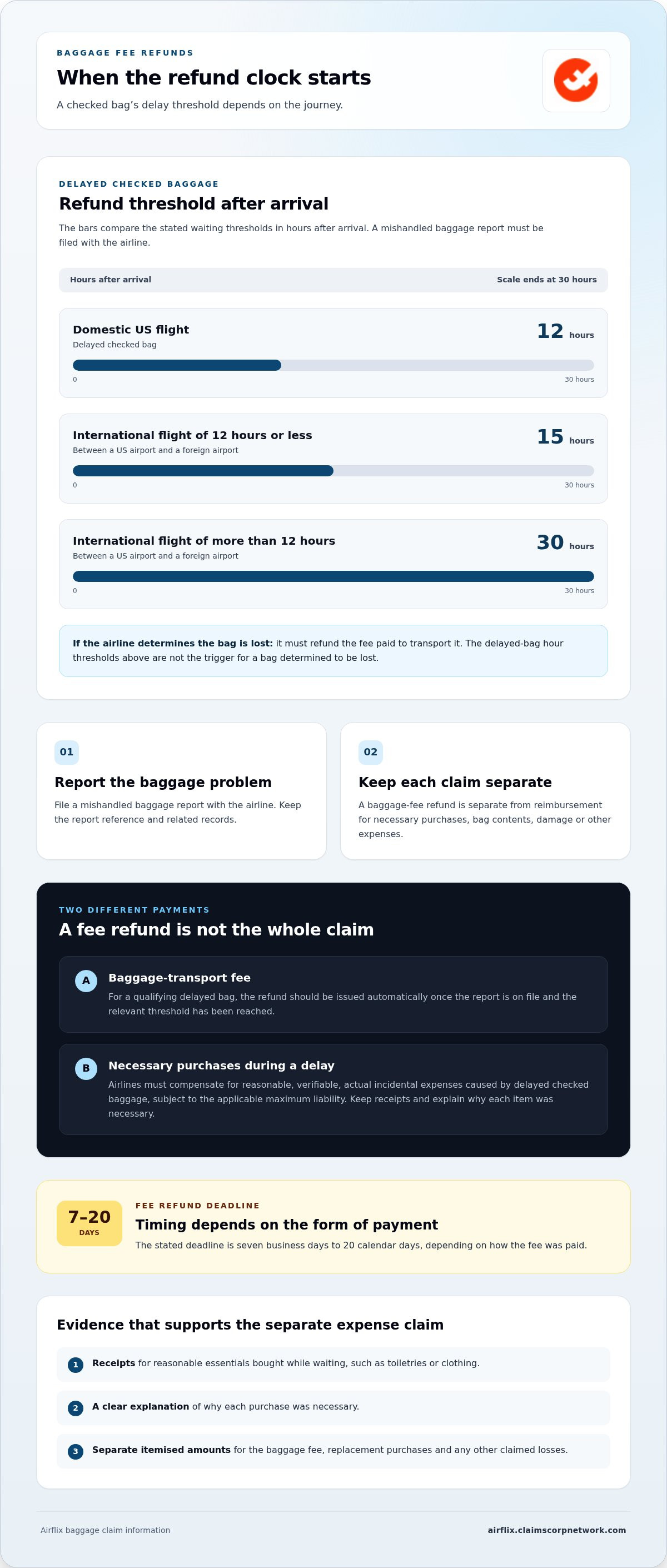
If an airline determines that your checked bag is lost, it must refund the fee paid to transport it. For delayed baggage, the refund threshold is 12 hours after arrival on a domestic US flight, 15 hours on an international flight of 12 hours or less, and 30 hours on an international flight of more than 12 hours. You must file a mishandled baggage report with the airline.
A fee refund is separate from reimbursement for necessary purchases, and neither automatically covers other costs, such as travelling to collect a bag. This guide explains how lost baggage passenger rights apply to refunds, what international liability limits cover, and which reporting and claim deadlines matter. It also explains how to document reasonable expenses and assess whether the cost of collecting delayed baggage belongs in a claim.
Key Takeaways
- A baggage-fee refund is distinct from reimbursement for essential purchases or other expenses, so identify each part of your claim separately.
- International baggage liability is subject to a cap, and the applicable rules depend on the journey and the circumstances of the loss or delay.
- Report the problem promptly, retain receipts and records, and pay close attention to the deadlines for written claims.
- Travel costs to collect a bag are a separate expense; clear evidence of the cost and why the journey was necessary can help explain your request.
- Airflix’s Baggage Claim Regress service can assist with pursuing baggage claims when handling the process directly becomes difficult.
Are there any exceptions that apply to refunding bag fees for lost or significantly delayed baggage?
When an airline determines a checked bag is lost, it must refund the fee paid to transport it. That refund is separate from compensation for the bag’s contents, damage or expenses during a delay. This distinction is central to lost baggage passenger rights: recovering the transport fee does not settle every part of a claim. List the baggage fee, replacement purchases and any other claimed losses separately.
A delayed bag can also qualify for a fee refund, but the significant-delay threshold depends on the journey. On domestic flights, the threshold is 12 hours after arrival. For international flights between a US airport and a foreign airport, it is 15 hours if the flight is 12 hours or less, and 30 hours if it is more than 12 hours. File a mishandled baggage report with the airline. Once the report is on file and the threshold is reached, the refund should be issued automatically.
That automatic refund doesn’t replace a claim for necessary purchases. Airlines must compensate passengers for reasonable, verifiable, actual incidental expenses caused by delayed checked baggage, subject to the applicable maximum liability. Keep receipts for essentials bought while waiting, such as toiletries or clothing. For example, cosmetics and a change of clothes may be reasonable after a 24-hour delay. If the bag is lost on a return flight, claims for purchases are limited to necessary items, such as medicines or personal effects, supported by documents.
Compensation for a damaged, delayed or lost bag is not unlimited. The applicable cap depends on the route and the rules governing the journey; it may cover proven baggage loss and reasonable expenses, rather than every amount claimed. For delayed baggage, the approximate maximum stated for replacement purchases is 1,385 euros per passenger. Airlines usually don’t pay for stress or inconvenience alone. Describe the practical loss, itemise actual expenses and retain proof of purchase to support the amount requested.
Travel insurance or a credit card may cover losses beyond airline compensation limits, depending on the policy or card benefit and its conditions. Review the benefit documents and keep the airline report, receipts and settlement details together.
For a fee refund, submit the baggage report even if the airline later locates the bag. The refund deadline is seven business days to 20 calendar days, depending on the form of payment. For other expenses, send a written claim with receipts and a concise explanation of why each purchase was necessary. Separate evidence helps the airline assess a fee refund independently from reimbursement for delayed, damaged or lost baggage.
International baggage liability under the Montreal Convention
The Montreal Convention sets baggage liability rules for most international flights. The applicable limit and supporting evidence affect what a passenger can claim when checked baggage does not arrive, is damaged or goes missing.
Montreal Convention liability
The Montreal Convention governs baggage carriage on most international flights, including many journeys with a domestic segment. It makes airlines responsible for baggage loss, damage and delay, subject to a maximum liability limit. In the few situations involving travel to or from the United States where the Convention does not apply, the Warsaw Convention may apply instead.
Canada also lists section 23 of its Air Passenger Protection Regulations as an applicable baggage-rights law. These frameworks may both matter when a journey involves Canada and international carriage. Identify every flight segment and the airline that handled the bag, then state the route clearly in your baggage claim. The route helps establish which rules apply.
Writing a compensation claim
A written compensation claim sets out what happened to the bag and the amount claimed. Identify the flight, explain whether the checked baggage was lost, delayed or damaged, and describe the resulting loss. State that you are claiming under the Montreal Convention when it governs the journey. A clear account helps distinguish the baggage claim from a separate request for a bag-fee refund.
Itemise each claimed loss and link it to evidence instead of submitting one unexplained total. For example, list the value of missing belongings separately from necessary purchases made during a delay. Include the airline’s baggage report reference and details of delivery or loss. Keep copies of your submission and attachments so you can track what the airline received and respond consistently.
Compensation limits and Special Drawing Rights
For baggage covered by the Montreal Convention, the maximum liability is 1,519 Special Drawing Rights per passenger, approximately $2,175.00 US. This is a cap for the passenger, not a separate allowance for every suitcase. The International Civil Aviation Organization reviews the limit for inflationary adjustment every five years, so the applicable amount can change.
Special Drawing Rights are an international unit of account, not a fixed US-dollar payment. The conversion to dollars depends on the exchange rate used when the airline settles the mishandled-baggage claim. The cap does not mean every claim receives the maximum: you must support the loss, and the airline assesses the evidence against the applicable limit.
Documents for reimbursement claims
To claim reimbursement for lost baggage, provide the airline’s baggage report, flight and baggage-tag details, a description of the missing bag and its contents, and receipts or other proof of value. For purchases made during a delay, include receipts and explain why each item was necessary. These documents link the claimed amount to your journey and the baggage problem.
Photographs of the bag and a list of its contents can help identify what was missing or damaged. Keep copies of claim forms, correspondence and any airline settlement offer. If the bag arrives damaged, include clear photographs and a written description of the damage. A complete file helps show which losses remain unpaid and how you calculated each amount.
How long do I have to file a claim for lost or damaged luggage?
Report missing baggage to the airline at the airport, before leaving the baggage claim area. Ask the baggage services office to record the problem and complete the required form, such as a Property Irregularity Report. Keep the reference number, baggage tag and flight details. Reporting promptly records when the airline was notified and which bag was affected.
For domestic U.S. flights, airlines may limit liability for lost, damaged, or delayed baggage, but the U.S. Department of Transportation says the DOT regulation allows a maximum liability limit of $4,700 per passenger. This is a maximum, not an automatic payment. The airline assesses the loss and supporting evidence, so list each missing or damaged item and provide proof of its value.
Timing matters for damaged baggage. Submit a written claim within 7 days of receiving the suitcase to request compensation, a refund or reimbursement. If the bag arrives with a broken wheel, handle or strap, photograph the damage before arranging repairs. Airlines cannot exclude liability for damage to those checked-baggage components. Keep repair estimates or bills, along with photographs and a detailed description of what is broken.
Report any missing contents to the airline promptly after collecting your baggage. If the whole bag is delayed, a passenger has 21 days from receiving it to submit a written claim for necessary purchases. Airlines may take between five and fourteen days to declare a missing bag lost, although their policies vary. If it remains unreturned, submit a lost-baggage claim once the airline officially considers it lost, and retain the written decision.
Compensation for belongings can reflect their age and continued use, rather than the original purchase price alone. For example, airlines usually reimburse 50 percent of replacement clothing costs because clothing can be reused. Provide receipts where available and explain the item’s condition and value. The airline’s liability limit applies to the claim, so a clear inventory helps show how the requested amount was calculated.
There is also a longer limit for taking a delayed-baggage compensation claim to court: legal action must begin within 2 years of arrival. That period is separate from the shorter reporting and written-claim deadlines. Keep airline correspondence, claim forms, receipts and repair evidence together. For domestic air travel, lost or damaged assistive devices used by passengers with disabilities are not subject to the usual baggage-liability limits.
Claim and reporting deadlines
File a baggage report with the airline at the airport, then submit any written compensation claim within the deadline for that type of loss. The time limit depends on whether the checked bag is delayed, officially lost, damaged or delivered with missing contents.
Written complaint deadlines
A written complaint records the loss and the remedy requested, with dates and evidence for the airline’s assessment. For damaged baggage, submit the claim within 7 days of receiving the suitcase. If contents are missing, report them within 7 days after collecting the bag. These are separate issues, so describe each clearly rather than treating the whole luggage problem as one claim.
For example, photograph a damaged case when it arrives, then describe what is broken and when you noticed it. Attach repair estimates or receipts, and keep a copy of your complaint. An airport report creates an initial record, but it does not replace the written compensation claim. Its reference number helps connect later correspondence to the original baggage incident.
Claim filing deadlines
For delayed luggage, a passenger has 21 days from receiving it to submit a written claim for reimbursement of necessary purchases. If baggage arrives within 21 days, make a claim within 21 days after the flight. These deadlines serve different purposes: one concerns documented expenses after delivery, whilst the other concerns claiming for baggage returned after the journey.
If the airline officially considers a bag lost, submit the lost-baggage compensation claim within 7 days of that decision. Ask the airline to confirm the loss status in writing, then attach the baggage tag details, contents list and proof of value. Keep the report, claim and response together; their dates show when each step took place.
Legal action deadlines
A passenger must initiate legal action within 2 years of arrival to assert a right to compensation for delayed baggage. This is distinct from the shorter reporting and claim deadlines. Sending a complaint to the airline does not change the stated court-action period, so record the arrival date alongside each submission date.
For flights within Canada, file a delayed-baggage claim as soon as possible and no later than the deadline in the airline’s tariff. Check the tariff that applies to the transport and keep a dated copy with your claim documents. Reporting windows can differ by airline, so report missing or damaged luggage at the airport and keep proof of every later submission.
Reimbursement of travel costs to collect baggage
A trip back to the airport to collect delayed baggage is a separate expense from the bag-fee refund or replacement purchases. Airline liability covers reasonable, verifiable, actual incidental expenses incurred while checked baggage is delayed, subject to maximum limits. You can include a collection trip in a claim, but document why it was necessary and how its cost resulted from the delay.
Start with the airline’s instructions. If its message asks you to collect the bag at the airport, keep the message and note when it arrived. If you arrange collection yourself, explain why, such as an urgent departure or the airline’s collection arrangements. Link the trip directly to the delayed baggage, rather than to unrelated travel.
Keep evidence for every expense. This could include a public transport ticket, taxi receipt, parking receipt or fuel receipt, along with the date, route and reason for travelling. A simple record can show where you travelled from, which airport you visited and when you collected the bag. Attach the baggage report reference and collection confirmation so the airline can match the cost to the incident.
Submit travel expenses separately from purchases made while the bag was missing. For example, list a return train fare under transport and essential toiletries or clothing under replacement purchases. Include receipts for both. Airlines must compensate reasonable, verifiable, actual incidental expenses during a baggage delay, subject to liability limits. A checked-baggage fee refund is a separate request.
The route affects the applicable liability framework, including whether domestic or international rules govern the flight. For domestic US itineraries, the maximum liability limit for delayed checked baggage is US$4,700 per passenger. For international baggage covered by the Montreal Convention, the maximum is 1,519 Special Drawing Rights per passenger. These limits are not separate allowances for travel to the airport, and a passenger should show how each expense relates to the delay.
Send a written request for reimbursement with the baggage report, airline instructions, collection details and original receipts or clear copies. A passenger whose delayed bag arrives has 21 days from receiving it to submit a written claim for necessity purchases. Include travel expenses in that submission and identify them clearly, so the airline can assess them alongside other documented costs.
If collecting baggage has created documented costs, get help pursuing a baggage claim.
Airflix: Flight Disruption Legal Assistance
Airflix supports baggage claims through its Baggage Claim Regress service, helping passengers pursue claims when baggage is lost, delayed or damaged. This support can be useful when an airline’s response does not address documented expenses or the claimed value, or when correspondence and deadlines become difficult to manage.
Airflix also provides Real-time Claim Status Tracking, so you can follow a claim as it progresses. If a baggage dispute proceeds to court, Airflix offers legal representation in court procedures. These services support claim handling but do not replace the need to report the problem promptly and keep relevant documents, such as baggage reports and receipts.
For support with a baggage claim, contact Airflix to discuss the next step.
Take the next step with a clear claim record
Understanding lost baggage passenger rights can help turn a confusing disruption into a well-documented claim. Focus on what happened, the losses you can prove and the outcome you are seeking. Keeping a clear record also helps explain your position if the airline’s response leaves a specific issue unresolved.
Airflix offers a Baggage Claim Regress service for baggage claims and Flight Disruption Legal Assistance for flight disruption matters. Organisations managing passenger claims can use its White-label Passenger Portal. The right support depends on the task: an individual baggage dispute is different from an organisation’s need to manage claims through a passenger portal.
If you want support with a baggage claim, contact Airflix about your claim. A well-organised record gives you a practical starting point for the next step.
Frequently Asked Questions
What are airlines’ responsibilities when they damage your baggage?
Airlines cannot exclude liability for damage to checked-baggage wheels, handles, straps or other components. Report the damage promptly and describe it specifically: identify the broken part, its location and how it affects the case. For example, explain if a damaged wheel prevents the suitcase from rolling. Photographs from several angles can show the problem clearly, while a repair estimate helps explain the remedy you are requesting.
When does an airline consider a bag lost?
Airlines usually declare a missing bag lost between five and fourteen days after the flight, although their policies vary. That declaration changes the claim from a delay enquiry to a lost-baggage claim. Ask for the airline’s decision in writing and keep it with your baggage report. If the bag is later found, update the airline and retain records of any expenses already claimed.
Can the airlines exclude liability for certain items?
Some item categories may be excluded, but international journeys have an important qualification: airlines are responsible for excluded categories if they accepted those items for transportation. This also applies to a domestic segment of an international itinerary, even if you did not disclose the items at check-in. Keep evidence that the item travelled in checked baggage, such as a packing record, photograph or purchase document, and identify the relevant flight segment.
How can I quickly find out whether I can get compensation, and if so, how much?
First identify whether the bag was delayed, lost or damaged, then match your claim to the journey and available evidence. The airline’s baggage report, itinerary, itemised losses and receipts help establish what happened and what you are claiming. A liability cap is a maximum, not a standard award. The amount assessed depends on the proven loss, reasonable expenses and the rules that apply to the route.
How do I claim compensation?
Open a baggage report with the airline, then submit a written claim identifying the flight, bag and loss. For example, distinguish a cracked case from an item missing inside it, and provide separate evidence for each. Include the report reference, receipts, photographs and a clear breakdown of the amount requested. If the airline has officially declared the bag lost, add that written decision to your claim file.
How do I get reimbursement from an airline?
Send a written reimbursement request to the airline that handled the baggage, with receipts and a brief explanation linking each expense to the incident. Separate necessary purchases during a delay from transport costs and a baggage-fee refund request. For instance, list replacement toiletries separately from a taxi journey to collect the bag. Keep the airline’s response and any settlement details with your submitted documents.
Is the airline liable for signs of usage?
An airline assesses whether a claimed condition is damage from baggage carriage or ordinary wear that was already present. Describe what changed instead of saying only that the case looks worn. A photograph taken before travel can help distinguish an existing scuff from a new crack; photographs after arrival can record the current condition. Include the baggage tag and report reference when submitting your evidence.
How long must baggage be missing before an airline considers it lost?
There is no single waiting period across airlines: most declare a missing bag lost between five and fourteen days after the flight, and policies differ. Report the missing bag as soon as it fails to arrive rather than waiting for that period to pass. Keep the airline’s updates and ask for written confirmation when it officially changes the bag’s status, since that decision informs your next claim step.


