

A bag that never arrives does not mean every passenger is entitled to the same payout. For U.S. flights, the U.S. Department of Transportation sets the maximum baggage liability at $4,700 per passenger; delayed-bag expenses must be reasonable, verifiable and actual, with no daily spending cap. A baggage compensation recovery service can help pursue eligible costs, but the amount depends on the proven loss and the rules governing the flight.
It’s understandable to expect an airline to cover the value of what was lost, damaged or needed while a bag was delayed. In practice, claim deadlines, evidence and liability limits affect what can be recovered. For international flights, the amount recoverable for baggage problems can depend on the applicable rules and the passenger’s proven loss.
This guide explains how to report a baggage problem, document your expenses and belongings, calculate a claim within the applicable limit, and escalate it if the airline does not resolve the matter. It also shows how receipts, baggage records and photographs can support your claim.
Key Takeaways
- Report missing or damaged baggage promptly and keep the reference details for your claim.
- Save receipts for essential purchases and evidence of the bag’s contents, condition and value.
- Work out whether the claim concerns delay, loss or damage, as each affects what you can seek.
- Compare your documented loss with the liability limit that applies to your flight.
- If the airline does not resolve the claim, keep a written record and use the appropriate escalation route.
How does the Baggage Tracking & Compensation Service work?
For U.S. flights, start by reporting delayed, damaged or missing baggage to the airline and keeping the case reference. The U.S. Department of Transportation sets the maximum liability amount allowed by the regulation at $4,700 per passenger. Delayed-baggage reimbursement covers reasonable, verifiable, actual incidental expenses, without a daily spending cap.
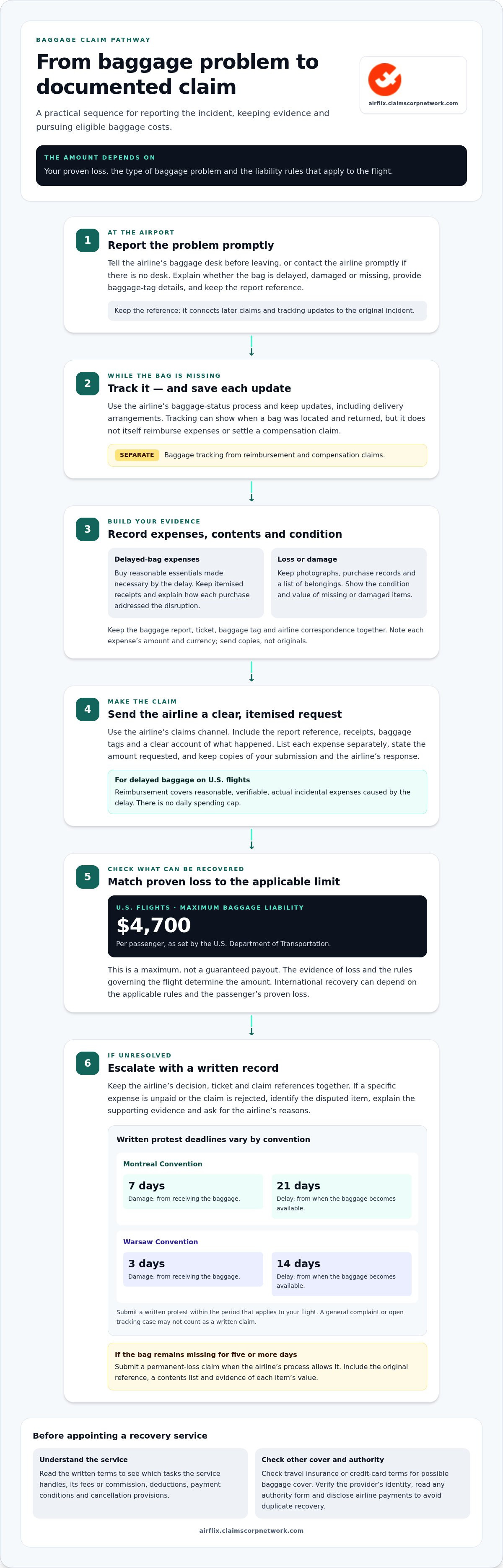
- Report the problem at the airport. Speak to the airline’s baggage desk before leaving, or contact the airline promptly if there is no desk. Provide your baggage-tag details and explain whether the bag is delayed, damaged or missing. Keep the report reference: it links later claims and tracking updates to the original incident.
- Keep the airline’s tracking information. Use the airline’s baggage-status process and save each update, including delivery arrangements. Tracking can establish when the bag was located and returned, but it does not automatically reimburse expenses or settle a compensation claim. Keep these processes separate.
- Document expenses caused by the delay. Buy only reasonable essentials made necessary by the delay, and keep itemised receipts. The U.S. Department of Transportation requires airlines to reimburse reasonable, verifiable, actual incidental expenses caused by delayed baggage, with no daily spending cap. Explain how each purchase addressed the disruption.
- File a direct claim with the airline. Submit the baggage report reference, receipts, baggage tags and a clear account of the disruption through the airline’s claims channel. List each expense separately and state the amount you are requesting. Keep copies of your submission and the airline’s response for follow-up.
- Compare recovery assistance with filing yourself. Filing directly means preparing and submitting the evidence, then managing correspondence with the airline. A recovery service can help pursue the claim; the service agreement sets out which tasks it handles. Read its written terms before authorising representation.
- Check whether your incident and carrier qualify. Claims may involve delayed, lost or damaged checked baggage, but liability depends on the flight and the applicable rules. The U.S. maximum is not a guaranteed payout: the evidence of loss and the relevant limit determine the amount. Identify the airline that handled your baggage and flight.
- Review fees before appointing a service. Providers set their own fees or commission terms. Read the agreement for deductions, payment conditions and cancellation provisions. Do not assume assistance is free or that you will receive the full airline reimbursement. Compare the terms with the work involved in handling the claim yourself.
- Protect your claim and check other cover. Treat requests for payment or sensitive details cautiously. Verify the provider’s identity and read its authority form before signing. Travel insurance or credit-card benefits may offer additional reimbursement for baggage loss. Check the policy or card terms and disclose any airline payment to avoid duplicate recovery.
Escalating unresolved airline compensation claims
Escalate with a clear written record, while observing the deadline that applies to your flight. Keep the airline’s decision, your ticket and every claim reference together.
-
Gather receipts and claim documents
Gather the baggage report, ticket, baggage tag and airline correspondence. Add receipts for replacement essentials and evidence of damaged or missing belongings, such as photographs or purchase records. For each expense, note the amount and currency, and explain how the baggage problem caused it. Send copies, not originals, and keep a dated copy of everything you submit.
-
Check written claim deadlines
Identify which convention governs the flight, then submit a written protest within its applicable period. According to the International Civil Aviation Organization, passengers on Montreal Convention flights must protest baggage damage within 7 days of receiving the baggage. For delayed baggage governed by that convention, the written protest must reach the carrier within 21 days of the baggage becoming available. Keep proof of submission.
Warsaw Convention deadlines differ: a written protest for damage is due within 3 days of receiving baggage, while a delay protest is due within 14 days of availability. Don’t rely on a general complaint or an open tracking case to count as a written claim. State the flight, incident, requested reimbursement and supporting evidence clearly.
- Turn a prolonged missing-bag case into a loss claim. If the bag remains missing for five or more days, submit a permanent-loss claim when the airline’s process allows it. Include the original baggage claim reference, a contents list and evidence of each item’s value. List items inside the bag separately from the suitcase itself, and keep the amounts consistent across your documents.
- Ask the airline for a reasoned response. If the airline rejects the claim or leaves a specific expense unpaid, reply in writing. Identify the disputed item, explain which evidence supports it and ask for the airline’s reasons. Reattach relevant receipts or photographs, and keep the response. A concise record shows what remains unresolved without restarting the claim.
-
Take a baggage claim to court
Consider court only after organising the airline’s final response, claim documents and evidence of loss. In England, a luggage compensation claim can be taken to small claims court within 2 years of the flight. Set out the amount sought and how it was calculated, then check that the court route and deadline fit your case before submitting a claim.
What compensation in case of loss or damage?
- Record the bag’s status and identify the applicable loss process. Keep the airline’s tracking updates and baggage reference together after arrival. Airlines commonly search for delayed bags for five to 14 days before declaring them lost. In England, luggage is officially considered lost after the airline has had 21 days to find and deliver it. A tracking update alone does not establish the value of your contents.
- Prepare an itemised inventory before accepting a settlement. List each missing item, its approximate purchase date, condition and purchase price. Attach receipts, photographs, bank records or product details where available. Separate the suitcase from its contents so the airline can assess each part of the loss. For example, list a damaged case and missing clothing as separate items, not as one combined figure.
- Use the item’s actual condition to explain its claimed value. Airlines often apply a discount rather than reimbursing lost belongings at their new value. Provide evidence of each item’s cost and describe its age and condition before travel. A recently purchased coat and a well-used coat may be assessed differently. If the airline offers a reduced settlement, compare its calculation with your inventory and supporting records.
- Check the baggage rules before estimating the maximum recovery. Under the Montreal Convention, the maximum compensation for baggage is approximately €1,525 per passenger, equivalent to 1,288 Special Drawing Rights. Under the Warsaw Convention, the calculation is approximately €26 per kilogram, subject to Special Drawing Rights exchange-rate fluctuations. The applicable convention affects the method and limit, so check the flight ticket’s baggage terms.
- Identify any assistive device separately from ordinary luggage. On domestic flights in the United States, airlines are liable for the full cost of a lost passenger assistive device, even when it exceeds $3,800. International rules may limit compensation for a lost assistive device. Describe the device and document its replacement cost separately from clothing or other belongings.
- Review the settlement against your evidence before agreeing. Compare each proposed amount with your itemised inventory, receipts and condition details. If the airline’s offer excludes an item, ask for the reason in writing and provide the relevant evidence again. Specific insurance taken out when checking baggage or insurance linked to a credit card may provide additional reimbursement.
Compensation limits for lost or damaged baggage
- Identify the rules that govern your flight. Start with your ticket and route, then establish whether domestic or international baggage rules apply. The liability limit is a ceiling, not an automatic payment: the airline assesses the proven loss against the applicable maximum. If your documented loss is below that limit, your claim is for the loss itself, not the full maximum.
- Calculate loss from evidence, not replacement hopes. List each damaged or missing item and show its condition and value before travel. Airlines often discount belongings rather than paying their new replacement value. For a damaged suitcase, separate the repair cost from any claimed loss of use. For missing contents, identify each item and support the claimed amount with receipts or other records.
- Check whether your documented loss exceeds the cap. If the proven loss is higher than the applicable liability limit, recovery is generally capped at that limit unless you made a special declaration of interest when checking in the baggage. Keep any declaration or related travel record with your claim. The cap can restrict a claim even when receipts establish a higher value.
- Separate repairable damage from total loss. Photograph the damaged case at the airport and retain a repair assessment or replacement evidence. A claim may cover part of the cost of repairing or replacing luggage and its contents, rather than the full purchase price. In England, baggage compensation is usually no more than around £1,000 in total, so itemise the suitcase and contents against that overall figure.
- Report damage linked to a security inspection through the appropriate route. If you believe a TSA search caused damage, contact the Transportation Security Administration directly on 866-289-9673. Keep photographs, the baggage report and any inspection notice together. State what was damaged and when you discovered it. This helps distinguish inspection-related damage from damage that occurred during airline handling.
- Check whether the claim concerns cabin baggage or checked baggage. In England, a passenger can claim for cabin-baggage problems only if the airline is at fault. Describe the incident and explain the airline’s role with specific details, such as where the damage occurred. Airlines usually do not compensate for stress or inconvenience, so focus on documented property loss and eligible repair or replacement costs.
Compensation when baggage is not returned
- Report the missing checked bag immediately. If it does not arrive at your destination, report it at the airline counter before leaving the airport. If there is no counter, contact the airline as soon as possible. Ask for a written baggage reference and keep your checked-bag tag. The report starts the tracing process and records when the bag went missing for your later claim.
- Keep tracking updates, but prepare for a loss claim. Save messages showing searches, status changes and delivery attempts. A bag may remain classified as delayed before the airline treats it as lost, so keep communicating with the carrier while it searches. Once the airline confirms the bag will not be delivered, submit a written lost-bag claim. Include the reference number and state clearly that the bag has not arrived.
- Build a documented claim for the contents and suitcase. Make an itemised list of what was inside, including each item’s age, condition and purchase value. Attach available receipts, photographs or other proof, and list the suitcase separately. Claim the proven value of your loss, not an unsupported replacement total. Keep copies of your submission and any settlement calculation so you can identify omissions.
- Check the route and the applicable baggage convention. In England, passengers have a legal right to claim from an airline for checked-in luggage that is delayed, lost or damaged. The Montreal Convention allows a baggage claim, with a maximum of €1,525 per passenger, equivalent to 1,288 Special Drawing Rights. The amount recoverable depends on the proven loss and applicable limit, not simply the number of missing items.
- Address connecting flights in the claim. For a connection involving different airlines, identify each flight and carrier when making your claim, as it may not be clear which airline should handle it. An airline cannot refuse to handle a luggage claim solely because another carrier was involved. Name each flight and carrier, then explain where the bag was last checked or recorded.
- Separate airline recovery from other possible cover. Specific insurance taken out when checking the bag, or cover linked to a credit card, may provide additional reimbursement. Keep any insurer correspondence and disclose compensation received from the airline. In England, passengers with travel or home contents insurance covering luggage may be better off claiming through their insurer. Compare the cover and evidence requirements before accepting a settlement.
Airflix: Flight Disruption Legal Assistance
Airflix offers a Baggage Claim Regress service to help passengers pursue unresolved baggage claims. It can be useful after you have reported the problem and assembled your evidence but still need support with the airline’s claims process. Real-time Claim Status Tracking lets you follow your claim’s progress, and legal representation is available if court proceedings arise.
Keep your baggage report, airline correspondence and supporting documents organised so your claim can be assessed against the applicable rules and evidence. Airflix’s Flight Disruption Legal Assistance is a separate service for flight-disruption matters.
Contact Airflix to discuss baggage claim regress support for your case.
Take the next step with a clear claim record
An unresolved baggage claim is easier to pursue when the evidence and requested remedy are organised. Keep the airline’s latest response with your original report, receipts and a concise account of what remains unpaid or unaddressed. This gives you a practical basis for deciding whether to continue directly or seek help with recovery.
A baggage compensation recovery service may help when correspondence has stalled or the claim needs further follow-up. Before proceeding, understand the service terms and the authority you are giving to act on your claim. Choose the next step based on your case’s status, whether the airline is still tracing the bag or has issued a decision.
If you’re ready to discuss support for an unresolved baggage claim, contact Airflix about claim support. A well-organised record puts you in a stronger position to move forward.
Frequently Asked Questions
Delay or damage to your luggage when travelling by plane: what are you entitled to?
You may claim reasonable expenses caused by a delay, or documented loss from baggage that is damaged or lost, subject to the rules for your flight. In England, essentials such as toiletries and underwear can form part of a delayed-luggage claim when supported by invoices. Damage claims should describe the defect and the repair or replacement sought. Airlines generally don’t compensate for stress or inconvenience alone.
How can I use this service?
Use a recovery service if you want help progressing a baggage claim instead of managing every exchange yourself. Prepare your flight details, airline report and evidence of the loss, then submit them through the service’s claim process. Read the authorisation and service terms before proceeding, including what the assistance covers and how any settlement is handled. Keep your own copies of the documents and airline correspondence.
What happens next?
After you submit a claim, the airline may review the incident, assess the evidence and issue a decision or request further documents. Record each update and provide requested information clearly and in an organised form. If the airline rejects part of the claim, identify the disputed item or expense and address it in writing. An unresolved complaint may need to be escalated through an applicable route.
When is a bag considered lost?
The point at which a bag is treated as lost depends on the applicable rules and the airline’s search process. Airlines often search for a delayed bag for five to 14 days before declaring it lost. In England, luggage is officially considered lost after the airline has had 21 days to find and deliver it. Keep the delayed-bag record, even if the airline changes its status earlier.
What is a baggage compensation recovery service and how does it work?
A baggage compensation recovery service assists with pursuing an airline claim for delayed, lost or damaged baggage. It can help organise the claim and handle follow-up, depending on the service agreement. The passenger still needs to provide accurate incident details and supporting evidence. Before appointing a service, understand its authority to act, the work it undertakes and the terms governing any compensation recovered.
What are the deadlines for reporting baggage problems and filing claims?
Deadlines depend on the flight and whether baggage was delayed or damaged. For delayed baggage on Montreal Convention flights, a written protest is due within 21 days of the bag becoming available; for damage, within 7 days of receipt, according to the International Civil Aviation Organization. In England, delayed or missing luggage claims are due within 21 days after the flight, and damage claims within 7 days of receipt.
How much compensation can travellers recover for delayed, damaged or lost baggage?
Recovery is based on proven loss and the liability limit applicable to the journey, so the maximum is not an automatic payout. For U.S. flights, the U.S. Department of Transportation states a maximum liability amount of $4,700 per passenger. Under the Montreal Convention, the maximum is approximately €1,525 per passenger, equivalent to 1,288 Special Drawing Rights. The airline assesses eligible expenses or property loss against the relevant limit.
What documents and evidence are needed to file a baggage compensation claim?
Keep your ticket, baggage tag and the airline’s incident reference together. Add photographs of damage, receipts for purchases made because of a delay, and an itemised list of missing contents with available proof of value. For example, a receipt or bank record can support the cost of a missing coat, while photographs can show a cracked suitcase. Save copies of claim forms, delivery updates and every written response from the airline.


