

The deadline for a delayed-baggage protest can start when the bag becomes available, not when the flight lands. Where the Montreal Convention applies, a written protest must be sent to the carrier within 21 days of the delayed baggage becoming available, according to the International Civil Aviation Organization. A delayed baggage compensation claim service should distinguish this formal deadline from a request to recover reasonable, verifiable, actual incidental expenses incurred during the delay.
It’s understandable to expect a straightforward payment when your belongings don’t arrive with you. In practice, what you can claim depends on the baggage problem, the expenses you can document and the rules that apply to your journey. This article explains how to report a missing bag, seek reimbursement for essential purchases and understand the separate deadlines for delay, loss and damage. It also explains what changes when an airline treats a bag as lost, so you know which claim steps matter and when.
Key Takeaways
- Report a missing bag promptly and keep its identification tag and the airline’s claim reference.
- Keep receipts for essential purchases during a delay; documented, reasonable expenses are central to a reimbursement request.
- Separate delayed, damaged and lost-baggage claims, as each can involve different reporting and written protest deadlines.
- Record when delayed baggage becomes available, since this can affect the deadline for a written protest.
- Airflix’s Baggage Claim Regress service can help with baggage claims that need further handling.
Keeping baggage identification tags and reporting problems
Report a missing checked bag to the airline promptly, and keep the baggage tag and claim reference. The report creates a record for the search and any later reimbursement request.
Reporting and tracking missing baggage
Reporting and tracking means registering the missing bag with the airline and following the search using a claim reference. At the airport, go to the airline’s baggage counter before leaving, show your baggage identification tag and ask for written confirmation. Keep the reference number, as it connects later messages and documents to the same case.
Record the bag’s colour, size, brand and distinguishing marks, then provide your contact details and delivery address. Keep the boarding pass and baggage receipt with the tag, and save messages from the airline. If the bag remains missing, use the reference number when requesting an update. Avoid opening a separate report, which could make the record harder to follow.
Airline-specific reporting deadlines
Reporting deadlines are the time limits an airline sets for notifying it about delayed or damaged luggage. They matter because the airline’s reporting window can be shorter than a general claim deadline. For international flights between a U.S. airport and a foreign airport that are 12 hours or less in duration, baggage is significantly delayed if it is not delivered within 15 hours after arrival, according to the U.S. Department of Transportation.
Carrier rules vary. United Airlines customers should report delayed bags within 21 days for international flights; American Airlines asks passengers to report international delays on arrival, before leaving the airport. For damaged baggage, Delta Air Lines sets a seven-day reporting period for international flights, while Alaska Airlines also requires reports within seven days. Follow the relevant airline’s process and retain its written acknowledgement.
Travel insurance may reimburse eligible essentials during a delay, subject to the policy’s waiting period, exclusions and documentation requirements. Airline compensation concerns the carrier’s responsibility; insurance may provide separate cover, with its own limits and claim process. Submit the baggage claim to the airline first, and keep receipts for purchases.
For a connection involving different airlines, contact the carriers involved to confirm which one should handle the baggage claim. Identify each flight and carrier in the report, and include the baggage tag so the airlines can trace the journey.
If a bag is later declared lost, damaged or delivered after you return home, update the original report rather than treating the problem as resolved. Photograph damage and contents, keep the bag and receipts, and send the airline a written claim. For damaged luggage or missing contents, the claim deadline is seven days after receiving the bag; delayed or missing luggage has a 21-day claim deadline after the flight. Check the carrier’s reporting rules as well, since they can require earlier notification.
Reimbursement for reasonable expenses during a baggage delay
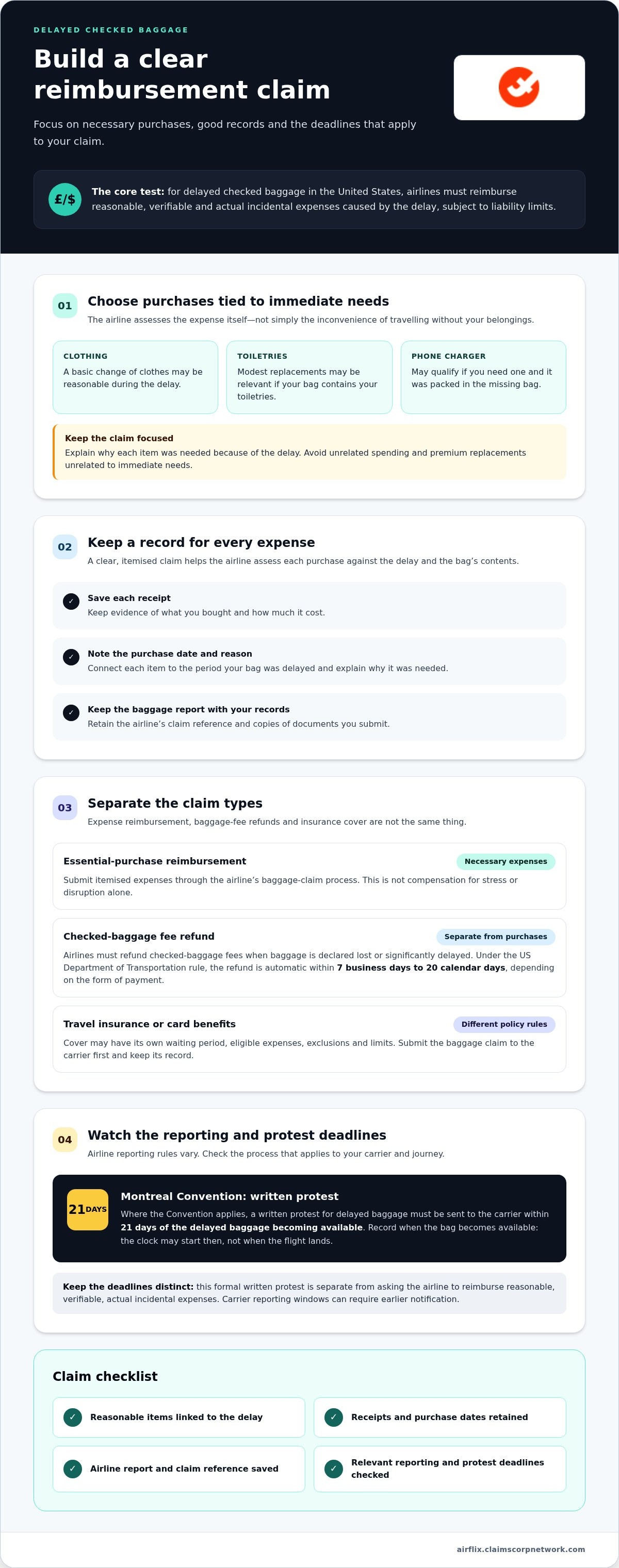
In the United States, airlines must reimburse reasonable, verifiable and actual incidental expenses caused by delayed checked baggage, subject to liability limits. A separate baggage-fee refund may also apply when checked luggage is significantly delayed.
What delayed-baggage reimbursement covers
Reimbursement covers necessary out-of-pocket purchases made because your checked bag hasn’t arrived. The airline assesses the expense itself, not simply the inconvenience of travelling without your belongings. Clothing, toiletries and phone chargers are examples of reasonable incidental purchases. Keep each receipt and connect it to the period when your bag was delayed.
Reimbursement isn’t the same as compensation for stress or disruption. Airlines don’t usually pay for inconvenience alone. Record what you bought, why you needed it and how it related to the missing luggage. A basic change of clothes may be easier to justify than a premium replacement unrelated to immediate needs.
Airlines must also refund checked-baggage fees when baggage is declared lost or significantly delayed. The fee refund is separate from reimbursement for essential purchases. Under the US Department of Transportation rule, airlines must automatically refund baggage fees within seven business days to 20 calendar days, depending on the form of payment.
Reimbursement for essential purchases
Essential-purchase reimbursement is a request for the cost of necessary items bought while waiting for delayed bags. A clear, itemised claim lets the airline assess each expense against the delay and the bag’s contents. Save receipts, note purchase dates and keep the airline’s baggage report with your records.
For example, if your checked luggage contains toiletries and everyday clothing, buying modest replacements may be reasonable during the delay. A phone charger may also qualify if you need one and it was packed in the missing bag. Explain how each purchase relates to the baggage delay, and avoid including unrelated spending.
Submit invoices through the airline’s baggage-claim process and retain copies. If the carrier reimburses expenses before finding the bag, American Airlines says those payments are deducted from any final settlement if it cannot locate the luggage. This prevents the same loss from being paid twice.
Travel insurance or benefits attached to a credit card may provide separate baggage-delay cover. Policies can set their own minimum delay periods, eligible expenses and limits. Check the policy wording and keep the airline claim record; travellers generally need to submit a baggage claim to the carrier before seeking insurance reimbursement.
The Montreal Convention concerns liability for baggage on qualifying international flights, while essential-delay expenses and insurance benefits follow their applicable rules. A delayed-baggage claim should distinguish purchases, baggage fees, and any loss or damage claim, with receipts and airline correspondence supporting each part.
What compensation in case of loss or damage?
For eligible baggage claims, compensation is generally based on proven loss, not an automatic payment of the maximum. The applicable convention and journey determine the liability limit, while evidence establishes the amount claimed.
For domestic flights in the United States, airlines may limit liability for lost, damaged or delayed baggage to a maximum of $4,700 per passenger, according to the U.S. Department of Transportation. For most international flights covered by the Montreal Convention, the maximum is 1,519 Special Drawing Rights per passenger currently. These figures are liability ceilings, not guaranteed payouts.
The Montreal Convention applies to flights between two states that have ratified it. Describe the loss or damage in writing, identify the baggage and flight, and state that the claim is made under the Montreal Convention. Keep the ticket or boarding pass, baggage tag, airline report, photographs and repair or replacement receipts. These records connect the claimed amount to the journey and the baggage problem.
Compensation reflects the proven damage when it falls below the applicable maximum. If the proven loss exceeds that limit, payment is limited to the applicable cap unless the passenger made a special declaration of interest when checking in the baggage. For example, a damaged suitcase claim should distinguish the cost of repairing or replacing the case from the value of items inside it. Emotional distress or inconvenience alone is not usually compensated.
Written deadlines matter. Under the Montreal Convention, passengers must send a written protest to the carrier within 7 days of receiving damaged baggage, according to the International Civil Aviation Organization. For delayed baggage, the written protest must reach the carrier within 21 days of the baggage becoming available, according to the International Civil Aviation Organization. Keep a copy and evidence of when it was sent.
The Warsaw Convention may govern some international journeys. It applies to flights between two states when only one has ratified the Montreal Convention. Under Warsaw, baggage compensation is calculated by weight at approximately €26 per kilogram. This differs from Montreal’s passenger-based maximum, so the applicable convention affects how a claim is assessed.
To support a delayed-baggage claim, retain receipts for reasonable purchases and any baggage fees, alongside the baggage report and flight documents. For loss or damage, add photographs, an itemised description and repair or replacement evidence. A credit card statement can help show payment, but it doesn’t replace receipts or the written protest required by the applicable convention. Submit the records together so the airline can assess responsibility, proof of loss and the relevant liability limit.
When airlines classify baggage as lost
A bag may remain classed as delayed while the airline searches, then move to a lost-baggage claim. For international flights between a U.S. airport and a foreign airport that are more than 12 hours in duration, baggage is significantly delayed if it is not delivered within 30 hours after arrival, according to the U.S. Department of Transportation. That threshold describes significant delay, not the point when every airline declares a bag lost.
Airlines set their own lost-baggage procedures. Most declare a bag lost between five and fourteen days after a flight, although policies vary. Until the airline makes that decision, keep using the existing missing-bag report and reference number. Ask for the current status in writing, and record when the airline confirms the classification. That confirmation marks a practical shift from searching for delivery to claiming for lost belongings.
Once the airline determines that a bag is lost, it must refund the fee paid to transport it. This refund is separate from reimbursement for belongings inside the luggage. Keep the baggage-fee receipt or ticket record, and include it with the lost-bag claim. If the original payment record is unavailable, identify the passenger and flight so the airline can locate the charge.
For the contents claim, prepare an itemised list of what was packed, with purchase details where available. A suitcase containing clothing, toiletries and electronic equipment calls for separate descriptions, rather than one unsupported total. Receipts, photographs or other ownership evidence can help establish the items’ value. The claim concerns proven loss, subject to the liability limit that applies to the flight.
Airlines often apply a discount when reimbursing lost belongings, rather than paying their new purchase value. An item’s age, condition and supporting purchase evidence can affect its assessed value. For example, a used coat may not be valued like a newly bought one. Set out the purchase date and condition as accurately as possible, and keep a copy of the airline’s calculation.
If the proposed settlement omits an item or uses an incorrect value, respond with a concise written explanation. Refer to the itemised list, attach relevant evidence and identify the difference between the amount offered and the documented loss. Keep the airline’s decision and any revised offer with the original baggage report. A clear record helps distinguish an outstanding valuation issue from a bag that remains under search.
Check that the airline’s final response addresses both the baggage fee and the contents claim. These are separate parts of the loss, with separate supporting records. Keep copies of the claim, receipts and written decision together so the basis for any payment remains clear.
Written protest deadlines for delayed baggage
Report missing luggage to the carrier as soon as possible, then distinguish that report from a formal written protest. The applicable deadline can depend on the flight and convention.
Deadlines for reporting delayed baggage
Reporting means notifying the airline that your checked bag hasn’t arrived, preferably before leaving the airport. The carrier needs a record to trace the luggage and link later correspondence to your case. Submit the report promptly, keep its reference and note when you filed it. Airline reporting windows differ, so a general claim deadline shouldn’t be treated as permission to wait.
For example, United Airlines asks for international delayed-bag reports within 21 days of arrival, while American Airlines asks passengers to report international delays before leaving the airport. These are carrier reporting rules, not interchangeable treaty protest periods. Record the flight, baggage tag and report date, then follow the relevant airline’s stated process for updates.
Deadlines for submitting a claim
A claim requests reimbursement or compensation; a written protest formally notifies the carrier of a baggage problem. The distinction matters because sending an airport report doesn’t necessarily replace a written protest. Under the Montreal Convention, the protest deadline for delayed baggage is 21 days after the bag becomes available, according to the International Civil Aviation Organization.
For delayed or missing luggage, the claim deadline is 21 days after the flight. Under the Warsaw Convention, a written protest for delayed baggage is due within 14 days of the bag becoming available. Identify which convention applies before calculating the protest date; the flight route and the states involved determine the relevant framework.
Use the event that starts each deadline, not simply the day you notice the problem. For a Montreal Convention protest, record when the airline makes the bag available. For a claim deadline measured from the flight, record the flight date. If the bag arrives after you return home, retain delivery evidence, such as the carrier’s message or delivery record.
Send the protest in writing to the carrier and describe the delay, flight and baggage reference. State what you’re claiming, such as reasonable expenses, and attach relevant receipts where available. Keep the sent message, attachments and proof of submission. A credit-card statement can support evidence of payment, but it doesn’t replace a dated written notice.
Keep separate records for airport reporting, expenses and the formal protest. A report reference shows that the missing bag was registered; receipts document purchases; the protest records your written complaint. If the airline replies, save its response with the original notice. This organised record helps show which step occurred and when, especially where reporting and claim deadlines have different starting points.
Use a calendar reminder for the applicable protest and claim dates as soon as the bag is reported missing. For example, note the flight date and the date the delayed luggage becomes available as separate entries. This helps prevent a deadline tied to availability from being mistaken for one tied to travel.
Airflix: Flight Disruption Legal Assistance
Airflix provides Flight Disruption Legal Assistance and a Baggage Claim Regress service for baggage claims that need further handling. After reporting the problem and gathering receipts, flight records and written correspondence, passengers can use this service for support in pursuing a baggage claim. Real-time Claim Status Tracking helps users follow a claim’s progress, and legal representation is available in court proceedings.
This support is relevant when a claim needs structured follow-up beyond the initial report, particularly if the airline’s response or proposed settlement needs further attention. Keep the claim reference and supporting evidence organised so the case information is clear. For assistance with a baggage claim, contact Airflix.
Move your baggage claim forward
The next step is to turn your records into a clear request that identifies the issue, the outcome sought and the supporting evidence. A delayed baggage compensation claim service can help structure the process when correspondence or settlement discussions need further attention. Keep copies of new messages and documents together so the claim remains easy to follow.
Airflix offers Flight Disruption Legal Assistance and a Baggage Claim Regress service. For organisations supporting passengers, its White-label Passenger Portal provides another way to manage claim journeys. The appropriate support depends on whether you’re pursuing an individual baggage claim or managing passenger claims operationally.
Prepare your claim reference and relevant documents before taking the next step. Contact Airflix about your baggage claim to discuss the support available. A well-organised record gives the claim a clear foundation, and you can proceed with greater confidence.
Frequently Asked Questions
Delay or damage to your luggage when travelling by plane: what are you entitled to?
You may claim reasonable, verifiable expenses caused by a checked-bag delay, and compensation for proven loss or damage within the applicable liability limit. A baggage-fee refund may also apply when checked luggage is declared lost or significantly delayed. For cabin baggage, a claim is available only if the airline caused the problem. Separate each part of your request, since expenses, fees and damaged belongings require different supporting evidence.
What are airlines’ responsibilities when your bag is delayed?
Airlines must compensate passengers for reasonable, verifiable and actual incidental expenses incurred while checked baggage is delayed, subject to maximum liability limits. They must also refund baggage fees when checked baggage is declared lost or significantly delayed. These responsibilities don’t mean every purchase or claimed amount is payable. Explain why an essential item was needed during the delay and provide its receipt to support the request.
What happens next?
After you report the bag, the airline records the case and searches for the luggage. Keep its case reference and retain messages about the search. If the bag arrives, check its contents and condition promptly. For damage on a journey covered by the Montreal Convention, send the carrier a written protest within seven days of receiving the bag. If it doesn’t arrive, ask the airline to update the existing case rather than starting an unconnected report.
What should a passenger do if their bag is missing after taking a flight?
Before leaving the airport, report the missing checked bag at the airline’s baggage counter and obtain a case reference. Keep the baggage tag and boarding pass, then describe the bag and provide a delivery address. If your journey involved multiple airlines, include every carrier and flight in the report. Use the same case reference for follow-up messages, and keep copies of delivery updates or written decisions.
When does an airline consider a bag lost?
Airlines’ policies vary, but most declare a bag lost between five and fourteen days after a flight. Until the airline confirms that status, it may continue searching and treat the case as delayed. Ask for the classification in writing, then submit an itemised contents claim with supporting evidence. Keep the baggage-fee request separate from the claim for belongings, as they concern different losses.
How do I file a delayed baggage claim with an airline?
Start with the airline’s baggage-report process and give it your flight details, baggage tag and contact information. A delayed baggage compensation claim service can help organise the written claim, supporting receipts and case records. Identify the expenses or loss you’re claiming, then keep a copy of your submission and any acknowledgement. For delayed or missing luggage, the claim deadline is 21 days after the flight, so record the flight date.
What expenses can I claim for essentials while my bag is delayed?
Reasonable essentials may include clothing, toiletries and a phone charger when those items were in the missing bag. Keep itemised receipts and explain how each purchase related to the delay. A modest replacement for an immediate need is easier to link to the disruption than unrelated shopping. Submit the expenses to the airline with your baggage case reference, and retain copies in case you need to provide them again.
Which services help passengers claim compensation for delayed baggage, and what fees do they charge?
Airflix offers a Baggage Claim Regress service and Real-time Claim Status Tracking. A delayed baggage compensation claim service can help manage claim administration, but it doesn’t replace evidence or applicable deadlines. Airflix also offers Flight Disruption Legal Assistance and a White-label Passenger Portal for organisations managing passenger claims. Fees depend on the case and are provided after a quote request, based on the claim’s scope and support required.


