

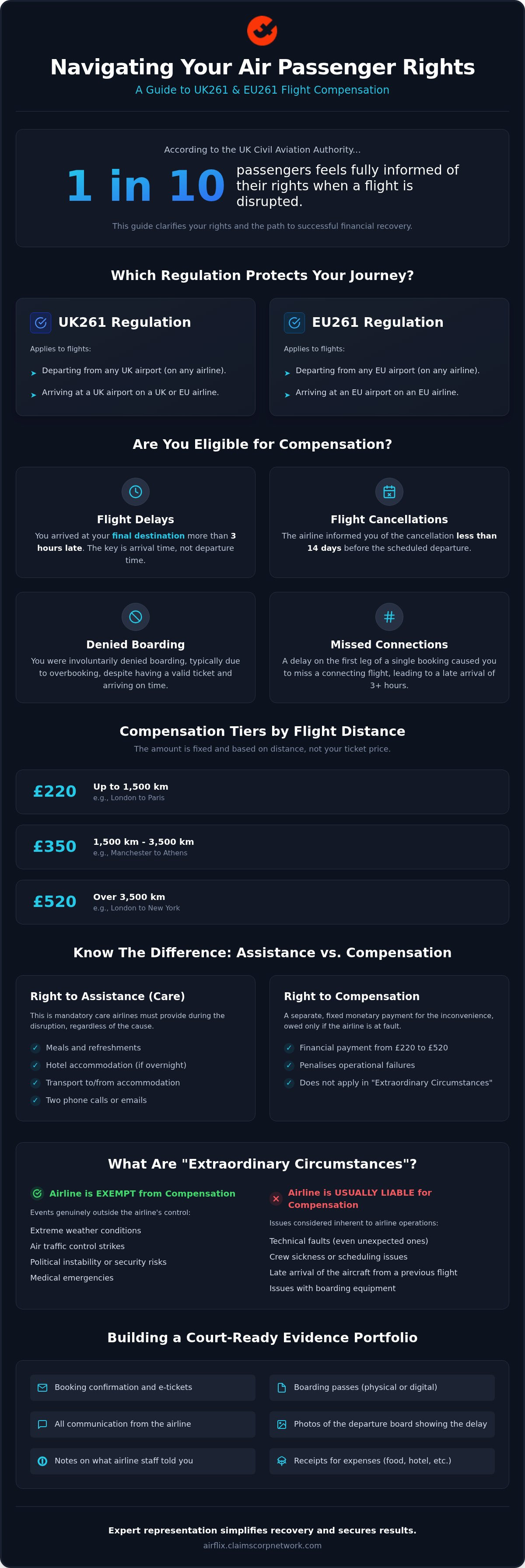
According to the UK Civil Aviation Authority, only one in ten passengers feels fully informed of their rights when a flight is disrupted. This lack of transparency often leaves travellers navigating a complex web of regulations without a clear path to resolution. It's understandable that you might feel overwhelmed by opaque airline communication or the technical distinctions between UK261 and EU261 frameworks. Obtaining professional legal advice flight compensation is not merely about understanding the law; it's about the methodical enforcement of your rights through a structured process.
We recognise that the fear of hidden legal costs and administrative friction often prevents passengers from pursuing what they're rightfully owed. This guide provides a comprehensive analysis of the legal structures protecting air passengers in 2026. You'll learn how to determine your eligibility for claims and how to compile a court-ready evidence checklist that withstands airline scrutiny. We'll examine the specific operational requirements for successful claims and demonstrate how expert representation simplifies the transition from administrative complexity to successful financial recovery.
Key Takeaways
- Clarify the jurisdictional reach of UK261 and EU261 to ensure your claim is filed under the correct regulatory authority for your specific route.
- Master the criteria for eligibility, including the precise calculation of delays at the final destination and the 14-day cancellation notice requirement.
- Obtain expert legal advice flight compensation to effectively navigate the systematic rejection strategies and administrative hurdles often utilised by airline legal departments.
- Organise a robust evidence portfolio that serves as the technical foundation for both initial administrative claims and formal court proceedings.
- Evaluate the operational benefits of professional legal representation in managing the end-to-end recovery process and ensuring full institutional compliance.
Understanding the Legal Landscape of Air Passenger Rights (UK261 and EU261)
The legal framework governing air travel is built upon two primary pillars: Regulation (EC) No 261/2004 and its British counterpart, the Air Passenger Rights and Air Travel Organisers’ Licensing (Amendment) (EU Exit) Regulations 2019, commonly known as UK261. While a reform to the European system was approved in July 2026, the new rules will not take effect until the second half of 2027. Consequently, the established EU261 and UK261 regulations remain the active legal standards for all current disputes. Obtaining professional legal advice flight compensation is essential because airlines often conflate the right to "assistance" with the right to "compensation". Assistance involves immediate care, such as meals, refreshments, and hotel accommodation, which is mandatory regardless of the cause of the delay. Compensation, however, refers to fixed monetary payments designed to penalise operational failures.
The 2026 legal landscape requires more than a surface-level understanding of these rules. Airlines have become increasingly sophisticated in their administrative defences, often citing complex operational data to discourage individual claimants. Relying on a disciplined, evidence-based approach is the only way to ensure that these statutory rights are enforced rather than merely acknowledged.
UK261 vs EU261: Which Law Applies to Your Flight?
Determining the correct jurisdiction depends on the flight's point of departure and the nationality of the carrier. UK261 applies to all flights departing from a UK airport and flights arriving in the UK on a UK or EU carrier. EU261 covers departures from EU airports and arrivals into the EU on an EU carrier. If you're flying with a non-European carrier from a third country into Europe, these specific regulations typically don't apply. Knowing the "law of the land" is a prerequisite for filing a formal dispute that an airline cannot dismiss on jurisdictional grounds.
The Definition of Extraordinary Circumstances
Airlines frequently attempt to avoid payments by categorising disruptions as "extraordinary circumstances". Legal interpretations have narrowed this definition significantly. Technical faults, even those that are unexpected, are now generally viewed as "inherent" to the operation of an aircraft and don't exempt an airline from liability. Extraordinary circumstances are events outside an airline’s actual control, such as extreme weather or air traffic control strikes. Successful recovery often hinges on challenging the airline's classification of an event through expert systems like FlightClaimEU, which provide the technical oversight needed to verify operational claims.
Assessing Eligibility: Legal Criteria for Valid Compensation Claims
Determining eligibility requires a disciplined review of the disruption's mechanics. Seeking expert legal advice flight compensation helps clarify whether a delay meets the statutory threshold of the "Three-Hour Rule". Under this rule, the law considers a flight delayed only if the aircraft doors open 180 minutes or more after the scheduled arrival time at the final destination. It's the time of arrival, not the time of departure, that dictates the legal validity of a claim. For cancellations, the legal threshold is 14 days. If an airline notifies you of a cancellation within this window, they're typically liable for compensation unless they can prove the disruption was caused by extraordinary circumstances.
Denied boarding due to overbooking represents the highest tier of passenger protection. In these instances, the airline is often legally required to provide immediate fixed-sum payments alongside alternative transport. Similarly, when missed connections occur on a single booking, the airline remains legally responsible for the entire journey's delay. Even if the initial delay was minor, if it results in an arrival at your final destination more than three hours late, the right to compensation is triggered for the full itinerary.
Statutory Limits and Compensation Tiers
The financial value of a claim is dictated by flight distance rather than the original ticket price. The Civil Aviation Authority guidance on delays outlines three primary tiers for UK-regulated flights: £220 for short-haul flights under 1,500 km; £350 for medium-haul distances up to 3,500 km; and £520 for long-haul journeys exceeding 3,500 km. For long-haul delays between three and four hours, the airline is permitted to reduce the compensation amount by 50%. Whilst waiting at the airport, passengers are also entitled to a "right of care", which includes food, drink, and communication facilities, typically after a two-hour wait for short-haul departures.
Luggage and Baggage: The Regress Service Explained
Disputes involving lost or damaged baggage fall under the Montreal Convention rather than the UK261 framework. This requires a different administrative approach, often involving a "regress service" to recover costs from third-party ground handlers who manage luggage on behalf of the airline. To secure your rights, you must file a Property Irregularity Report (PIR) before leaving the airport, as strict time limits apply for subsequent claims. Professional legal advice flight compensation ensures that these distinct baggage claims are handled with technical precision, preventing airlines from shifting liability to airport contractors and ensuring you receive the full reimbursement for essential items and damaged property.
Resolving Disputes: The Journey from Filing a Claim to Court Proceedings
The process of securing payment begins with a formal administrative submission to the airline's internal claims department. Whilst this appears straightforward, most individual efforts are met with a "Standard Rejection". This is a calculated operational tactic where airlines utilise automated templates to deny liability, often citing vague technical issues or weather events. They rely on the fact that most passengers lack the resources to verify these claims. This system differs significantly from the American model, where the U.S. Department of Transportation Fly Rights focus primarily on ticket refunds and baggage liability rather than the mandatory cash compensation found in UK and EU law. If an airline maintains its rejection, passengers may look to Alternative Dispute Resolution (ADR) schemes, yet these bodies often lack the enforcement power of a court order.
When administrative channels are exhausted, the dispute must transition from a request to a legal demand. This shift requires professional legal advice flight compensation to ensure the case is built on a technical foundation that an airline's legal team cannot easily dismiss. Moving into formal litigation signals to the carrier that the claimant is prepared to enforce their statutory rights through the judiciary system, a move that often prompts a reassessment of the airline's initial rejection.
The Formal Legal Procedure Against Airlines
The first step in any formal escalation is the drafting of a "Letter Before Action". This document outlines the legal basis for the claim and provides a final window for the airline to settle before court papers are filed. If the case proceeds to a hearing, professional representation is vital. Firms such as FlightClaimEU provide the necessary legal oversight, managing the entire court process so that passengers aren't required to attend hearings in person. This professional presence ensures that procedural rules are followed precisely, which is often where individual "DIY" claims fail.
The "No Win, No Fee" Model in 2026
Professional legal assistance in 2026 centres on risk mitigation. By utilising a "No Win, No Fee" structure, the financial risk of litigation is transferred from the passenger to the legal provider. This model ensures total transparency, as fees are typically a fixed percentage of the successful recovery, with no upfront costs for the claimant. Airlines are statistically more likely to settle out of court when faced with expert legal firms; they recognise that the likelihood of a successful defence is low when the claimant has the backing of a disciplined legal partner.
Strategic Documentation: Organising Evidence for a Successful Legal Outcome
A successful recovery hinges on the quality of the evidence file rather than the severity of the disruption. Whilst the legal framework is designed to protect passengers, the burden of proof remains with the claimant. Documentation serves as the technical foundation that transforms a personal narrative into an enforceable legal demand. Obtaining professional legal advice flight compensation ensures that your evidence is structured to withstand the specific scrutiny of airline legal departments, who often rely on the absence of physical records to justify a rejection. Courts and adjudicators prioritise objective, third-party data over verbal accounts; therefore, real-time recording is a critical phase of the process that begins the moment a delay is announced.
Digital records have become the "spine" of modern claims. Storing boarding passes, communication logs, and time-stamped screenshots creates a chronological trail that is difficult for airlines to manipulate. This methodical approach to record-keeping simplifies the transition from an initial complaint to a formal dispute, providing your legal representative with the necessary tools to challenge airline data. When evidence is organised systematically, the path to resolution becomes significantly more efficient.
Essential Evidence Checklist
The hierarchy of evidence begins with the proof of contract. You must preserve all boarding passes and e-tickets, as these confirm your status as a passenger on the disrupted flight. Beyond these, capturing time-stamped photographs of departure boards provides a visual record that often contradicts the airline's internal logs. If airline staff offer a reason for the delay, try to obtain this in writing or via a digital message. These specific items form a robust evidence portfolio that FlightClaimEU can cross-reference with global aviation databases to verify the technical accuracy of the airline's claims.
Tracking Expenses for Additional Claims
The legal right to reimbursement for "reasonable" expenses is distinct from fixed-sum compensation. Under the duty of care provisions, airlines must cover the costs of meals, refreshments, and necessary hotel accommodation during significant delays. What constitutes "reasonable" is generally defined as essential sustenance and standard lodging; luxury purchases or alcohol are typically excluded from these protections. Maintaining a disciplined log of all receipts is vital for a successful reimbursement claim. To ensure your evidence is handled with professional precision, you can upload your receipts to our passenger portal, where our systems integrate your expenses directly into your legal file for real-time status tracking.
Expert Legal Assistance: Why Professional Representation Secures Results
Individual attempts to secure compensation often stall during the initial administrative phase. Data from industry oversight bodies suggest that a significant majority of individual claims are rejected upon first submission. This high failure rate is rarely due to a lack of merit; instead, it stems from the airline's superior technical and legal resources. Professional legal advice flight compensation acts as a strategic equaliser, replacing individual effort with a disciplined, institutionalised process. By utilising automated validation and real-time monitoring, Airflix and FlightClaimEU ensure that every claim is technically sound before it reaches the airline's legal department. This methodical approach reduces the window for airline rejection and ensures that the recovery process remains efficient and transparent.
The Airflix Advantage: From Portal to Courtroom
Airflix operates as a clarifying force within a fragmented regulatory environment. Through its specialised white-label passenger portal, the system allows travel agents and corporate partners to protect their clients' rights with minimal administrative overhead. This infrastructure is supported by the Claims Corporation Network (CCN), which has provided specialised legal oversight since 2014. This network is particularly effective in managing cross-border disputes where jurisdictional complexities often defeat individual claimants. The service also includes a dedicated Baggage Claim Regress service, ensuring that luggage disputes are handled with the same legal rigour as flight delays. Professional assistance is not merely a one-off service; it's a commitment to systemic efficiency that ensures airlines remain compliant with their statutory obligations.
Securing Your Future Flights
The transition from reactive to proactive protection is facilitated through flexible service models. Whilst pay-per-flight options are available for occasional travellers, monthly and yearly subscriptions provide a more robust framework for frequent flyers. A subscription ensures that the moment a disruption is detected via real-time tracking, the legal recovery process initiates automatically. This removes the burden of documentation from the passenger and ensures that legal representation is already in place if court procedures become necessary. This model provides a reliable partner for every journey, ensuring that your rights are never ignored due to administrative friction. You can secure your professional legal representation by visiting FlightClaimEU today.
Enforcing Your Rights in the 2026 Aviation Landscape
Mastering the complexities of aviation law requires a transition from passive observation to disciplined action. You now understand that eligibility depends on precise arrival times and that the "extraordinary circumstances" clause is narrower than airlines often suggest. By organising a robust evidence portfolio and understanding the jurisdictional nuances of UK261 and EU261, you've established the groundwork for a successful claim.
Relying on expert legal advice flight compensation ensures that your case is managed with technical precision rather than administrative guesswork. Airflix, backed by the Claims Corporation Network (CCN), provides a comprehensive framework for recovery, including real-time status tracking and formal legal representation in court procedures if an airline refuses to settle. This systematic approach transforms a complicated disruption into a manageable administrative workflow, ensuring that the burden of proof is met with professional rigour.
Protect your passenger rights with Airflix legal assistance and ensure your claims are handled with the expertise they deserve. You don't have to navigate these legal hurdles alone; the right partnership ensures your statutory protections are fully enforced.
Frequently Asked Questions
How much does legal advice for flight compensation typically cost?
Airflix offers flexible engagement models, including per-flight, monthly, or yearly subscription options. This structure ensures that obtaining legal advice flight compensation remains accessible without unpredictable hourly rates. By choosing a subscription, passengers mitigate the financial risk associated with individual claims. All fees are transparently outlined within the service agreement, allowing for predictable budgeting whilst ensuring that expert legal oversight is available for every journey taken throughout the year.
Can I still claim compensation if the airline provided me with food and a hotel?
Yes, the provision of food, refreshments, and hotel accommodation is part of an airline's duty of care and is entirely separate from statutory compensation. Receiving these essential services doesn't waive your right to a monetary payment for the delay itself. Whilst the airline must provide immediate assistance for disruptions over two hours, the legal right to compensation is triggered by the length of the delay at your final destination.
What is the time limit for taking an airline to court for a disrupted flight?
In England, Wales, and Northern Ireland, the limitation period for filing a claim is six years from the date of the flight. In Scotland, this timeframe is five years. It's vital to initiate the process well within these statutory limits to ensure that evidence remains verifiable and that the airline cannot dismiss the case on procedural grounds. Professional legal assistance ensures that all court filings meet these strict temporal requirements.
Is it possible to claim for baggage delays through a legal assistance service?
Airflix provides a specialised Baggage Claim Regress service to manage disputes related to lost or delayed luggage. These claims are governed by the Montreal Convention and require a distinct administrative approach compared to flight delays. By utilising a professional service, you ensure that the technical requirements, such as filing a Property Irregularity Report at the airport, are correctly integrated into your legal demand for reimbursement and damages.
What happens if my flight was cancelled due to an airport strike?
Cancellations caused by airport staff strikes, such as air traffic control or security personnel, are typically classified as extraordinary circumstances because they're outside the airline's direct control. In these instances, the airline is usually exempt from paying compensation. However, they're still legally obligated to provide a refund or rerouting and fulfil their duty of care. Professional validation is often required to confirm the strike was the genuine cause of the disruption.
Do I need to hire a solicitor myself to sue an airline?
You don't need to engage an external solicitor independently when using Airflix. The service provides comprehensive legal representation in case of court procedures as part of its end-to-end management. This institutional approach ensures that qualified legal experts handle all filings and hearings on your behalf. This system removes the administrative burden from the passenger whilst ensuring that the case is presented with the necessary technical and legal rigour.
Can travel agents use Airflix to manage claims for their customers?
Travel agents and tour operators can utilise the White-label Passenger Portal to manage claims on behalf of their clientele. This professional tool simplifies the dispute process, allowing agents to offer high-level legal assistance under their own brand. By integrating with the Airflix infrastructure, agents can provide their customers with real-time tracking and expert legal oversight, enhancing their service offering whilst ensuring their clients' statutory rights are systematically protected.
What does "real-time claim tracking" actually mean for my case?
Real-time claim status tracking provides a transparent view of every stage of the legal process via a dedicated portal. Instead of waiting for irregular updates from an airline, you can monitor the progression of your case from initial submission to final settlement. This system ensures that you're always informed of the current status of your legal advice flight compensation claim, reflecting the methodical and disciplined nature of the recovery process managed by CCN.


