

An estimated €5.9 billion in flight compensation remains unclaimed every year; a substantial figure that highlights just how many passengers are deterred by complex carrier bureaucracy. Much of this shortfall is attributed to the frequent, often opaque citation of "extraordinary circumstances" as a reason to deny valid claims. If you've struggled to navigate the rules regarding extraordinary circumstances flight compensation whilst dealing with automated rejection emails and dense legal terminology, your frustration is a logical response to a complicated system.
Obtaining a clear, binary understanding of eligibility is essential for any passenger seeking redress. This guide clarifies the specific legal definitions currently in place, empowering you to identify when an airline is misapplying the law. We'll provide a structured method for gathering necessary evidence and demonstrate how professional legal representation can manage the transition from a rejected claim to formal court procedures. By the end of this article, you'll have a methodical framework to challenge airline decisions and secure the financial redress you're legally owed.
Key Takeaways
- Identify the precise legal definitions under UK 261 and EU 261/2004 to determine if your specific flight disruption qualifies for a statutory claim.
- Understand the criteria for extraordinary circumstances flight compensation and why internal issues like crew shortages or routine technical faults don't exempt airlines from payment.
- Recognise that the burden of proof lies entirely with the airline, which must demonstrate that a delay was truly unavoidable despite taking all reasonable measures.
- Establish a structured method for gathering evidence whilst at the airport to strengthen your position when you're challenging an airline's initial rejection.
- Learn how professional legal assistance and real-time claim tracking can resolve complex disputes if it's necessary to pursue formal court procedures.
What Are Extraordinary Circumstances in Flight Compensation?
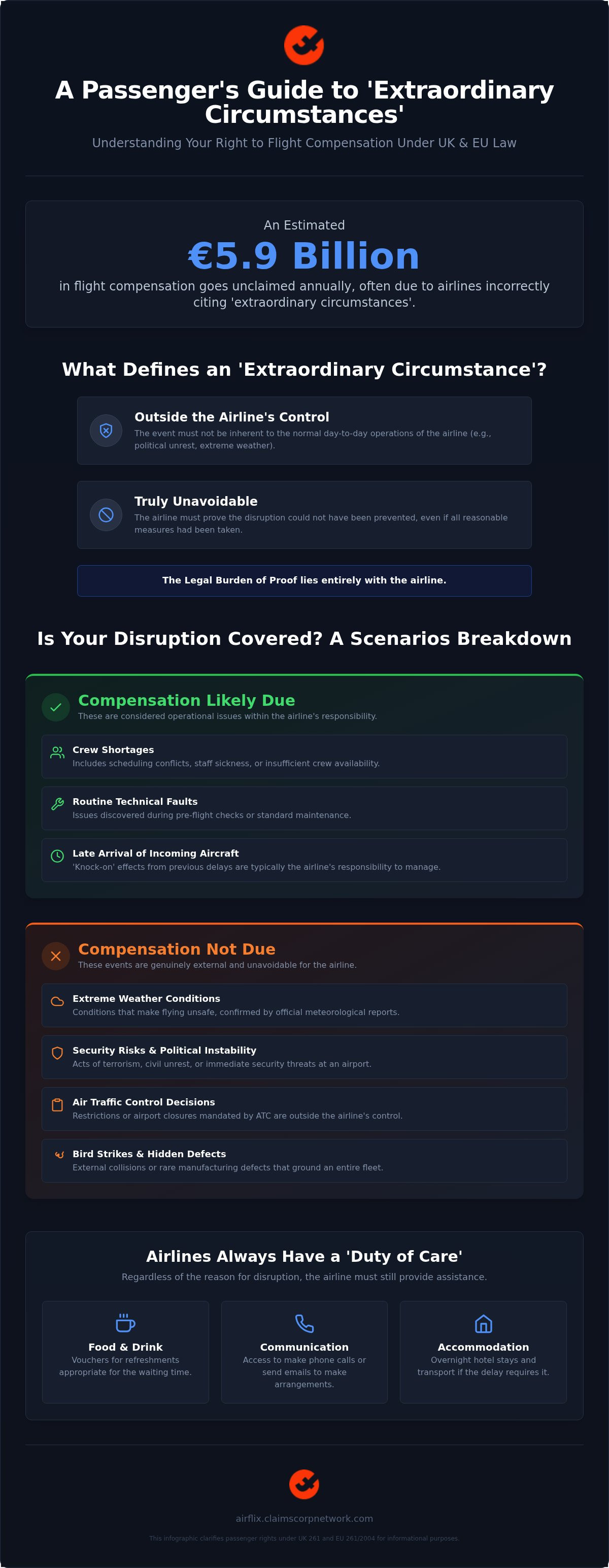
The legal mechanism of "extraordinary circumstances" serves as the primary defence for airlines seeking to avoid financial liability following a flight disruption. At its core, this term refers to situations that are not considered part of the normal day-to-day operations of an airline and remain outside its actual control. Airlines frequently utilise this terminology as a standardised response to initial claims; however, the legal threshold for such a classification is remarkably high. To successfully deny a claim for extraordinary circumstances flight compensation, the carrier must prove that the event could not have been avoided even if all reasonable measures had been taken.
There is a critical distinction between operational failures and external factors. Operational issues, such as crew scheduling conflicts or routine technical faults, are considered inherent to the business of running an airline. Conversely, external factors like air traffic control restrictions or extreme weather may qualify as legal exceptions. It's common for carriers to apply the "extraordinary" label to manageable operational hurdles to discourage passengers from pursuing their rightful redress. Recognising this tactic is the first step in challenging an unjustified rejection.
The Legal Framework: UK 261 and EU 261/2004
British passengers continue to benefit from robust protections despite the UK's departure from the European Union. These rights are enshrined in UK 261, which mirrors the protections found in EU Regulation 261/2004. For a claim to fall under these jurisdictions, the flight must either depart from a UK or EU airport, or arrive at one whilst being operated by a UK or EU based carrier. Whilst these regulations focus on delays and cancellations, the Montreal Convention remains the governing framework for international flight claims involving baggage disruption. Understanding which regulation applies is vital for establishing the correct legal grounds for your case.
Why the Definition Matters for Your Claim
Establishing whether a disruption qualifies as an extraordinary circumstance is the pivotal factor in determining your eligibility for compensation. This is the only legal avenue through which an airline can exempt itself from paying statutory amounts for delays exceeding three hours. Even when a genuine extraordinary event occurs, the carrier maintains a "duty of care" towards its passengers. This includes providing food, drink, and communication facilities, regardless of the cause of the delay. Legally, extraordinary circumstances are events which are not inherent in the normal exercise of the activity of the air carrier. If an airline cannot prove both the extraordinary nature of the event and their attempts to mitigate it, they remain liable. Utilising professional assistance, such as that offered by Airflix, ensures that these technical legal tests are applied correctly to your specific disruption.
Common Scenarios: What Qualifies and What Does Not
Airlines often apply a broad interpretation to the events that disrupt their schedules. Genuine extraordinary circumstances are limited to events such as political instability, immediate security risks, and extreme weather conditions that make flight operations unsafe. Bird strikes are also classified as extraordinary because they represent an external collision that the airline cannot predict or prevent. Conversely, "non-extraordinary" events include crew shortages, routine technical faults discovered during maintenance, and the late arrival of incoming aircraft. Whilst US passenger rights primarily mandate refunds for significant changes, UK and EU laws require fixed compensation for these operational failures.
A specific area of legal contention involves the difference between standard technical defects and hidden manufacturing defects. Most technical issues, even those that occur unexpectedly, are considered inherent to the normal operation of an aircraft. Maintenance is a core airline responsibility. However, a hidden manufacturing defect is a rare and valid exception. This occurs when a manufacturer or a safety regulator identifies a systemic flaw that requires an entire fleet to be grounded. In such instances, the airline isn't held liable for the disruption. If you've received a rejection based on technical grounds, it's often productive to submit your case for professional review to ensure the airline isn't mischaracterising a routine fault.
Weather Conditions vs. Operational Decisions
Poor weather doesn't provide a blanket exemption for airlines. To qualify as an extraordinary circumstance, the conditions must specifically prevent the safe operation of your flight. If other aircraft are departing and arriving as scheduled, the airline’s claim of weather disruption is likely invalid. Also, weather that affected a previous flight on the same aircraft doesn't automatically justify the cancellation of your later flight. Airlines must prove that the disruption was unavoidable despite taking all reasonable measures. If the weather has cleared but the airline hasn't organised a replacement crew, the delay becomes an operational failure rather than a meteorological one.
Strikes: Airline Staff vs. Third Parties
The eligibility for extraordinary circumstances flight compensation during industrial action depends entirely on who is striking. Strikes by the airline's own staff, such as pilots, cabin crew, or engineers, are considered within the carrier's control. Recent legal precedents have established that these "wildcat" or planned actions are part of normal business risks. In contrast, strikes by third parties are truly extraordinary. This includes action by air traffic control, airport baggage handlers not employed by the airline, or security staff. Identifying the specific union or group of workers involved is a critical step in determining if you're owed compensation.
The Legal Burden of Proof and Airline Deflection
Under the established legal frameworks of UK 261 and the Official EU air passenger rights, the burden of proof resides entirely with the air carrier. Passengers aren't required to demonstrate why a flight was delayed; rather, the airline must provide evidence that the disruption was caused by an event meeting the strict criteria for extraordinary circumstances flight compensation. This requirement was solidified by the landmark Wallentin-Hermann case, which clarified that technical problems are not extraordinary unless they originate from events outside the airline's normal activity. Carriers often attempt to shift this burden through deflection, using vague terminology to obscure the operational reality of the delay.
Deflection usually involves standardised emails citing "operational reasons" or "unforeseen technical issues". These terms lack legal standing on their own. Without specific evidence, such as a maintenance log entry or a verified meteorological report, these claims don't satisfy the judicial requirements for an exemption. Airlines frequently rely on the assumption that passengers won't challenge these assertions or lack the technical literacy to demand specific proof. Maintaining a disciplined approach to these rejections is necessary to secure the redress you're legally owed.
What Constitutes 'Reasonable Measures'?
Even if an event is truly extraordinary, an airline must demonstrate that it took all reasonable measures to prevent the resulting delay or cancellation. This includes maintaining adequate backup systems, such as spare aircraft or reserve flight crews, to handle foreseeable operational hurdles. A failure to rebook a passenger on the next available flight, including those operated by competing carriers, often invalidates an airline's defence. Reasonable measures are the technical and organisational steps a prudent airline must take. If a carrier prioritises its own costs over passenger punctuality, it has failed this legal test.
Challenging Vague Airline Responses
When you receive a rejection based on "operational issues", you should immediately request specific documentation to verify the claim. Airlines are obligated to provide transparency, yet they rarely do so without a formal request. You should ask the following questions to force a more detailed disclosure:
- What was the specific technical fault code recorded in the aircraft's Technical Log?
- At what time was the 'extraordinary' event first identified by the flight crew or ground staff?
- Can the airline provide the METAR weather report that specifically prohibited the safe operation of this flight?
An airline's internal policy or its own definition of "extraordinary" does not override national or international law. If the carrier refuses to provide this evidence, it's often an indication that the disruption was manageable. Professional legal oversight through learn more can facilitate the retrieval of these technical records to ensure your claim is assessed against objective data rather than airline rhetoric.
How to Challenge a Rejected Claim Successfully
Challenging a carrier's refusal requires a methodical approach to evidence and a firm grasp of statutory requirements. Airlines often issue automated rejections, banking on the hope that passengers will find the legal process too daunting to pursue. The first stage of a successful challenge begins at the terminal. You should request the specific reason for the delay in writing from ground staff immediately. Verbal explanations often shift once a formal claim is filed, making a contemporary written statement an invaluable piece of evidence. Simultaneously, you should document the scene by taking photographs of departure boards and any meal vouchers issued, as these confirm the airline's acknowledgement of the delay duration.
Once you've received a formal rejection, you must verify the airline's claims against independent data. This involves comparing their stated reason against historical flight tracking logs and METAR weather reports. If the carrier cites weather as the basis for denying extraordinary circumstances flight compensation, yet other aircraft on the same route operated without disruption, their defence is likely legally insufficient. Formalising your response requires citing the specific protections under UK 261 to demonstrate that you're aware of your rights and the airline's burden of proof.
Gathering Evidence at the Scene
Retaining boarding passes and receipts for all out-of-pocket expenses is a fundamental requirement for any claim. These documents provide the logistical and financial proof needed to substantiate the total value of your redress. It's also productive to speak with other passengers to determine if they've been given conflicting information; inconsistencies in the airline's narrative can be used to undermine their defence. Additionally, you should take screenshots of any mobile app notifications or SMS alerts provided by the carrier, as these create a digital trail of their real-time communications during the disruption.
The Role of ADR and Legal Representation
Alternative Dispute Resolution (ADR) bodies provide a mediation framework, yet they often lack the enforcement power required for complex cases where "extraordinary circumstances" are heavily disputed. Airlines are sophisticated litigants that frequently only settle once they face formal court procedures. If an ADR process reaches a stalemate, the claim often requires the technical expertise of a legal firm to initiate a summons. This transition from a standard claim to formal litigation is often the only way to compel a carrier to settle. If you've encountered a persistent rejection, you can secure professional legal representation to handle the technical arguments and manage the litigation process on your behalf.
Professional Legal Assistance for Complex Disruption Claims
Resolving disputes regarding extraordinary circumstances flight compensation requires more than just a basic understanding of passenger rights. It demands a disciplined, systemic approach to legal advocacy. Airflix, powered by FlightClaimEU and the Claims Corporation Network (CCN), provides this oversight by combining high-level legal expertise with operational efficiency. Whilst individual passengers often struggle against the administrative weight of airline legal departments, professional assistance levels the playing field. This is achieved through a methodical transition from initial administrative filing to formal legal representation in case of court procedures if a carrier remains uncooperative.
A primary advantage of this structured approach is the integration of real-time claim status tracking. This transparency ensures that you remain informed throughout the lifecycle of your claim without the need for manual follow-ups. The service operates on a 'No Win, No Fee' basis, which removes the financial barrier to entry for passengers. This structure ensures that the risk of litigation is borne by the legal experts, allowing you to challenge airline rejections without the fear of incurring legal costs in an unsuccessful pursuit of redress.
Why Airflix is the Strategic Partner for Travellers
The validation process is grounded in objective data. Every claim undergoes a rigorous cross-reference against global flight databases and meteorological records to ensure that the airline's defence is legally sound. Being part of the CCN, founded in 2014, provides a significant advantage in managing cross-border legal complexities that often arise in international aviation. This infrastructure also supports a white-label passenger portal, allowing travel agents to organise and manage claims for their clients with the same level of professional rigour. This systemic approach transforms a chaotic administrative hurdle into a predictable, manageable workflow.
Beyond Compensation: Baggage and Refund Services
The scope of professional assistance extends beyond simple delay compensation. Airflix also provides a baggage claim regress service to address the financial impact of lost or damaged items, ensuring that all aspects of travel disruption are covered. Additionally, if a flight is cancelled and you choose not to travel, the system facilitates the recovery of ticket refunds alongside statutory compensation. This comprehensive oversight ensures that no aspect of your legal entitlement is overlooked. To bypass the complexities of airline bureaucracy and secure the redress you're owed, you can start your claim with Airflix today.
Securing Your Legal Entitlement
Navigating the technicalities of extraordinary circumstances flight compensation doesn't have to be a deterrent to receiving the redress you're legally owed. We've established that the burden of proof rests entirely with the carrier. Vague operational excuses rarely meet the high threshold required for a valid exemption. By gathering contemporary evidence and understanding the "reasonable measures" test, you're positioned to challenge unjustified rejections with authority.
If an airline continues to obstruct your claim, transitioning to formal legal oversight is a strategic next step. You can secure the compensation you deserve with Airflix’s expert legal assistance. Our system provides real-time tracking of your claim status and expert legal representation in court procedures if necessary. This professional service operates under a No Win, No Fee structure, ensuring you face no financial risk whilst pursuing your case. You don't have to manage this complex process alone. Professional support ensures that your rights are robustly defended.
Frequently Asked Questions
Is a technical fault considered an extraordinary circumstance?
No, technical faults are rarely classified as extraordinary circumstances. Standard mechanical failures or parts wearing out are considered inherent to the normal operation of an aircraft. Airlines have a duty to maintain their fleet to prevent such disruptions. A claim for extraordinary circumstances flight compensation is typically valid in these cases unless the airline proves the fault was caused by a hidden manufacturing defect or an act of sabotage beyond their control.
Can I claim compensation if the airline says the delay was due to 'operational reasons'?
You can certainly challenge this. "Operational reasons" is a vague, non-legal term frequently used by carriers to obscure issues like crew scheduling conflicts or aircraft rotation delays. These internal logistical hurdles remain the responsibility of the airline and don't exempt them from paying compensation. If your claim is rejected on these grounds, you should demand a specific technical explanation, as these scenarios do not meet the legal threshold for an extraordinary event.
How long does an airline have to prove an extraordinary circumstance?
Whilst there is no strict statutory countdown for an airline to provide evidence to a passenger, they must justify a rejection immediately upon denying a claim. The burden of proof lies entirely with the carrier. If the matter proceeds to court procedures, they must present detailed logs or weather reports. Following reforms in 2026, many jurisdictions are moving towards a 30-day response deadline, which will become a standardised requirement across the EU by late 2027.
What happens if my claim is rejected because of a strike?
Eligibility depends on the specific group involved in the industrial action. Strikes by the airline's own employees, such as pilots or cabin crew, are considered part of the carrier's internal management and are not extraordinary. However, strikes by third parties, such as air traffic control or airport security staff, are outside the airline's control. If your claim is rejected, you must verify the strike's origin to determine if the airline remains liable for compensation.
Are bird strikes always considered extraordinary circumstances?
Bird strikes are almost always considered extraordinary circumstances because they are external events that an airline cannot reasonably prevent. Courts have consistently ruled that these collisions are not inherent in the normal exercise of an air carrier's activity. Whilst you won't be eligible for fixed compensation in this scenario, the airline still maintains a duty of care. They must provide you with food, drink, and alternative transport regardless of the cause of the disruption.
Can I still get a refund if the cancellation was due to an extraordinary circumstance?
You are always entitled to a full refund if your flight is cancelled and you choose not to take an alternative flight, regardless of the reason for the cancellation. Extraordinary circumstances only waive the airline's obligation to pay additional compensation. They do not waive your right to get your ticket money back. If an airline denies both compensation and a refund, they are likely in breach of UK 261 or EU 261 regulations.
What should I do if the airline offers vouchers instead of cash compensation?
You should exercise your right to insist on a cash payment or bank transfer. UK and EU law stipulates that compensation must be paid in money unless the passenger provides written consent to accept vouchers. Airlines often offer vouchers as a default to preserve their cash flow, but these often come with restrictive expiry dates. You don't have to accept them. Professional legal assistance can help ensure the airline settles your claim using your preferred payment method.
How many years back can I claim for a flight disrupted by extraordinary circumstances?
In the United Kingdom, you have up to six years from the date of the flight to file a claim. In the European Union, the time limit varies significantly between member states, typically ranging from one to five years. For example, Germany allows three years, whilst other nations are currently more restrictive. It's advisable to initiate the process as soon as possible to ensure that technical logs and weather data remain available to support your case.


