

The most established name in the industry isn't always the most efficient partner for your specific legal claim. When evaluating Flightright vs Airflix, many passengers assume that market longevity is the only metric that matters, whilst the reality of modern aviation law requires a more disciplined, technical approach. Many claimants encounter the persistent challenges of opaque fee structures and the protracted communication delays common amongst major airlines. It's an environment where complex EU and UK 261 requirements often function as administrative barriers, making professional oversight essential for a successful resolution.
This comparison offers a pragmatic, objective look at how these two providers manage the transition from disruption to resolution. The analysis provides a transparent breakdown of their operational frameworks to ensure claimants achieve maximum compensation with minimal manual effort. It examines the methodical approach to real-time tracking, baggage claim capabilities, and the quality of legal representation provided during court procedures. By the end of this assessment, it will be clear which service acts as the superior strategic facilitator for flight compensation requirements in 2026.
Key Takeaways
- Understand the legal protections established by UK 261 and EU 261/2004 that allow passengers to challenge airline rejections through professional legal assistance.
- Evaluate the operational differences in the Flightright vs Airflix comparison to determine which system offers the most reliable route to resolution for your specific claim.
- Analyse the financial implications of various success fee structures to ensure you retain the maximum possible portion of your compensation.
- Discover how to address often-overlooked baggage issues using specialised services like Baggage Claim Regress to secure compensation under the Montreal Convention.
- Identify whether a per-flight model or a professional subscription framework best aligns with your travel frequency and administrative requirements.
The Landscape of Air Passenger Rights and Legal Assistance
The protection of air passengers within European and British airspace relies on a robust framework of legislation designed to mitigate the impact of operational failures. The cornerstone of these protections is Regulation (EC) No 261/2004, which establishes clear entitlements for travellers experiencing significant disruptions. Following the UK's departure from the European Union, these rights were mirrored in UK 261, ensuring that passengers maintain similar levels of legal recourse. Despite these clear mandates, individual passengers often face systemic resistance when filing claims directly with airlines. Carriers frequently cite administrative complexities or vague internal policies to justify initial rejections. This behaviour is common amongst major airlines, forcing passengers to navigate complex airline operational centres that aren't designed for easy consumer access or transparent communication.
This friction has necessitated the rise of professional facilitators like Flightright and Airflix. When comparing Flightright vs Airflix, it's clear that both services exist to bridge the gap between statutory rights and actual financial recovery. They provide the technical expertise and legal weight required to challenge airline decisions that would otherwise remain uncontested. These platforms act as strategic intermediaries, transforming a high-friction manual process into a streamlined legal transaction.
Defining the Scope of Legal Assistance
Flight legal assistance is the systematic enforcement of consumer rights against corporate carriers. Valid claims typically arise from three primary disruption types:
- Flight cancellations: Where a scheduled service is abandoned by the carrier without sufficient notice.
- Delays exceeding three hours: Calculated based on the arrival time at the final destination.
- Denied boarding: Often occurring due to overbooked flights or operational adjustments.
Whilst the regulations are precise, airlines often employ "extraordinary circumstances" as a defence strategy to avoid liability. These circumstances, such as extreme weather or air traffic control strikes, are often cited even when the disruption was within the carrier's operational control. For instance, a technical fault is rarely considered extraordinary, yet it remains a frequent reason for initial claim denial. By utilising professional oversight, claimants can ensure that these defences are rigorously scrutinised rather than accepted at face value.
The Burden of Proof in Flight Disruption
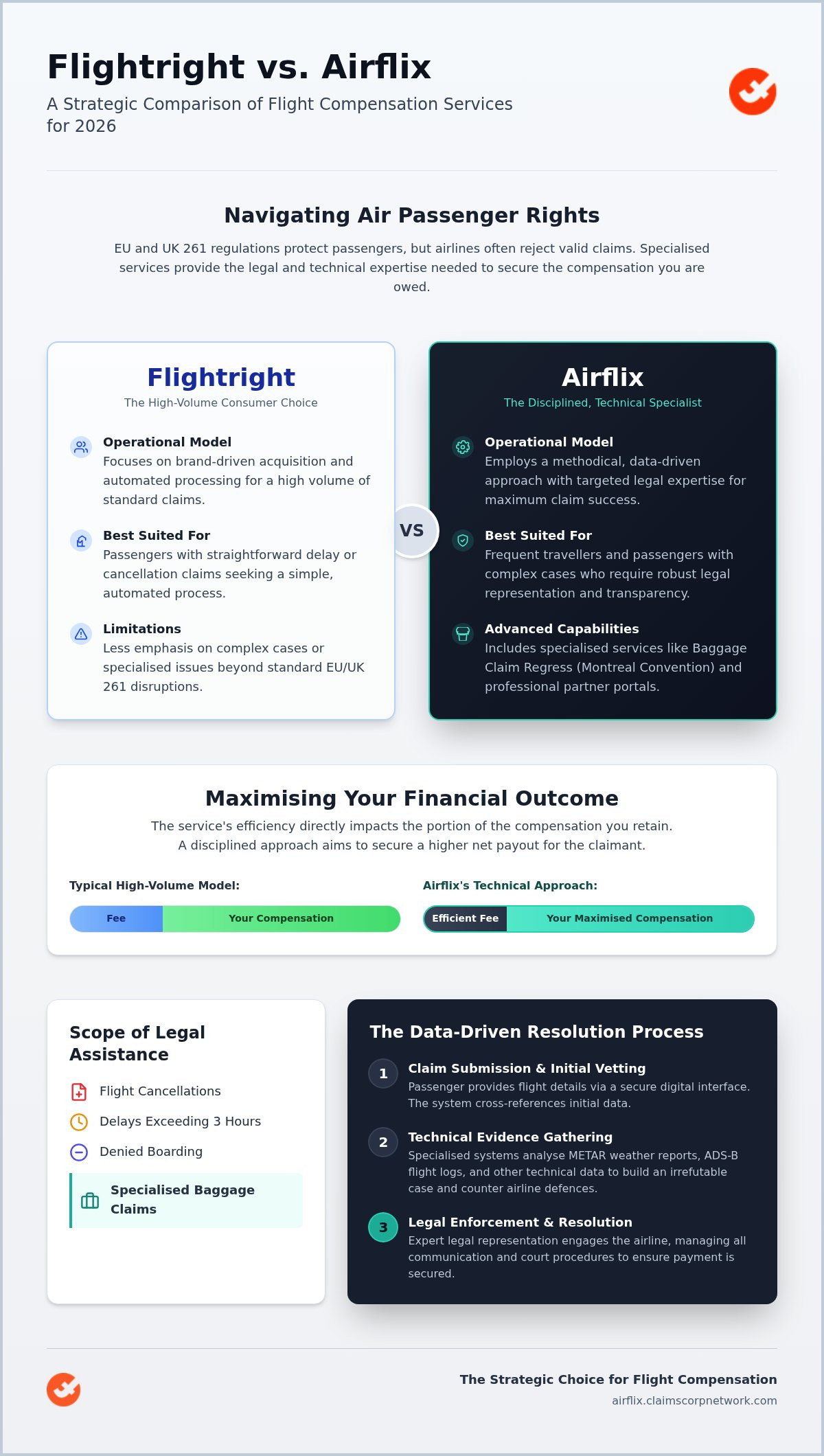
Resolution requires evidence. Proving a claim requires more than a simple boarding pass or a photo of a departure board. It involves access to detailed technical data, including METAR weather reports and ADS-B flight logs, to counter the airline's internal reports. The industry has shifted from manual, paper-based filing towards automated, data-driven validation systems. This transition is a core component of the Flightright vs Airflix dynamic, as both platforms use sophisticated software to verify disruption causes instantly. A methodical approach to data collection reduces the risk of rejection by providing irrefutable evidence of the carrier's responsibility. This systematic validation ensures that legal representation is backed by facts, making it significantly harder for airlines to ignore their financial obligations to passengers.
Comparing Service Frameworks: How Flightright and Airflix Organise Claims
Operational efficiency is the primary differentiator when evaluating Flightright vs Airflix. Whilst the legal basis for compensation is fixed, the administrative workflows used to extract that compensation vary significantly. Both platforms provide digital interfaces that allow passengers to input flight details, upload boarding passes, and sign legal mandates. However, the underlying logic of these systems reflects different institutional priorities. The speed at which a claim moves from initial submission to airline contact depends on the robustness of these back-end frameworks.
Operational Logic: High Volume vs. Targeted Expertise
Flightright operates as a high-volume consumer brand, focusing heavily on brand-driven acquisition and automated processing for standard delay claims. This model is effective for straightforward cases but can sometimes encounter bottlenecks when faced with complex airline rebuttals. In contrast, Airflix functions within the Claims Corporation Network (CCN) ecosystem. Established in 2014, CCN provides a more disciplined, technical framework that treats each claim as a structured legal transaction. This heritage in professional claims handling often makes the system more resilient when managing "difficult" claims that require persistent legal pressure and specialized oversight.
Tracking and Transparency Features
Transparency is a critical requirement for passengers who have already experienced the frustration of airline silence. Whilst the U.S. government provides a consumer guide to air travel to help passengers understand global standards, navigating the specific status of a live claim requires dedicated tracking tools. Both services offer dashboards, but the rhythm of updates differs. Airflix emphasises a methodical update cycle through its white-label passenger portal, ensuring that claimants receive real-time status monitoring at every stage of the litigation cycle.
Effective claim organisation also involves a seamless transition from administrative filing to formal legal representation. When an airline refuses to settle, the case must move to a litigation phase. Both Flightright and Airflix provide legal representation in case of court procedures, but the integration of this service is vital. A strategic facilitator should move a case into the legal stream without requiring the user to restart the process or provide redundant documentation. For those seeking a highly structured route to resolution, accessing a professional passenger portal can clarify the mechanics of this transition and provide the oversight necessary for successful recovery.
Fee Structures and Success Rates: The Financial Logic
Most legal assistance providers operate on a "No Win, No Fee" basis. This model ensures that passengers don't face financial risk when challenging an airline. However, the headline fee often excludes additional costs that become relevant if a case proceeds to court. When comparing Flightright vs Airflix, the financial logic depends on how each firm calculates its success fee and handles legal surcharges. Whilst the initial percentage might appear similar, the net payout varies based on the administrative efficiency of the provider.
The True Cost of Legal Representation
A standard success fee usually ranges from 25% to 35% of the total compensation. Whilst this covers the administrative handling of the claim under official EU air passenger rights, it may not include VAT or court surcharges. For example, some high-volume providers add a 14% to 15% surcharge if legal action is required, which can reduce the passenger's final payout to nearly half of the original compensation. Airflix leverages CCN infrastructure to maintain a competitive and transparent fee centre. This systemic efficiency allows for a clearer understanding of the final net amount before the process begins, ensuring that legal representation remains a viable route to resolution.
Subscription vs. Pay-per-Claim
A significant distinction in the Flightright vs Airflix comparison is the availability of subscription-based protection. Traditional models require a commission on every successful claim. For frequent business travellers, this can lead to substantial cumulative costs over a year. Airflix organises its services into monthly and yearly tiers, alongside a standard per-flight option. This provides consistent coverage for all disruptions without the need for individual claim negotiations on every trip.
Evaluating the ROI of a subscription requires an analysis of travel frequency. If a professional travels more than four times a month, a yearly subscription often proves more cost-effective than paying individual success fees. This methodical approach to financial planning ensures that legal redress becomes a predictable operational expense rather than a variable loss. By removing the per-claim commission for subscribers, the system prioritises long-term reliability and institutional stability for the claimant. It's a strategic shift from reactive claim filing to proactive passenger protection.
Beyond Basic Claims: Baggage Regress and Partner Portals
Whilst flight delays dominate the conversation around passenger rights, mishandled baggage remains a persistent operational failure for airlines. Many compensation services focus exclusively on time-based disruptions, leaving travellers to manage lost or damaged luggage through high-friction airline customer service channels. In the comparison of Flightright vs Airflix, a key differentiator is the latter's broader service scope, which includes dedicated legal assistance for baggage issues. This integrated approach ensures that all aspects of a travel disruption are managed within a single, disciplined framework rather than through fragmented manual efforts.
Baggage Claim Regress: A Specialist Service
Baggage claims are legally distinct from delay claims. Whilst EU and UK 261 govern flight timings, baggage issues fall under the Montreal Convention. This treaty establishes carrier liability for the destruction, loss, damage, or delay of luggage. Airflix manages the regress process for these cases, providing a methodical route to recovery that many competitors overlook. Having a single partner for both flight and baggage disruptions simplifies the administrative burden for the claimant. Instead of navigating two different legal standards alone, the passenger relies on a strategic facilitator to enforce rights across all disruption types.
The White-Label Passenger Portal
The operational requirements of travel agencies and tour operators demand more than just individual claim handling. These professional entities need a way to support their clients without outsourcing the entire brand experience. Airflix addresses this through its white-label passenger portal, allowing partners to offer flight disruption assistance under their own branding. This system provides B2B partners with real-time dossier tracking and automated status updates, making it an indispensable component of modern travel agency operations.
Integrating these services into a broader professional ecosystem allows travel operators to provide immediate value when disruptions occur. By using a white-label solution, agencies maintain their position as the primary point of contact whilst leveraging the technical and legal expertise of the CCN group. This transition from complexity to simplicity is a defining characteristic of the platform's design. For travel professionals looking to enhance their service offering, the Airflix partner portal provides the necessary infrastructure to manage claims with transparency and institutional weight.
Conclusion: Selecting the Right Partner for Your Flight Disruption
The choice between a high-volume consumer brand and a specialised technical facilitator depends on the complexity of the disruption and the required level of oversight. In the comparison of Flightright vs Airflix, the distinction lies in the institutional background and operational priorities of the providers. Flightright serves as a prominent entry point for the general public, whilst Airflix operates as a disciplined component of a broader professional ecosystem. For passengers seeking a methodical route to resolution, the background of the provider is as important as the success fee itself. Operational stability and the ability to escalate a claim to court without administrative friction are the hallmarks of an effective legal partner.
Whilst both companies provide essential services, the Flightright vs Airflix comparison highlights a shift towards more integrated, professional claims handling. Evidence is the only currency recognised by airline operational centres, and the most effective partner is the one that can validate that evidence with technical precision. Choosing a provider with established legal representation in court ensures that your rights are enforced through systemic pressure rather than simple requests.
The Final Verdict
Airflix is the preferred choice for claimants who value a transparent, data-driven approach to legal redress. By functioning within the CCN network, the service provides a level of institutional weight that is often necessary to overcome airline resistance. This framework ensures that claims are not merely filed but are systematically managed through every phase of the litigation cycle. For an immediate claim assessment, passengers can access FlightClaimEU to determine their eligibility and initiate the recovery process. The system’s focus on professional transactions makes it a superior strategic facilitator for both individual travellers and B2B partners who require reliable, real-time tracking of their dossiers.
Next Steps for Impacted Passengers
Securing compensation requires a disciplined approach to documentation. Airlines often rely on administrative gaps to justify claim rejections, so the burden of proof rests entirely with the passenger. To ensure the highest probability of success, follow this methodical sequence:
- Collect and retain all boarding passes, booking confirmations, and disruption notices provided by the airline.
- Record the actual arrival time at the final destination, as this is the metric used for UK and EU 261 calculations.
- Submit flight details through the Airflix portal to trigger a real-time validation of the disruption cause.
- Monitor the dossier status through the white-label portal to stay informed of airline responses or legal escalations.
A systematic approach to claim filing reduces the risk of rejection and ensures that the transition from administrative filing to legal procedure is seamless. By selecting a partner that prioritises operational stability, you increase the likelihood of a successful financial recovery. Secure your legal assistance today to ensure the recovery of the full compensation amount you are entitled to under the law.
Securing Your Rights Through Strategic Legal Assistance
The evaluation of Flightright vs Airflix indicates that whilst brand visibility is a factor, the underlying operational framework determines the efficiency of a recovery. Successful resolution requires a partner with the institutional stability of the Claims Corporation Network (CCN) to navigate airline resistance. Real-time claim tracking and specialised options like the Baggage Claim Regress service ensure that every aspect of a disruption is addressed with professional oversight.
Passengers who prioritise transparency and methodical execution find that a disciplined system provides the most reliable route to resolution. Whether you are managing an individual delay or a professional travel portfolio, the transition from administrative complexity to financial recovery is best achieved through a strategic facilitator. You can ensure your entitlements are fully protected by using a system designed for systemic enforcement.
Start your flight compensation claim with Airflix today to resolve your disruption with expert legal representation. Reclaiming your compensation shouldn't be an arduous process when the right infrastructure is in place.
Frequently Asked Questions
Is Airflix more reliable than Flightright for court procedures?
Airflix provides comprehensive legal representation in case of court procedures, leveraging the institutional stability of the Claims Corporation Network (CCN). Whilst Flightright manages high-volume consumer claims, the CCN-backed system offers a disciplined framework for complex litigation. This established expertise in third-party administration ensures that court proceedings are handled with professional rigor, making the platform a reliable strategic facilitator for cases that require formal legal escalation against corporate carriers.
How does the Baggage Claim Regress service work with Airflix?
The Baggage Claim Regress service manages the recovery of compensation for lost, damaged, or delayed luggage under the Montreal Convention. Unlike standard flight delay services, this specialised offering addresses the specific legal requirements for baggage disruptions. Passengers submit their claim details through the portal, allowing the system to initiate a methodical regress process against the airline. This ensures that travellers receive professional assistance for luggage issues that many other providers typically overlook.
Can travel agencies use Airflix as a white-label portal?
Travel agencies and tour operators can utilise the White-label Passenger Portal to manage client claims under their own corporate branding. This solution integrates real-time claim status tracking into the agency's service ecosystem, providing a transparent interface for their customers. By leveraging this infrastructure, agencies maintain their position as a primary facilitator whilst the back-end legal processes are managed by the CCN group, enhancing operational efficiency for professional travel partners.
What is the success fee for Airflix vs Flightright in 2026?
In the Flightright vs Airflix comparison, both services typically operate on a "No Win, No Fee" basis. Flightright success fees often range between 25% and 35%, with additional surcharges frequently applied if a case requires court representation. Airflix maintains a transparent fee centre by leveraging the CCN group's existing infrastructure. This systematic approach ensures that passengers understand the net payout of their compensation before the litigation cycle begins, avoiding unexpected administrative overheads.
Does Airflix offer a subscription for frequent travellers?
Airflix provides flexible coverage options, including monthly and yearly subscriptions designed for frequent travellers. These tiers offer consistent protection for all flights within the subscription period, removing the need for individual per-claim negotiations. This model is particularly beneficial for business professionals who require a predictable route to legal redress. Alternatively, passengers who travel less frequently can still access the service on a per-flight basis for specific disruption events.
How long does it typically take to receive compensation through these services?
The duration of the recovery process depends primarily on the airline's responsiveness and the complexity of the disruption. Straightforward claims are often resolved within a few months through automated validation systems. However, if an airline rejects a valid claim and legal representation in court becomes necessary, the timeline will naturally extend to accommodate judicial schedules. Real-time claim status tracking allows passengers to monitor progress throughout these different stages of the administrative cycle.
What happens if the airline rejects my claim with Airflix?
If an airline rejects an initial claim, the case is evaluated for formal legal escalation. Airflix provides full legal representation in case of court procedures to challenge unjustified rejections. The system uses technical flight logs and ADS-B data to counter airline defences, ensuring that claims are backed by irrefutable evidence. This transition from administrative filing to litigation is managed seamlessly within the platform, maintaining the methodical pursuit of the passenger's statutory rights.


