

What if the next systemic flight disruption became the precise moment your clients felt most secure in your partnership, rather than most frustrated by the delay? It's a reality that manual tracking of airline responses is an arduous, time-consuming process that often results in a loss of client trust when communication falters during peak travel periods. Most agencies view these disruptions as a drain on internal resources and a significant threat to their professional reputation.
Implementing a disciplined approach to flight claim management for travel agencies allows you to transform these administrative burdens into seamless brand-building opportunities. You can protect client loyalty whilst establishing a new value-add service through a system that operates with technical precision. This 2026 guide examines how a white-label passenger portal and automated real-time tracking provide the operational stability needed to manage claims with transparency. We'll detail the transition from complex manual workflows to a simplified, legal-backed framework that keeps your agency at the centre of the client relationship, ensuring every disruption is handled with expert oversight and methodical efficiency.
Key Takeaways
- Evaluate the operational impact of flight disruptions and learn how to mitigate client friction through systemic resolution frameworks.
- Master the 2026 legal landscape of UK261 and EU passenger rights to accurately identify eligible claims for your travellers.
- Implement automated flight claim management for travel agencies to replace time-consuming manual tracking with a professional white-label portal.
- Integrate real-time status tracking and legal expertise into your workflow to transform administrative burdens into brand-building opportunities.
- Leverage specialised services like Baggage Claim Regress to offer a comprehensive resolution ecosystem that protects client loyalty.
The Burden of Flight Disruptions on Modern Travel Agencies
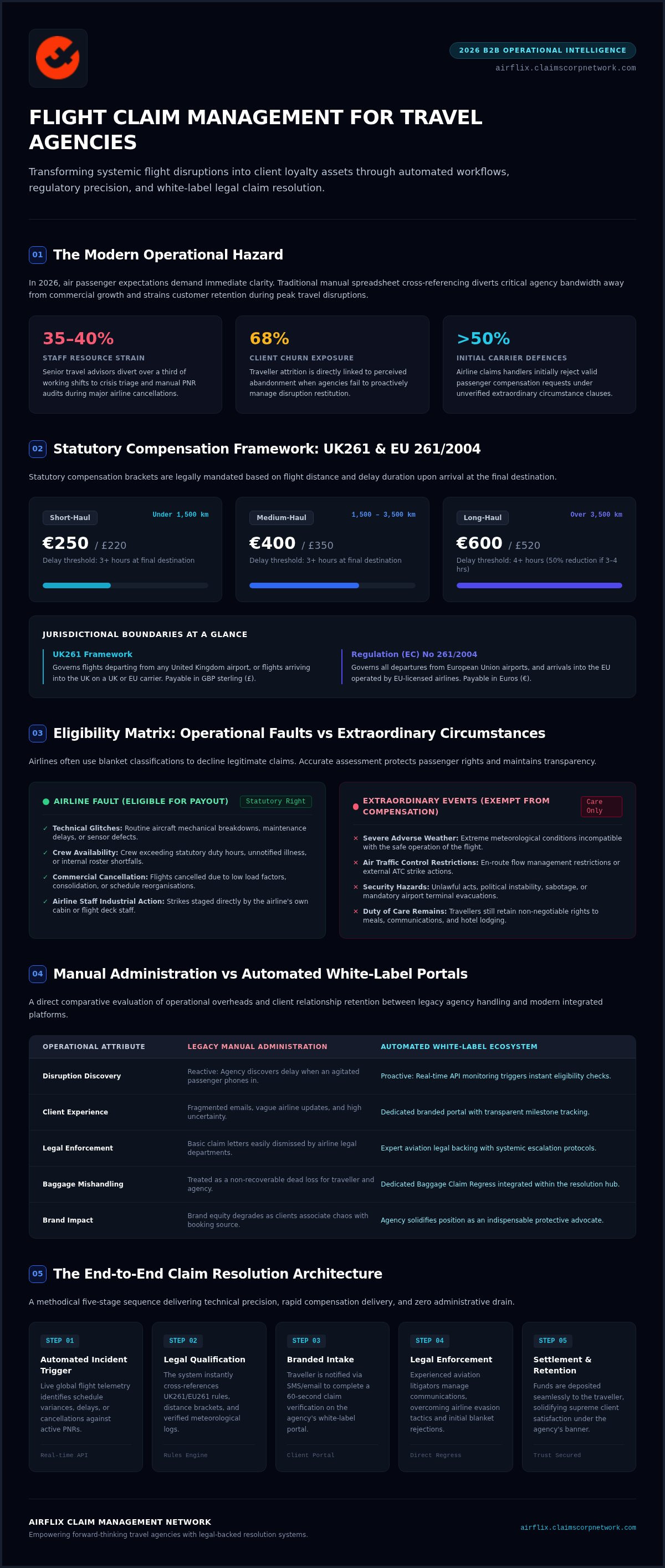
Flight disruptions have evolved from occasional inconveniences into significant operational hazards. For travel agencies, a single cancelled flight triggers a chain reaction of administrative tasks that extend far beyond rebooking. The direct impact on operational costs is measurable through increased call volumes and the diversion of senior staff from revenue-generating activities to crisis management. By 2026, passenger expectations have reached a point where immediate, transparent resolution is the baseline requirement. Clients don't accept "we are waiting for the airline" as a valid response anymore.
The hidden costs of manual flight claim management for travel agencies often remain unquantified until a systemic disruption occurs. Relying on manual tracking means staff spend hours cross-referencing PNRs with airline updates and legal eligibility criteria. This reactive posture doesn't just drain productivity; it erodes the agency's value proposition. When an agency fails to lead the recovery process, the client feels abandoned at their most vulnerable point. This leads to a sharp decline in long-term retention rates as trust evaporates.
The Administrative Complexity of 2026 Aviation
Traditional communication channels between agencies and airlines remain a primary bottleneck. Whilst airlines have digitised their booking systems, their claim resolution processes often remain opaque and deliberately slow. Staying updated on the nuances of Regulation (EC) No 261/2004 requires constant vigilance. Legal interpretations and thresholds for "extraordinary circumstances" shift frequently. Managing these complexities through manual spreadsheets is no longer a viable strategy for flight claim management for travel agencies dealing with multi-passenger claims. The risk of human error or missed deadlines is too high when dealing with statutory compensation windows.
Reputation Management in a Disrupted Landscape
A traveller's psychological response to a disruption is defined by the speed and quality of support they receive. If an agency acts only as a passive intermediary, they risk being seen as a redundant layer in the travel chain. Transitioning to a proactive protector model requires more than just empathy. It requires technical execution. Providing professional legal assistance through a structured portal ensures the client feels the agency is actively fighting for their rights. This systemic efficiency restores confidence. It positions the agency as an indispensable partner. Agencies that utilise advanced claim systems turn a negative travel event into a clear demonstration of brand reliability.
Understanding UK261 and EU Passenger Rights for B2B Partners
The legal landscape governing aviation compensation is defined by two primary frameworks that operate in parallel. Since the UK's departure from the European Union, the regulatory environment has split into UK261 and the original Regulation (EC) No 261/2004. For a travel agency managing a high volume of bookings, the distinction between these two is critical for determining eligibility. These laws establish clear mandates for compensation, reimbursement, and a duty of care when flights are delayed or cancelled. Detailed criteria are available in the EU air passenger rights guidelines, which outline specific compensation brackets ranging from €250 to €600 based on the flight's distance and duration of the delay.
A primary challenge in flight claim management for travel agencies involves distinguishing between "extraordinary circumstances" and airline operational failures. Airlines frequently cite weather or air traffic control restrictions as a blanket defence against claims. However, operational failures such as technical faults, crew shortages, or avoidable scheduling conflicts don't exempt them from liability. Legal precedents established in 2025 have further clarified that agencies aren't financially liable for the compensation itself, but they do carry a significant responsibility for the accuracy of the information provided to the traveller during the disruption. Failure to provide timely updates can lead to reputational damage and potential litigation regarding service delivery.
UK261 vs EU 261/2004: Key Differences
Navigating post-Brexit aviation rights requires identifying the correct jurisdiction for every claim. UK261 applies to flights departing from a UK airport or flights arriving in the UK on a UK or EU airline. Conversely, EU 261/2004 covers flights departing from an EU airport or arriving in the EU on an EU airline. It's common for a single itinerary to involve both jurisdictions. Determining the applicable law is the first step in ensuring a successful resolution. Accessing comprehensive disruption data allows your team to verify these jurisdictional nuances without manual research.
The Legal Strength of CCN Backing
Airlines are statistically more likely to settle claims when they're backed by a professional legal network. Being a member of the Claims Corporation Network (CCN) provides your agency with institutional weight that an individual passenger or a small agency lacks. This framework ensures that your claims are treated as serious legal matters rather than mere customer service complaints. Having legal representation ready for court procedures is essential for cases where airlines refuse to acknowledge their operational failures. This disciplined approach ensures that flight claim management for travel agencies remains a robust part of your professional ecosystem. You can explore how to integrate these legal frameworks into your workflow through a specialised passenger portal designed for B2B efficiency.
Manual Administration vs Automated White-Label Portals
Traditional methods of handling disruptions often involve fragmented communication and manual data entry. This approach creates a significant efficiency gap that expands during peak travel periods. Transitioning to a digital, automated framework replaces erratic workflows with a disciplined, systemic process. Implementing flight claim management for travel agencies through a centralised platform ensures that every claim follows a methodical path from submission to resolution, reducing the risk of human error.
Transparency is a fundamental component of professional flight claim management for travel agencies. Real-time tracking reduces the volume of client enquiry emails by providing immediate access to claim statuses. This self-service capability values the reader's time and reduces the administrative load on your support team. Additionally, a centralised platform enhances data security. Managing sensitive passenger information within a GDPR-compliant system is far more secure than using manual spreadsheets. It ensures that data remains protected throughout the legal process, reinforcing the agency's reputation for operational integrity. You can review these systemic advantages in detail at flightclaimeu.com.
The Value of the White-Label Approach
Maintaining brand consistency is a strategic requirement for agencies focused on long-term client retention. Referral models often force agencies to relinquish control by sending clients to third-party apps, which can dilute the perceived value of the agent's role. A white-label passenger portal allows you to customise the user interface to match your agency’s visual identity. This approach turns a flight disruption into a branded service offering, positioning your agency as the primary facilitator of the solution rather than a passive bystander. It's a powerful tool for building loyalty during the middle and bottom stages of the client relationship.
Efficiency Metrics: Time and Cost Savings
Quantifying the advantages of automation reveals substantial time and cost savings. Automating the validation and submission process eliminates the need for manual oversight of complex legal criteria. This reduction in manual intervention lowers the error rate in legal filings, whilst ensuring submissions align with UK CAA guidance on flight delays. Real-time status updates amongst staff improve internal communication, allowing your team to provide precise information without the need for internal follow-ups or airline enquiries. This systemic efficiency directly translates into protected profit margins and higher staff productivity.
Integrating Seamless Claim Support into Your Agency Workflow
Successful integration requires a structured transition from manual oversight to a systemic digital environment. It's not enough to simply refer clients to a third party. A professional flight claim management for travel agencies strategy involves embedding legal assistance directly into your service lifecycle. This ensures operational stability whilst maintaining the agency's position as a strategic facilitator and expert problem-solver.
The Implementation Roadmap
Onboarding follows a three-phase progression to ensure technical and staff readiness. Following this sequence prevents operational friction and ensures the system is fully utilised from the first day of deployment.
- Phase 1: Focus on technical setup and white-label customisation. This involves aligning the portal's visual identity with your agency's brand to ensure a seamless client experience across all digital touchpoints.
- Phase 2: Conduct staff training on the legal assistance dashboard. Your team must understand how to navigate real-time tracking and interpret claim statuses to provide accurate internal oversight without external reliance.
- Phase 3: Launch the portal as a value-added service. This phase involves communicating the new capability to your client base as a proactive brand-protection measure that distinguishes your agency from competitors.
Identifying eligible claims shouldn't be a reactive task. Training your staff to screen for disruptions during the post-travel follow-up allows for the early identification of compensation opportunities that might otherwise be overlooked by the passenger. Setting up automated triggers for delayed or cancelled flight notifications ensures that your team is alerted to potential claims before the client even reports them. This proactive stance reinforces the agency's role as a disciplined partner that values the traveller's statutory rights.
Managing Client Communications Whilst Claims are Pending
Maintaining transparency during the legal process is essential for protecting client trust. Automated status updates provide the necessary clarity without requiring manual intervention from your consultants. When clients enquire about the specific timelines of legal proceedings, your team can leverage the FlightClaimEU expertise to provide authoritative, grounded answers. This reduces the friction typically associated with the long duration of airline settlements. Using a structured communication framework ensures that flight claim management for travel agencies remains a professional asset rather than an administrative burden.
A well-integrated system transforms a complex administrative burden into a predictable, revenue-generating workflow that strengthens your professional ecosystem. You can begin this transition by registering for a white-label passenger portal to automate your disruption management and protect client loyalty.
Airflix: Elevating Agency Reputation through Legal Expertise
Airflix, powered by the Claims Corporation Network (CCN), functions as the professional backbone for agencies seeking to master operational stability. It provides a structured path for transitioning from administrative complexity to systemic efficiency. By implementing flight claim management for travel agencies through this platform, you ensure that every disruption is met with a disciplined response. The system is designed to act as a clarifying force, replacing fragmented manual workflows with a high-functioning ecosystem that prioritises the resolution of passenger grievances.
Operational flexibility is a core component of the Airflix model. We offer subscription structures that accommodate diverse business requirements, including monthly, yearly, or per-flight options. This allows agencies of all sizes to access professional legal assistance without the burden of fixed overheads. Real-time monitoring and court-ready legal representation ensure that your agency remains protected, regardless of the volume of claims you manage. You can explore these operational advantages and the mechanics of our process at flightclaimeu.com.
Beyond Flight Delays: Baggage Recovery Services
Lost or damaged luggage represents a significant, yet frequently neglected, friction point in the traveller's journey. Most standard solutions focus exclusively on flight delays, leaving a gap in the client's recovery experience. The Airflix Baggage Claim Regress service addresses this specific pain point by providing a comprehensive protection ecosystem. It allows your agency to offer a total resolution package that extends beyond the terminal. By integrating baggage recovery into your service list, you increase the perceived value of your agency's expertise and ensure that clients feel supported throughout every stage of their journey.
Strategic Facilitation of Legal Success
Professional legal assistance is the necessary conclusion for disruptions where airlines fail to meet their statutory obligations. Airflix leverages the institutional weight of the CCN to ensure that airlines honour the rights of your passengers. When a claim moves toward court procedures, having a disciplined legal framework in place is the difference between a dismissed complaint and a successful settlement. Airlines are statistically more inclined to settle when they recognise the involvement of an established legal network. This approach closes the loop on flight disruptions. It transforms a negative travel event into a demonstration of agency reliability, ultimately resulting in a satisfied and loyal client. The transition from complexity to simplicity is achieved through technical execution and a commitment to systemic integrity.
Securing Operational Stability for 2026 and Beyond
The evolution of passenger rights and the increasing complexity of global aviation require a transition from reactive support to systemic resolution. By adopting automated flight claim management for travel agencies, your business replaces administrative friction with a disciplined framework that prioritises client retention. You've seen how white-label portals maintain your brand's authority whilst legal backing ensures airlines meet their statutory obligations. This shift from manual tracking to digital oversight ensures that every disruption is handled with technical precision and transparency.
This approach doesn't just resolve disruptions; it transforms them into a measurable value-add service. As a member of the Claims Corporation Network (CCN), Airflix provides real-time tracking and full legal representation through customisable white-label solutions. This ensures your agency remains the primary point of contact and the strategic facilitator of the recovery process. You can enquire about our White-label Portal for Travel Agencies to begin your transition toward operational excellence. Establishing a robust resolution ecosystem today ensures your agency is prepared for the travel landscape of tomorrow and continues to build enduring client trust.
Frequently Asked Questions
How does a white-label portal benefit a travel agency specifically?
A white-label portal ensures that your agency remains the primary point of contact during a disruption. It allows you to offer professional legal assistance under your own visual identity, which reinforces client trust and brand authority. By providing a seamless, branded interface, you transform a negative travel experience into a clear demonstration of your agency's commitment to resolution and expert oversight.
Can travel agencies earn revenue from flight claim management?
Travel agencies can generate new revenue streams by integrating flight claim management for travel agencies into their service offerings. This is typically achieved through a value-add service model or a structured partnership where the agency facilitates the legal recovery process. This approach turns a previously uncompensated administrative burden into a professional service that protects profit margins whilst increasing the agency's overall value proposition.
What is the difference between UK261 and EU261 for British agencies?
The primary difference lies in the jurisdiction and the specific criteria for applicability. UK261 applies to flights departing from a UK airport or those arriving in the UK on a UK or EU airline. Regulation (EC) No 261/2004 covers flights departing from an EU airport or arriving in the EU on an EU carrier. Understanding these nuances is critical for British agencies managing itineraries that traverse both regions.
How long does the flight compensation process typically take in 2026?
The duration of the compensation process depends on the airline's internal response times and the complexity of the claim. Whilst automated systems have improved efficiency, some cases may take several weeks or months to reach a resolution. If a claim requires formal legal intervention or court procedures, the timeline will extend according to the specific requirements of the relevant judicial system and the airline's defensive posture.
What happens if an airline refuses to pay a valid claim?
If an airline refuses to settle a valid claim, the case proceeds to a formal legal review. Airflix, as a member of the Claims Corporation Network, provides full legal representation to challenge these refusals through established judicial frameworks. This disciplined approach ensures that airlines honour their statutory obligations even when they initially cite extraordinary circumstances to avoid payment, providing a robust path to resolution for your clients.
Is the baggage claim regress service included in the standard portal?
The baggage claim regress service is a core component of the Airflix ecosystem and is available through our specialised portal. This service allows agencies to manage claims for lost or damaged luggage alongside flight disruption compensation. Providing this integrated support creates a comprehensive protection framework that addresses multiple friction points in the traveller's journey within a single, professional interface, enhancing the agency's reputation for thoroughness.
Can we integrate the claim portal into our existing agency website?
Integration of flight claim management for travel agencies into your existing website is a straightforward process designed for technical efficiency. The white-label portal can be customised to match your site's visual identity, ensuring a consistent user experience for your clients. This allows you to host a professional claim management tool directly on your domain, maintaining your position as the strategic facilitator of the disruption recovery process.
How does Airflix handle court procedures on behalf of our clients?
Airflix manages the entire litigation process when court procedures become necessary to secure compensation. Our legal experts handle the preparation of filings, evidence submission, and formal representation against the airline. This allows your agency to offer a high-level legal solution without the need to maintain an in-house legal department or navigate complex international aviation laws independently, ensuring a methodical and expert approach to every case.


