

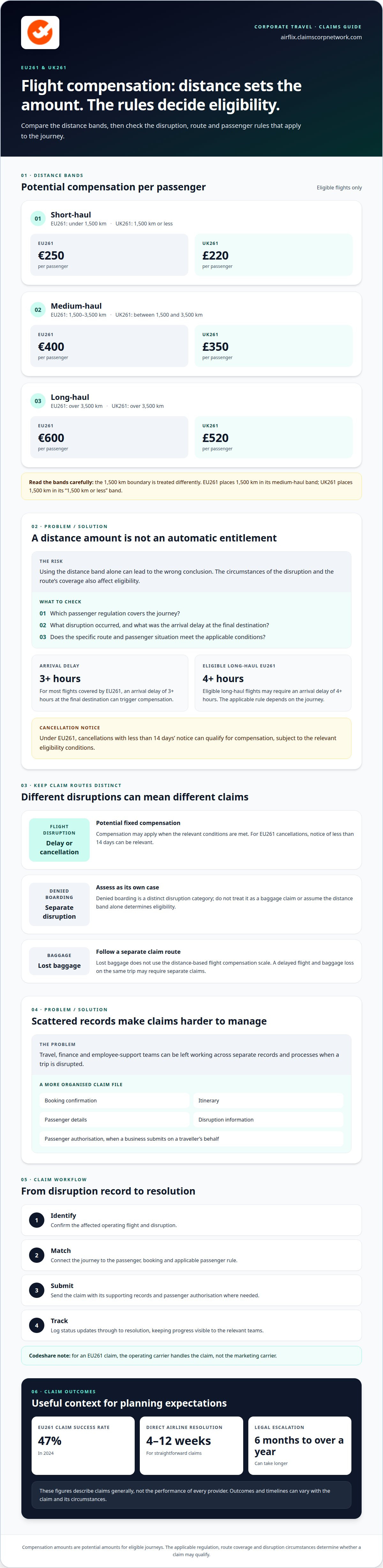
Integrating B2B flight compensation solutions can give corporate travel teams a structured way to identify and manage eligible claims. According to the European Union, eligible flights under EU261 may qualify for €250 per passenger at distances under 1,500 km and €400 per passenger from 1,500 to 3,500 km; eligible flights over 3,500 km may qualify for €600. The amount depends on flight distance and the applicable passenger rules.
Disruption handling can otherwise leave travel, finance and employee-support teams working across separate records and processes. Integration helps bring claim workflows into the systems teams already use, making it easier to organise cases, track progress and maintain oversight across business travel.
This article explains how integration works, how compensation amounts vary by distance, and how EU and UK passenger rules affect eligibility. It also covers API connections, enterprise features and practical criteria for choosing a solution for corporate travel operations.
Key Takeaways
- Learn how flight distance and the rules that apply to a journey shape potential compensation.
- See how API integration can connect disruption records with a more organised claims workflow.
- Assess enterprise features by how well they support oversight, claim-status visibility and passenger access.
- Understand how cancellation notice and other eligibility conditions affect EU passenger claims.
- Explore how legal assistance, baggage claims and passenger portal tools can support corporate travel teams.
Compensation amounts by flight distance
Under EU261, eligible short-haul flights under 1,500 km may qualify for €250 compensation per passenger, according to the European Union. Eligible medium-haul flights from 1,500 to 3,500 km may qualify for €400 compensation per passenger, also according to the European Union. Eligible long-haul flights over 3,500 km may qualify for €600 per passenger. The distance band sets the amount, but disruption circumstances and route coverage affect eligibility.
UK261 has separate compensation amounts: £220 for flights of 1,500 km or less, £350 for flights between 1,500 and 3,500 km, and £520 for flights over 3,500 km. For most flights covered by EU261, arrival delays of 3+ hours at the final destination can trigger compensation. Under EU261, eligible long-haul flights may require an arrival delay of 4+ hours. The applicable rule depends on the journey and the regulation covering it.
Delays and cancellations can lead to fixed compensation when the relevant eligibility conditions are met. Under EU261, cancellations without 14 days notice can qualify for compensation, according to the European Union. Denied boarding is a distinct disruption category, while lost baggage follows a separate claim route rather than the distance-based flight compensation scale. For example, an eligible delay and a baggage loss from the same trip may need separate claims.
Providers can be compared by the routes and disruption types they handle, how they report claim outcomes, and how they communicate progress. The EU261 claim success rate was 47% in 2024. Straightforward claims resolved directly with airlines typically take four to twelve weeks; legal escalation can take six months to over a year. These figures describe claims generally, not the performance of every provider.
In the United States, compensation for flight delays is not standardised; airline policies may provide vouchers, rebooking or accommodation. Involuntary denied boarding compensation is 200-400% of the one-way fare, capped at $775-$1,550. International eligibility depends on the rules covering the route. For example, EU261 and UK261 apply to eligible journeys within their respective scope, while Canada’s passenger regulations set different compensation bands for qualifying operational delays or cancellations.
A claim file should bring together the booking confirmation, itinerary, passenger details and disruption information. When a business submits a claim for a traveller, it should also record the passenger’s authorisation. Keeping these records together helps identify the affected flight, passenger and disruption behind each claim.
A practical filing process starts by identifying the operating flight and disruption, then matching the journey to the applicable rule. The claim is submitted with its supporting records, and status updates are logged through resolution. For a codeshare under EU261, the operating carrier handles the claim, not the marketing carrier.
Businesses handling claims should account for legal, privacy and reputational risks. Inaccurate eligibility decisions can lead to disputes, while unnecessary access to passenger and itinerary information can increase privacy exposure. Clear authorisation, controlled access to claim records and accurate progress updates help keep the process accountable.
API integration
An API connects separate software systems so they can exchange structured information. In a corporate travel workflow, it can pass relevant itinerary and disruption records between a travel platform and a claims process. Integration alone does not establish eligibility or calculate compensation. Those decisions depend on the applicable passenger rules and the details of each disruption.
Start by mapping the information needed at each stage. A booking reference, passenger identity, flight number, operating airline, scheduled itinerary and disruption status can help distinguish cases. Define which system is authoritative for each field. For example, a travel platform may hold booking details, while a case-management system records claim progress.
- Receive the record: identify the event that starts the workflow, such as a cancellation or delay record.
- Match the journey: associate the disruption with the correct passenger, booking and flight.
- Assess the case: route the record for eligibility assessment rather than treating every disruption as claimable.
- Return an update: record whether the case needs information, is ready to submit, or has progressed.
These steps create a defined hand-off, not an automatic entitlement. The operating airline, route and actual disruption may affect the assessment. If a record lacks a passenger match or contains conflicting flight details, the workflow should send it for review rather than submit an incomplete claim. This helps prevent duplicate or misdirected cases.
Before connecting systems, agree on the data format, field names and permitted status values. Shared definitions of “submitted”, “under review” and “resolved” help teams interpret updates consistently. Decide how to handle corrections when an airline changes a flight record or a traveller is rebooked. Keep an audit trail of received information, amendments and submission decisions.
Access controls matter because booking records contain personal travel information. Limit data transfers to fields required for the claim workflow, and define which roles can view or amend each record. Set out how failed transfers are reported, records retried and duplicate submissions identified. These rules make exceptions visible instead of allowing silent gaps.
Test the integration with representative cases before using it in live operations. Include a cancellation, delayed arrival, rebooking and record with missing information. Confirm that each case reaches the right review step and that status changes return to the intended system. A clear API specification and documented ownership help corporate teams maintain the process as their travel systems change.
Corporate features and enterprise limitations
Enterprise use depends on how claims fit existing travel, finance and passenger-support workflows. Assess coverage, technical requirements and operational boundaries before introducing a service across international travel programmes.
Corporate service features
Corporate services may include claim intake, eligibility assessment, case tracking and passenger communications. These functions help travel teams manage cancellations and delays alongside existing travel records. Assess how each case is assigned, which status updates are visible and how exceptions reach a human reviewer. For example, a record with conflicting itinerary details should be reviewed, not treated as ready to submit.
Enterprise features also need clear roles and permissions. A travel manager may need an overview of open cases, while a passenger needs information about their own claim. Check how the service handles corrections, duplicate records and cases spanning multiple bookings. The workflow should distinguish a disruption report from a claim that meets the relevant eligibility criteria.
Technical fit is another key consideration. Assess how the service exchanges data with booking, expense or case-management systems, and how teams handle failed transfers. Agree which system owns each field, such as itinerary details or claim status. If a flight is rebooked, retain the original disruption record and associate the revised journey correctly.
Provider fit across travel businesses
The market includes specialist flight-claims services, legal-assistance providers and travel technology platforms with claims workflows. Suitability depends on the business model and journeys handled. A travel agency may prioritise a passenger-facing process, an airline may focus on operational case handling, and a corporate travel provider may need consolidated oversight across employee bookings.
Compare providers by the countries and disruption types they cover, how they handle international claims, and how they report case progress. A service focused on passenger claims may not address every need of an airline or travel management operation. Assess how cancellations, delayed arrivals, denied boarding and baggage issues are handled as distinct case types.
Limitations often emerge at the boundaries. A service may depend on complete booking information, while a corporate programme may use several booking channels. Passenger rules can also affect eligibility based on route and operating airline. Define which cases the workflow accepts, which need additional review and how unresolved cases are escalated. This clarifies responsibilities when teams introduce the service across departments.
Before rollout, review data access, passenger consent and reporting. Decide who can submit a claim on a traveller’s behalf, what information is retained and how passengers receive updates. A small pilot using representative bookings can reveal technical gaps before wider adoption. Document how to handle exceptions, including a cancelled flight followed by a rebooking, so teams manage similar claims consistently.
EU passenger compensation
EU261 eligibility depends on the journey, disruption and airline’s role. Under EU261, cancellations without 14 days notice can qualify for compensation, according to the European Union. That notice period makes the timing and content of the airline’s cancellation confirmation important when a business reviews a booking.
Route coverage needs separate consideration. Passengers may qualify for compensation on flights departing from an EU Member State, or on travel into the EU from a third country when the airline is based in the EU. A corporate booking record should therefore capture the departure country, destination and operating airline, not just the ticket seller.
For codeshare journeys, the operating carrier handles an EU261 compensation claim, rather than the marketing carrier. This distinction matters when a booking confirmation displays one airline’s brand but another airline operates the flight. A claims workflow should identify the operating carrier from the actual journey before directing the submission.
A passenger’s right to compensation also applies to business travel. The passenger may retain that right even if their employer paid for the ticket, unless an advance contractual arrangement requires payment to the employer. Travel teams can clarify claim ownership by recording relevant employer arrangements before submitting a claim.
Compensation and care are distinct. EU261 right-of-care provisions require airlines to provide meals, accommodation and communications during delays of 2 or more hours. Those provisions are separate from fixed compensation, so a case record should distinguish care provided during disruption from a later compensation claim.
The reason for a disruption affects eligibility. Delays caused by circumstances beyond the airline’s control, such as bad weather or bird strikes, do not qualify for compensation. Significant delays for reasons within the airline’s control may qualify. Record the airline’s stated reason and the actual arrival circumstances rather than treating every delay alike.
A practical review can follow a consistent sequence:
- Match the passenger to the booking, ticket and affected flight.
- Record the route, operating carrier, disruption and cancellation notice.
- Assess whether EU261 covers the journey and the disruption circumstances.
- Submit an eligible compensation claim to the operating airline.
- Retain the airline’s confirmation and track the response against the case.
Deadlines also vary by country. Claim deadlines can vary by country, so the relevant jurisdiction may affect how long passengers have to act. Corporate teams handling international bookings benefit from recording the relevant country and claim date with each case.
EU261 and UK261 passenger compensation
EU261 and UK261 share a distance-based compensation structure, but their procedures differ. Corporate travel teams should record the applicable rules against each booked journey. That helps separate fixed compensation from refunds, rerouting and assistance during unexpected disruptions. A passenger’s arrival time, the journey distance and the reason for disruption can each affect the outcome.
For most flights covered by EU261, arrival delays of 3+ hours at the final destination can trigger compensation. The relevant time is arrival at the final destination, not simply departure from the airport. For a connection itinerary, the case record should therefore include the complete booked route and final arrival details. A delay on the first leg alone does not describe the full journey.
Rerouting can affect the amount payable under EU rules. Under EU Regulation 261/2004, compensation may be reduced by 50% if rerouting arrives close to the original scheduled time. This means the replacement itinerary and its actual arrival time belong in the claim file. For example, a case involving a disrupted outbound flight should record both the original schedule and the rerouted arrival.
Refund rights and compensation are separate considerations. Under UK261, passengers delayed 5+ hours can claim full refunds on non-refundable tickets. That refund relates to the ticket, whereas fixed compensation concerns the qualifying disruption. Travel teams should record whether the passenger continued travelling, accepted a replacement flight, or sought a refund, then classify each request accurately.
Care obligations can remain relevant even where extraordinary circumstances exempt an airline from fixed compensation. Under EU261, airlines must provide meals, accommodation for overnight delays, and two free communications. These forms of assistance address immediate passenger needs and do not, by themselves, determine whether fixed compensation is due. A clear expense record can help distinguish care provided from compensation claimed.
For a corporate workflow, maintain a separate evidence trail for each passenger and flight. Capture the original booking, disruption notice, revised itinerary, final arrival time and airline communications. Record whether the passenger received meals or accommodation, and whether they accepted a refund or rerouting. This makes the distinction between compensation, ticket costs and disruption assistance clear during review.
Claim timing also differs by jurisdiction. Passengers covered by UK261 can file claims within 6 years. A travel programme operating across European and UK routes should therefore store the relevant rule and claim date with each case. Do not treat the booking country, the ticket seller and the operating carrier as interchangeable fields; each can describe a different part of the journey.
Before submitting, organise each case by disruption type and requested remedy. A delay claim needs arrival information; a refund request needs ticket and booking details; a rerouted journey needs its revised schedule. A structured record helps teams explain the passenger’s position and manage the claim without mixing compensation with travel expense reconciliation.
Airflix
Airflix supports corporate travel teams managing flight disruption claims and passenger updates. Its Flight Disruption Legal Assistance supports disruption-related claims, while Baggage Claim Regress addresses baggage claims. A White-label Passenger Portal provides a passenger-facing channel, and Real-time Claim Status Tracking gives teams visibility into case progress.
These services can support organisations that need help managing claims alongside existing travel processes. The right next step depends on the team’s workflow, passenger communication needs and the types of claims it handles.
Contact Airflix to discuss your corporate travel requirements.
Make the next step operational
Use your next planning discussion to define how disruption cases move from detection to resolution. Set out who owns each decision, how passenger authorisation is recorded and which updates travel teams need. A clear operating model helps employees, finance teams and travel managers understand their roles when a case arises.
Then map that process against your existing booking and support workflows. Identify where records are created, how exceptions are handled, and how passengers receive progress information. This gives your organisation a practical basis for assessing whether B2B flight compensation solutions fit its operational requirements, rather than treating the decision as a technology purchase alone.
Airflix can discuss how its services align with your corporate travel process. Discuss your claims workflow with Airflix and take a considered next step towards a clearer approach.
Frequently Asked Questions
Why integrate Flight Delay Compensation?
Integration gives corporate teams a consistent route from travel disruption records to claim review. It can connect an affected booking with the relevant passenger, itinerary and case status, reducing manual transfers between systems. For example, a travel manager can see which cases need passenger information and which have progressed. Integration supports oversight, but does not itself establish eligibility or guarantee compensation.
How long does the compensation process take?
Timing depends mainly on whether the airline resolves a claim directly or whether it requires legal escalation. Straightforward claims resolved directly with airlines typically take four to twelve weeks. Claims requiring legal escalation can take six months to over a year. For corporate planning, distinguish the time needed to assemble and submit a complete case from the airline’s handling time and any subsequent legal process.
Is there a time limit to make my claim?
Yes. The deadline depends on the country whose limitation period applies. EU flight-compensation limitation periods vary from one to six years by member state, whilst passengers covered by UK261 can file claims within six years. A company managing travel across several countries should record the relevant jurisdiction and disruption date for each case. Submitting promptly also helps keep booking records and passenger details readily available.
What are B2B flight compensation solutions and how do they work?
B2B flight compensation solutions help organisations manage passenger claims as part of business travel operations. A workflow typically links a disrupted journey to its passenger and booking, assesses the case against applicable rules, then supports submission and status monitoring. Airflix offers Flight Disruption Legal Assistance and Real-time Claim Status Tracking. This can give travel teams a defined process for managing cases without treating every disruption as eligible.
How do B2B flight compensation platforms integrate with booking systems and travel management software?
Platforms can exchange selected booking and disruption information with travel management software through an API or another agreed data connection. A practical setup maps fields such as passenger identity, flight details and booking reference, then defines which system updates claim status. Establish how teams will handle corrections, failed transfers and duplicate records. For instance, a rebooked itinerary should remain associated with its original disruption case.


