

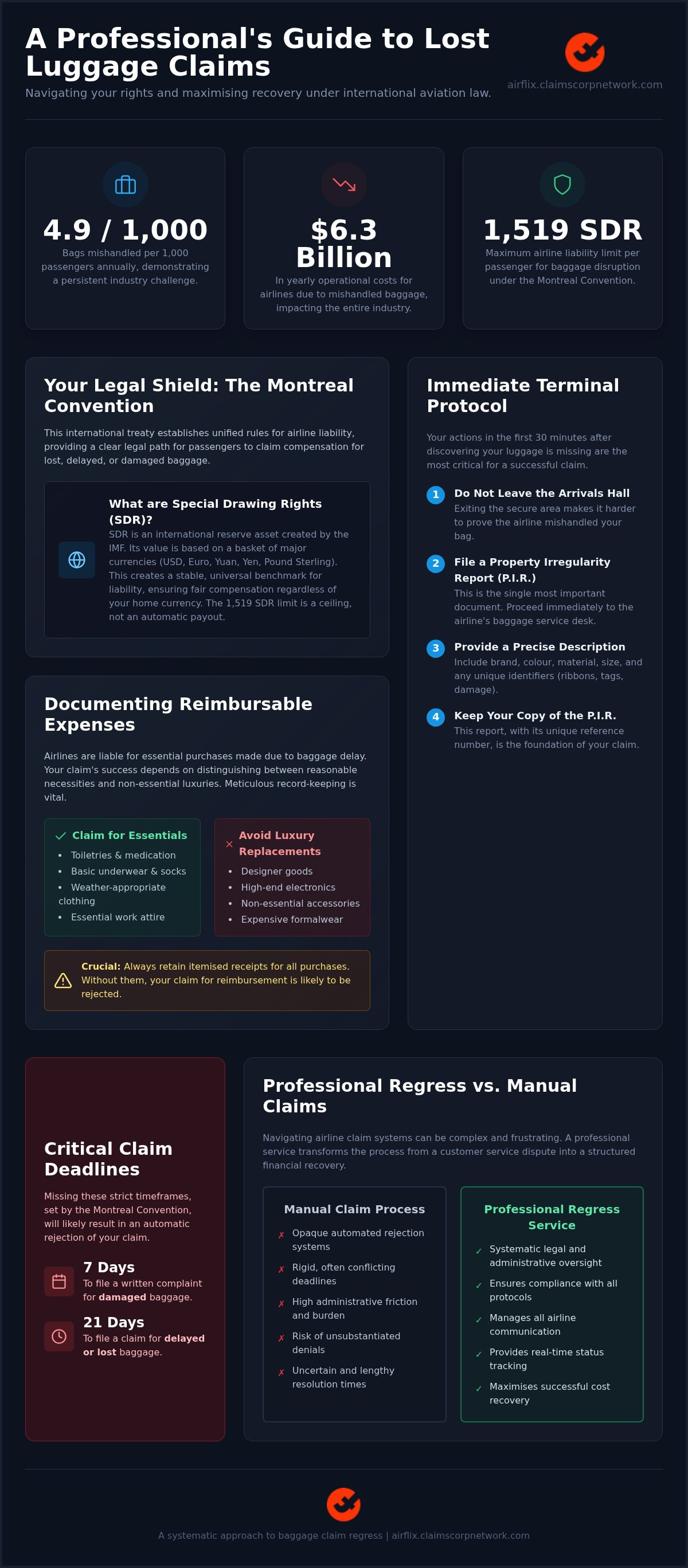
Despite advancements in tracking technology, the airline industry mishandled approximately 4.9 bags per 1,000 passengers in 2025, resulting in a staggering $6.3 billion in operational costs. For the affected traveller, the administrative burden of securing reimbursement often proves more frustrating than the initial loss. You've likely encountered the opaque barriers of automated rejection systems or rigid, conflicting deadlines that seem designed to discourage legitimate claims. This guide provides a methodical framework for understanding how to claim expenses for lost luggage, ensuring you navigate the Montreal Convention's 1,519 SDR liability limit with professional precision.
We'll examine the specific documentation required for essential purchases, the critical timelines for filing a Property Irregularity Report; and how professional legal regress transforms a complex customer service dispute into a structured financial recovery. This systematic approach ensures that every essential expense is accounted for whilst maintaining full compliance with international aviation protocols. By following a disciplined administrative process, you can transition from the uncertainty of a missing suitcase to the successful recovery of documented costs and the restoration of your professional requirements.
Key Takeaways
- Identify the 2026 liability thresholds defined by the Montreal Convention, which provides a compensation ceiling of 1,519 SDR for international baggage disruptions.
- Execute the mandatory reporting protocol by securing a Property Irregularity Report (P.I.R.) at the terminal before departing the airport environment.
- Master the administrative requirements of how to claim expenses for lost luggage, specifically the necessity for itemised receipts for all essential purchases.
- Minimise administrative friction by utilising professional Baggage Claim Regress services that offer systematic legal oversight and real-time status tracking.
- Understand the distinction between essential item reimbursement and luxury replacements to ensure your claim aligns with established airline liability frameworks.
The Legal Framework: International Rights and the Montreal Convention
The Montreal Convention serves as the primary treaty governing international airline liability for baggage. Established to unify rules across global jurisdictions, it ensures passengers have a clear legal path to recovery when luggage is mishandled. Understanding the mechanics of this framework is essential when determining how to claim expenses for lost luggage. As of 2026, the liability thresholds have been adjusted to reflect economic shifts; the current limit is 1,519 Special Drawing Rights (SDR) per passenger. This figure represents the maximum financial responsibility an airline carries for documented losses, including the purchase of essential items during a delay.
Timeframes for reporting remain rigid under this treaty. For damaged items, a written complaint must be submitted within 7 days of receipt. In cases of delayed or lost baggage, the window extends to 21 days from the date the luggage was due to arrive. Missing these deadlines typically results in an automated rejection of the claim, as the carrier's legal obligation expires once these periods pass.
Understanding Strict Liability in 2026
Airlines operate under a principle of strict liability for checked baggage whilst it is in their care. This means the carrier is generally responsible for loss or damage occurring between the point of check-in and the point of collection. To secure a successful reimbursement, the passenger must demonstrate the actual value of the items or the necessity of expenses incurred. This documentation forms the foundation of a legally robust claim and prevents airlines from dismissing the request as unsubstantiated.
There are specific exceptions where an airline can legally refuse a claim. If the damage resulted from an inherent defect in the suitcase or if the items were improperly packed by the traveller, the carrier may deny liability. Maintaining a methodical record of your baggage's condition before travel is a professional safeguard against these denials and ensures the burden of proof remains manageable.
Special Drawing Rights (SDR) Explained
Special Drawing Rights (SDR) are an international reserve asset used to standardise airline liability. This unit of account, managed by the International Monetary Fund, fluctuates based on a basket of major global currencies. To determine the value of your claim in British Pounds, you must convert the SDR limit using the current daily exchange rate. This standardisation prevents confusion across different national currencies and provides a stable benchmark for international travel claims.
The 1,519 SDR limit serves as a ceiling for cost recovery, not a guaranteed payout. Airlines only reimburse the documented value of your loss. If you cannot provide itemised receipts whilst navigating how to claim expenses for lost luggage, the carrier will apply depreciation or reject the claim. Utilizing Airflix ensures that your valuation is accurate and less likely to be dismissed by airline administrative teams.
Immediate Terminal Protocol: Reporting Your Misplaced Luggage
The moments immediately following the discovery of a missing bag are critical for the eventual success of your claim. Understanding how to claim expenses for lost luggage requires an immediate shift from travel to administration. You must not leave the arrivals hall without formalising the loss; once you pass through customs and exit the terminal, the airline's ability to dispute the location of the loss increases significantly. Securing a physical record of the mishandling is the foundation upon which all subsequent legal regress is built.
The Property Irregularity Report (P.I.R.)
The Property Irregularity Report (P.I.R.) is the single most important document in the recovery process. You should proceed directly to the airline's baggage service desk or the lost and found counter to initiate this report. When completing the form, provide a precise description of the suitcase, including the brand, material, and any identifying features like ribbons or unique locks. This detail ensures the report is legally robust and harder for the carrier to dismiss during the secondary review phase.
- Accurate Categorisation: Use the standard industry colour and type codes provided by the agent to categorise your luggage correctly.
- Contact Details: Ensure the delivery address and contact number on the P.I.R. are accurate for the next 21 days.
- Reference Number: Secure the unique 10-character file reference (e.g., LHRBA12345), which is essential for monitoring your recovery status.
If the service desk is unattended, travellers should document the scene with photographs of the empty counter and any provided contact signage. Attempt to locate an authorised airline representative in the departures area to secure a manual report before leaving the airport boundary. Don't rely on verbal promises from ground staff; only a printed or digital P.I.R. receipt holds weight in a legal dispute.
Evidence Management at the Airport
Successful evidence management transforms a simple complaint into a professional claim. Before leaving the terminal, photograph your baggage receipts, boarding passes, and the completed P.I.R. document. These items serve as primary evidence of the contract of carriage and the airline's failure to perform its duty. Securing the contact details for the specific ground handling agent responsible for your flight is also a strategic advantage, as they often manage the physical search whilst the airline handles the administrative claim.
Organising your initial documentation is the first step to facilitate a professional baggage claim. By maintaining a disciplined record from the outset, you prevent the airline from using administrative technicalities to reject your filing. Utilising a platform for real-time claim status tracking ensures you remain informed throughout the recovery cycle and provides the transparency required for complex international travel disruptions.
Documenting Reimbursable Expenses: What the Airline Must Pay
Securing reimbursement for a mishandled bag requires a shift from passive waiting to active financial documentation. When considering how to claim expenses for lost luggage, you must distinguish between "essential items" and luxury upgrades. International law, specifically the Montreal Convention, requires airlines to cover the cost of reasonable replacements whilst you're without your belongings. This isn't a fixed-sum payout; it's a reimbursement of actual, documented costs incurred due to the carrier's failure to deliver your luggage on time.
The "proportionality rule" is the standard used by airline administrative teams to evaluate these claims. If your luggage is delayed during a business trip, the purchase of a suit for a scheduled meeting is generally considered a justifiable essential expense. However, the purchase of designer labels or high-end electronics as replacements for standard items will likely result in a partial or total rejection of that specific expense. Every purchase made during the delay must be supported by an itemised receipt; credit card statements alone are rarely accepted as sufficient proof of the specific items purchased.
Calculating the Value of Essential Purchases
Universally accepted reimbursable items include basic toiletries, undergarments, and clothing appropriate for the climate and purpose of your trip. If your luggage contains life-sustaining medication or specialised professional equipment, the airline's liability for these items is higher, provided you can demonstrate the necessity of immediate replacement. Cost recovery focuses on returning the passenger to their original financial state. To maintain a legally robust claim, you should avoid "new-for-old" replacements and focus on mid-range items that mirror the quality of the belongings currently in the airline's possession.
Permanent Loss Valuation
If your luggage has not been located within 21 days, its status officially transitions from "delayed" to "lost" under international aviation protocols. At this juncture, the claim shifts from a list of daily essential expenses to a total valuation of the suitcase and its contents. You must provide a comprehensive inventory of the lost items, ideally supported by original purchase receipts or photographic evidence of the packed bag.
Airlines apply depreciation to used items, meaning the final payout will reflect the current market value rather than the original purchase price. For high-value items where you cannot provide a receipt, the carrier may apply a standard flat-rate valuation that often falls significantly below the actual replacement cost. Managing this transition requires a disciplined approach to inventory management and a clear understanding of the 1,519 SDR liability ceiling, which serves as the maximum recovery limit for the entire incident.
Professional Recovery vs. Manual Claims: Navigating Airline Denials
Manual submission portals often serve as the first line of defence for carriers seeking to limit their financial exposure. Whilst airlines promote these digital channels as the most efficient route for reimbursement, the reality for many travellers is a cycle of automated rejections. Navigating how to claim expenses for lost luggage through these systems requires an intimate knowledge of aviation law that most individuals lack. Professional luggage recovery services provide a necessary counterweight to these corporate strategies by applying a disciplined, legalistic approach to every filing.
The administrative burden of managing a claim is significant. It involves monitoring strict legal deadlines, responding to complex follow-up correspondence, and ensuring all documentation meets the carrier's specific evidentiary standards. Operational friction is often high in manual processes, leading many to abandon legitimate claims because they don't have the time to challenge a rejection. Professional services utilise automated claim validation to strip away this complexity, ensuring that only robust, compliant submissions move forward. This systemic efficiency reduces the time spent on administrative tasks and increases the likelihood of a successful resolution.
Common Airline Defences
Airlines frequently employ the concept of "extraordinary circumstances" to evade liability, even in baggage cases where the threshold for such a defence is high. They may also argue that a claim was submitted too late or that certain receipts are insufficient under their internal policies. Professional legal oversight is vital in identifying these bad-faith denials. By scrutinising the carrier's justification against the Montreal Convention standards, legal experts can effectively counter arguments that would typically silence an unassisted passenger. It's often the case that a formal legal letter can resolve a dispute that has stalled for months in a customer service queue.
The Advantage of Legal Representation
There are instances where a simple administrative claim must escalate to formal legal action. When an airline remains non-compliant despite clear evidence, court representation becomes necessary to force a settlement. This transition from a standard customer complaint to a formal Baggage Claim Regress changes the dynamic of the transaction. It signals to the airline that the passenger has the resources to pursue the matter to its legal conclusion, which often prompts a more pragmatic response from the carrier's legal department.
During this process, transparency is maintained through real-time tracking systems. These tools provide visibility on the claim status, ensuring the passenger remains informed whilst the legal team manages the technical execution. To secure professional oversight for your recovery, you can access our Baggage Claim Regress service to ensure your rights are fully protected and your expenses are recovered in full.
Strategic Resolution: Leveraging Airflix for Baggage Claim Regress
Airflix, a CCN brand, operates as a strategic facilitator within the aviation claims sector. Developed by FlightClaimEU and backed by the Claims Corporation Network (CCN), which has been active since 2014, the platform addresses the systemic inefficiencies that typically hinder the recovery process. It functions as a clarifying force in a complicated landscape, providing the technical and legal oversight required to challenge airline denials. This disciplined approach is especially beneficial for travel organisations that must manage disruptions for a broad client base without increasing their own administrative overhead.
The Airflix Methodology
The platform's core value lies in its ability to transition complex administrative tasks into a simplified digital workflow. It's not just about filing a report; it's about managing a legal transaction with precision. Travellers can choose between flexible protection models, including per-flight, monthly, or yearly subscriptions, depending on their professional requirements. Real-time claim status tracking ensures that users aren't left in the dark whilst the legal process unfolds. This transparency is a critical component of a high-functioning recovery strategy, providing a sense of operational stability that manual systems cannot match.
Starting Your Recovery Strategy
To initiate a professional regress, the system requires only the essential evidence gathered at the terminal. Once you've uploaded your P.I.R. and itemised receipts, the automated validation tools take over the technical execution. For B2B partners, the white-label passenger portal offers a formidable tool for client retention. It allows agencies to organise claims for their entire client base through a centralised system, ensuring that every traveller receives the same level of subject matter expertise. If you're currently determining how to claim expenses for lost luggage, don't let the carrier's administrative barriers prevent your recovery. Ensure your rights are protected and instruct Airflix to handle your baggage claim today.
Securing Financial Resolution for Baggage Disruptions
Successful cost recovery following a baggage disruption is contingent upon administrative discipline and a thorough understanding of international aviation law. By adhering to the mandatory reporting protocols at the terminal and maintaining itemised records of essential purchases, travellers establish a robust foundation for their claim. Understanding how to claim expenses for lost luggage requires moving beyond standard customer service interactions and embracing a structured legal approach that accounts for the 1,519 SDR liability limit.
Airflix provides the necessary expertise to navigate these complexities, offering a systemic alternative to the high rejection rates of manual filing. As part of the Claims Corporation Network (CCN), the platform ensures global legal coverage and provides court representation when carriers remain non-compliant. With real-time monitoring of all legal procedures, you maintain full visibility on your recovery status without the burden of administrative follow-up. You can instruct Airflix to manage your luggage cost recovery and ensure your professional requirements are met with institutional weight. Restoring your financial position is a manageable process when supported by established subject matter expertise.
Frequently Asked Questions
How long do I have to submit a claim for lost luggage expenses?
You must submit a written complaint for damaged baggage within 7 days of receipt. For delayed or lost luggage, the strict deadline is 21 days from the date the bag should have arrived. Missing these windows often results in an automatic denial of liability by the carrier. Whilst legal action can be initiated up to 2 years later, the initial report is a mandatory prerequisite for any successful professional recovery strategy.
Can I claim for expensive items if I do not have the original purchase receipts?
You can still submit a claim without original purchase receipts, but the airline will likely apply a significantly lower flat-rate valuation or a higher depreciation rate. Providing alternative evidence, such as bank statements or photographs of the items, can support your case. However, for high-value belongings, the absence of an itemised receipt often serves as a primary reason for carriers to limit their financial exposure during the settlement process.
What is the difference between baggage compensation and cost recovery?
Baggage compensation is often misunderstood as a fixed-sum payout for inconvenience, whereas cost recovery refers to the reimbursement of actual, documented financial losses. Under the Montreal Convention, the airline is liable only for the proven value of lost items or essential purchases made during a delay. Understanding how to claim expenses for lost luggage involves focusing on itemised receipts to ensure you are returned to your original financial state rather than seeking punitive damages.
Does the airline have to pay for my suitcase if it is damaged beyond repair?
The airline is liable for the current market value of a suitcase that is damaged beyond repair whilst in their care. You must report the damage via a Property Irregularity Report before leaving the airport to establish the carrier's responsibility. The reimbursement amount typically accounts for the age and condition of the bag, meaning you will receive the depreciated value rather than the original purchase price of a new replacement suitcase.
Can a travel agency manage multiple luggage claims for their clients via Airflix?
Travel agencies can efficiently manage multiple claims through the Airflix white-label portal, which is designed for professional B2B partners. This system allows agents to organise and track the status of numerous client files from a centralised interface. By leveraging the expertise of FlightClaimEU and the broader CCN network, agencies can offer a robust baggage recovery service under their own brand whilst reducing their internal administrative burden and improving client retention.
What happens if the airline ignores my manual claim for more than 30 days?
If an airline fails to respond to a manual claim within 30 days, it often indicates a strategic delay or an administrative backlog. At this stage, transitioning to a professional Baggage Claim Regress service is advisable to escalate the matter. Airflix provides the legal oversight necessary to issue formal demands, ensuring that the carrier cannot simply ignore its statutory obligations under international aviation treaties or domestic regulations through prolonged silence.
Is there a maximum limit to what I can recover for lost luggage in 2026?
For international flights governed by the Montreal Convention, the maximum recovery limit in 2026 is 1,519 Special Drawing Rights (SDR) per passenger. This value is approximately £1,600, though it fluctuates based on global exchange rates. It's important to note that this figure is a liability ceiling for documented losses rather than an automatic payment. For domestic flights within the United Kingdom, different national carrier conditions may apply to the total reimbursement.
How does real-time tracking work for my baggage claim status?
Real-time tracking provides transparent visibility into the progress of your legal file as it moves through various stages of the recovery process. Once a claim is initiated via the Airflix platform, you can monitor every update, from the initial validation to formal legal correspondence with the airline. This system eliminates the uncertainty of manual follow-ups, providing documented evidence of the claim's status and ensuring that all legal deadlines are strictly observed.


